Baron Samedi Will Not Dig the Grave
Eternal present of Haitian Vodou ceremony · tradition fully codified in 18th–19th century Saint-Domingue and Haiti · A rural Haitian cemetery at the edge of a village; the crossroads of the first grave; the threshold between the living world and Ginen
Contents
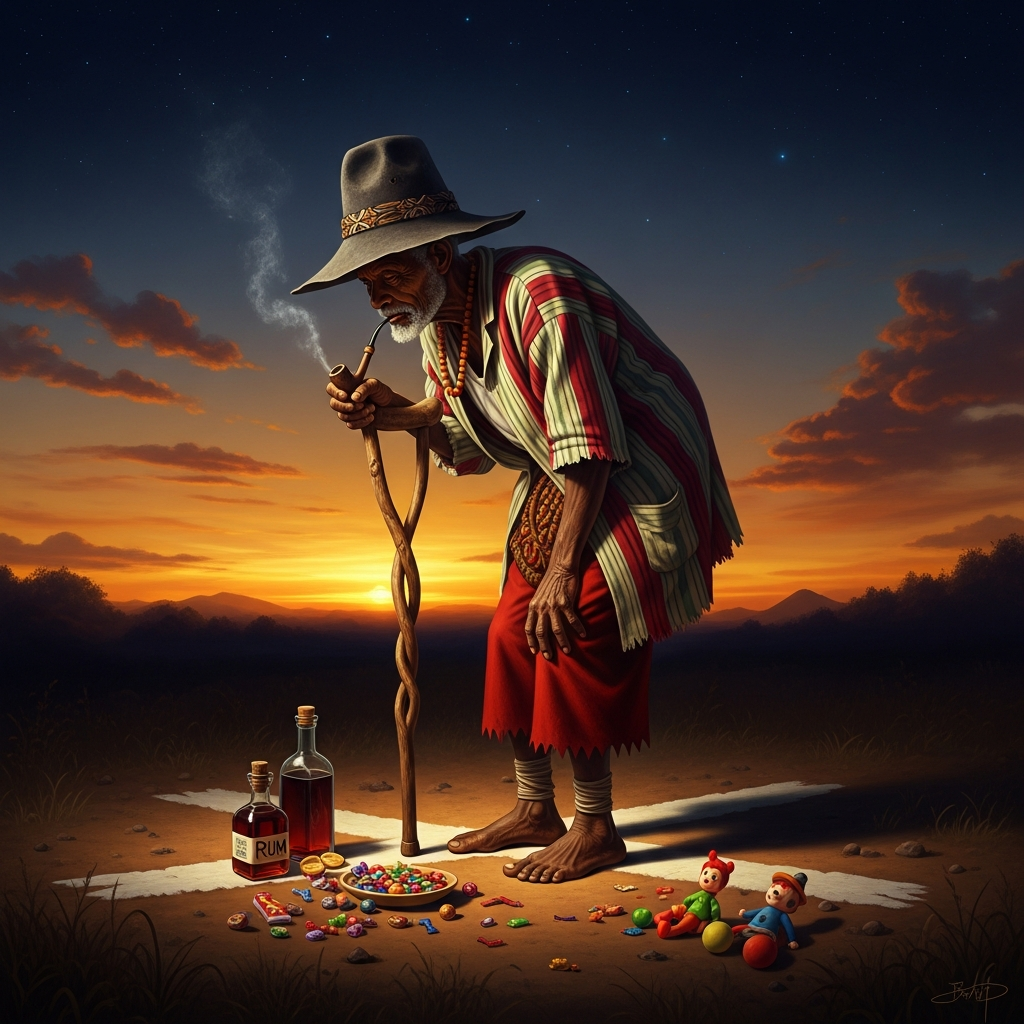
Baron Samedi — top hat, dark glasses, rum and cigars, crude jokes at the cemetery gate — is the only lwa who decides whether a person truly dies. If he refuses to dig the grave, the dying live. He rules the Gede, the nation of the dead who speak through the living. He dances at the crossroads of every Haitian cemetery, and he is the most terrifying thing you have ever seen laugh.
- When
- Eternal present of Haitian Vodou ceremony · tradition fully codified in 18th–19th century Saint-Domingue and Haiti
- Where
- A rural Haitian cemetery at the edge of a village; the crossroads of the first grave; the threshold between the living world and Ginen
The man has been dying since morning.
His family has been taking turns sitting with him, measuring the intervals between his breaths, watching the color change in his face and hands. The village healer has come and gone. The priest from the concrete church at the edge of town has come and administered the last rites — the oil, the prayer, the whispered formula — and returned to his house. There is nothing more that either medicine or the Catholic God can offer. The man’s wife kneels at the end of the bed and holds his feet through the blanket, which is the only part of him she can hold without him flinching.
She has sent for the houngan.
He arrives in the dark, after the priest has gone.
He carries a small leather bag and a bottle of clairin — raw Haitian sugar cane rum, white, harsh, not for drinking in the usual sense. He sets the candles he brought on the floor beside the bed and lights them and kneels and studies the dying man’s face for a long time without touching him. He is reading something. He is reading how far the man has already gone, how much of him has already crossed over into Ginen — the great water below, the Vodou realm of the dead — and how much is still anchored on this side.
He sits back on his heels. The wife is watching him.
“We will go to the cemetery,” he says.
The houngan walks the road to the cemetery alone.
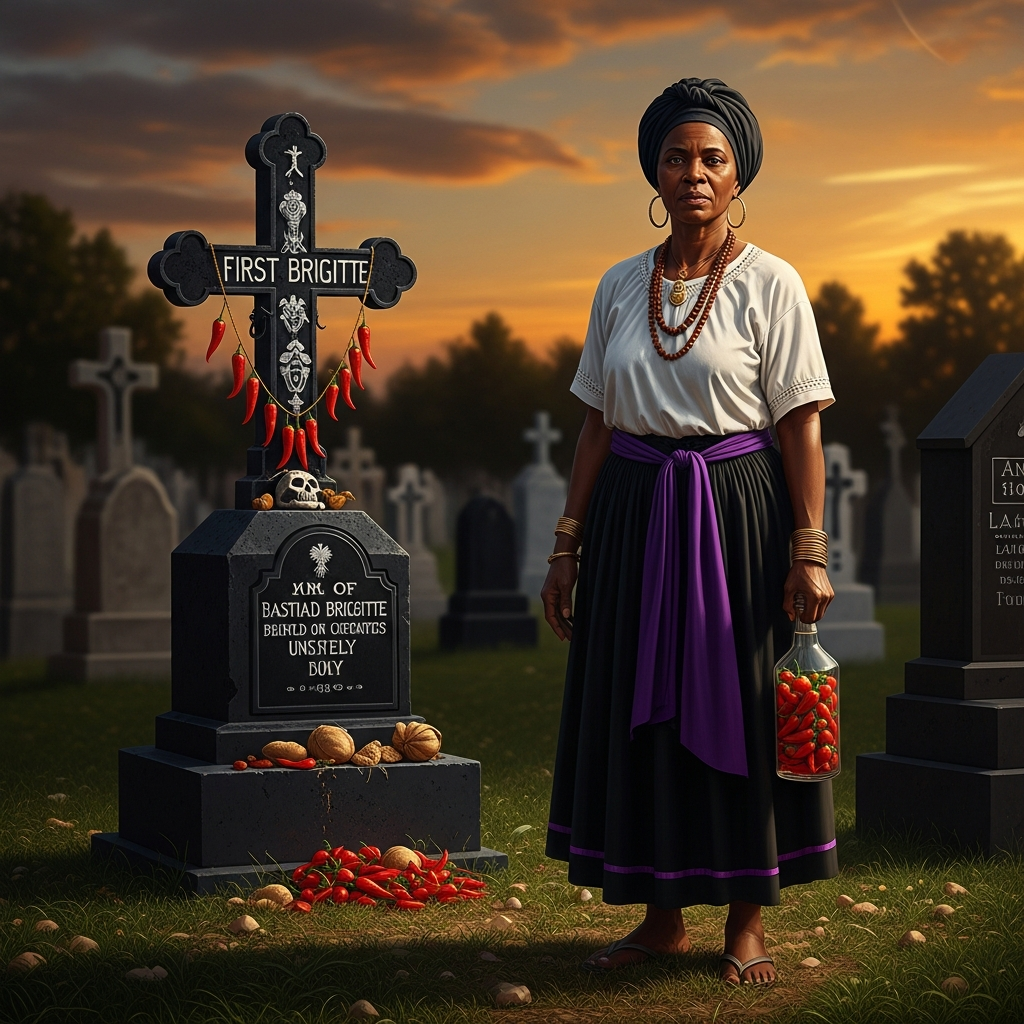
It is past midnight. The cemetery is at the edge of the village, a collection of painted cement tombs and wooden crosses, some with photographs of the dead laminated under glass, some with rum bottles and sunglasses and cigars left on top as offerings. The oldest grave in the cemetery is marked by a simple iron cross painted black. That is the grave of the first person buried here — the grave that belongs to Baron Samedi and his wife Maman Brigitte, the first grave in every cemetery in Haiti.
The houngan stops at the cemetery gate. He opens the bottle of rum and pours a long stream of it into the dirt at the entrance. He takes a cigar from his pocket, lights it, draws on it once, and places it across the neck of the bottle on the ground.
He says:
Baron, ou la?
Baron, are you there?
The Baron arrives the way laughter arrives.
He does not mount a cheval tonight — there is no one to be ridden except the houngan himself, and the houngan is not in a receptive state, he is working. The Baron arrives instead as a presence: a weight in the air at the center of the cemetery, a feeling that someone is standing just outside the edge of the candlelight and has been there for some time, amused, in no hurry, wearing a top hat.
The houngan speaks to the presence. He does not perform for it; the Baron has seen every performance and does not require one. He states the case plainly: the man is dying. His wife and children are at the house. He has lived a decent life, not a perfect one. He has more years than this — the houngan believes it, the family believes it, and he is bringing it as a petition, not a demand, because you do not demand things from Baron Samedi and expect to be taken seriously.
The houngan reaches into his leather bag and draws out the other offerings: a black candle, a black cloth, a small bottle of rum infused with twenty-one hot peppers — the Baron’s particular preference, the drink that burns enough to taste like truth. He arranges these at the base of the first grave.
He waits.
The Baron negotiates.
This is what the stories do not say often enough: the Baron can be reasoned with. He is not arbitrary. He has a deep sense, underneath the obscene humor and the rattling pelvis and the endless crude jokes he tells through whichever cheval is willing to be ridden — underneath all of that, a profound and paradoxical tenderness for the living. He presides over the dead. He knows the dead. And what he knows about the dead is that they mostly wish they had stayed a little longer.
He will not dig a grave for someone whose time has not fully come. This is not mercy in the soft sense — it is accuracy. The Baron knows when it is time and when it is not, and he does not dig early because early is wrong, because the rhythm of a life has a shape he can read the way a mambo reads a veve, and to cut the shape short before it resolves is to leave the line unfinished.
The dying man’s line is not finished.
The Baron’s decision is made somewhere in the dark of the cemetery, in the conversation between the houngan and the presence, in the rum and the pepper and the cigar and the careful, respectful petition. No one sees him decide. The houngan feels it — a shift in the weight of the air, a sense of absence where the presence was, the way a gate clicking shut sounds different from a gate left open.
He dances before he goes.
Because the Baron does not leave without dancing. He mounts the houngan for ten minutes — just enough time, the older woman watching from outside the cemetery gate will say later, for the Baron to do what the Baron always does when he has decided someone will live: he dances the banda, the death-dance, all rolling hips and arched back and thrown head, the dance that imitates the act of making new life at the crossroads of ending it. He takes a long pull from the pepper rum. He tells a joke that the watching woman will repeat for twenty years because she has never heard anything that filthy before or since, and she laughs every time she tells it. He adjusts his invisible top hat.
He walks out through the cemetery gate and turns south on the road toward the mountains, and the houngan stands in the dirt and breathes.
In the morning, the man’s fever breaks.
His wife, who did not sleep, is still holding his feet when the first light comes through the window and he opens his eyes and looks at her and says her name. The room fills up — children, neighbors, the houngan who returned just before dawn and has been sitting in the corner with the leather bag in his lap. They cry. They laugh. Someone makes coffee.
The houngan tells the wife what to bring to the cemetery: another bottle of pepper rum, another black cigar, a few coins. Payment is not required — the Baron did what the Baron does — but gratitude is always appropriate. You go to the cemetery and you leave the offerings at the first grave and you say thank you in Kreyòl because the Baron speaks Kreyòl and also French and also Spanish and also the language of the dead, which is no language at all.
He is there whether you thank him or not. He is always there. He stands at the gate in the top hat and the dark glasses with the rum and the cigar, and he watches every living person with the particular attention of someone who knows exactly how long each life will last and has decided not to say.
Baron Samedi is the most honest god there is: he tells you to your face that you will die, that this is not negotiable, that the grave at the center of the cemetery has your name on it in a language you will eventually read. He tells you this while laughing, while dancing, while drunk on rum that burns like the truth, while making the most outrageous joke you have ever heard. He tells you, in other words, what every tradition says in its most serious voice — but he says it while dancing, because he knows that the only appropriate response to the fact of death is to be as alive as you possibly can for as long as the Baron will let you.
Scenes
Baron Samedi stands at the cemetery gate in his top hat and dark glasses, a cigar burning between two fingers, a bottle of rum in his other hand
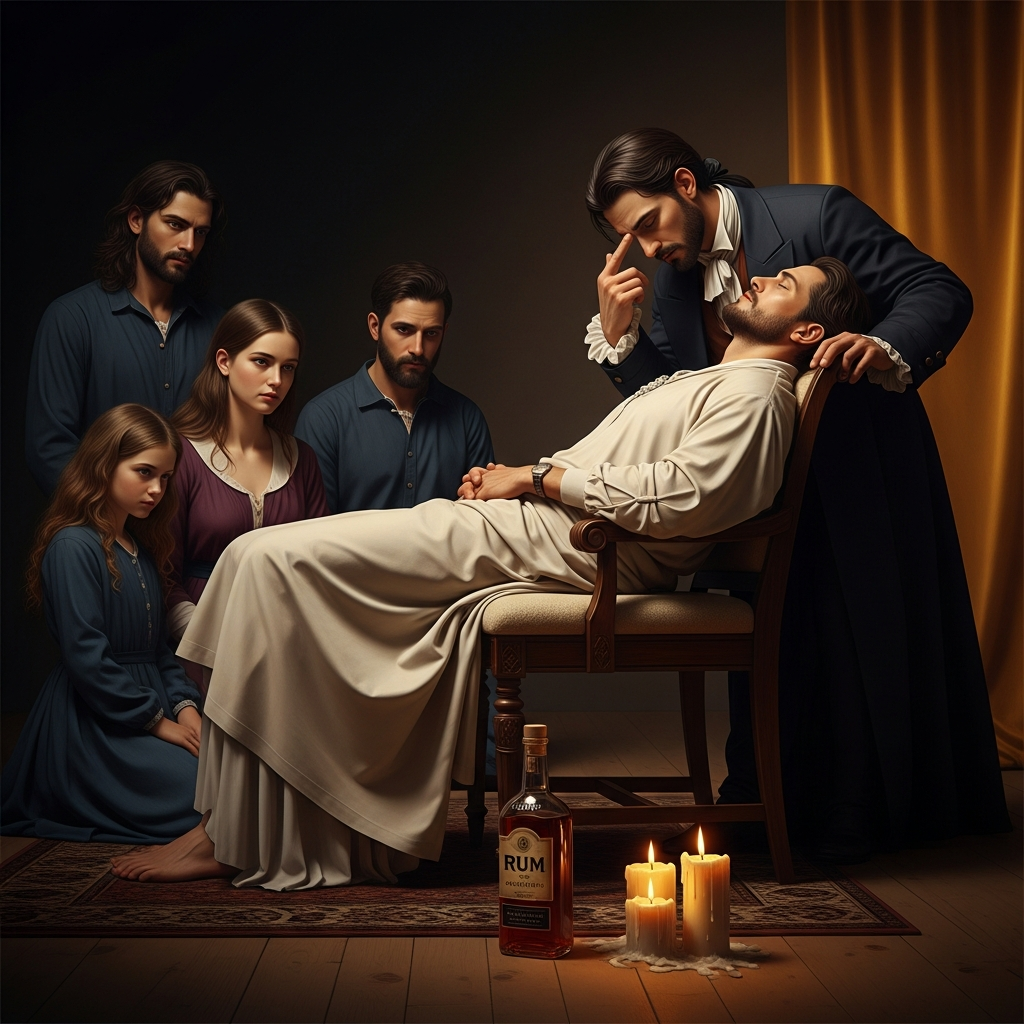
Generating art… The Baron bends over the sick man, pressing two fingers to his temple, his face stripped of all mockery for this single moment
 Generating art…
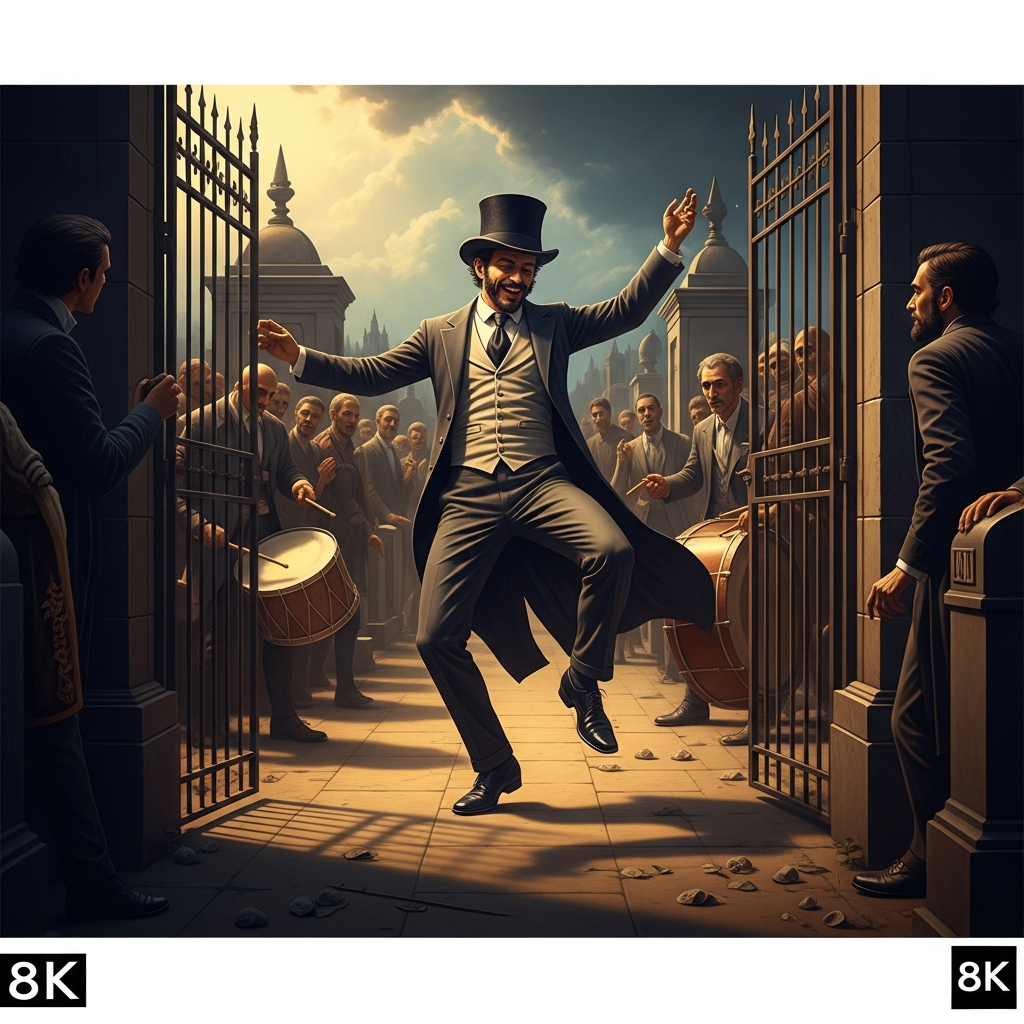
 He dances the banda at the crossroads of the cemetery — the death-dance, all thrust hip and thrown head — his top hat still in place, his coat open, his laugh audible over the drums
 Generating art…
 Echoes Across Traditions
Entities
- Baron Samedi (lwa of the dead)
- Maman Brigitte (his wife, lwa of the first grave)
- the Gede (the nation of the dead)
- the houngan (priest who petitions the Baron)
- the dying man (who is returned)
Sources
- Maya Deren, *Divine Horsemen: The Living Gods of Haiti* (1953)
- Karen McCarthy Brown, *Mama Lola: A Vodou Priestess in Brooklyn* (1991, updated 2001)
- Alfred Métraux, *Voodoo in Haiti* (1959, English translation 1972)
- Donald Cosentino (ed.), *Sacred Arts of Haitian Vodou* (1995, UCLA Fowler Museum)
- Wade Davis, *The Serpent and the Rainbow* (1985)