Pachamama Shrugs
Pre-Inca through present day · oldest continuous religious practice in the Andes; ch'alla offerings documented from pre-Columbian through contemporary practice · The Andes — Tiwanaku culture, Inca Empire, and surviving Quechua and Aymara communities
Contents
Pachamama — the Earth Mother — predates the Inca, predates the Spanish, predates every organized religion in the Andes. She is not worshipped in temples because she is not inside them: she is what temples sit on. Every earthquake is her movement. Every farmer pours the first sip of chicha onto the ground before drinking. The Spanish tried to replace her with the Virgin Mary. In many villages, the Virgin Mary now shakes the earth.
- When
- Pre-Inca through present day · oldest continuous religious practice in the Andes; ch'alla offerings documented from pre-Columbian through contemporary practice
- Where
- The Andes — Tiwanaku culture, Inca Empire, and surviving Quechua and Aymara communities
She does not live in the temple.
This is the first and most important thing about Pachamama, the thing the Spanish missionaries never fully grasped, which is why their campaign to replace her failed so thoroughly: she cannot be replaced with a structure because she is not in a structure. The Coricancha in Cuzco, the great Temple of the Sun — she is what it sits on. Every church the Spanish built over the Inca temples — she is what the church sits on. She is not housed. She is the housing.
Pachamama: Pacha — world, time, space, the totality of reality; Mama — mother, origin, the one from whom everything comes. Not “Earth Mother” in the sentimental modern ecological sense, though that reading is not wrong. Earth-time-space-mother. The being who is the substrate of existence rather than a figure within it. The Aymara and Quechua languages, which are different languages, both have her, which suggests she is older than the split between them, older than the Inca who organized both peoples into an empire, older than the archaeological record that would help us date her.
She is ancient. She is continuous. She is underfoot.
When she moves, the mountains move with her.
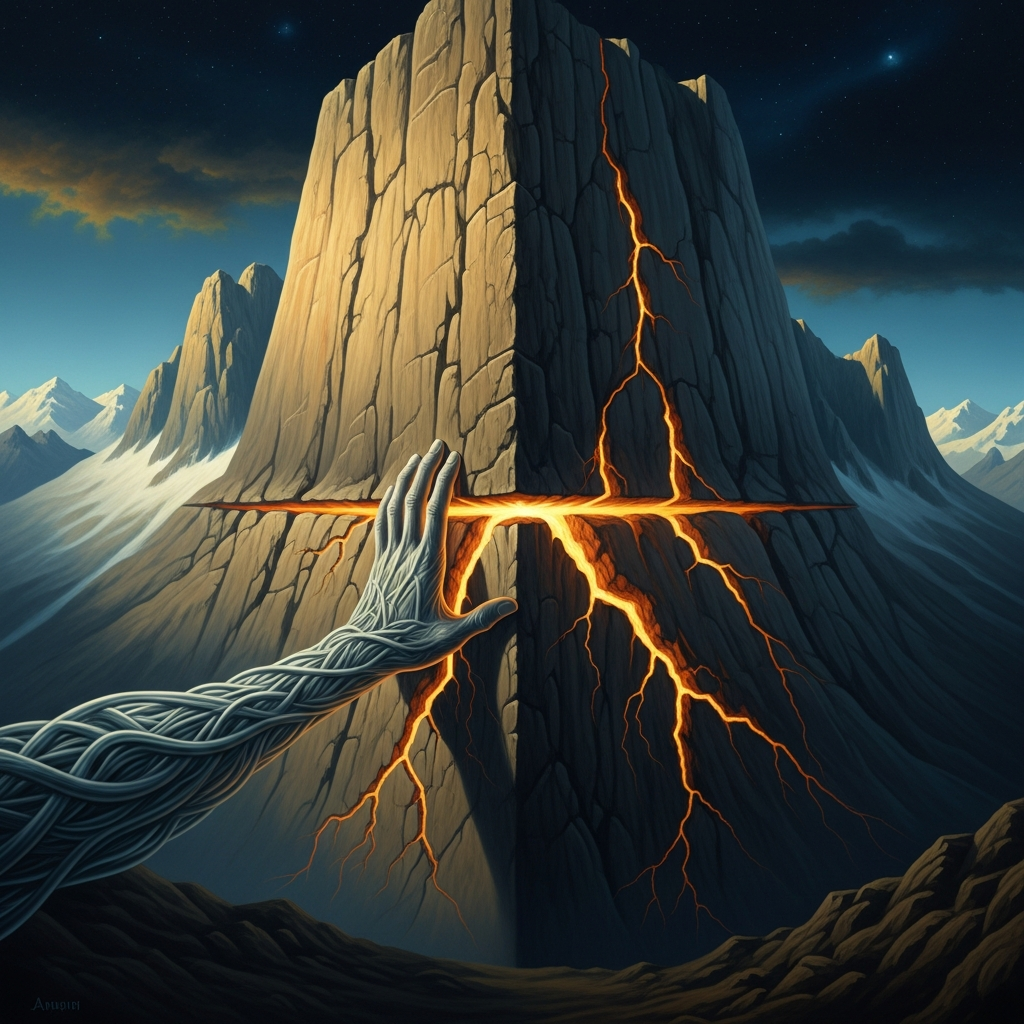
The Andes are the second-highest mountain range on earth, still rising, the Nazca oceanic plate still subducting under the South American continental plate at the boundary that runs along the entire Pacific coast of the continent. The resulting seismicity is constant — dozens of measurable earthquakes every week, the occasional catastrophic one that reshapes river valleys and buries towns. From a geological perspective this is plate tectonics. From the Andean perspective, it has always been Pachamama adjusting her position.
She does not move from anger, exactly. The Andean theological tradition does not moralize her movement the way the Christian God moralizes the Flood. She shrugs because she is a body that moves — because the earth is alive and living things move, and the mountains are her spine, and the rivers are her blood, and the agricultural soil is her skin, and these things shift as bodies shift. When the temblor comes and the walls crack and the dust rises, what the Quechua farmer knows is that Pachamama has changed her position, and what is required is not blame and not prayer for forgiveness but an offering: food buried quickly in the cracked earth, coca leaves pressed into a fissure, the acknowledgment that her movement was her right and the human task is to adapt and renew the relationship.
This is a profoundly different relationship with natural disaster than the ones most religious traditions articulate. She does not punish. She does not test. She moves, and movement is life, and the appropriate response to life is not fear but reciprocity.
The ch’alla happens before every drink.
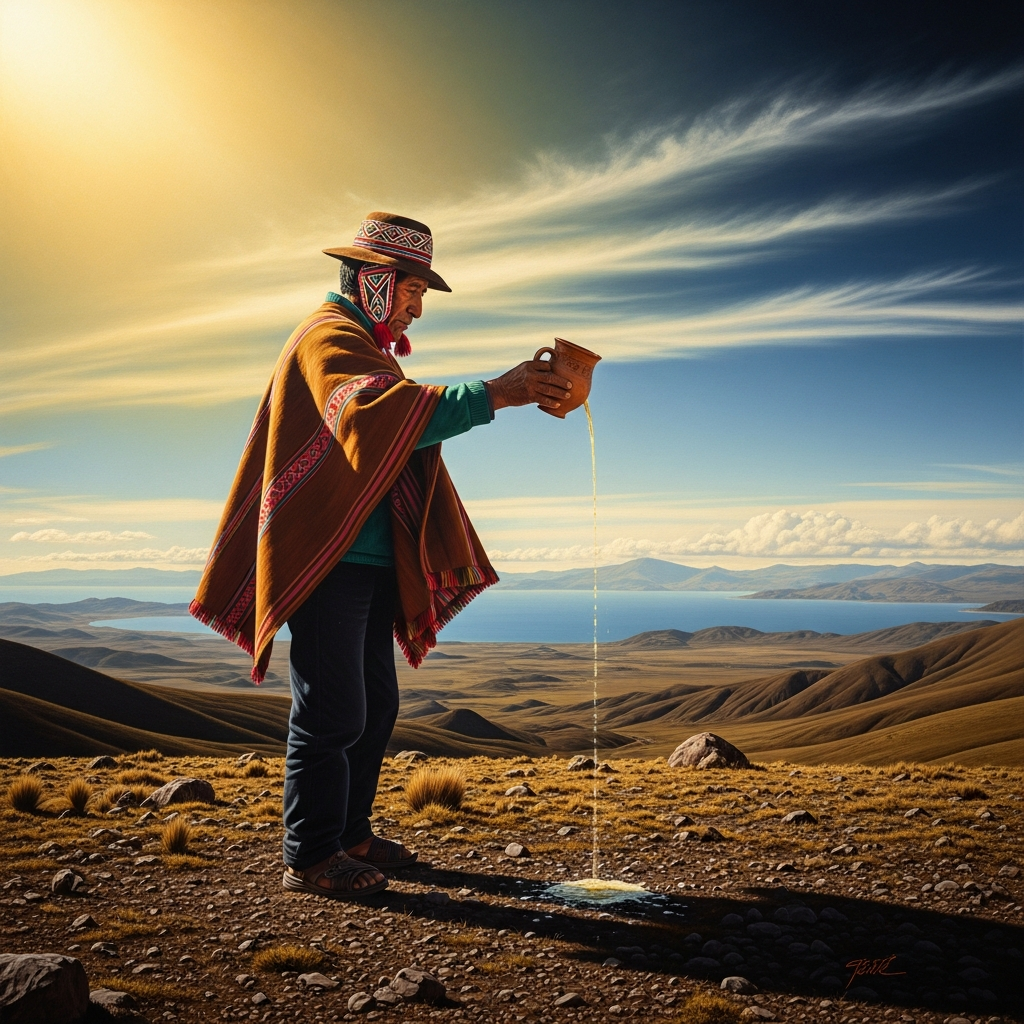
You are sitting with friends in a village above Cuzco, or in La Paz, or in a mining camp in Potosí, or in a kitchen in Lima with a mother who grew up in the highlands and carried the practice to the coast. Someone opens the chicha — the corn beer, the ancient beverage, the drink that existed before the Inca and will exist after all their successors — and before it reaches a human mouth, the first pour goes to the floor. Not spilled. Given. The tilt of the cup is deliberate, the stream intentional, the drop landing on the earth or the floor or, if the floor is concrete, the nearest threshold, the nearest place where the built world meets the ground.
For Pachamama, someone says, or says without saying, or says in a gesture that requires no words because everyone at the table already knows.
This is not performance. Catherine Allen’s ethnography of Sonqo, a Quechua community in the southern Andes, documents the ch’alla as the baseline expectation of every shared meal: before eating, before drinking, the earth receives its portion. Not a large portion. A drop, a bite, a pinch of coca leaves pressed into the soil of the courtyard. Enough to acknowledge that the food came from her and she is still feeding you and the relationship continues and you know it continues and she knows you know.
The ch’alla is older than the Inca, older than Tiwanaku, older than anything the archaeological record can date with confidence. It is still practiced today in every Andean country, in communities that have been Catholic for five hundred years, by people who go to mass on Sunday and pour chicha on the ground before drinking it on Monday, and who see no contradiction between these practices because Pachamama and the Catholic God occupy different registers of existence: he is in the sky and she is underfoot, and you need both, and you have always needed both.
The Spanish tried to kill her, and what they created instead was a door.
The extirpación de idolatrías — the Extirpation of Idolatry — was the formal Church campaign to eliminate indigenous religious practice in the Viceroyalty of Peru, running most intensively from 1609 to the 1660s. Pablo José de Arriaga, the Jesuit who published the operational manual for the campaign in 1621, identified Pachamama as one of the primary targets: she was called upon at planting and harvest, she received libations and food offerings, she was the explanation for earthquakes. The inspectors went village by village, confiscated the ritual objects, burned the offerings, flogged the practitioners, and forced conversions.
And they introduced the Virgin Mary.
The Virgin Mary: a woman who is the mother of God, who stands at the intersection of the divine and the earthly, who is associated with mountains (apparitions at Guadalupe, at Lourdes, at Fátima — always on high ground), who receives flowers and food and is dressed in elaborate garments and whose statues are carried through the streets in procession. The missionaries who chose her as the replacement for Pachamama either understood what they were doing or stumbled into it. Either way, the translation was immediate.
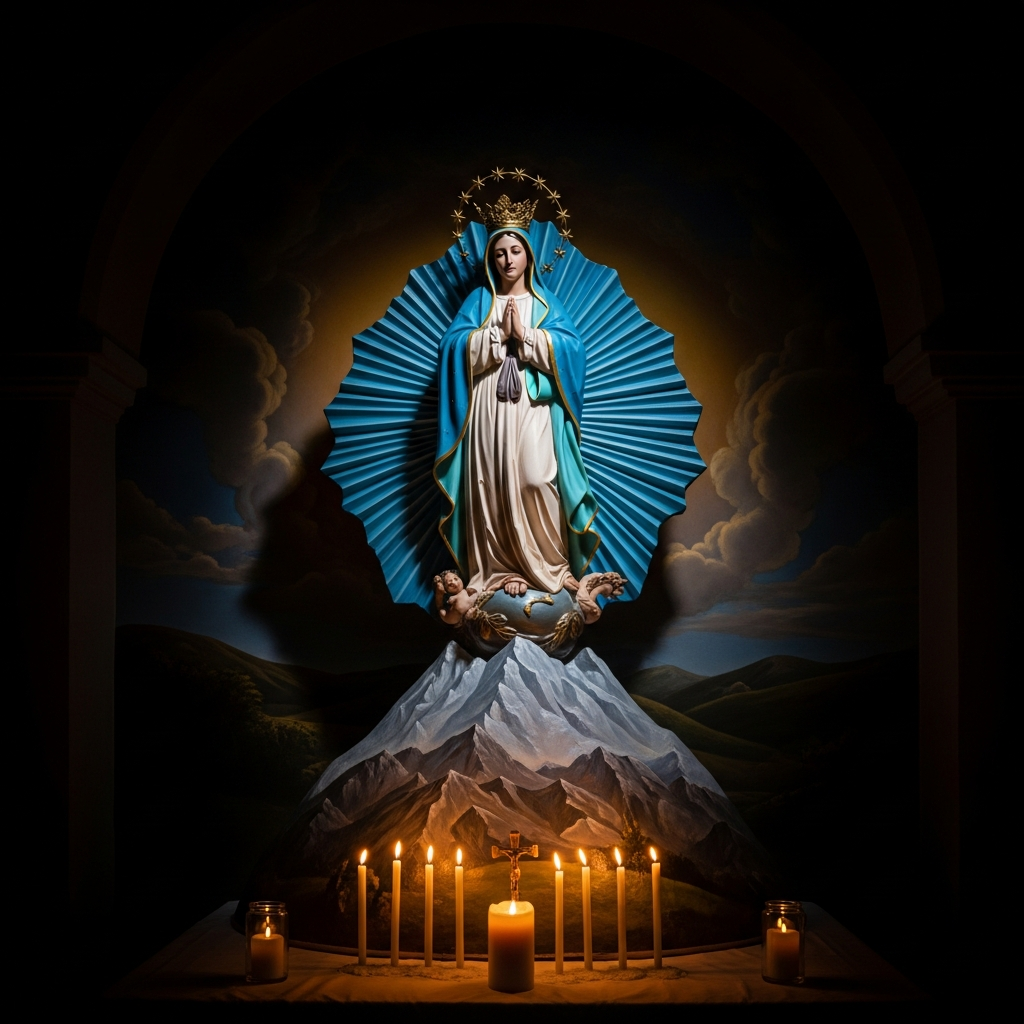
In Quechua communities throughout Peru, the Virgin Mary is addressed as Pachamama. Her blue robe is the color of the earth’s sky-face. Her feast days coincide, through careful calendrical adjustment by both Catholic missionaries and Andean practitioners, with the planting and harvest cycles. When the ch’alla is poured on the ground before drinking, in some households it is poured for the Virgin and for Pachamama together, their names given in the same breath, their jurisdiction understood to overlap completely.
In many communities, the Virgin Mary now shakes the earth.
This is not the official theological position of the Catholic Church, which has its own explanations for earthquakes. It is the working cosmology of Andean Christianity as it actually exists in the highlands, documented by anthropologists from the 1970s through the present: when the tremor comes, the explanation that makes sense within the lived theology is that Pachamama has moved. And since Pachamama and the Virgin Mary have been overlapping for five hundred years, the question of which one moved is not one the theology requires you to answer.
The extirpation failed not because the missionaries were incompetent but because Pachamama is not a belief. You can suppress beliefs with enough force. You can burn books, destroy temples, execute priests, and imprison practitioners until a belief system loses critical mass and collapses. The extirpation did exactly this to several Inca institutions: the ceque system of Cuzco, the mummy-ancestor veneration, the solar priesthood of the Coricancha. These required specialists, infrastructure, and institutional memory. When the specialists were killed and the institutions dismantled, they died.
Pachamama required none of these things. She required only that you sit on the ground. That you eat food that grew from the earth. That you feel an earthquake and understand that you are sitting on something alive. She required that you exist in a body on the surface of a planet, which is the only requirement that no colonial project has ever successfully repealed.
She is still receiving her portion.
In the altiplano of Peru and Bolivia, in the high desert valleys of Ecuador, in the Atacama foothills of Chile, in the Andean neighborhoods of Lima and La Paz and Quito, before every significant meal and every significant work, someone pours the first drop to the ground. The earth receives it. The relationship continues.
August is her month — Agosto, Pachamama Raymi — when the earth is understood to be most hungry, most open, most in need of feeding. Families bury offerings in the earth: coca leaves, llama fat, wine, mullu shells, food. The earth eats. The family eats afterward. The agricultural cycle the Inca codified and Viracocha encoded in the stars is still turning, five hundred years after the empire was destroyed and four hundred years after the extirpation campaigns ran through the villages, and it is turning because she never stopped being the ground.
The theologians of the extirpation campaigns wrote reports about Pachamama as if she were a hypothesis that could be refuted. They were wrong about the category. You do not refute the ground. You stand on it, and pour your first drink into it, and acknowledge that it was there before you arrived and will be there after you are gone — and that this acknowledgment, repeated daily, is the oldest religious practice in the Andes, and possibly the oldest in the world.
Scenes
An Aymara farmer on the altiplano above Lake Titicaca pauses before drinking his chicha, tilts the cup, and lets the first stream of corn beer fall to the ground — the ch'alla, the earth's portion, given before any human takes theirs
Generating art… The Andes flex and crack along fault lines older than any religion — the Nazca Plate still driving under the South American Plate at the rate of a fingernail's growth per year, the mountains still rising, Pachamama still moving
 Generating art…
 In the church of a highland Quechua village, a statue of the Virgin Mary stands on a mountain of painted plaster; her blue robe fans outward like the slopes of Pachamama; the candles at her feet burn for the earth, not the sky
 Generating art…
 Echoes Across Traditions
Entities
- Pachamama
- Mama Qucha (Sea Mother)
- Inti (the Sun)
- Virgin Mary (colonial syncretism)

Sources
- Verónica Cereceda, *Semiología de los textiles andinos* (1978)
- Catherine Allen, *The Hold Life Has: Coca and Cultural Identity in an Andean Community* (1988)
- Bernabé Cobo, *History of the Inca Empire* (1653)
- Pablo José de Arriaga, *The Extirpation of Idolatry in Peru* (1621)
- Irene Silverblatt, *Moon, Sun, and Witches: Gender Ideologies and Class in Inca and Colonial Peru* (1987)
- Paul Gelles, *Water and Power in Highland Peru* (2000)