Combat Profile
Terrapluvial Renewal
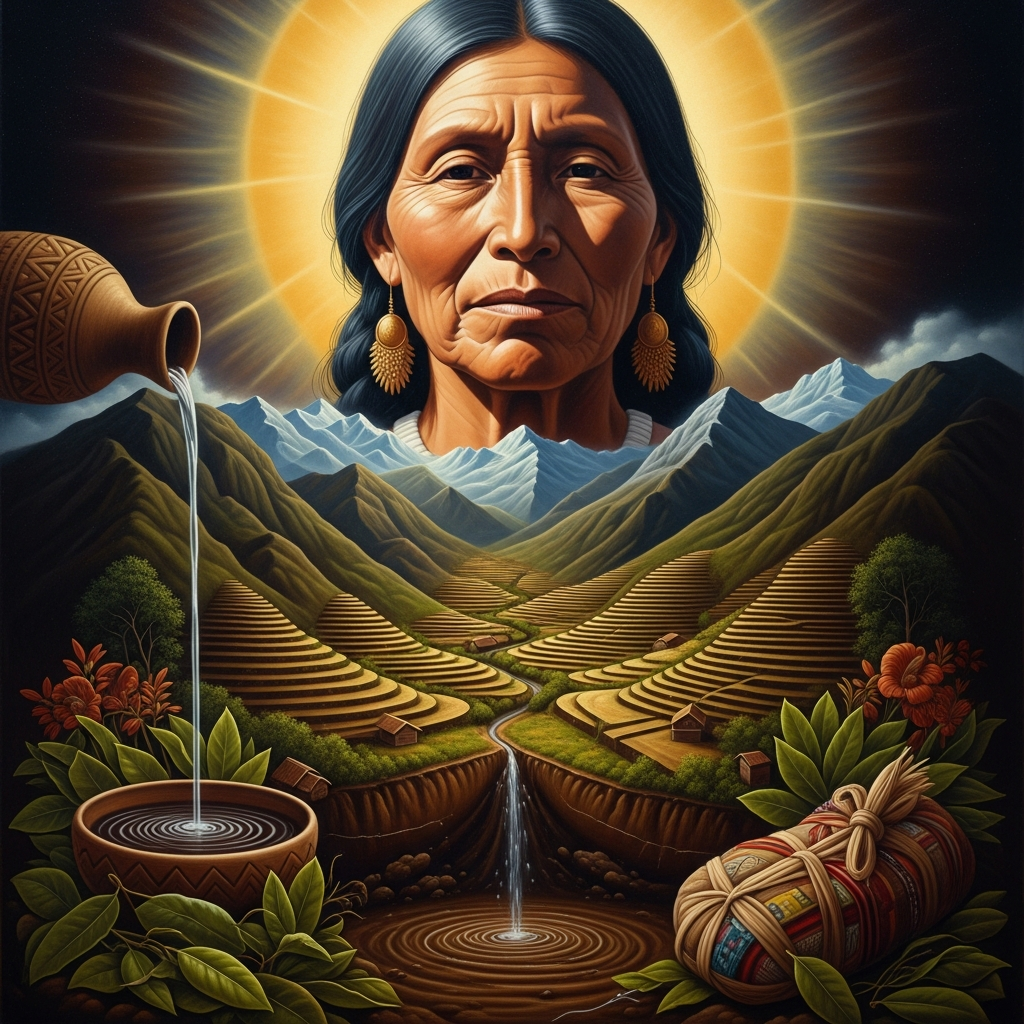
Pachamama shakes the earth to restore all crops and fertile lands within her domain, rendering them eternally abundant for one cycle of seasons.
Mother's Breath
All living things rooted in or sustained by earth gain continuous regeneration and resistance to decay; her presence marks the passage of deep time itself.
Hungry -- if not fed regularly through *ch'alla* libations and *despacho* offerings, she withdraws her fertility and the crops fail
“Before you drink, you pour the first drops on the earth. Para la Pachamama. She drinks before you do. Forget her once and the harvest fails. Forget her twice and the mountain takes you.”
Lore: Pachamama (Quechua/Aymara: Pacha “world/time/space” + mama “mother” — World Mother or Time Mother) is the most pervasively worshipped deity in the modern Andes and arguably the most important entity in the entire Andean religious system. Where the imperial cult of Inti collapsed with the Spanish conquest and where Viracocha was always remote from common life, Pachamama is the goddess of the soil itself — she is encountered every time a farmer plants a seed, every time a household pours chicha before drinking, every time a herder asks a mountain for the safety of the llamas. She did not require temples. She is the temple.
The defining ritual of her worship is the ch’alla (Aymara: ch’alla, “to splash”): the libation offered to the earth before any drinking. A glass of chicha, aguardiente, beer, or even Coca-Cola is held briefly above the ground; a few drops are tipped onto the earth with the words para la Pachamama (“for Pachamama”); only then does the drinker take their own sip. This ritual is performed millions of times every day across Bolivia, Peru, Ecuador, northern Argentina, and northern Chile, in homes, markets, mining camps, and city offices. It is the most widespread continuously-practiced pre-Columbian religious act in the world.
The more elaborate offering is the despacho (or mesa) — a ritual bundle assembled by a paqo or yatiri (Andean ritual specialist) containing coca leaves, llama fat, seeds, candies, colored wool, llama fetuses (still sold openly in Bolivia’s witches’ markets), and dozens of other ingredients. The despacho is buried in the earth or burned, sending its essence to Pachamama and the apus (mountain spirits). August is her sacred month — the time of the pago a la tierra (“payment to the earth”) when families across the Andes formally feed her before the planting season begins. Failing to make the offering is believed to cause illness, crop failure, mining accidents, and the susto — soul-loss caused by a startle, often by Pachamama herself when she has been neglected.
When the Spanish friars arrived demanding that the indigenous abandon the old gods and worship the Virgin Mary, the Andeans complied — in form. In substance, Pachamama simply absorbed the Virgin. The two became indistinguishable. The Virgin of Copacabana (the patron of Bolivia, enshrined on the southern shore of Lake Titicaca) is openly understood by her devotees as Pachamama under another name. The Virgin of Cocharcas, the Virgin of Carmen, the Virgin of Candelaria — each rural Marian apparition in the Andes overlies an older shrine to Pachamama. The Spanish did not defeat her. She wore the Virgin’s robes and continued.
In 2008, Bolivia became the first country in the world to grant legal personhood to the earth through its Law of Mother Earth (Ley de Derechos de la Madre Tierra), which gives Pachamama — by name — legal standing to sue. Ecuador followed with a constitutional provision in 2008 recognizing the rights of Pacha Mama. The deity is now a litigant. No other pre-Columbian goddess has achieved this.
Parallel: Earth mother goddesses are among the most universal religious figures: Greek Gaia is the closest etymological parallel (both names mean “Earth”); Roman Tellus Mater served the same function; Hindu Bhumi Devi is invoked in the same way — the first sip poured to her, the first grain offered before consumption. The Aztec-Maya Coatlicue parallels Pachamama in earth-motherhood but emphasizes the devouring aspect that Pachamama largely lacks — Pachamama is hungry but not predatory. She wants to be fed; she does not hunt. The biblical earth, by contrast, is largely passive — “the Lord God formed the man of dust from the ground” (Genesis 2:7), but the ground itself is not a being who must be fed and addressed. The closest biblical resonance is Cain’s bloody offering: “the voice of thy brother’s blood crieth unto me from the ground” (Genesis 4:10) — the earth as a witness who cries out, who participates in justice. But Pachamama is more than a witness. She is an interlocutor, a partner, the ground of being from whom all life proceeds and to whom all life returns.
3 min read
None -- she is the ground beneath every other being's feet
Cobo, *Historia del Nuevo Mundo* (1653); Allen, *The Hold Life Has* (2002); Bastien, *Mountain of the Condor*; ongoing ethnographic record