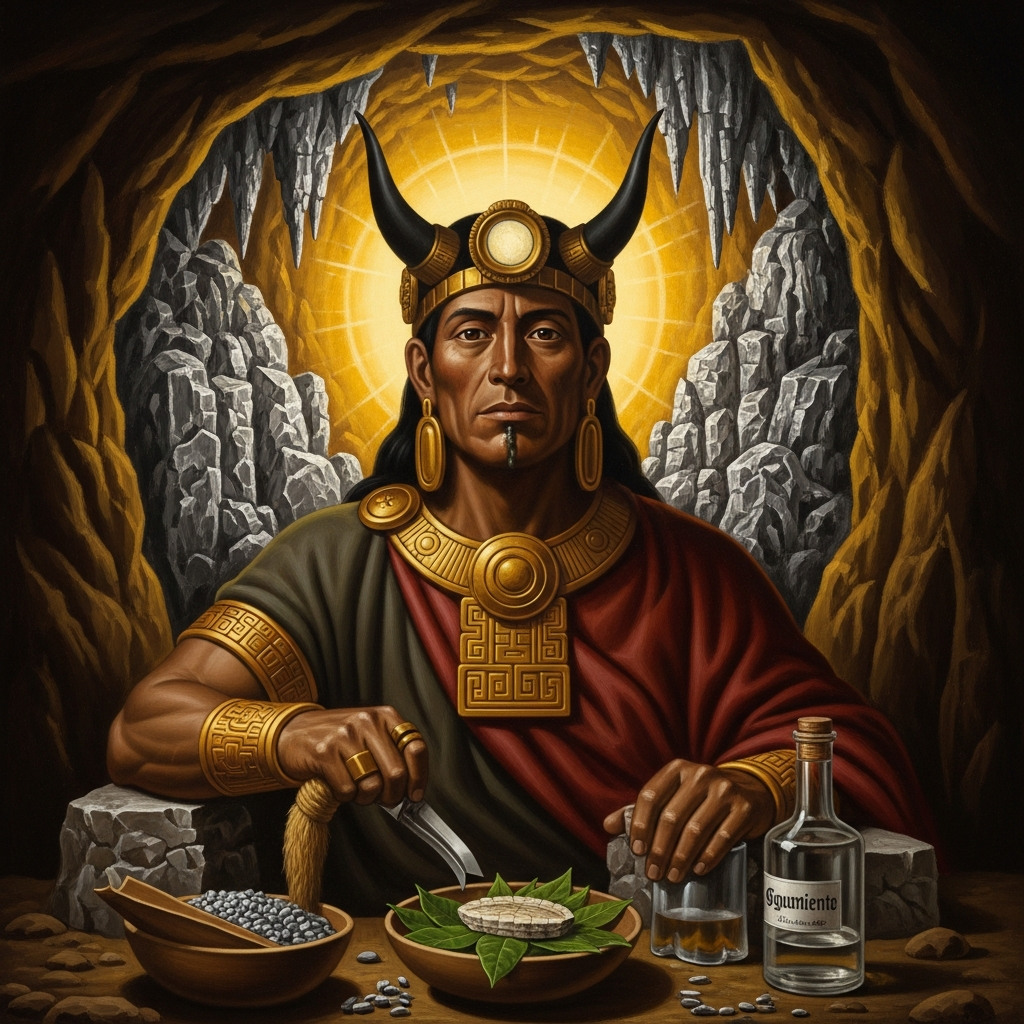
Combat Profile
Wealth of the Deep
Supay summons precious metals and gems from the earth, enriching allies or crushing foes beneath riches that manifest as crushing weight.
Lord of Ukhu Pacha
Supay's presence strengthens in underground or dark places, and he perceives all hidden things beneath stone and soil.
His pre-conquest theological character was largely erased by Spanish missionaries who systematically conflated him with Satan. The original Supay must be reconstructed from oblique chronicler references and surviving folk practice
“He is not the devil. The Spanish made him the devil. He was already there when they arrived — the lord of the inner places, the keeper of the silver. The miners know. They feed him every Friday.”
Lore: Supay (Quechua: Supay, originally a shade or spirit of the dead) is the most theologically distorted entity in the Andean pantheon, a victim of the most successful religious propaganda campaign in colonial history. In the pre-conquest Andes, Supay (or Supayqona, the plural) seems to have been a relatively neutral lord of Ukhu Pacha — the inner world from which the dead, the unborn, and the precious metals all emerged. Like the Aztec-Maya Mictlantecuhtli or the Greek Hades, he was a custodian of the underworld rather than a malevolent tempter. He did not punish the wicked. He simply ruled the place where everyone goes.
The Spanish missionaries, working from a Christian theological framework that demanded a unitary devil-figure, seized upon Supay as the local equivalent of Satan. The 1583 Third Council of Lima — the great ecclesiastical council that codified the Christianization of the Andes — explicitly used Supay as the Quechua translation of “devil” in catechisms, sermons, and trial transcripts. By the late colonial period, supay in Andean Spanish simply meant “demon” or “evil spirit.” The original deity was buried under five centuries of demonization.
But he survived. In the silver mines of Potosi (Bolivia) — the great mountain whose extraction killed perhaps eight million indigenous and African workers between 1545 and 1825 to fund the Spanish empire — the miners venerate a figure they call El Tio (Spanish: “The Uncle”) — a horned, masked, often grotesquely-endowed effigy enshrined in a niche near every mine entrance. Each Tuesday and Friday, the miners gather to feed El Tio: coca leaves stuffed into his mouth, lit cigarettes placed between his teeth, aguardiente poured over his body, sometimes a llama sacrificed and its blood smeared on the mine walls. The miners are nominally Catholic. They cross themselves before mass on Sunday. But they all know that the silver does not belong to Christ. It belongs to El Tio, and without his permission, no man leaves his realm alive.
The anthropologist Michael Taussig, in his influential study The Devil and Commodity Fetishism in South America (1980), argued that El Tio represents Andean theology’s response to the alienating violence of colonial mining capitalism: the indigenous miners absorbed the Spanish demonization of Supay and turned it back on the Spanish, recognizing that the mine itself — this place that consumes lives to produce wealth that flows away to Europe — is a properly demonic economy, and that its presiding deity is therefore appropriately demonic. El Tio is Supay weaponized against capitalism: yes, he is the devil; yes, the silver is the devil’s silver; yes, we serve him because we have to, but we do so on our own terms, and the priests do not get to interpret our relationship with him.
Parallel: The closest functional parallel is the Aztec-Maya Mictlantecuhtli — the original Supay was almost certainly a neutral underworld custodian of similar character. The Spanish-imposed demonic Supay parallels the Christian Satan — but Satan is a fallen angel, a rebel against God, while Supay was simply the lord of his realm and never rebelled against anyone. The closer parallel is to Hades (Greek), who was likewise reframed by later Christian polemics as a “devil” figure despite originally being a neutral, even somewhat dignified ruler of the dead. The El Tio mining cult has interesting resonances with the medieval European tradition of the Knockers or Tommyknockers — the underground spirits of British and Welsh mines who had to be propitiated with offerings of food and respect or they would cause cave-ins. Underground work in every culture seems to require an underground god.
3 min read
The mountain *apus*, who can intervene against him; offerings of coca, alcohol, and tobacco that placate him at the mine entrance
Cobo, *Historia del Nuevo Mundo* (1653); Taussig, *The Devil and Commodity Fetishism in South America* (1980); Nash, *We Eat the Mines and the Mines Eat Us* (1979); Albo, *La Cara India y Campesina*