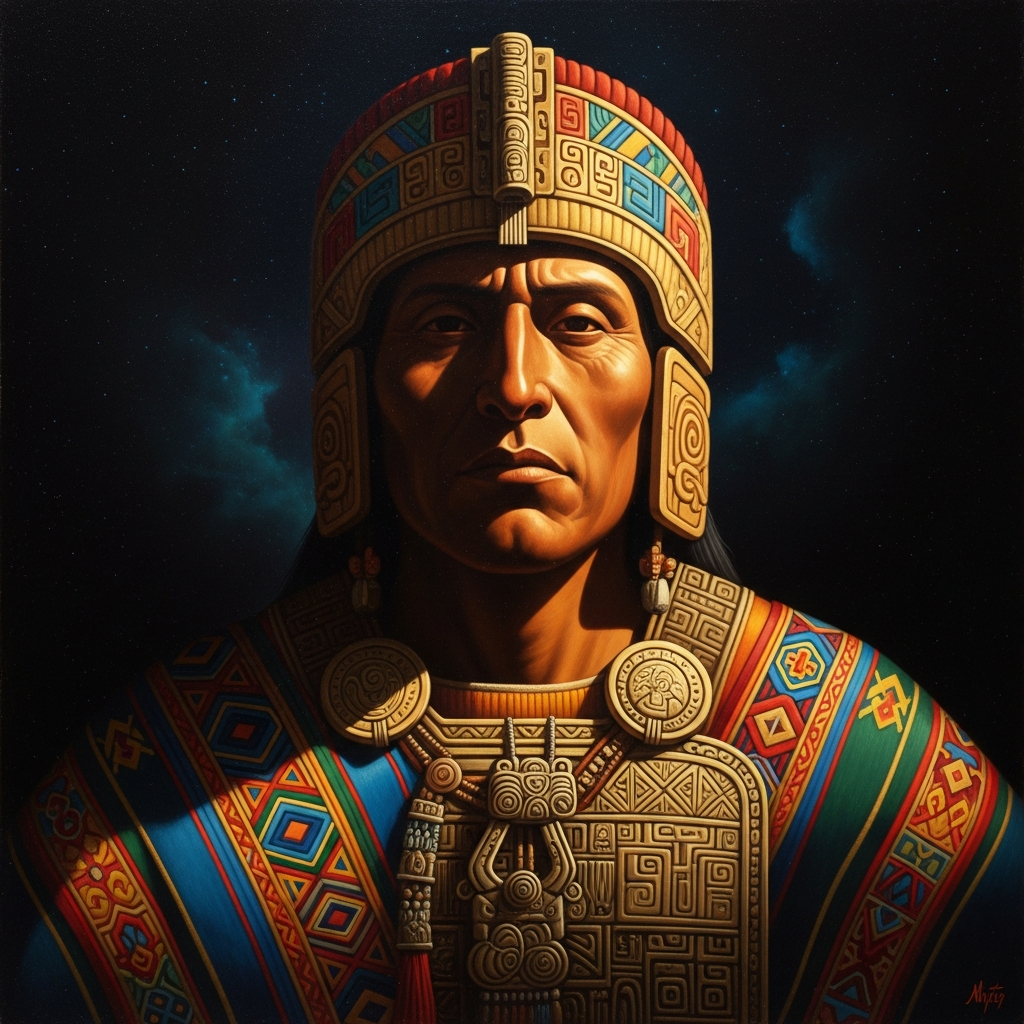
Combat Profile
Sacred Manifestation
Huacas materialize their will through natural landmarks, granting blessings or curses to those who honor or desecrate their domains.
Ancestral Anchoring
Huacas exist simultaneously as guardians of the land and conduits to the spirit realm, maintaining the cosmic balance between the living and the dead.
The Spanish extirpation campaigns systematically destroyed thousands of huaca shrines, burned the mummy-huacas (*mallqui*), and tried to abolish the entire system. Most physical shrines were destroyed; the spirits, the practitioners insist, were not
“They thought we worshipped stones. We did not worship stones. We worshipped the place the stone marked. They burned the stones. The places are still there.”
Lore: Huaca (Quechua: waka; sometimes spelled huaca, waqa, wak’a) is the most theologically important word in the Andean religious vocabulary, and the most difficult to translate. It does not mean “idol” or “fetish” or “shrine” in any European sense, though every Spanish chronicler tried to force it into one of those categories. A huaca is a place where the sacred is concentrated and accessible. It can be a mountain, a spring, a cave, a particular boulder, an ancient ruin, a tree of unusual shape, a stone of unusual color, the place a person was born, the place a person was buried, a mummy, a battlefield, a meteorite-fall site, a confluence of rivers, or a doorway. The category is not defined by what the thing is but by its participation in the sacred — by the fact that, at this specific location, the boundary between Kay Pacha (the human world) and the other worlds (Hanan Pacha and Ukhu Pacha) is thinner than elsewhere.
The Spanish chroniclers found this incomprehensible. They had been trained to think of religion as worship of deities — discrete personal beings with names and attributes, located in heaven or in temples that represented heaven. The Andean system had personal deities (Viracocha, Inti, Pachamama, Illapa, etc.) but the daily religious life of most people consisted not of these high gods but of relationships with thousands of huacas, most of which were specific to a particular family, village, or region. The chronicler Bernabe Cobo recorded that the Inca capital Cuzco alone had 328 official huacas, organized along 41 sight-lines (ceques) radiating from the Coricancha. Each huaca had a specific tribute schedule, was tended by a specific kin-group (ayllu), and was associated with specific months, agricultural activities, and life events.
The most powerful huacas are the apus — the spirits of major mountains. Apu Salkantay, Apu Ausangate, Apu Veronica, Apu Misti, Illimani, Sajama — each is a personality, a power, a being who must be addressed properly and never offended. Modern Andean ritual specialists (paqos, altomisayoqs, yatiris) maintain ongoing relationships with specific apus, performing despacho offerings on their slopes and asking permission before crossing their passes. To climb Salkantay or Ausangate without offering coca to the mountain is to invite the mountain’s anger — altitude sickness, sudden storms, falling rocks, lost paths. Modern climbers from the West find this superstitious; modern Andean guides do not climb without the offerings.
The mummies of dead Inca emperors and their lineages were huacas of a special class called mallqui (“planted ones”). Each emperor’s mummy retained its lands, its servants, its wives (the women who had been married to him in life continued to attend his mummy after his death), and its political voice — the mummy was carried to councils, consulted on policy, fed at meals, taken to visit other emperors’ mummies. This is why Inca emperors built so many palaces: each successor could not inherit his father’s, because the dead father’s mummy still owned and inhabited it. The Spanish, recognizing the mallqui system as the central engine of Inca religious continuity, conducted a campaign of mummy-extraction and mummy-burning across the central Andes throughout the 17th century. Cristobal de Albornoz, Pablo Jose de Arriaga, and other “extirpators of idolatry” boasted of the thousands of mallquis they had located and burned. Some mummies were saved by their descendants and hidden in remote caves — many of these were rediscovered by archaeologists in the 20th century.
The Huarochiri Manuscript (~1608), an extraordinary text written in Quechua by an indigenous Andean and intended to provide the Spanish with information about the very religion they were trying to suppress, is our single most important window into the huaca system as it was understood by its practitioners. It records the genealogies, deeds, and personalities of the major huacas of the Huarochiri region (in central Peru), and demonstrates that what the Spanish dismissed as “stone-worship” was in fact a sophisticated mythopoetic system in which the landscape itself was a network of related and competing sacred persons, each with stories, marriages, fights, and historical relationships to specific human lineages.
The system survives. The mountains still receive offerings. The springs are still consulted. The boulders are still passed with a coca k’intu (a folded bundle of three coca leaves, blown upon and offered to the place). Every Andean village has its apus whose names every villager knows. The Spanish destroyed the official Inca state cult; they could not destroy the huaca system, because the huacas were not buildings or institutions but the land itself, and the land remained.
Parallel: The huaca system is the Andean expression of what Lynn White called “spiritual geography” — the perception that specific places in the landscape are sacred not because of what humans have built there but because of what the place is. The closest parallel in world religion is Shinto (Japan), where kami inhabit specific mountains, waterfalls, ancient trees, and stones, and where the religion is expressed primarily through pilgrimage and place-veneration rather than doctrinal assent. Australian Aboriginal Dreamtime geography — in which specific landscape features are the sites of mythic events and the bodies of ancestral beings — shows striking structural parallels. Celtic sacred-place religion (springs, hills, groves) in pre-Christian Britain and Ireland operated on similar principles, and many Celtic sacred places survive as Christian shrines (the holy wells of Ireland are continuous with pre-Christian water-deity cults). The biblical tradition is largely opposed to place-veneration of this kind — the Hebrew prophets condemned the bamot (high places) as idolatrous (1 Kings 14:23, Hosea 10:8), and Christian theology generally locates God in heaven rather than in specific landscape features. But even Christianity could not eliminate spiritual geography: every cathedral built over a spring, every shrine on a mountaintop, every pilgrimage route across Europe is a half-remembered acknowledgment that some places are different from other places. The Andes never forgot this. They simply continued to know it.
5 min read
Iconoclasm -- the Spanish thought they could end huaca worship by smashing the objects. They could not. The huacas had not been the objects but the places, and the places remained
Cobo, *Historia del Nuevo Mundo* (1653); Polo de Ondegardo, *Errores y Supersticiones de los Indios* (1559); Arriaga, *Extirpacion de la Idolatria del Peru* (1621); Salomon & Urioste, *The Huarochiri Manuscript* (~1608); Bauer, *The Sacred Landscape of the Inca*