Combat Profile
Celestial Slingshot
Illapa hurls cosmic stones that strike with devastating precision, dealing massive lightning damage to all enemies in a wide arc
Storm Lord
Illapa's presence amplifies electrical phenomena; all lightning-based attacks gain increased critical chance and weather effects linger longer
Capricious -- can withhold rain in drought or send hail that destroys the crops; must be propitiated with sacrifices, especially of black llamas (whose dark color is sympathetic magic for storm clouds)
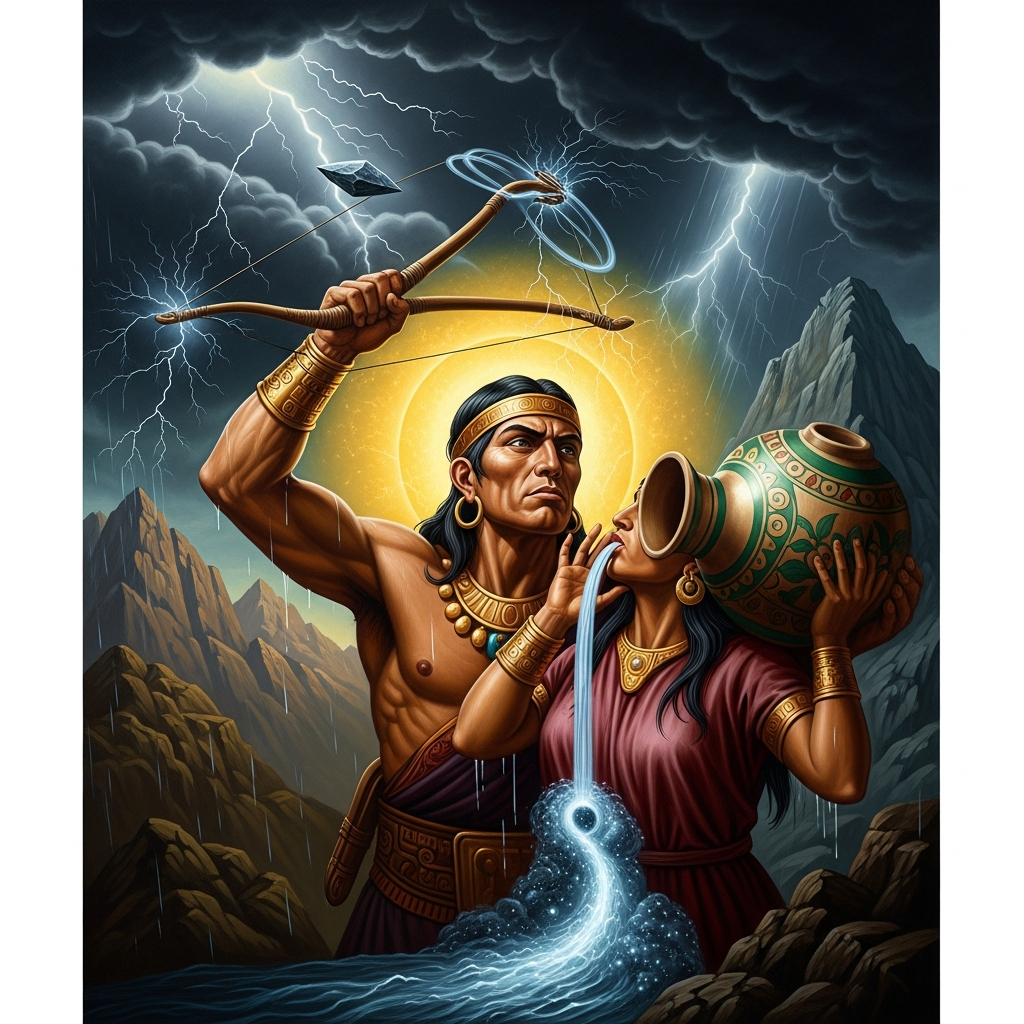
“He is a man with a sling. The Milky Way is the river he drinks from. His sister carries the water jar. He cracks his sling at the jar — the crack is thunder, the released stone is lightning, the bursting jar is rain.”
Lore: Illapa (also written Illap’a or Illapu; Quechua, possibly meaning “to flash/shine”) is the Inca god of thunder, lightning, and rain — one of the most actively-worshipped deities in pre-conquest Andean religion because, in an agricultural civilization perched at high altitude where rain was always uncertain, the storm-god’s favor was the difference between abundance and famine. He ranked third in the imperial pantheon after Viracocha and Inti, and his image (in some traditions a man holding a club and sling, in others a celestial figure with a jaguar’s mouth) was venerated alongside theirs at the Coricancha.
The Inca cosmology of rain is one of the most vivid in world mythology. The Milky Way — which the Inca called Mayu, “the Celestial River” — was understood as an actual river of water running across the sky. Illapa drinks from this river, and his sister (in some versions, his daughter) carries a great water jar drawn from it. Illapa’s role is to break open the jar at the right moment so that rain falls onto the earth. He does this with a sling — the Andean weapon par excellence, used by warriors, herders, and children alike. He whirls his sling above his head, the leather strap cracks against the air — this is thunder — and the released stone strikes the water jar — this is lightning, and the breaking of the jar is the falling rain.
This is a far more elegant theology of meteorology than most ancient civilizations developed. The connection between thunder and lightning is correctly identified as a single causal event (the slinging) producing two perceptual effects (the crack of the strap, the flash of the stone). The connection between lightning and rain is identified as the lightning being the agent that releases the rainfall (the stone breaking the jar). The Andean herders who watched their slings whirl above the high pampa for centuries gave their storm-god a weapon they understood viscerally, and from that understanding built a theology of weather that described the phenomenon with remarkable accuracy.
Illapa’s worship involved sacrifices of black llamas — the dark color was sympathetic magic for the dark storm clouds — and during severe drought, the Inca would tie black dogs in the plaza without food or water, allowing them to howl pitifully, in the belief that the gods would take pity on the suffering animals and send rain to relieve them. Public penitence rituals during drought also included the participation of the Sapa Inca himself, who would fast and weep until the rain came, his imperial body acting as a sacrificial prompt for the gods. After Christianization, Illapa was rapidly syncretized with Santiago Matamoros (Saint James the Moor-Slayer) — the Spanish patron saint depicted on a horse with sword raised, whose feast day (July 25) and martial energy mapped easily onto the Andean storm god. To this day, the festival of Santiago in many Andean villages doubles as a festival of Illapa, with prayers for rain offered alongside Catholic mass.
Parallel: Storm gods with weapons are perhaps the most universal divine type in world mythology. Norse Thor with his hammer Mjolnir is the closest parallel in weapon-based storm theology — both Thor and Illapa cause thunder by striking something, though Thor uses a hammer and Illapa a sling. Hindu Indra wields the vajra (thunderbolt) and slays the dragon Vritra to release the captive waters — the structural parallel to Illapa’s “breaking the water jar” is striking. Greek Zeus hurls his thunderbolts. Slavic Perun wields the axe and the millstone. Yoruba Shango wields the double axe and is associated with both thunder and royal authority. The biblical YHWH appears as a storm god in many archaic strata: “The voice of the LORD breaketh the cedars… maketh them also to skip like a calf” (Psalm 29:5-6) — a thunder-god description nearly indistinguishable from Illapa’s profile. The sling specifically is unusual; David’s defeat of Goliath (1 Samuel 17) is the most famous biblical sling-narrative, but the divine sling-wielder is largely an Andean innovation.
3 min read
Sustained drought breaks his power until propitiated; the dry season belongs to other deities
Cobo, *Historia del Nuevo Mundo* (1653); Polo de Ondegardo, *Errores y Supersticiones de los Indios* (1559); Garcilaso de la Vega, *Comentarios Reales* (1609); Urton, *At the Crossroads of the Earth and the Sky*