Combat Profile
Divine Succession
Inti grants eternal legitimacy to his chosen bloodline, amplifying the power of all descendants and rendering them immune to succession challenges.
Solar Radiance
Inti's presence bathes the world in golden light, strengthening imperial authority and causing all allied forces to gain increased resilience and clarity of purpose.
Subordinate to Viracocha in theological hierarchy despite political supremacy. His power is tied to the empire's political fortunes -- when the Spanish broke the imperial cult, public Inti worship collapsed, though it survived in folk practice
“He is the gold the Spanish came for. He is the father every emperor claims. When the priests of the Coricancha greeted his first dawn rays, they spoke for an empire of twelve million.”
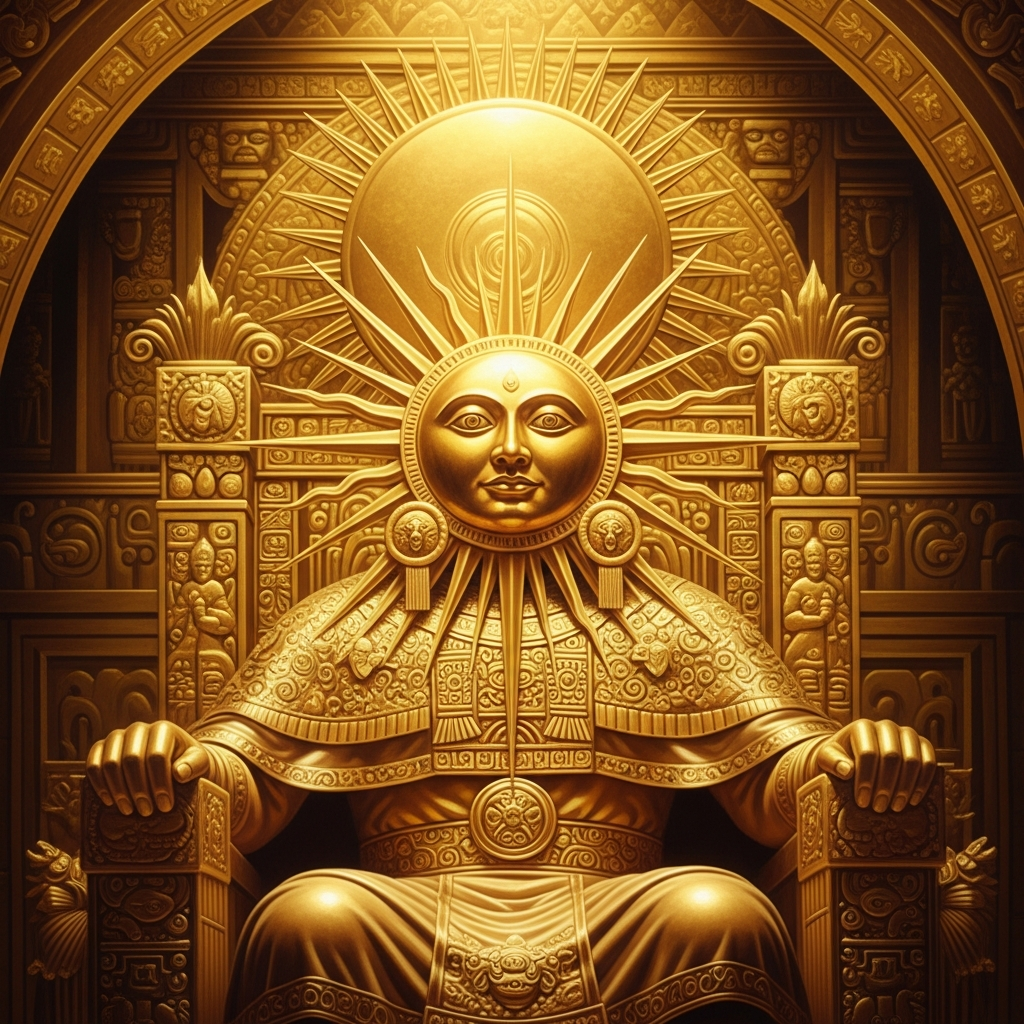
Lore: Inti (Quechua: Inti, “the Sun”) is the patron god of the Inca royal lineage and the most politically powerful deity in the imperial pantheon. While Viracocha may have been theologically supreme, Inti was the god whose worship structured the daily life of the empire, whose face appeared in gold throughout the Coricancha at Cuzco, and from whose loins — according to imperial myth — the Sapa Inca himself was descended. To worship Inti was to worship the imperial state; to die for him was to die for the empire.
The Coricancha (Quechua: Quri Kancha, “Golden Enclosure”) was the holiest building in Tawantinsuyu, located at the heart of Cuzco where the four imperial roads converged. Its walls were entirely sheathed in gold plates — the Spanish chroniclers describe the central garden as containing life-size golden statues of llamas, maize plants, and human figures, all made of pure gold and silver. At the heart of the temple stood the Punchao — a great golden disk representing Inti, positioned so that the rising sun on the June solstice would strike it directly and bathe the chamber in reflected light. The mummies of dead emperors were brought into the temple’s chambers to “consult” with the sun. When the Spanish demanded gold for Atahualpa’s ransom, much of the Coricancha’s plating was stripped, melted, and shipped to Spain. The Punchao itself was eventually captured and is presumed melted, though Andean tradition holds that priests hid it and that it remains buried somewhere in the mountains.
The festival of Inti Raymi — “Festival of the Sun” — was held at the June (winter) solstice, the Andean new year. With the sun at its weakest point in the southern sky, the Sapa Inca personally officiated rituals designed to “tie” the sun and prevent its further withdrawal. Llamas were sacrificed, chicha (maize beer) was poured onto the earth, and the empire reaffirmed its covenant with its solar father. The Spanish banned Inti Raymi in 1572. It was revived in 1944 by indigenous activists in Cuzco and is now Peru’s second-largest festival.
The genealogy of the imperial cult is precise: Inti sired Manco Capac, the first Sapa Inca, who fathered the line that ruled until 1572. Each living emperor was understood as the son of the sun in a literal sense — not a metaphor but a theological fact. This made the political and the religious indistinguishable. To rebel against the emperor was to rebel against the sun.
Parallel: Solar deities tied to royal legitimacy are widespread: the Egyptian Pharaoh was the son of Ra; the Japanese emperor descended from Amaterasu (a continuous claim until 1945); the Aztec-Maya Huitzilopochtli served a similar function for the Mexica royal line. The closest functional parallel is Amaterasu: both are major solar deities whose worship is inseparable from imperial legitimacy, both received their highest honors at solstice festivals, and both survived their respective empires’ political collapses through folk practice and modern revival. Unlike Huitzilopochtli, Inti did not require human sacrifice on a mass scale — llamas, chicha, and selected children (the Capac Cocha) sufficed. The Greek Helios is a more remote parallel, and the late Roman cult of Sol Invictus (the Unconquered Sun) bears interesting similarities to Inti in its imperial function.
3 min read
The clouds, the eclipse, the night -- temporary but inevitable obscurations of his light
Garcilaso de la Vega, *Comentarios Reales* (1609); Cobo, *Historia del Nuevo Mundo* (1653); Sarmiento de Gamboa, *Historia de los Incas* (1572); Urton, *Inca Myths*