Combat Profile
Foundation of Empire
establishes a city or settlement that grants all allied units sustained prosperity and protection from collapse
Divine Lineage
all units under his banner gain increased harmony and agricultural yield; descendants inherit his celestial authority
His brothers (the Ayar siblings) all turned against him or had to be eliminated for the founding to succeed -- the empire was built on intra-fraternal violence
“He carried a golden staff out of the cave of Pacaritambo. Where the staff sank into the earth, he founded the navel of the world. Of his three brothers, one was sealed in stone, one became a huaca, one returned to the cave. Manco Capac walked alone into Cuzco.”
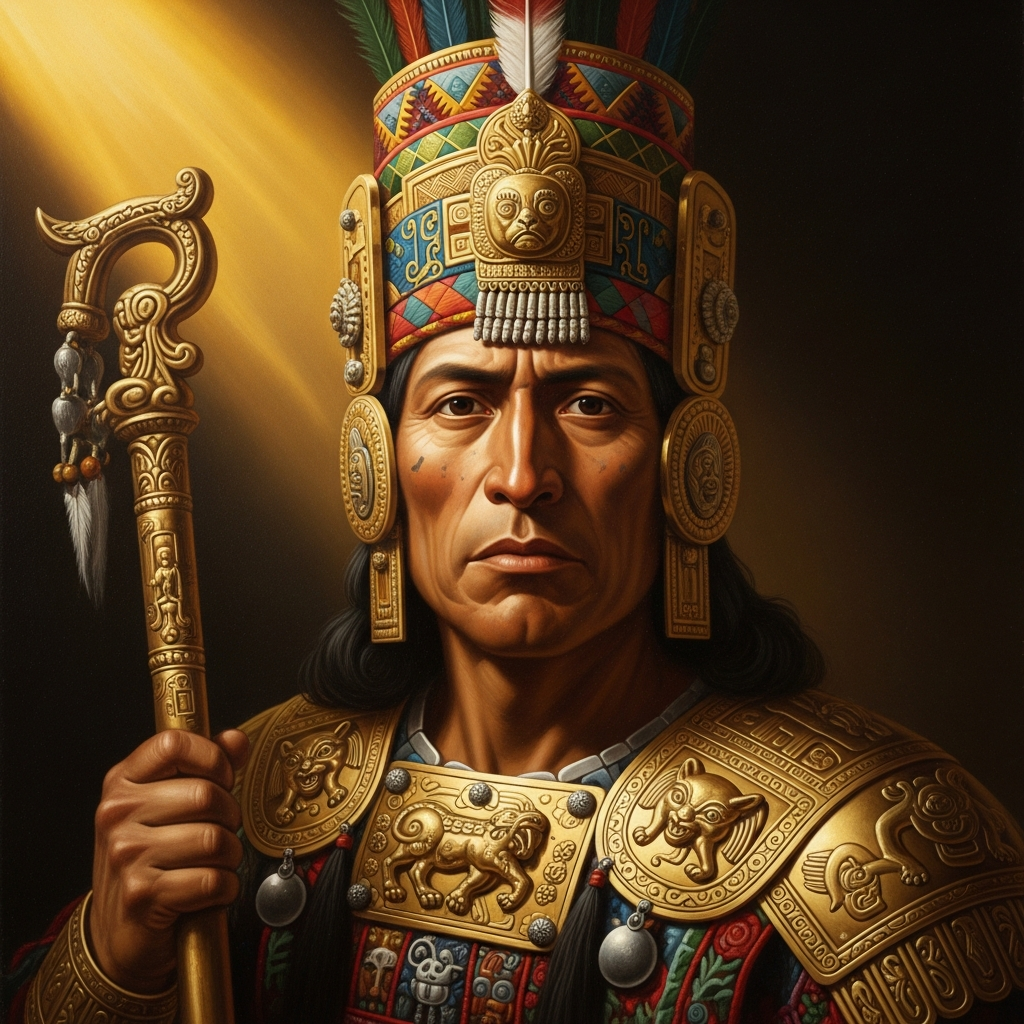
Lore: Manco Capac (Quechua: Manqu Qhapaq, “Splendid Foundation”) is the first Sapa Inca, the founder of Cuzco, and the human son of Inti from whom every subsequent emperor of Tawantinsuyu claimed descent. His foundation narrative is one of the most carefully-preserved myths in Inca tradition, recorded in detail by multiple early chroniclers (Sarmiento de Gamboa, Garcilaso, Betanzos, Cieza de Leon) who interviewed surviving Inca informants in the decades after the conquest. Two distinct versions exist:
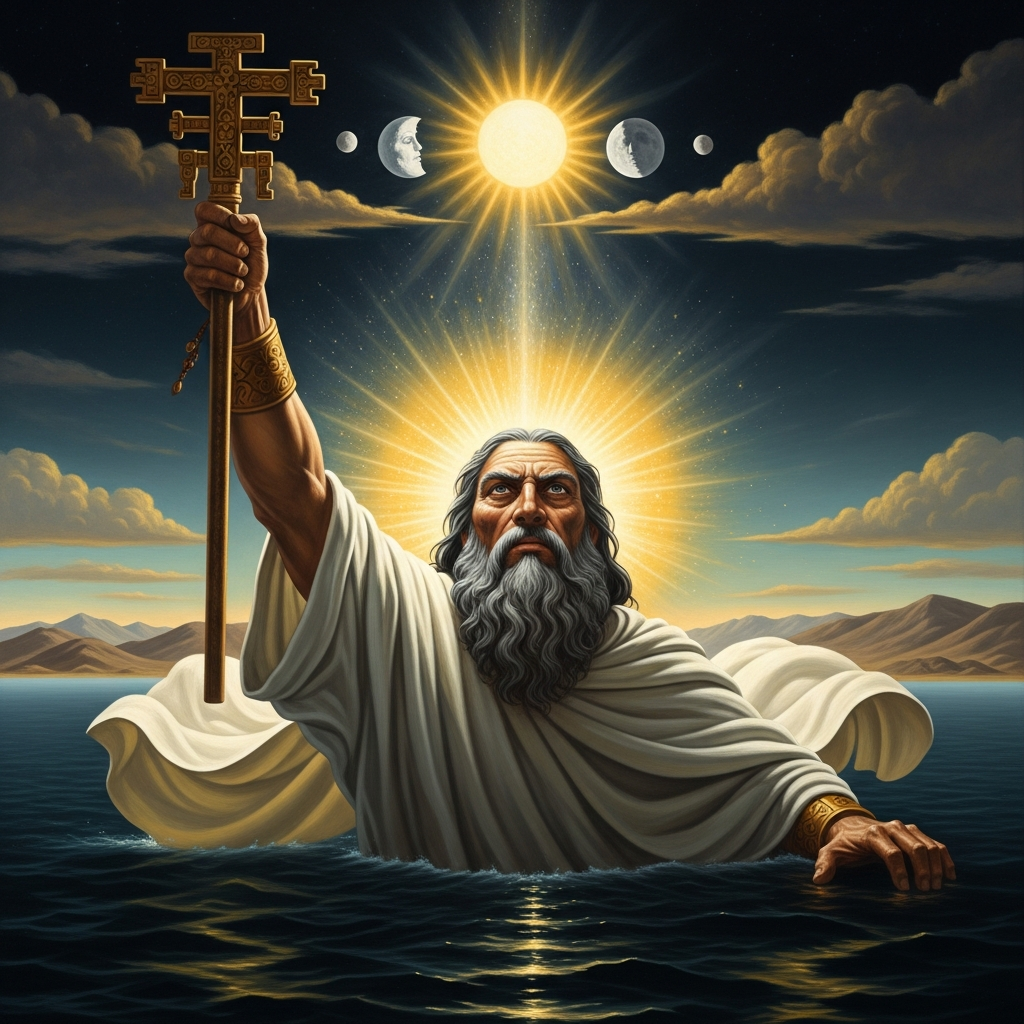
The Lake Titicaca version: Inti, looking down on a humanity living in barbarism, sent his son Manco Capac and his daughter Mama Ocllo up out of the waters of Lake Titicaca to civilize the Andean peoples. They carried a golden staff and were instructed to walk northward, testing the earth with the staff at each stop. Where the staff sank entirely into the soil on first thrust, that would be the place Inti had chosen for the imperial capital. They walked for years. At the hill of Huanacauri, near the Cuzco valley, the staff disappeared into the earth. They had arrived. Mama Ocllo taught the local women to weave and cook; Manco Capac taught the men agriculture, irrigation, and warfare. The city of Cuzco — whose name means navel in Quechua — was founded as the center from which the Four Regions of the world would eventually be unified.
The Pacaritambo version: Four brothers (the Ayar siblings) emerged from a cave at Pacaritambo (“Inn of the Dawn”), south of Cuzco, accompanied by their four sisters: Ayar Manco (who would become Manco Capac), Ayar Cachi, Ayar Uchu, and Ayar Auca. Each brother was powerful and ambitious. Ayar Cachi was so strong he could split mountains with his sling — the others, fearing him, tricked him into returning to the cave to retrieve a forgotten golden cup, then sealed him inside with a great stone. Ayar Uchu, on the way to Cuzco, was transformed into stone at Huanacauri and became the huaca of that sacred hill. Ayar Auca turned into a stone marker at the boundary of Cuzco. Only Ayar Manco — now Manco Capac — entered the city itself, with his sister-wife Mama Ocllo, and founded the dynasty.
The two versions are not necessarily contradictory. The Pacaritambo version is older and more local; the Lake Titicaca version was likely promoted under the emperor Pachacuti as part of his consolidation of the imperial cult, since Lake Titicaca was the most cosmically-significant body of water in the Andes (the place of Viracocha’s emergence) and grounding the imperial founder’s origin there gave the dynasty greater theological weight. Modern scholarship (Gary Urton, The History of a Myth) suggests the Pacaritambo cave is a real place, identifiable with a specific cave system south of Cuzco, while the Titicaca version is a later mythopoetic overlay.
The brother-elimination structure of the Pacaritambo version is theologically and politically revealing. Empire-foundation in Andean theology requires the elimination of competing power — not always through honest combat but often through trickery (sealing Ayar Cachi in the cave) or transformation (turning the brothers to stone, where they remain as loyal huacas guarding the empire’s borders). The empire is not built by one man alone but by one man plus the contained and transformed energies of his rivals, who become permanent features of the sacred landscape.
Parallel: The fraternal foundation of a sacred city through brother-elimination is one of the most archetypal narratives in world mythology. Romulus and Remus (Roman) is the closest parallel: twin brothers descended from Mars (sun-god analog), founding a city, with one brother (Remus) killed by the other (Romulus) so that the city can have a single founder. The biblical Cain and Abel (Genesis 4) follows the same structure, though without the city-founding — Cain kills Abel and then founds the first city (Genesis 4:17). The motif is so widespread that mythographer Rene Girard built an entire theory of culture (Violence and the Sacred) around the foundational role of brother-murder in establishing cities. The golden-staff trial parallels the Hebrew Aaron’s rod that budded (Numbers 17), a divine sign authenticating priestly/royal authority, and resonates with the Arthurian sword-in-the-stone test of legitimate kingship. The sister-wife marriage to Mama Ocllo parallels Egyptian Pharaonic brother-sister marriage and reflects a theology in which divine bloodlines must not be diluted with merely-human stock.
3 min read
Time -- the empire he founded lasted only ~330 years before the Spanish ended it
Sarmiento de Gamboa, *Historia de los Incas* (1572); Garcilaso de la Vega, *Comentarios Reales* (1609); Betanzos, *Suma y Narracion de los Incas* (1551); Urton, *The History of a Myth*