Combat Profile
Lunar Ascendancy
grants allies increased power during night cycles and allows them to perceive hidden truths veiled in darkness
Celestial Cycle
her presence regulates natural rhythms, harmonizing fertility, time, and the bonds of marriage for all within her domain
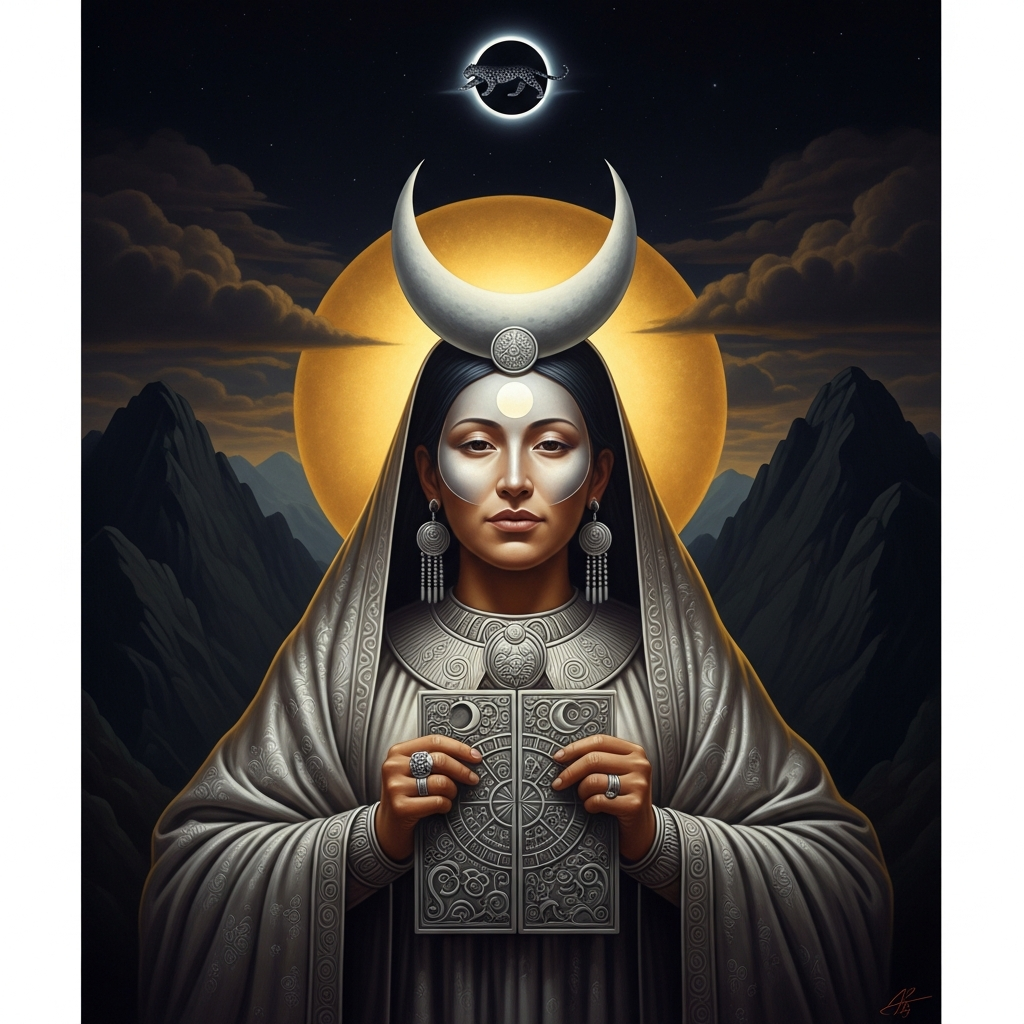
Eclipsed periodically by a celestial jaguar or serpent that swallows her -- during lunar eclipses, the Inca beat drums and made noise to frighten the predator and rescue her
“Inti is gold; Mama Quilla is silver. He rules the day, she rules the night. He rules the men, she rules the women. The moon is bitten and we beat the drums until she is whole again.”
Lore: Mama Quilla (Quechua: Mama Killa, “Mother Moon”) is the Inca moon goddess and the wife/sister of Inti, with whom she co-parents the imperial dynasty. Her image at the Coricancha was a great silver disk, the lunar counterpart to Inti’s golden Punchao, and her temple was attended by women just as Inti’s was attended by men. The metallic correspondence — gold for the sun, silver for the moon — is a near-universal feature of solar/lunar pairings across world mythology, and the Inca articulated it with characteristic precision: gold was inti’s tears or the sweat of the sun; silver was the tears of the moon.
She presides over the lunar calendar — a 12-month system that ran alongside the solar calendar and structured women’s ritual life, the timing of marriage ceremonies, and the planting of certain crops (especially those associated with women’s labor, like quinua and certain potato varieties). The Inca, like most agricultural civilizations, used a complex luni-solar calendrical system, and Mama Quilla’s phases were observed and recorded by specialized priests at the Coricancha. The chronicler Bernabe Cobo recorded that the Inca had developed methods of tracking her movements precise enough to predict eclipses.
Eclipses were terrifying events. The Inca believed that a lunar eclipse occurred when a celestial jaguar (or in some accounts, a great serpent) attacked Mama Quilla and tried to devour her. Across the empire, when the moon began to darken, the entire population would rush into the streets, beat drums and pots, blow conch trumpets, and shout to scare the predator away. Dogs were beaten so they would howl, adding to the cosmic uproar. The strategy worked — the moon always returned. The Spanish chroniclers found this hilarious; the Inca found it self-evidently effective.
The anthropologist Irene Silverblatt, in her landmark study Moon, Sun, and Witches: Gender Ideologies and Class in Inca and Colonial Peru (1987), demonstrated that Mama Quilla functioned not just as a lunar deity but as the structuring principle of a parallel female religious hierarchy that the Spanish chronicles largely overlook. Inca religion had two genealogies: men descended through their fathers and worshipped through Inti; women descended through their mothers and worshipped through Mama Quilla. Each village had a huaca in each lineage. The female priesthood — including the famous acllas (“chosen women”) who served at the Coricancha — maintained the lunar cult parallel to the male solar cult. The Spanish dismantled the female hierarchy and accused its surviving practitioners of witchcraft; many of the “witches” tried in 17th century Andean ecclesiastical courts were practitioners of the old Mama Quilla cult.
Parallel: The lunar goddess paired with a solar god is among the most widespread divine partnerships in world mythology. The closest parallels are Egyptian Isis (associated with the moon in later periods, paired with the solar Osiris/Horus), Greek Selene and her sister Artemis, and Aztec-Maya Coyolxauhqui (the moon goddess dismembered by Huitzilopochtli) and the Maya Ix Chel. The gold/silver metal-correspondence appears nearly universally: the alchemical tradition explicitly identifies the sun with gold (sol) and the moon with silver (luna), and the planetary metals system across Hindu, Greek, and medieval European astrology uses the same correspondences. Mama Quilla’s specifically-Andean feature is her organization of a parallel female religious hierarchy — something the Aztec-Maya and most other patriarchal religious systems did not develop to the same institutional extent.
3 min read
The eclipse-jaguar that hunts her in the sky; the patriarchal politics of the imperial cult that subordinated her to her brother-husband Inti
Garcilaso de la Vega, *Comentarios Reales* (1609); Cobo, *Historia del Nuevo Mundo* (1653); Sarmiento de Gamboa, *Historia de los Incas* (1572); Silverblatt, *Moon, Sun, and Witches*