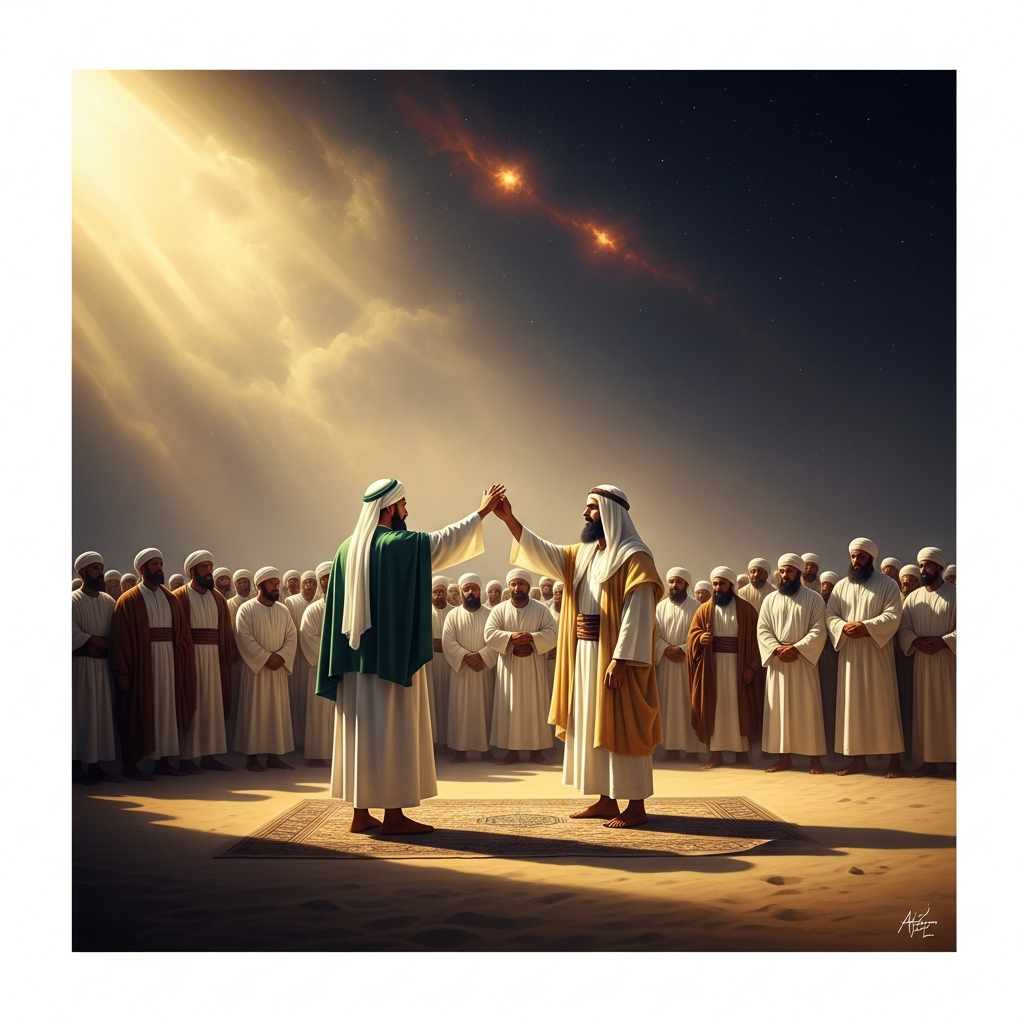
Ghadir Khumm: The Sermon That Split Islam
March 18, 632 CE / 18 Dhu al-Hijjah 10 AH (the sermon at Ghadir Khumm); the schism formalizes after Karbala, October 10, 680 CE · Ghadir Khumm — a watering hole on the road between Mecca and Medina in the Hejaz, in the heat of the desert at the height of summer
Contents
March 632 CE. Muhammad is returning from his Farewell Pilgrimage. The army halts at a pond called Ghadir Khumm in the desert heat. Muhammad takes Ali ibn Abi Talib — his cousin, his son-in-law, the husband of his daughter Fatima — by the hand and raises it: 'Of whomsoever I am the *mawla*, Ali is also the *mawla*.' Three months later Muhammad is dead. Abu Bakr is chosen caliph. Ali waits — through three caliphs and twenty-four years — and the argument about what was meant at Ghadir Khumm becomes the fault line that splits Islam in two.
- When
- March 18, 632 CE / 18 Dhu al-Hijjah 10 AH (the sermon at Ghadir Khumm); the schism formalizes after Karbala, October 10, 680 CE
- Where
- Ghadir Khumm — a watering hole on the road between Mecca and Medina in the Hejaz, in the heat of the desert at the height of summer
The pilgrimage is over. The Prophet is going home.
It is the eighteenth of Dhu al-Hijjah in the tenth year of the Hijra — March 18, 632, in the Christian calendar, though no Muslim present would have used such dating — and the army that has just performed the Farewell Pilgrimage is moving north out of Mecca toward Medina across the desert of the Hejaz. There are perhaps a hundred thousand pilgrims in the train; the chroniclers vary, as the chroniclers always do, but the number is large because Muhammad has called every Muslim who can travel to Mecca for what he has told them is his last hajj. He has been preaching to them for ten days. He has performed the rituals deliberately, slowly, marking each station with explicit instruction so the form will be remembered. He has stood on Mount Arafat and delivered the sermon that will be remembered as the Khutbat al-Wada’ — the Farewell Address — in which he announces that the religion has been completed and that the days of revelation are coming to an end.
He is sixty-two years old. He has been the Prophet for twenty-two years. He has built, from a marginal preacher’s house in Mecca, a religious community that now controls the Arabian peninsula. He knows that he will not see another hajj. He has been sick on and off through the journey, and the illness will, three months later, kill him.
The caravan moves slowly. The heat is severe. By midday on the eighteenth they reach a watering hole called Ghadir Khumm — the pond of Khumm — at the place where the pilgrims from Egypt and the Levant turn off the road that the pilgrims of Iraq and the eastern peninsula will continue along. After Ghadir Khumm the army will divide. Some will return to their tribes in the south. Some will continue with the Prophet to Medina. Some will turn east toward Najd and Yemen. The pond is the last place at which the entire pilgrimage assembly will be in one location.
Muhammad orders the column halted.
He sends riders forward to bring back the pilgrims who have gone ahead. He sends riders backward to call up the pilgrims who lag behind. He waits, in the heat at the pond, until the entire body of pilgrims has been gathered around him. He has the men cut branches from the salam trees by the water and clear them away so that the area at the pond is open. He has the men pile the camel saddles into a rough platform — a minbar — and he climbs onto it.
He preaches.
The sermon is long. There are multiple recensions, recorded by multiple companions, with variations of detail that the isnad scholars of later centuries will spend their careers comparing, but the central passages are stable across every tradition. He speaks first about himself: that he is the Prophet, that he has delivered the message, that the obligation has been fulfilled. He asks the assembly to bear witness. They do. He speaks about the duty of obedience to God and to the Prophet. He speaks about the Thaqalayn — the two weighty things — that he is leaving behind for the community: the Book of God, and his family. He says that as long as the Muslims hold to both they will not go astray.
Then he asks the question that frames the entire moment.
Do I not have more right over the believers, he says, than they have over themselves?
It is a quotation. He is reciting Qur’an 33:6 — al-nabiyyu awla bi-l-mu’minina min anfusihim, the Prophet has more right over the believers than they have over themselves. The verse establishes the Prophet’s wilaya — his guardianship, his governing authority, his closer relationship to the believer than the believer’s own self.
The assembly answers: Yes, O Messenger of God.
He repeats it. Do I not have more right over the believers than they have over themselves?
Yes, O Messenger of God.
He repeats it a third time. The crowd answers a third time.
He reaches down. He takes the hand of Ali ibn Abi Talib — his cousin, the man who has been with him since they shared a household when Muhammad was nine and Ali was a child of the family Muhammad’s uncle Abu Talib raised; the man who slept in Muhammad’s bed on the night of the Hijra so that the assassins outside would think the Prophet was still inside; the man who married Muhammad’s daughter Fatima and fathered the only grandchildren Muhammad would live to see grow into men. He takes Ali’s hand and raises it above the assembly so that the underarms of both men are visible — a specific gesture that the chroniclers preserve because of its bodily intimacy and its public theatricality.
And he says:
Man kuntu mawlahu fa-haza Aliyyun mawlahu.
Of whomsoever I am the mawla, Ali is also the mawla.
He repeats it. He says it three times, possibly four — the recensions vary on the number — and then he prays:
O God, befriend whoever befriends him, and be the enemy of whoever is his enemy. Aid whoever aids him, and forsake whoever forsakes him. Turn the truth with him wherever he turns.
He climbs down from the platform.
Ali stands beside him. The companions come forward to congratulate Ali. Umar ibn al-Khattab, the man who will become the second caliph, steps forward and says — and this is preserved in both Sunni and Shia chronicles — Bakhin bakhin, ya ibn Abi Talib! Asbahta wa amsayta mawlaya wa mawla kulli mu’minin wa mu’minatin. — Bravo, bravo, son of Abu Talib! You have become my mawla and the mawla of every believing man and believing woman.
The caravan resumes its march. They reach Medina ten days later.
Three months after that, Muhammad is dead.
The word mawla is the problem.
In classical Arabic the word does not have a single meaning. It can mean master — the legal owner of a slave, or the patron of a freed slave who retains certain residual obligations. It can mean client — the same relationship from the other direction, the freed slave who continues to owe loyalty to his former owner’s family. It can mean friend — a beloved companion to whom one is bound by affection. It can mean guardian — the legal protector of a minor or a dependent. It can mean next of kin — the relative who inherits in the absence of closer ties. It can mean ally — the political confederate who has sworn mutual support. In the Qur’an it appears with varying senses depending on context.
When Muhammad says Of whomsoever I am the mawla, Ali is also the mawla, the question that the next fourteen centuries will not finish answering is: which of these meanings does he intend?
The Sunni tradition — which will eventually be the majority — reads the sentence as a statement of beloved-companion: whoever loves me, let him also love Ali. The reading is supported by the immediately preceding context, in which Muhammad has just heard a complaint about Ali’s stinginess as a commander on a recent campaign in Yemen, and is publicly correcting the impression by demonstrating his own affection. The sermon at Ghadir Khumm, on this reading, is a personal endorsement of Ali’s character, embedded in a larger sermon about the unity of the umma and the duty of obedience to God and the Prophet, with no specific implication about political succession after Muhammad’s death.
The Shia tradition reads the sentence as a designation of authority. The structural parallel between Muhammad’s question — Do I not have more right over the believers than they have over themselves? — and his subsequent declaration about Ali is too tight, on this reading, to be coincidental. Muhammad has just established the meaning of mawla in this immediate context as the one who has authority over the believers; he has done it three times to make the meaning explicit; and he has then transferred that authority to Ali by the same word. On the Shia reading, Ghadir Khumm is the Prophet’s formal nass — his explicit textual designation — of Ali as his successor in both spiritual and political authority. The Imamate descends from this moment.
Both readings are philologically defensible. Neither can be excluded by close attention to the Arabic text. The argument depends, in the end, on the larger theological framework one brings to the sentence — and the larger theological framework is what the two communities will spend the next fourteen centuries developing in opposite directions, each reaching back into Ghadir Khumm to anchor itself.
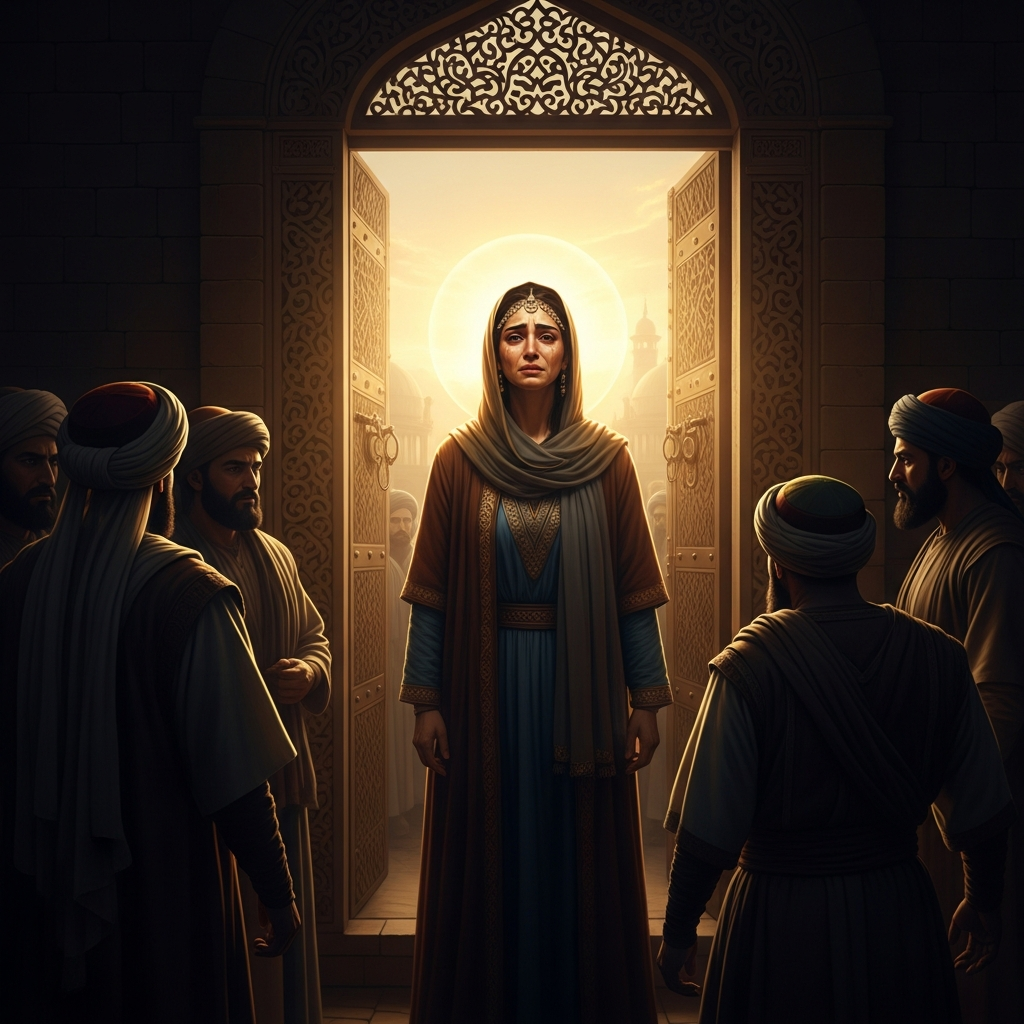
Three months later Muhammad is on his deathbed.
The traditions about his last days are themselves a battleground. Both Sunni and Shia sources record an episode in which Muhammad, weakened and dying, asks for writing materials so that he can dictate something — I will write for you a writing after which you will not go astray. Umar ibn al-Khattab, present at the bedside, refuses to bring the materials. He says — and this is preserved in al-Bukhari, the most authoritative Sunni hadith collection — The Prophet is overcome by his illness. We have the Book of God, and the Book of God suffices us.
There is a quarrel at the bedside. Some companions want the writing materials brought; others side with Umar. The chroniclers preserve the argument. Muhammad, hearing the quarrel, says: Get up and leave me. The materials are not brought. He never dictates the writing.
The Shia tradition holds, with varying degrees of explicitness, that the writing was to have been a formal restatement of Ali’s succession — that Muhammad, sensing the political instability his death would produce, intended to put the designation in writing so it could not later be disputed. The Sunni tradition holds that we cannot know what the writing would have contained, and that since it was never produced it has no juridical force.
Muhammad dies on the twelfth of Rabi’ al-Awwal in the eleventh year of the Hijra — June 8, 632, by the Christian calendar. Ali is in the room. So is Fatima. Ali begins washing the body for burial.
While Ali is washing the body, a meeting is taking place several blocks away.
The meeting is at the Saqifa Bani Sa’ida — the covered porch of the Banu Sa’ida clan, a roofed gathering area where the Ansar of Medina (the original Medinan Muslims, distinct from the Muhajirun who emigrated with Muhammad from Mecca) traditionally hold political assemblies.
The Ansar are meeting because they want a Medinan caliph. They have hosted Muhammad and his community for ten years; they have provided the army that fought at Badr, Uhud, and Khaybar; they have absorbed the Meccan emigrants into their families and their economy. They believe, with reasonable cause, that the political leadership of the new community should remain in Medina under Medinan leadership.
Abu Bakr and Umar — both Muhajirun, both senior Meccan companions — hear about the meeting and rush to the Saqifa. The argument that follows is one of the most documented political scenes in Islamic history. The Ansar nominate Sa’d ibn Ubada, an elder of the Khazraj tribe, as caliph. Abu Bakr argues that the Quraysh — the Meccan tribe of which Muhammad himself was a member — must lead the umma because they are the Prophet’s own kin and because the Arabs will not accept leadership from any other tribe. Umar supports him.
The argument lasts hours. By evening, in a moment Umar later describes as a falta — a sudden, slightly shameful, sudden movement that he will deny was a precedent for any subsequent succession — Umar takes Abu Bakr’s hand and gives him the bay’a, the oath of allegiance. The Muhajirun present do the same. The Ansar, faced with a unilateral declaration, give their own bay’a one by one. Sa’d ibn Ubada refuses to give his and will refuse for the rest of his life.
By nightfall, while Ali is still in his house with Fatima washing the Prophet’s body, Abu Bakr has been acclaimed caliph.
When Ali emerges from the funeral preparations and learns what has happened he is, by every account, stunned. He had not been consulted. Fatima had not been consulted. The Banu Hashim — Muhammad’s own clan — had not been consulted. The decision had been made while the family of the Prophet was performing the funeral rites, and it had been made by men who had not invited them.
Umar comes to Ali’s house — to the house of Fatima — to demand the oath of allegiance for Abu Bakr. The episode is recorded in multiple traditions, and it is the place where Sunni and Shia accounts diverge most sharply. The Sunni traditions describe a tense confrontation in which Ali eventually gives the bay’a — though some sources say not for six months, until after Fatima’s death. The Shia traditions describe a more violent confrontation in which Umar threatens to burn the house, in which Fatima is injured at the door, in which a child she is carrying is miscarried, and in which the wound she sustains contributes to her death within months.
What is uncontested across all traditions is that Ali waits. He does not press his claim. He does not raise an army. He does not appeal to Ghadir Khumm in any public forum. He withdraws into his household, raises his sons Hasan and Husayn, advises the caliphs when consulted, and waits.
He waits through the caliphate of Abu Bakr (632-634), through the caliphate of Umar (634-644), through the caliphate of Uthman (644-656). He waits twenty-four years. When Uthman is murdered by mutineers in his own house in 656, Ali is finally acclaimed caliph — the fourth — over the desperate political confusion that follows.
He reigns for five years. He fights two civil wars — against Aisha (Muhammad’s widow) and Talha and Zubayr at the Battle of the Camel in 656, and against Mu’awiya, the governor of Syria, at Siffin in 657. The civil wars exhaust the umma. Mu’awiya is not defeated. In 661, Ali is assassinated in the mosque of Kufa by a Kharijite — a member of a sect that has broken from Ali because they believe he was insufficiently uncompromising — who strikes him with a poisoned sword during morning prayer.
Ali dies two days later. His son Hasan briefly accepts the caliphate, then negotiates a settlement with Mu’awiya: he abdicates in exchange for a pension and the assurance that the caliphate will return to the family of Muhammad after Mu’awiya’s death.
Mu’awiya does not honor the agreement. He establishes the Umayyad dynasty in Damascus and designates his son Yazid as his successor. When Mu’awiya dies in 680, Yazid inherits the caliphate. The promise made to Hasan is broken.
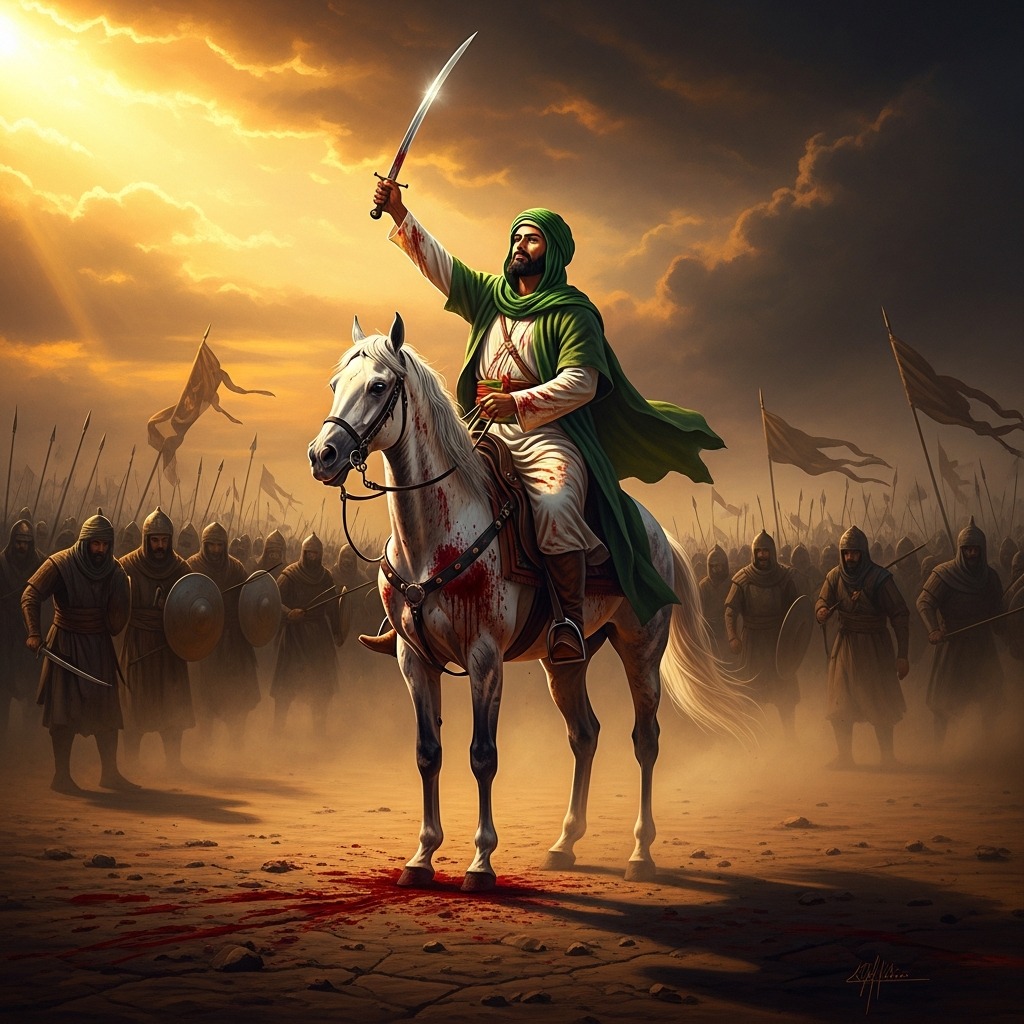
Hasan’s brother Husayn refuses the bay’a to Yazid. He sets out from Mecca for Kufa, where the people have invited him to lead a rebellion. On the plain of Karbala, near the Euphrates, on the tenth of Muharram in the year 61 of the Hijra — October 10, 680 — Husayn and seventy-two companions are surrounded by four thousand Umayyad soldiers and slaughtered. Husayn’s head is sent to Damascus on a spear.
The schism that began with an ambiguous sentence at Ghadir Khumm has now been sealed in blood. After Karbala, the Shia community — shi’at Ali, the party of Ali — exists as a permanent identity within the Islamic world, organized around the memory of the wrong they believe was done at Saqifa, articulated through the doctrine of the Imamate that traces the legitimate authority through Ali’s descendants, and ritualized in the annual mourning of Ashura that commemorates Husayn’s death every year on the tenth of Muharram in every Shia community on earth.
The numbers, today, are roughly 85 percent Sunni and 15 percent Shia within global Islam — about 1.6 billion to 250 million. The line runs through Iraq, through Lebanon, through Bahrain, through Yemen, through Iran, through Pakistan, through every country with a significant Muslim population. It is the line of the Iran-Iraq War and the Syrian civil war and the politics of the Arabian Gulf. It is the line that organizes contemporary Middle Eastern statecraft.
It runs back, every theological argument made on every side of it, to a single sentence spoken in the heat of a desert afternoon at a watering hole called Ghadir Khumm.
Of whomsoever I am the mawla, Ali is also the mawla.
The argument is fourteen centuries old. It will not end. The sentence is unambiguous in Arabic. The sentence is unambiguous in every translation. The sentence is unambiguous in every reading except the question of which of the word’s classical meanings the speaker intended — and on that question, on which a billion and a half lives are organized, the speaker is silent.
He has been silent since June 632.
He left the room before he could write the writing.
Scenes
March 18, 632
Generating art… Three months later
 Generating art…
 October 10, 680
 Generating art…
 Echoes Across Traditions
Entities
- Muhammad ibn Abdullah (the Prophet of Islam)
- Ali ibn Abi Talib (Muhammad's cousin and son-in-law)
- Fatima al-Zahra (Muhammad's daughter, Ali's wife)
- Abu Bakr al-Siddiq (first caliph)
- Umar ibn al-Khattab (second caliph)
- Uthman ibn Affan (third caliph)
- Husayn ibn Ali (Ali's son, martyr at Karbala)
Sources
- *Hadith of Ghadir* — recorded across Sunni and Shia collections: Sunan al-Tirmidhi (vol. 5, no. 3713), Musnad Ahmad ibn Hanbal (vol. 1, no. 84; vol. 4, no. 281), Sunan al-Nasa'i (Khasais, hadith 79); the Shia tradition considers it *mutawatir* — multiply attested at every level of transmission
- Ibn Ishaq / Ibn Hisham, *Sirat Rasul Allah* — translated by A. Guillaume as *The Life of Muhammad* (Oxford, 1955)
- al-Tabari, *Tarikh al-Rusul wa-l-Muluk* — *History of the Prophets and Kings*, trans. multiple volumes (SUNY Press)
- Wilferd Madelung, *The Succession to Muhammad: A Study of the Early Caliphate* (Cambridge University Press, 1997) — the standard Western academic account, sympathetic to the Shia reading on philological grounds
- Heinz Halm, *Shi'ism* (Edinburgh, 2nd ed. 2004)
- Vali Nasr, *The Shia Revival: How Conflicts Within Islam Will Shape the Future* (Norton, 2006)
- Hossein Nasr, Hamid Dabashi, and Vali Nasr (eds.), *Shi'ism: Doctrines, Thought and Spirituality* (SUNY Press, 1988)