Fatima al-Zahra: The Grieving Lady
Medina · ~11 AH / 632 CE · Medina — the Prophet's mosque, the house of Ali, the disputed land of Fadak
Contents
Fatima al-Zahra — daughter of Muhammad, wife of Ali, mother of Hasan and Husayn — is the pivot of the Shi'a tradition. Her grief at her father's death, her dispute with Abu Bakr over the garden of Fadak, and her death six months after Muhammad form the founding trauma of the Shi'a-Sunni split. Every Ashura procession mourns what began with her.
- When
- Medina · ~11 AH / 632 CE
- Where
- Medina — the Prophet's mosque, the house of Ali, the disputed land of Fadak
She is six years old when the revelation begins.
Not long after Muhammad returns from the cave at Hira trembling, not long after Khadija wraps him and says he cannot be possessed because he is a man of justice — in that early period, Fatima watches her father become the Prophet, watches the persecution of the small community of believers, watches her mother bear it all until she cannot. Khadija dies in the Year of Sorrow. Fatima is eighteen. She is the youngest of the Prophet’s daughters and the only one who outlives him — briefly.
After Khadija’s death, Fatima becomes what the tradition calls Umm Abiha — the mother of her father. She tends him. She is the one who wipes the blood from his head when the Quraysh throw offal on him while he prays. She is the one who stands between him and the harassment of the Meccan years. Muhammad calls her the chief of the women of paradise. He calls her Zahra — the radiant one. He says: Fatima is a part of me. Whoever grieves her grieves me, and whoever angers her angers me.
She marries Ali ibn Abi Talib in the second year after the Hijra. Ali is the Prophet’s cousin, one of the first believers, the man who will be the first imam in the Shi’a reckoning. They are poor — the dowry is Ali’s armor and a water-skin and a pillow stuffed with fibers. Their house is so small it can be crossed in a few steps. They have no servant, and Fatima grinds the grain until her hands blister. The Prophet hears of this and teaches her, instead, a prayer: thirty-four times Allahu Akbar, thirty-three times Alhamdulillah, thirty-three times SubhanAllah. This prayer — the Tasbih of Fatima — she will say every night for the rest of her life, and it will be said by every Shi’a Muslim after every prayer until the end of time.
She gives birth to Hasan. Then Husayn. Then Zaynab. Then Umm Kulthum. Four children in a small house with no servant, a husband who is away with the Prophet, a city always on the edge of war.
The Prophet is dying.
June of 632. He has returned from the farewell pilgrimage — the last time he circled the Ka’ba in Mecca — and at Ghadir Khumm, on the way back, he stopped the caravan and gave a speech. The Shi’a tradition holds that he named Ali as his successor: Man kuntu mawlahu fa-hadha Aliyyun mawlahu — whoever considers me their master, Ali is their master. The Sunni tradition reads the speech differently. The disagreement over what happened at Ghadir Khumm is the disagreement at the root of the split.
Now Muhammad is in his house in Medina, running a fever so high that he has to bind his head with cloth, and he leans on the arms of Ali and his companion as he leads the final prayers at the mosque. He is sixty-three years old. He is the last of the prophets. When he dies, the revelation ends.
Fatima is at his side. She weeps, and he tells her something in her ear, and she weeps harder. Then he tells her something else, and she smiles. Later she will say: first he told me he would die, and then he told me I would be the first of his household to follow him.
He looks up at her. I am grieved by your grief, he says. I am not grieved by anything else. They are his last words to her.
He dies in the month of Rabi’ al-Awwal, lying with his head in ‘A’isha’s lap.
Fatima goes to his grave and says: O Father, you who responded to the Lord who called you. O Father, whose abode is the paradise of Firdaws. O Father, we convey the news of his death to Gabriel.
Three days later, Abu Bakr is caliph.
The choice happens quickly, in the gathering at the Saqifah of Banu Sa’ida, while Ali and the Banu Hashim are still washing Muhammad’s body for burial. The mechanics of the succession are complex — different tribal factions, the distinction between Meccan emigrants and Medinan helpers, questions of precedence — and the historians, both Sunni and Shi’a, describe a certain urgency in the Saqifah gathering that has always invited the interpretation that the speed was deliberate. Ali is not present. The Banu Hashim are not present. The oath is taken.
Fatima does not accept it.
In the Shi’a account, she is the center of the opposition. She goes to Abu Bakr and demands what her father had given her: the land of Fadak, a fertile oasis of date palms in the Hijaz, which Muhammad had granted to her from the spoils of Khaybar. This grant, in the Shi’a account, was clear and documented. Abu Bakr refuses to hand it over. He cites a hadith — a tradition he claims to have heard from the Prophet — stating that prophets do not leave inheritance; what they leave is given to charity.
Fatima says: did you hear this? Did any other witness hear this? The hadith, in the Shi’a view, is a forgery deployed to deprive her.
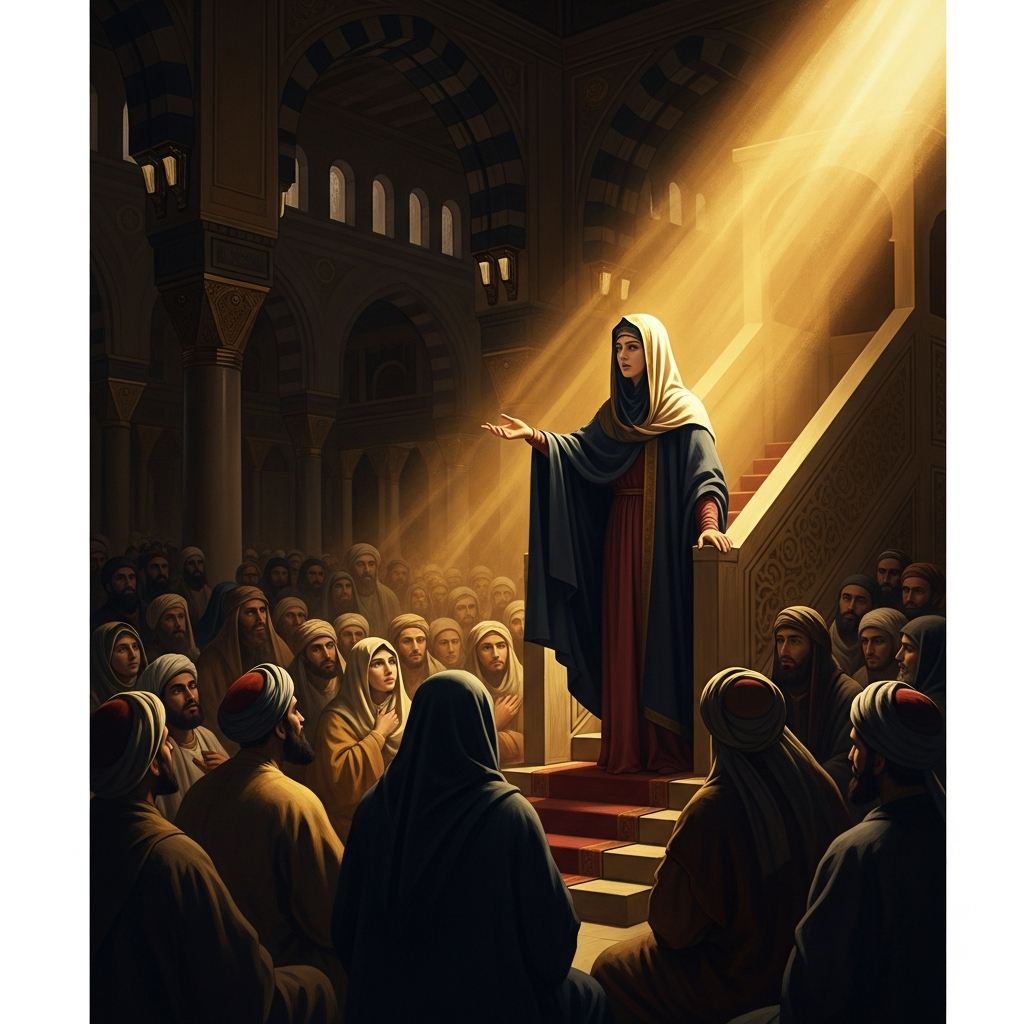
She goes to the mosque. She delivers what the tradition preserves as the Khutbat al-Fadakiyya — the Fadak Sermon — addressing the community of Muslims. The sermon, as preserved in Shi’a sources, is a formal legal and theological argument: she argues from Qur’anic inheritance laws, from the precedent of the prophets (Zachariah inherited from Jacob; Solomon inherited from David), from the fact that her father’s word regarding Fadak was reliable when it served other purposes and is now dismissed. She argues methodically, like a jurist.
She does not get Fadak back.
She returns from the mosque and, the sources say, she does not speak to Abu Bakr again. She maintains her anger — she was angry with Abu Bakr and kept away from him — until she dies. This anger is preserved in the hadith collections, including Bukhari. The fact of her anger, the Shi’a tradition holds, is the fact that answers the question of whether the caliphate was legitimate.
If Fatima was angry with Abu Bakr, and the Prophet said whoever angers her angers me, and whoever angers the Prophet angers God — the chain of implications is clear.
She dies six months after her father.
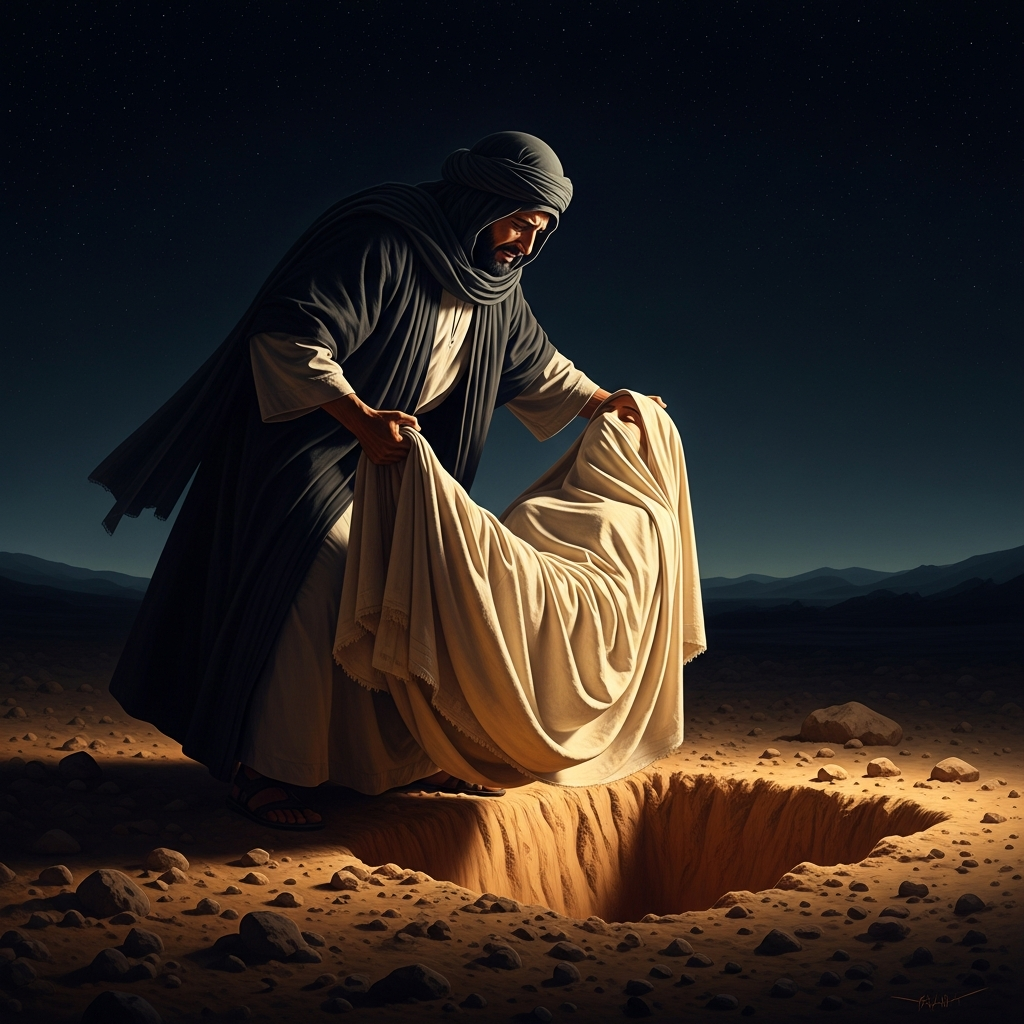
The exact date is disputed between Sunni and Shi’a sources. The Shi’a tradition holds that she was buried at night, by her own explicit request, in a location she asked Ali to keep secret — so that Abu Bakr and Umar would not attend the funeral prayers. The location of her grave has been unknown for fourteen centuries.
The secrecy of the burial is a statement. A grave that can be prayed over is a grave that can be visited, and a visit is a kind of recognition. She is refusing to give her enemies the opportunity to perform a reconciliation she has not granted. She died angry. She asks to be buried in anger, invisibly, beyond the reach of the political process that took Fadak and the succession.
She is twenty-seven years old.
Ali raises Hasan and Husayn. He becomes the fourth caliph — decades later, after Abu Bakr and Umar and Uthman — and is assassinated in Kufa while praying, in the year 661. Hasan abdicates the caliphate and is later poisoned. Husayn, the third imam, goes to Karbala in 680 with seventy-two companions and members of his family, faces an Umayyad army of thousands, refuses to surrender, and is killed on the tenth of Muharram. His head is displayed in the court of Yazid.
The massacre at Karbala is the event Ashura commemorates. But the grief at Ashura begins at Fatima’s death, six months after her father, in an unmarked grave no one has found. It begins in the Fadak sermon, in the argument that the first caliph’s authority was illegitimate from the beginning, that the wound was inflicted not at Karbala but at the Saqifah three days after the Prophet’s burial.
In the Shi’a devotional tradition, Fatima is not merely a historical figure. She is Ma’suma — the pure, the sinless. She is the intercessor between her family and God. She is the one whose grief at the prophetic loss mirrors the grief of every Shi’a who has lost something irreplaceable. The rawzeh-khani — the mourning ceremonies — invoke her name alongside Husayn’s. The lamentation literature (maqtal) traces the chain of suffering: Fatima, Ali, Hasan, Husayn, the imams who follow.
She is called Umm al-Imams — the mother of the imams. All twelve of the Shi’a imams trace through her and Ali. She is the node through which the prophetic authority passes from Muhammad to Ali to the twelve. Without her body, the transmission cannot happen. Without her, there is no Shi’a tradition.
This is also why her exclusion from Fadak, from the caliphate succession, from the political structures of early Islam, is felt as an original wound and not merely a historical injustice. The tradition that claims to derive from the Prophet through her is the tradition that was dispossessed in the first weeks of her bereavement.
A visitor once asked Imam Ali al-Ridha — the eighth Shi’a imam — about Fatima’s titles. He gave several: al-Zahra, the radiant. Al-Batool, the virgin, the one cut off from worldly attachments. Al-Tahira, the pure. Al-Muharrama — the sanctified. And Siddiqah — the truthful, the same honorific given to Abu Bakr by the Sunni tradition for his unconditional faith in the Night Journey.
The parallelism is pointed. Abu Bakr is al-Siddiq because he believed immediately, without evidence, that the Prophet traveled to Jerusalem and back in a night. Fatima is al-Siddiqah because she spoke the truth about Fadak and the succession, and paid for speaking it, and died speaking it.
Two people called the truthful one, in two branches of the same religion, for opposite acts. Abu Bakr’s name belongs to the Sunni caliphate. Fatima’s name belongs to the imamate. The distance between them is measured in every Ashura procession, in every marthiya (elegy), in every black-draped commemorative hall from Najaf to Lagos to New York.
She is buried somewhere in Medina. No one knows where. Every Shi’a who comes to the city visits the possible locations. The grave that cannot be located is the wound that cannot be closed.
Fatima’s story is the grief at the center of the largest schism in Islamic history, which is also the second-largest religion in the world. The grief is not metaphorical. It is specific: a woman, a date-palm garden, a dispute over a hadith nobody else heard, an anger maintained until death, a burial at night that refused reconciliation.
Every religious tradition has a founding wound — the moment when the sacred is lost or stolen or betrayed, and the tradition organizes itself around the grief of that loss. For Shi’a Islam, the wound is not Karbala, though Karbala is the most visible scar. The wound is the three days between the Prophet’s death and the Saqifah, when Ali was washing the body and the succession was being decided in another room.
Fatima knew what was happening. She went to Abu Bakr. She gave a sermon. She argued from scripture. She lost. She maintained her anger until her last breath and was buried in secret so that no political ceremony could paper over the rupture.
The Lady of Light, the Radiant One, the Mother of the Imams — she dies at twenty-seven, angry, in an unknown grave, mourned for fourteen centuries. The processions of Ashura carry her grief forward: the black flags, the chest-beating, the elegies, the particular Shi’a aesthetic of loving what has been taken and insisting on its return.
The location of her grave is unknown. The location of her grief is every Shi’a house in the world.
Scenes
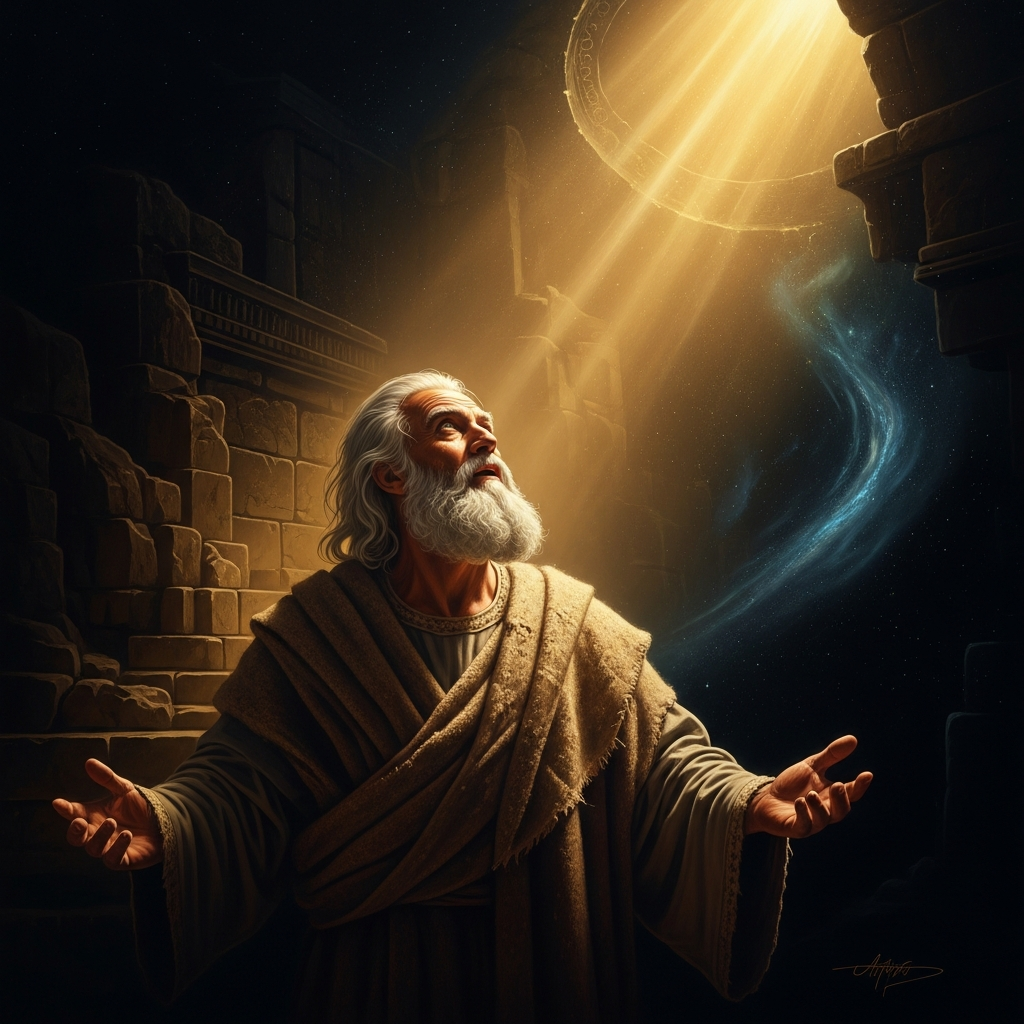
At the Prophet's deathbed in Medina, Fatima leans over her father as his eyes close, her grief the most visible grief in the room — the daughter who, he said, is a part of me, whoever grieves her grieves me
 Generating art…
 In the mosque of Medina, veiled in her cloak, Fatima delivers the Fadak sermon to the community — arguing from scripture, from precedent, from her father's direct word, for land that has already been taken
 Generating art…
 Ali buries Fatima at night, by her own request, so that Abu Bakr and Umar will not pray over her grave
 Generating art…
 Echoes Across Traditions
Entities
- Fatima al-Zahra
- Muhammad
- Ali ibn Abi Talib
- Abu Bakr
- Hasan ibn Ali
- Husayn ibn Ali
- Fadak
Sources
- Al-Shaykh al-Mufid, *Kitab al-Irshad* (The Book of Guidance), trans. I.K.A. Howard (Ansariyan, 1981)
- Sahih al-Bukhari, *Kitab al-Mughazi*, vol. 5 — the Fadak hadith
- Fatima al-Masuma al-Qummi, *The Fadak Sermon (Khutbat al-Fadakiyya)* — preserved in multiple Shi'a sources
- Sayed Ali Asgher Razwy, *A Restatement of the History of Islam and Muslims* (Islamic Seminary, 1997)
- Wilferd Madelung, *The Succession to Muhammad: A Study of the Early Caliphate* (Cambridge University Press, 1997)