Iceland Converts by Vote
Year 1000 CE · the Althing at Þingvellir · Þingvellir, southwest Iceland
Contents
Year 1000. Iceland's pagan Lawspeaker retreats under his fur cloak for a day and a night, then rises to hand his nation to the Christian God — on conditions no bishop would have chosen.
- When
- Year 1000 CE · the Althing at Þingvellir
- Where
- Þingvellir, southwest Iceland
The Althing has been meeting for two hundred years by the time the crisis arrives.
Every summer, the chieftains of Iceland ride to Þingvellir — the plain where the earth has split itself open, where the rift between the continental plates makes a natural amphitheater, where the Lawspeaker climbs the Law-rock and recites the legal code from memory for three days, a third of it each year. No king. No standing army. A parliament of farmers and gods-fearers who govern by argument and precedent. The world has not seen anything quite like it.
The summer of the year 1000 is different. The country arrives at Þingvellir already split.
The Christians have been growing for a decade. Missionaries from Norway. Converts from Ireland and Britain, brought home in Viking ships. And behind them all, the long shadow of Olaf Tryggvason — King of Norway, newly baptized, furiously devout, and in possession of ships and men that Iceland cannot match. His message to the island has arrived the way royal messages do: convert, or I will close your ports, murder your countrymen sheltering in Norway, and burn what needs burning. This is not an invitation.
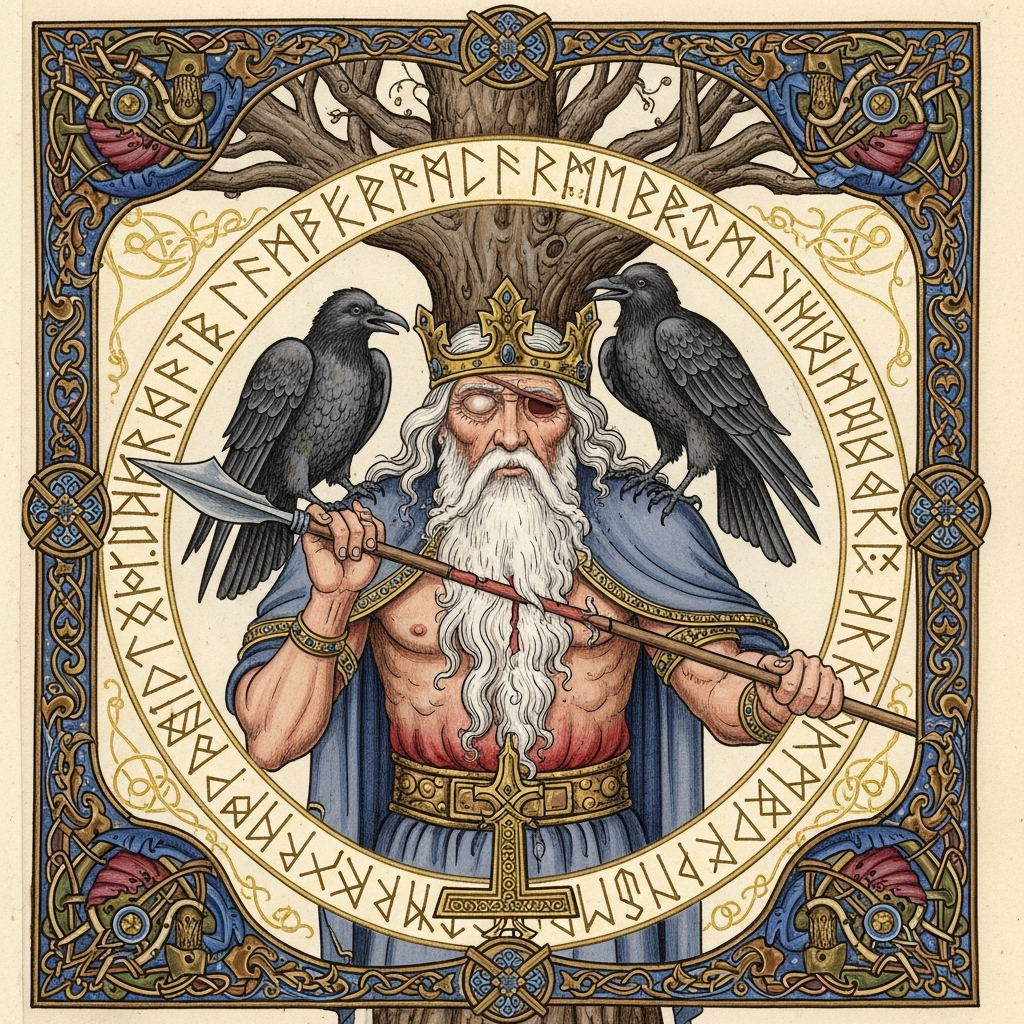
The pagans are not ready to yield. They worship Odin the All-Father who hung himself on Yggdrasil for wisdom. Thor who holds the hammer against chaos. Freya who receives half the battle-dead. These are not decorations. They are the structure of the world.
Both sides arrive at Þingvellir with their own Lawspeaker candidates. Both sides declare the other’s laws void. For a day, Iceland has two legal codes, which means it has none. Two legal codes means two nations. Two nations in one small island means war.
Someone has to decide. Both sides agree on one name.
Þorgeir Þorkelsson is the sitting Lawspeaker. He is a gothi — a pagan priest. He has officiated at the blót, the blood sacrifice, the rituals that bind the Norse cosmos together season by season. No one doubts where his gods stand.
That is exactly why both sides trust him. A man that embedded in the old religion cannot be suspected of selling the verdict in advance.
The chieftains bring him their question in the formal language of the Thing: Let one man decide for all. Þorgeir accepts. He goes to his booth, wraps himself in his fur cloak, and lies down.
He does not speak. He does not eat. He does not explain.
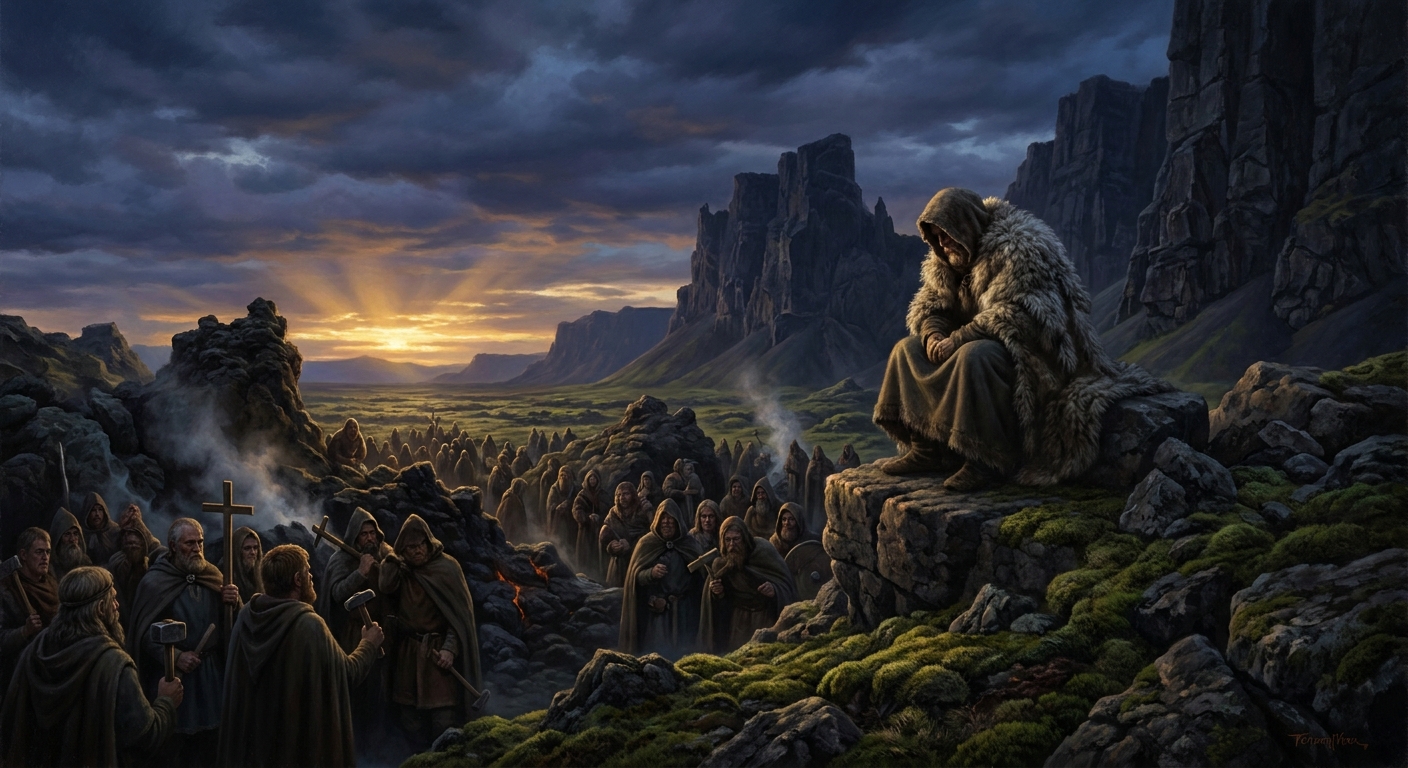
For a full day and a full night he lies there while Iceland waits outside in the grey Þingvellir light. The chieftains ride circuits of the plain. The Christian faction prays to their new God. The pagan faction makes offerings to the old ones. The Lawspeaker lies still under the cloak, and whatever is happening in that darkness is his alone.
What does a man think about when he is deciding for an entire people?
He knows the geography of the problem. Iceland is an island with one trade route and that trade route passes through Norway. Olaf Tryggvason is not bluffing. The Christians among his own countrymen are not going away. The saga writers who record this night do not tell us what Þorgeir thought, and that silence is the most honest thing in the record. Ari Þorgilsson, who writes the Íslendingabók a century later, says only that Þorgeir lay under his cloak — and that when he rose, the decision was already complete.
He rises the next morning.
The Althing assembles. Every chieftain, every farmer who has made the ride to Þingvellir, clusters at the Law-rock and looks up at the pagan priest who has spent the night alone in the dark.
Þorgeir speaks for a long time. The saga preserves what he says.
He tells them that a nation cannot have two laws any more than a body can have two hearts. Division is death. He has seen what happens to peoples who split — they bleed out through the crack. Iceland has survived this long because the Althing holds. Let the Althing hold now.
All shall be baptized. All shall accept the Christian God as the one God of Iceland.
The pagan chieftains are silent. The Christian faction begins to breathe.
Then Þorgeir continues.
But. The old rites may be practiced in private. The eating of horseflesh — sacred in Norse sacrifice, already banned in Christian lands — may continue. The exposure of infants when a family cannot feed another mouth may continue, as it always has, as poverty sometimes demands. These three privacies the new law will not touch.
He is a pagan priest handing his nation to a foreign god with one hand and holding the door open with the other. He is a lawmaker who understands that law which cannot be lived will not be obeyed. He is doing the most difficult thing a leader can do: making a compromise that leaves no one satisfied and everyone intact.
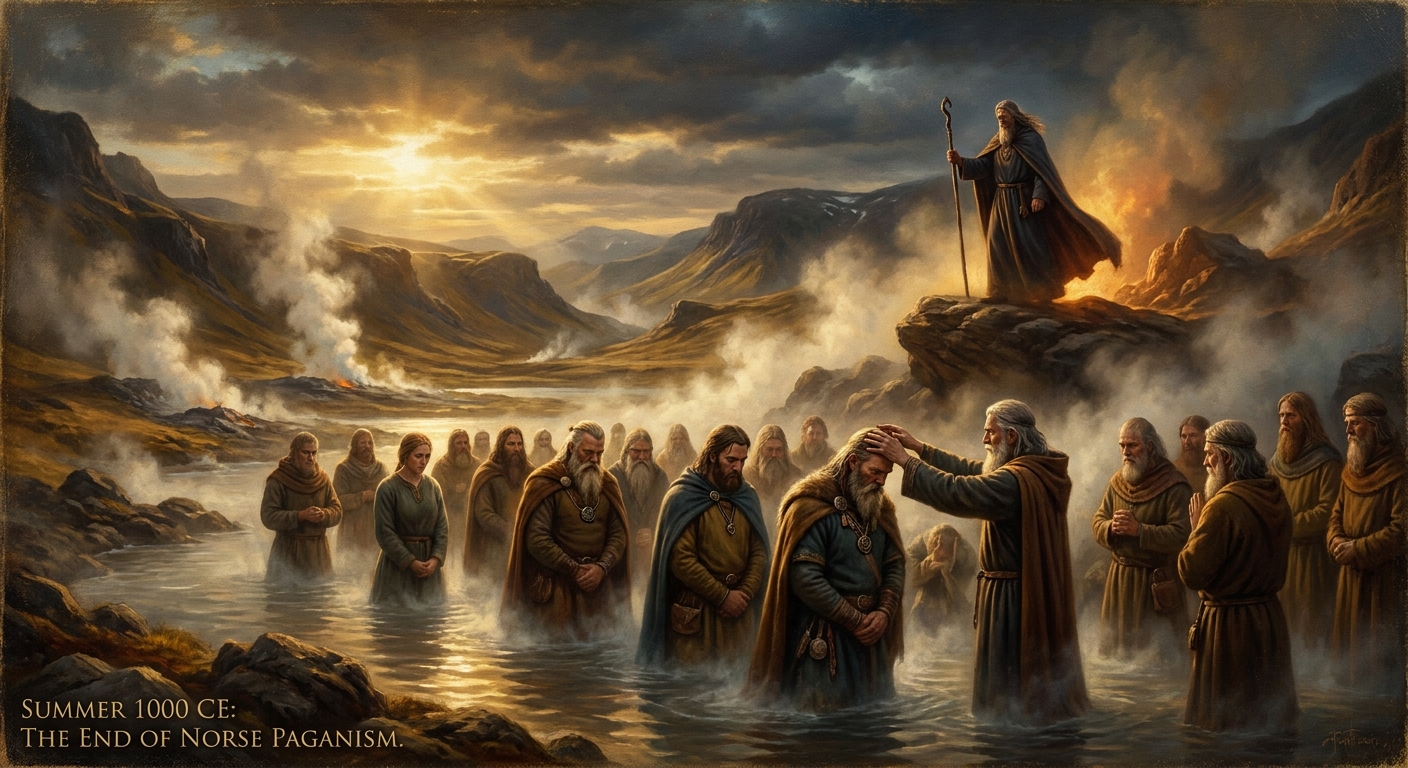
The baptisms happen in the warm springs near the river Öxará, the thermal waters that rise from the volcanic ground. The cold of the highland lake has already been tried and refused — the water is too cold for immersion, and the Icelanders are a practical people. They go into the warm water instead, a pagan nation entering the Christian world through geothermal springs, on geologic terms, in a landscape that belongs to nobody’s god in particular.
Þorgeir himself, it is said, goes home afterward and throws his pagan idols into a waterfall. This is probably legend. Or it is exactly true. Either way, the image holds: the man who made the decision does not exempt himself from it. He has voted, and he lives with the vote.
The compromise lasts. Iceland does not fracture. The Althing survives. The sagas — those extraordinary documents, the first prose fiction of the north — are written down in the Christian centuries by men who are Christian enough to write but pagan enough to remember. Snorri Sturluson, who will eventually compile the Prose Edda and preserve Norse mythology for posterity, is a Christian. He is also the reason we know Odin’s name.
That is Þorgeir’s real legacy. Not that he chose Christianity. That he chose both.
The private paganism that he protected in that cloak-shrouded night survives long enough to be written down. The rites go underground, then onto vellum. The myths become literature. The literature survives the missionaries, the Reformation, the centuries. Odin hangs on his tree in every library on earth because a pagan priest at Þingvellir understood that you do not kill what you drive indoors — you preserve it in the dark until someone needs it again.
No bishop designed this conversion. No army enforced it. A parliament of Norse chieftains voted, and a pagan priest decided, and the decision held — because it was honest enough about what it was: not a victory for either side, but a nation choosing to remain one.
That is the thing about Þorgeir under his cloak. He is not praying. He is not receiving revelation. He is thinking. And what he thinks, in the cold and the dark, with an island’s future balanced on his silence, is that the people who survive are the ones who stay together.
It is the most political act in any mythology. It is also, quietly, one of the wisest.
Scenes
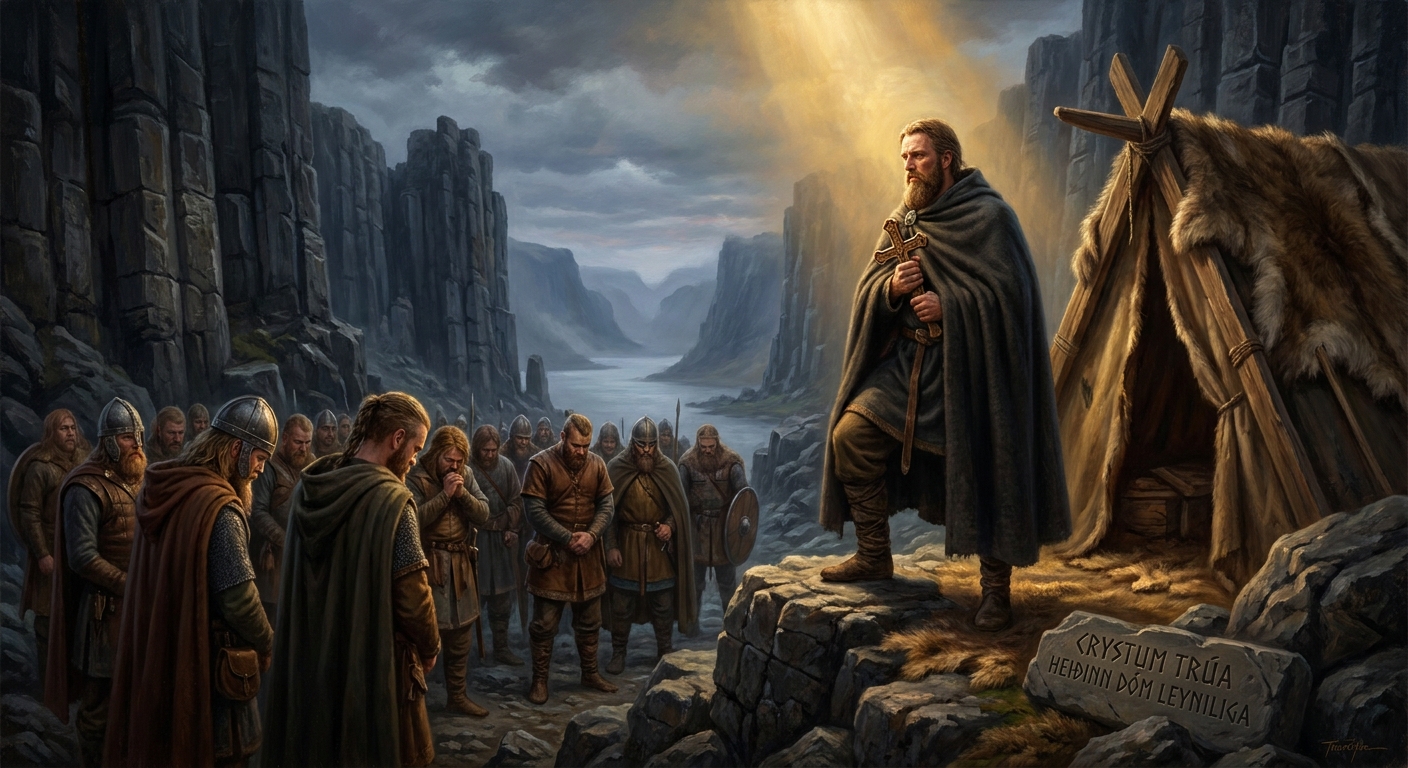
Þorgeir Þorkelsson stands on the Law-rock at Þingvellir, the assembled chieftains of Iceland spread across the rift valley below him, waiting for a word that will outlast every one of them
 Generating art…
 The Lawspeaker lies motionless under his fur cloak for a full day and night
Generating art… The mass baptism in the warm geothermal springs near Þingvellir — the cold of the highland lake refused, the thermal waters accepted, a pagan people entering the Christian world on their own terms
 Generating art…
 Echoes Across Traditions
Entities
- Þorgeir Þorkelsson
- Olaf Tryggvason
- Snorri Sturluson
Sources
- Ari Þorgilsson, *Íslendingabók* (c. 1122–1133)
- Snorri Sturluson, *Heimskringla* (c. 1230)
- Jón Hnefill Aðalsteinsson, *Under the Cloak* (1978)
- Jenny Jochens, *Old Norse Society and Iceland* (1995)