The Ijiraq and the Child Who Walked Too Far
Traditional era, c. 1000 CE (oral tradition; ethnographic documentation ongoing) · Nunavut and Nunavik, Arctic Canada
Contents
The ijiraq is an Inuit spirit that kidnaps children by stealing their sense of direction. When a child in Arctic Canada follows what looks like a caribou into the tundra, she walks into the spirit's territory and loses all knowledge of where she has come from. The community searches. The angakkuq descends. The child returns — but not quite the same child who left.
- When
- Traditional era, c. 1000 CE (oral tradition; ethnographic documentation ongoing)
- Where
- Nunavut and Nunavik, Arctic Canada
She sees a caribou at the edge of the camp’s visible perimeter and decides the camp is close enough.
This is the first error, and it is the kind of error that requires no failure of intelligence to make. She is seven, or perhaps nine — the accounts that preserve this story rarely fix her age exactly, which is itself significant, because the ijiraq’s target is any child who has reached the age of independent movement but has not yet fully internalized the Arctic rule about the horizon. The rule is: if you can no longer see the tents, you have gone too far. The rule sounds simple. It is simple. The difficulty is that the ijiraq does not operate by taking children who ignore the rule. It takes children at the moment before they notice they are ignoring it.
The caribou’s legs are not right. She notices this and does not interpret it correctly. She is seven and the thought she has is: that caribou is moving oddly. The thought she does not have is: that is not a caribou. The thought she absolutely does not have is: I am being led.
She follows it for perhaps forty minutes. Then she looks back and the camp is not there.
The interior of the ijiraq’s territory has been described by those who have returned from it — returned is the word the tradition uses, though in some accounts ‘escaped’ is more accurate — and the descriptions share a quality that is difficult to convey in ordinary language: sameness without repetition.
The tundra continues. The horizon is still there. The sky is still gray in the way that Arctic autumn sky is gray, which is a specific gray, the gray of light that has traveled a very long distance and arrived slightly depleted. But the distances are wrong. A ridge that appears to be twenty minutes away remains twenty minutes away after an hour of walking toward it. The child tries to retrace her path and the path retraces correctly — she can find her own footprints in the snow, she can follow them backward — but they do not lead to where they should lead. They lead to more tundra.
The ijiraq itself is rarely described directly. This is not coyness on the part of the tradition — it is an accurate report of the phenomenology. The spirit cannot be looked at directly. In peripheral vision it appears almost human, wearing a hood, sometimes carrying something. When you turn to look at it, it is a rock or a pressure ridge or nothing. The sense of being followed is reliable. The visual confirmation never comes.
What the child understands, eventually, is that she is somewhere that does not respond to the ordinary logic of place. Direction has lost its reference points. The wind, which in the Arctic is a compass — prevailing from the northwest, reliable enough to navigate by — blows from changing directions, each direction convincing until the next. She does not know where the sun is because the sky is overcast. She sits down.
Back at the camp, the absence is noticed within the hour.
This is one of the adaptive behaviors that Arctic cultures evolved in response to a land where the margin for error is this thin: children are tracked. Not obsessively, not helicopteringly, but with the distributed attention of a community in which everyone is responsible for noticing. The grandmother notices first. She says the name. The name is not answered. The search begins before the blizzard, which is fortunate.
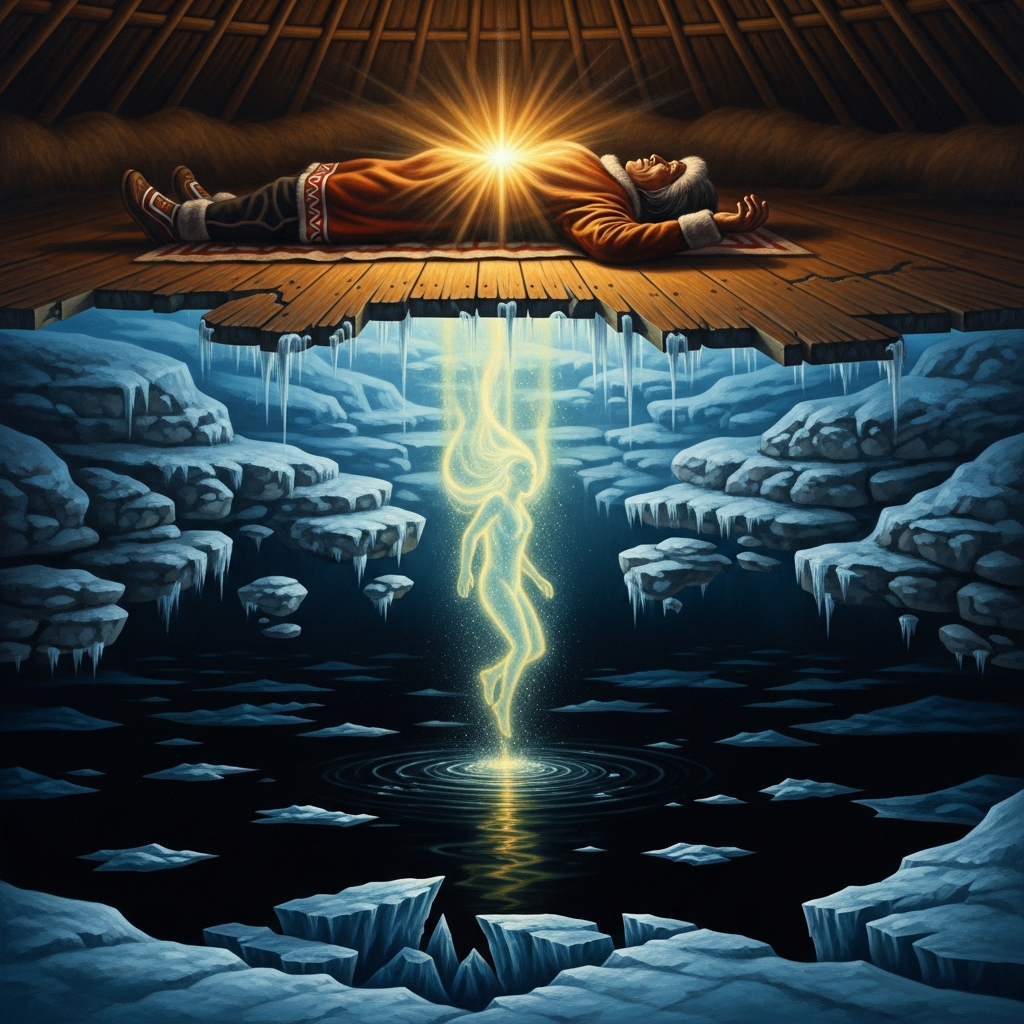
The angakkuq goes into trance while the hunters spread out across the tundra in a line, calling. His trance here is not the theatrical seizure of popular imagination but something quieter: a shift in the quality of his attention, visible to those who know him as a particular stillness in the eyes, a slowing of the breath, a quality of presence-in-absence. His body continues to walk with the search party. Something else goes elsewhere.
In the shamanic cartography of the Iglulik and Caribou Inuit, the ijiraq’s territory overlaps with the human world but does not coincide with it. It is not underground, not overhead, not across a body of water — it is adjacent, which is the most dangerous kind of elsewhere because the boundary is not marked. The angakkuq navigates to it by the quality of wrongness: where the tundra feels slightly off-proportion, where the wind carries a note that has no meteorological source, where the light is coming from a direction that does not correspond to any physical origin.
He finds her by following the trace of her name. Names in the Inuit tradition are not merely labels. They carry the person’s spiritual signature. The child’s name — and here the traditional accounts become careful, because names have power — is a thread in the spirit world, and the angakkuq follows it the way a person follows a rope in a whiteout: hand over hand, without looking up, trusting the connection more than the evidence of the eyes.
The return is negotiated.
This is the detail that ethnographers found most surprising when they began collecting these accounts in the late nineteenth and early twentieth centuries: the angakkuq does not fight the ijiraq. He does not banish it. He does not destroy it. He speaks to it. The conversation, conducted in the language of the spirit world which the angakkuq acquired during his initiation, is an argument about the legitimacy of the taking and the terms of the return.
The ijiraq, in these negotiations, is described as having a position: the child crossed into the territory voluntarily, however unwittingly. The spirit’s claim has some validity. The angakkuq’s counter-position is equally consistent with the tradition’s logic: the crossing was induced, the child was led, the consent was manufactured. The ijiraq led the caribou-form close enough to tempt. The transaction was not clean.
In most versions of the story the child is returned on the condition that she will carry something back with her. Not an object. A capacity: the ability to perceive the boundary between the human world and the spirit’s territory that she could not perceive before the crossing. She will know, for the rest of her life, when she is approaching that edge. She will be able to feel the slight wrongness in the proportions, the wind from the wrong direction, before anyone else does.
She returns with this and with something else that cannot be named: the knowledge of what the tundra looks like from inside the ijiraq’s frame, which is a knowledge the community will find useful for the next seventy years whenever she sits in council and the conversation turns to children who have gone missing, or hunters who have not come back, or the quality of the spring that has not arrived when it should.
She grows up to be the person the community consults when the world stops making ordinary sense.
Not the angakkuq — she does not have his training, did not undergo his initiation, does not possess his helping spirits. She is something different and rarer: a witness. A person who crossed the boundary without seeking to, without preparation, without the scaffolding of shamanic technique, and came back with something that cannot be transmitted except as testimony. The tradition preserves her kind of knowledge separately from the angakkuq’s. Both are necessary. The shaman knows the map. The witness knows what it is like to be lost on it.
The community makes an annual practice of retelling her story to the children, in the autumn before the dark comes, at the time of year when the tundra looks most like the ijiraq’s version of itself.
The spirit is still out there, the stories say, and it is not malicious in the ordinary sense of the word. It takes children because it is lonely, or because it misunderstands the difference between invitation and proximity, or because the boundary between its world and ours is permeable enough that a child in motion can cross it without either party fully intending the crossing. The Inuit do not require their spirits to be evil in order to be dangerous. The ijiraq is dangerous for the same reason the tundra is dangerous: it is indifferent to your survival in a way that has nothing personal about it. The response is not hatred or banishment. The response is attention. Know where you are. Stay where you can be found. If you cannot, know that someone will come looking — and that what you bring back may be worth the cost of the crossing.
Scenes
A child of perhaps seven years walks across the tundra toward what appears to be a caribou, except the caribou's legs are slightly wrong — too long at the wrong joints
 Generating art…
 The spirit's world as the child experiences it: the tundra continues but the proportions have shifted
 Generating art…
 Hunters in a line across the tundra, calling a child's name into the wind
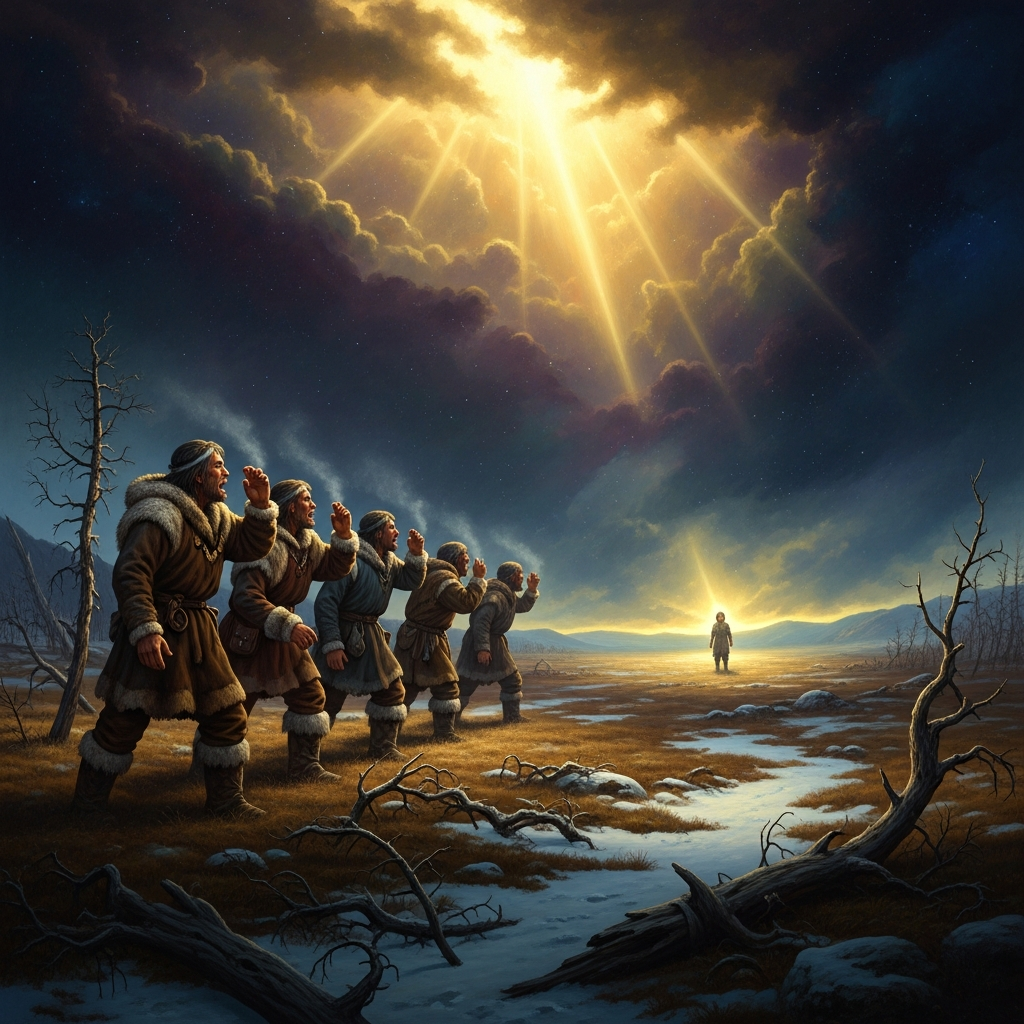 Generating art…
 Echoes Across Traditions
Entities


Sources
- Laugrand, Frederic and Jarich Oosteran, *Hunters, Predators and Prey: Inuit Perceptions of Animals* (Berghahn Books, 2015)
- Bennett, John and Susan Rowley (eds.), *Uqalurait: An Oral History of Nunavut* (McGill-Queen's University Press, 2004)
- Boas, Franz, *The Central Eskimo* (Bureau of American Ethnology, Smithsonian Institution, 1888)
- Merkur, Daniel, *Powers Which We Do Not Know: The Gods and Spirits of the Inuit* (University of Idaho Press, 1991)
- Rasmussen, Knud, *Observations on the Intellectual Culture of the Caribou Eskimos* (Gyldendalske Boghandel, 1930)