Raven Steals the Light from the Box
Traditional era, c. 1000 CE (oral tradition; multiple circumpolar versions) · Haida Gwaii; Tlingit territory, Southeast Alaska; and Inuit Arctic Canada and Alaska
Contents
Before there is light, there is a box. The box belongs to a powerful man who keeps it sealed. Raven — transformer, trickster, necessity — shapeshifts into a human child, is born to the box-keeper's daughter, and cries without stopping until the man opens the box and light floods the world. The Haida, Tlingit, and Inuit versions of this circumpolar myth are compared: same logic, different cosmological stakes, different moral.
- When
- Traditional era, c. 1000 CE (oral tradition; multiple circumpolar versions)
- Where
- Haida Gwaii; Tlingit territory, Southeast Alaska; and Inuit Arctic Canada and Alaska
In the beginning there is no light, and Raven finds this situation unacceptable.
This is the essential fact about Raven across all the versions: he is not a deity in the sense of possessing supernatural moral authority, and he is not a hero in the sense of acting from altruism. He is hungry, he is restless, he is bored by darkness in a way that resembles a physical appetite, and he possesses a quality that no other being in the circumpolar world has in quite the same measure — the ability to become something else when becoming something else is the only way forward.
In the Haida telling, which the mythteller Ghandl rendered in such precise narrative verse that Robert Bringhurst called it ‘one of the great poems of the world,’ Raven is already a being of considerable power when the story begins. The world exists. The sea exists. The darkness exists absolutely. Raven, moving through the dark by echolocation and memory, hears rumors of a man — Nang Kilstlaas in Haida, ‘the one in the house in the sea’s center’ — who keeps something in a box.
The box is actually three boxes, nested. The innermost box contains the light.
The shapeshifting is practical rather than magical.
Raven cannot simply take the box. The man is powerful enough to keep it sealed against every force that has tried to open it. So Raven considers the problem from a different angle, which is his specialty: what is the one thing this man cannot resist? The answer, in all three major versions of the myth, is the same: his daughter. More precisely — his daughter’s children, or his desire for a grandchild.
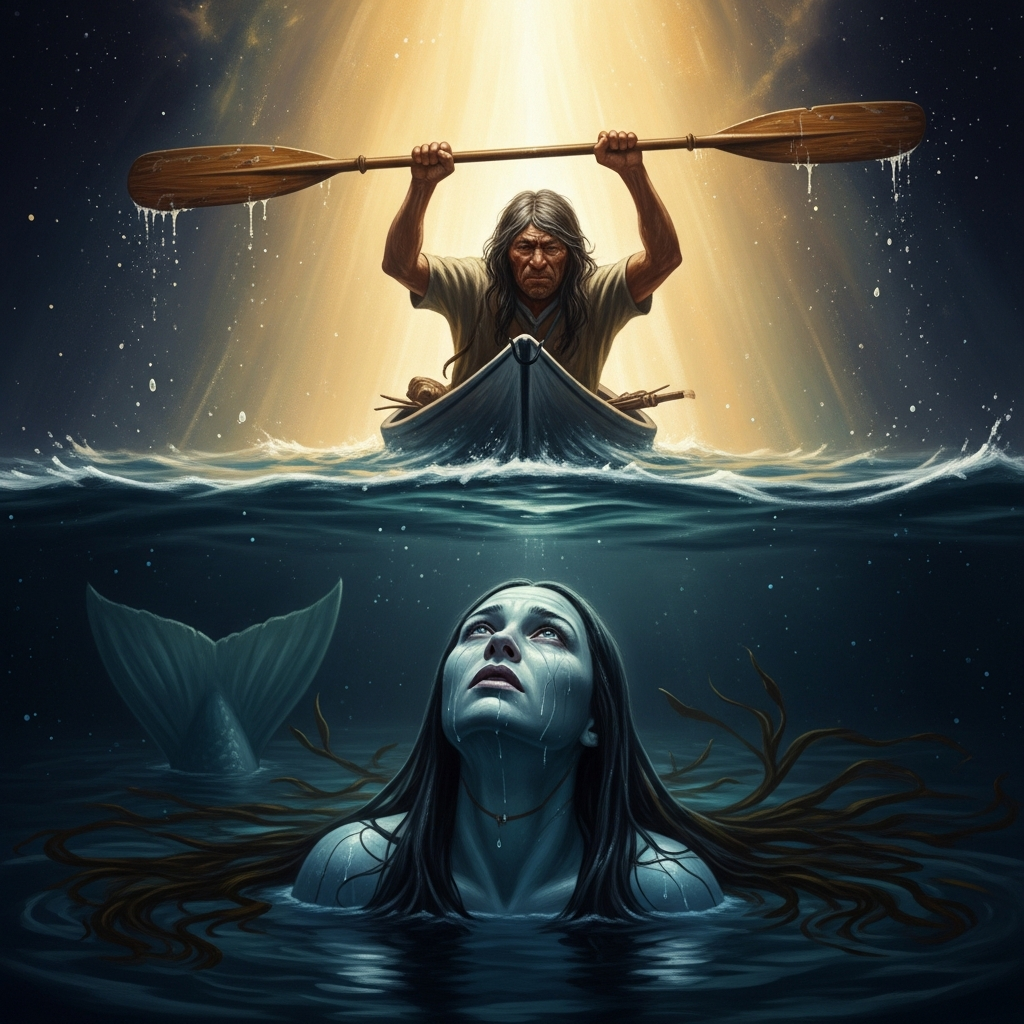
In the Haida version Raven transforms himself into a spruce needle and floats down into the water that the daughter is drinking. She swallows him without knowing it. He grows inside her. He is born in the ordinary way, except that he arrives with his eyes open and with an appetite that is not quite the appetite of a human infant.
He is beautiful. This is important. The grandfather is enchanted. The child has eyes that are darker than they should be, a curiosity about the nested boxes in the corner that is more focused than any infant’s curiosity has a right to be — but he is beautiful, and the grandfather, who has kept the light in the box alone in the dark for a very long time, is not immune to the company.
The crying is the mechanism.
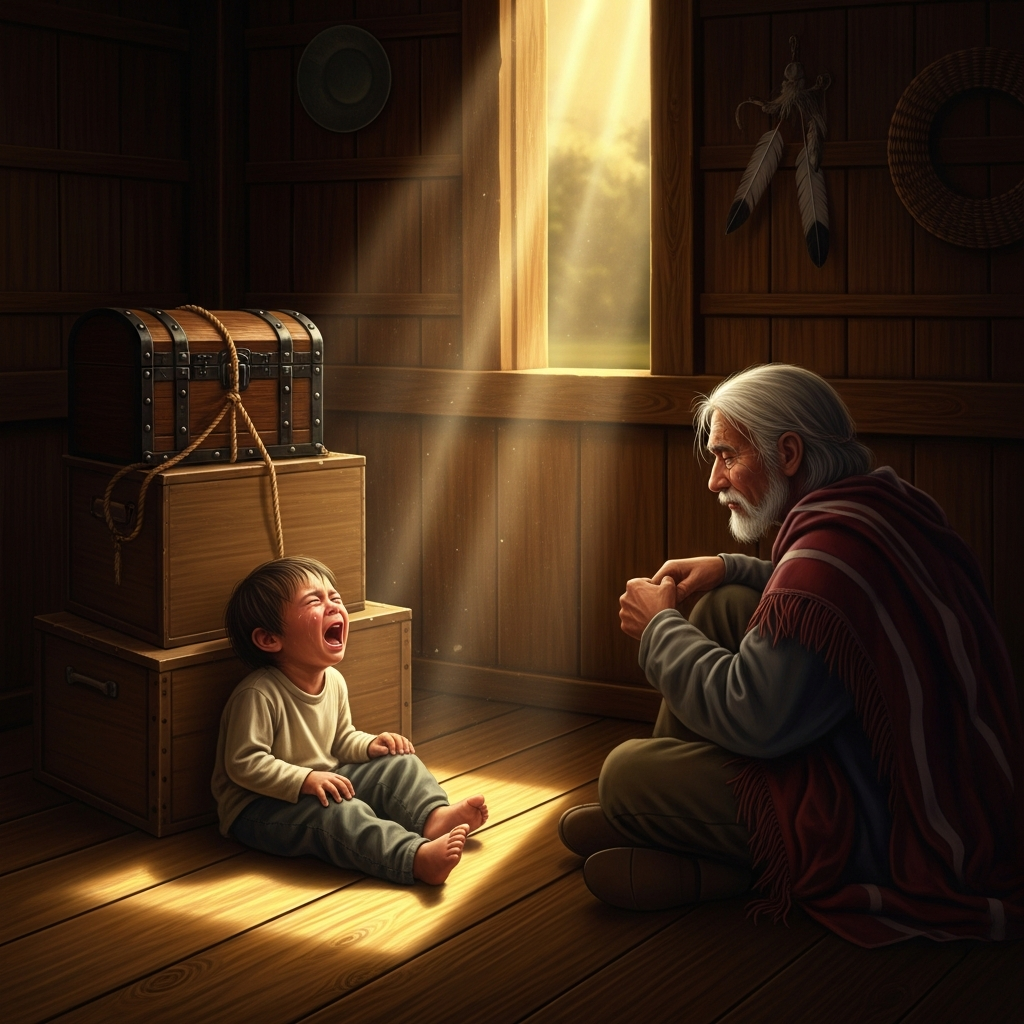
It starts on the second day and it does not stop. In the Tlingit versions — where Raven is Yeil, already a being of extraordinary capability — the crying is described in terms that convey its inhuman duration. Days. A week. The grandfather has not slept. The mother has not slept. The other people in the house have rotated shifts of desperate comfort, offering food, water, warmth, story, song. Nothing stops it. The child wants the box.
The grandfather tries the first box. The child stops screaming — briefly, long enough for the grandfather to hope — and then, clutching the outer box, begins again. He wants what is inside the outer box. He wants what is inside the box inside the outer box. He wants the innermost box. He wants it with an intensity that is not childlike, that is not human, that is the intensity of a being who has organized an entire incarnation around a single act of acquisition.
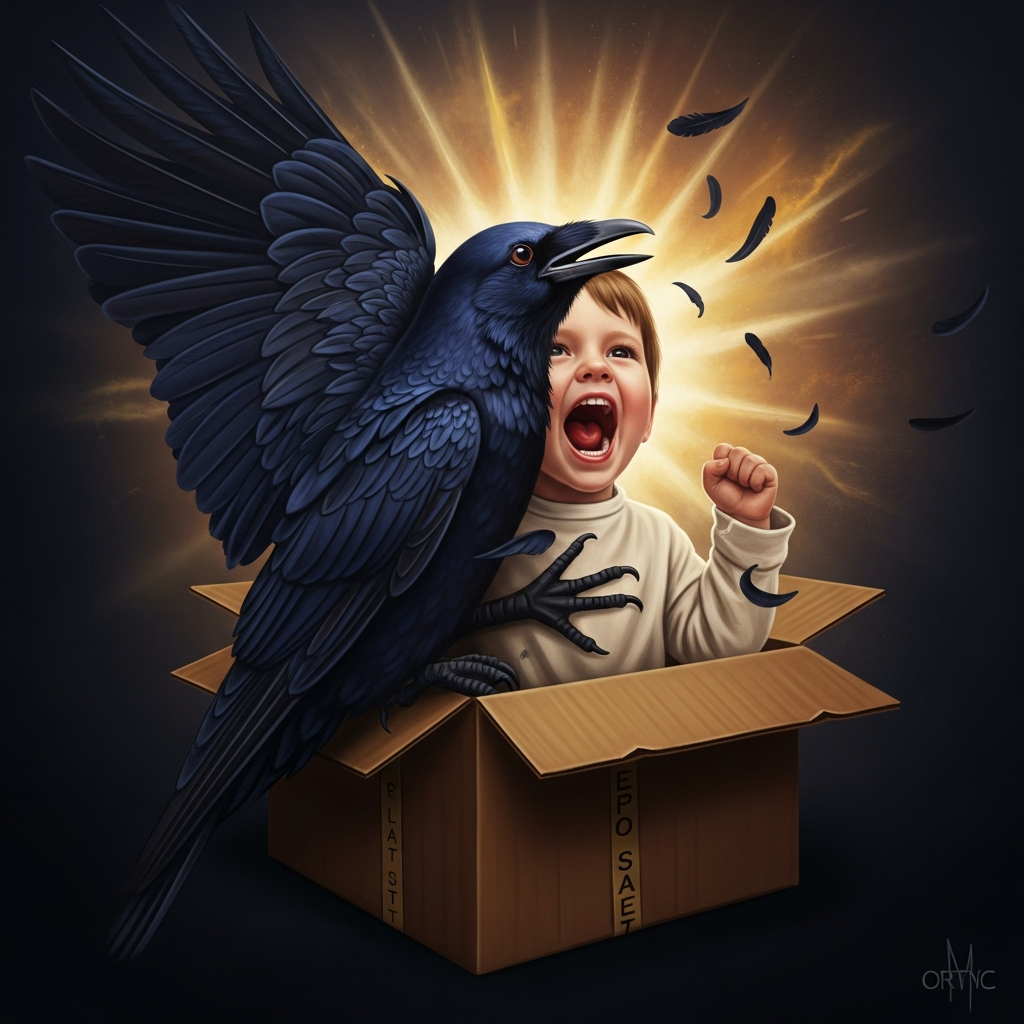
When the grandfather finally opens the innermost box — exhausted, defeated by love, or possibly by something darker, some ancient recognition that this was always coming — the light does not gradually appear. It explodes.
The Inuit versions differ from the Haida and Tlingit in one significant respect: Raven is less of a character and more of a force.
Where the Northwest Coast traditions preserve Raven as a named entity with consistent personality across hundreds of stories, the central Inuit raven myths tend to blur the boundary between the bird and the function. The raven in Inuit cosmology is one of the animals with an inua — an inner person, a spirit — of exceptional intelligence, but the specific narrative of the light-theft is less elaborate, the shapeshifting less theatrically described. In some Inuit versions it is simply said that before there was light, Raven was responsible; the mechanism is mentioned rather than dramatized.
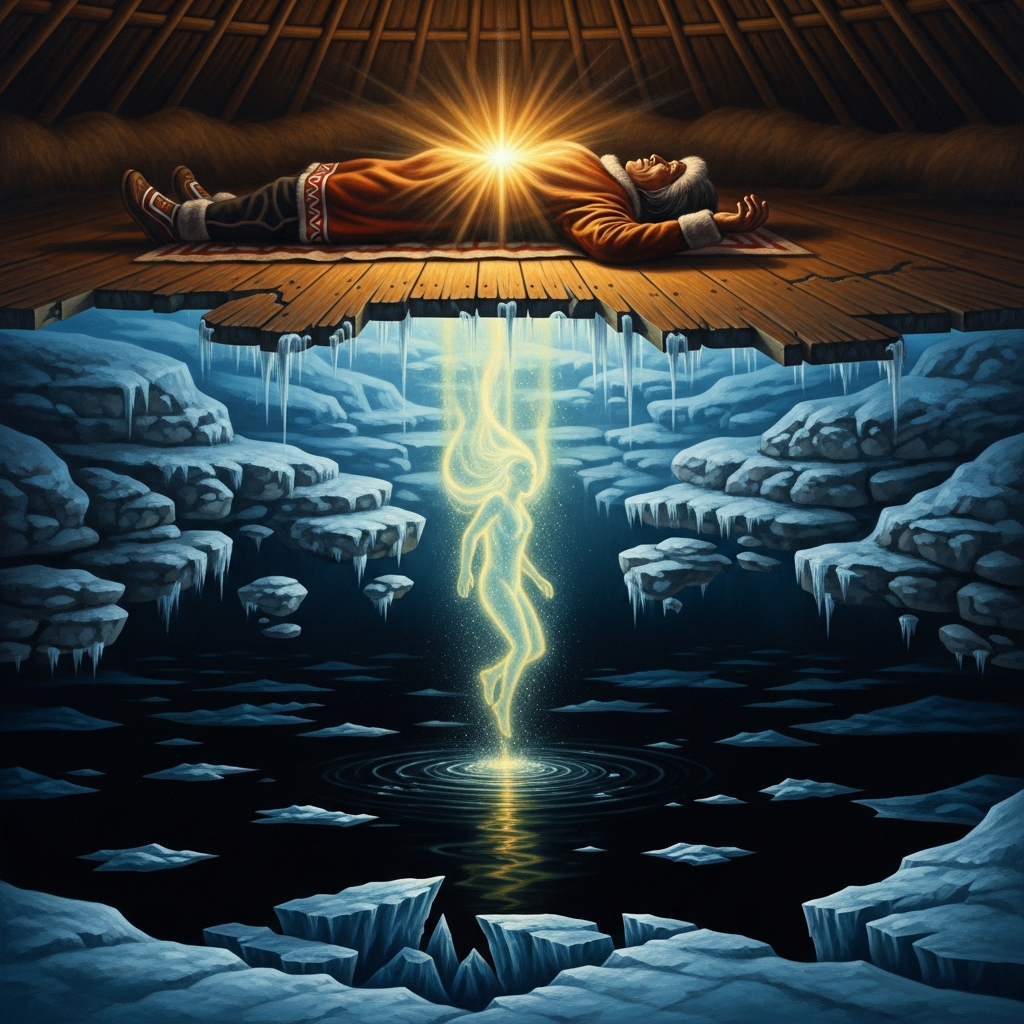
This difference is illuminating. The Haida and Tlingit are cultures of abundance relative to the Arctic interior, cultures where the box-keeper’s wealth and the trickster’s cunning are legible social categories that the audience understands from daily life. The Inuit of the central Arctic live in a world where the scarcity is so absolute that elaborate trickster theater is a luxury the narrative cannot afford. The light arrived. Raven brought it. The important thing now is the seal at the breathing hole.
What the Inuit version preserves, and the Northwest Coast versions sometimes obscure, is the terror of the original darkness. The Inuit understand darkness in their bodies in a way that coastal peoples do not. Polar night is not simply nighttime extended. It is the actual absence of solar light for months, and the human animal responds to it in ways that go beneath culture. When the Inuit version of the Raven myth says darkness and means darkness, it means something specific that has to be lived to be fully understood.
After the light escapes, Raven cannot put it back.
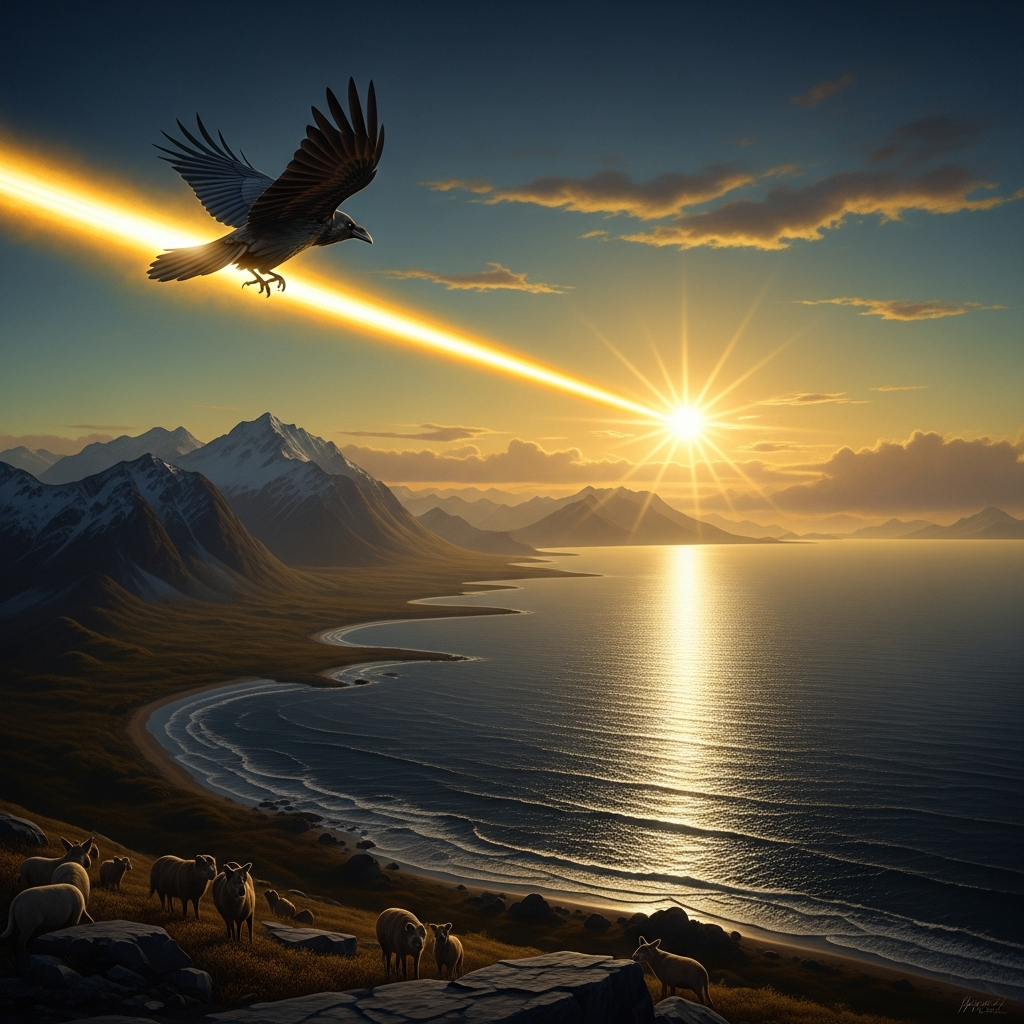
In the Haida version the grandfather is furious. In some Tlingit tellings the theft is followed immediately by Raven releasing the light into the sky — throwing it upward and running before the keeper can catch him. In either case, once the light is in the sky it cannot be retrieved. It spreads. The world that was invisible becomes visible. The mountains, the coastline, the ocean with its particular color — all of it appears, being seen for the first time, simultaneously astonished and indifferent to its own visibility.
The light also reveals Raven. The grandfather sees the dark feathers, the beak pushing back through the human face, the thing he was raising revealed as what it always was. In some versions this is the moment that fixes Raven’s color — he was white, or many-colored, before the theft, and the grandfather’s fire or his curse turns Raven permanently black. In others Raven was always black and the darkness was simply his natural medium, and light is what makes him visible in his own true form.
Either way, he flies. He carries something with him that he did not have before the theft — not the light itself, which is already everywhere, but the knowledge that the necessary and the transgressive are sometimes the same act, and that a world organized around keeping things locked in boxes is a world that deserves to have them stolen.
Levi-Strauss argued that the Raven myth is fundamentally about the problem of the middle term — Raven as the bird who eats carrion, who occupies the boundary between the living and the dead, the sky and the earth, the wild and the domestic, and who therefore can move between categories that other beings are fixed within. This is structurally correct but phenomenologically incomplete. The people who kept this story across the Arctic and the Northwest Coast were not primarily doing structural analysis. They were living in a world where the light left every autumn and there was no guarantee it would return, and where the story of Raven stealing it from a box — cunning, hunger, necessity, and love all tangled together — was the story that made the return of light feel like something that had been earned rather than merely received.
Scenes
A small child sits on the floor of a cedar-post house, screaming
 Generating art…
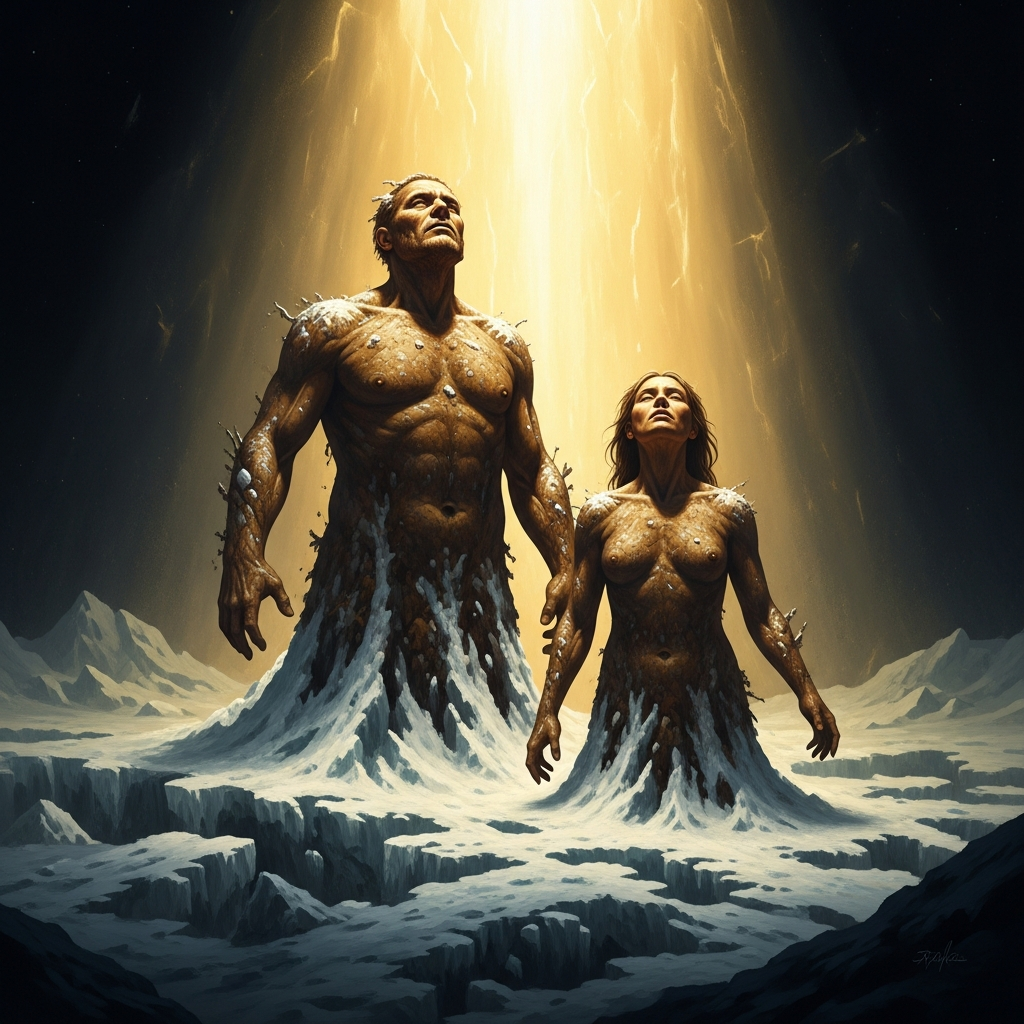
 The moment the innermost box opens: light explodes outward into a world that has never seen it
 Generating art…
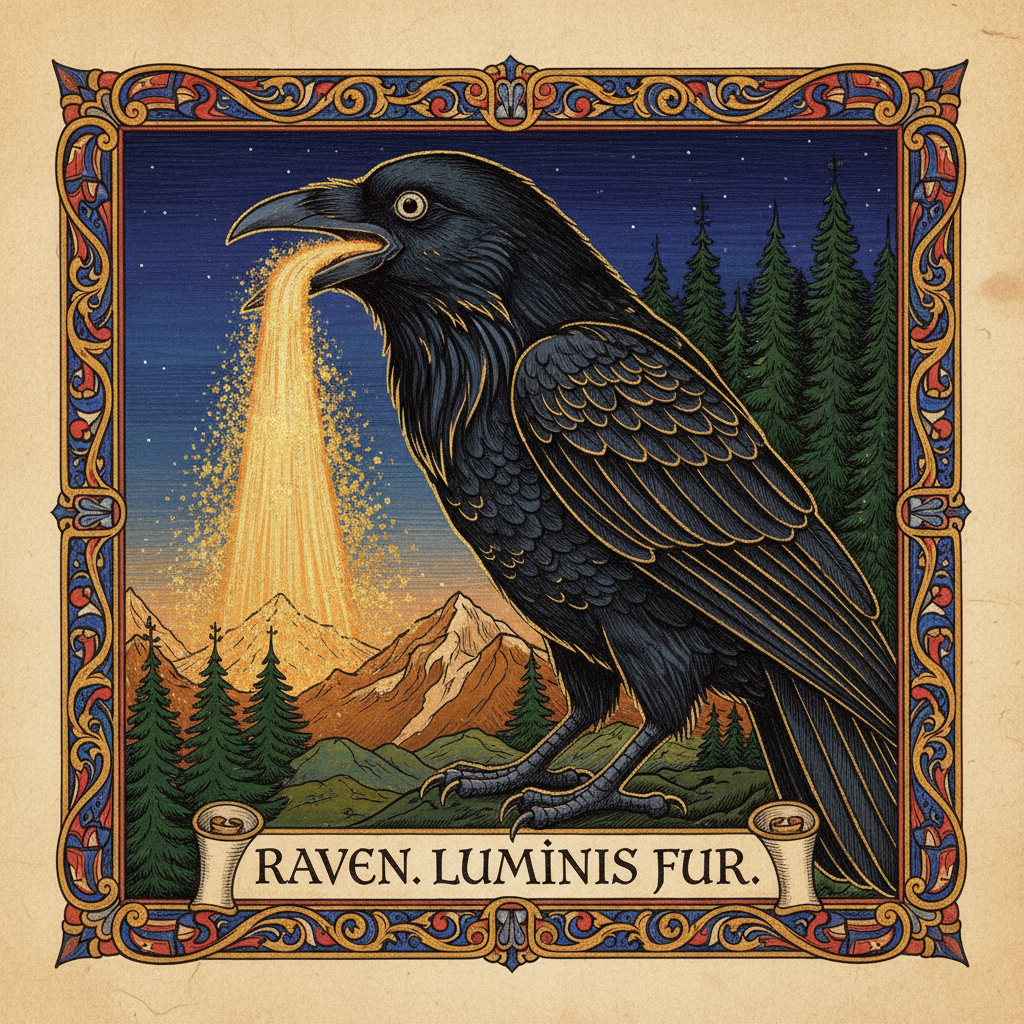
 Raven in flight over the Arctic, the sun trailing behind him in a stream of light
 Generating art…
 Echoes Across Traditions
Entities


Sources
- Swanton, John R., *Haida Texts and Myths: Skidegate Dialect* (Bureau of American Ethnology, Smithsonian Institution, 1905)
- Bringhurst, Robert, *A Story as Sharp as a Knife: The Classical Haida Mythtellers and Their World* (Douglas and McIntyre, 1999)
- de Laguna, Frederica, *Under Mount Saint Elias: The History and Culture of the Yakutat Tlingit* (Smithsonian Contributions to Anthropology, 1972)
- Levi-Strauss, Claude, *The Raw and the Cooked: Introduction to a Science of Mythology*, vol. 1 (University of Chicago Press, 1969)
- Erdoes, Richard and Alfonso Ortiz (eds.), *American Indian Myths and Legends* (Pantheon Books, 1984)