Sedna Falls Into the Sea
In the time before animals existed · oral tradition preserved across Inuit peoples from Alaska to Greenland · The open Arctic sea — above the treeline, in the cold that has no name for its own end
Contents
A girl is thrown from a kayak by her father. She clings to the side. He cuts off her fingers joint by joint — and every severed piece becomes a creature of the sea.
- When
- In the time before animals existed · oral tradition preserved across Inuit peoples from Alaska to Greenland
- Where
- The open Arctic sea — above the treeline, in the cold that has no name for its own end
The girl’s name is Sedna.
In some tellings she is proud; she refuses every suitor her father brings. In others she is deceived — a spirit in bird-form takes her across the water and reveals itself too late. In others still her name is Arnakuagsak, or Nunavgak, or Nerrivik — for the sea remembers many versions of what it cost to make the world beneath it. The details shift from shore to shore, from Greenland to Alaska to Baffin Island, but the central moment does not shift: the girl is in the kayak with her father, and the sea is cold, and then the father’s hands close on the paddle.
He throws her in.
She does not let go. Her fingers grip the gunwale and her knuckles whiten and she looks up at her father across the black rail of the boat. The kayak rocks. The sea is very cold. Her father looks at her face and looks away.
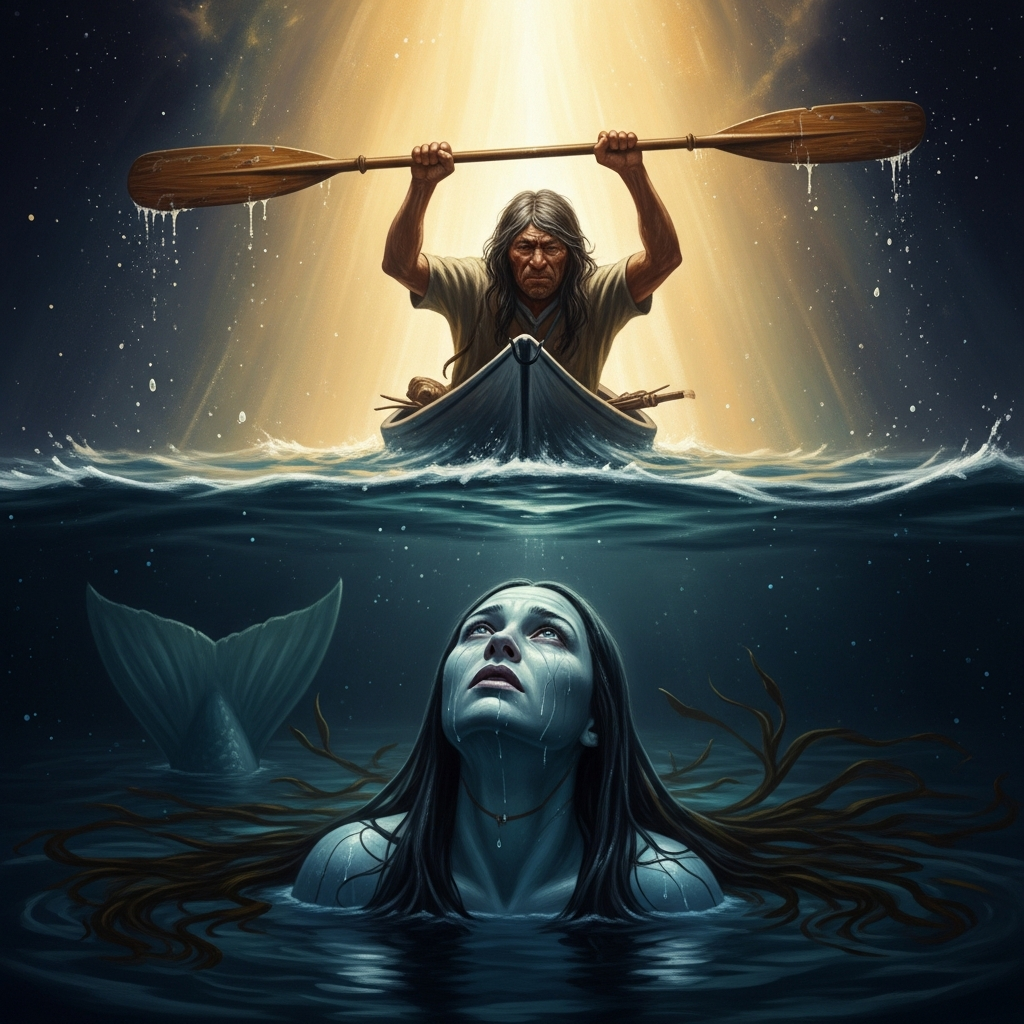
He brings the paddle down on her fingers.
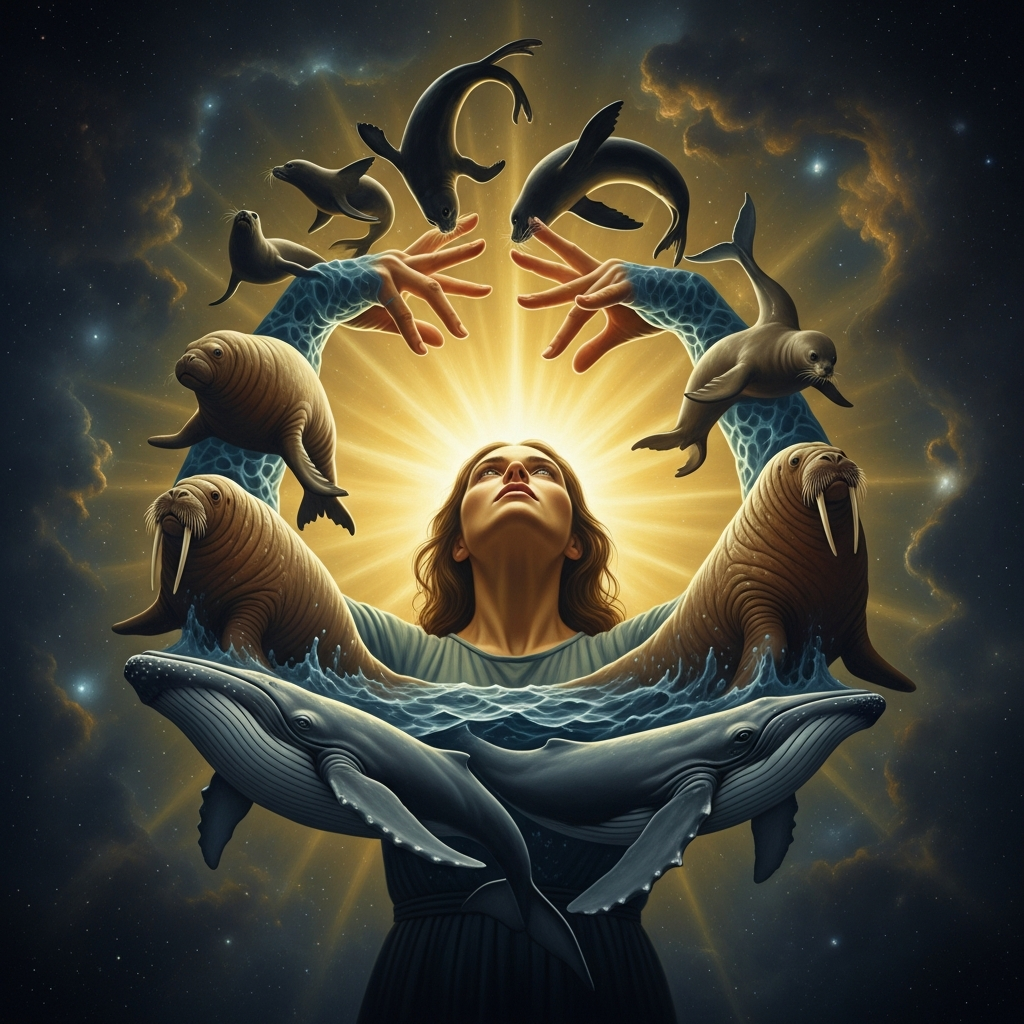
The first joints separate cleanly — the outermost knuckles, the tips of her ten fingers, severed all at once — and they fall into the water, and they do not sink. They round and darken and fill from the inside. Fur appears. Eyes blink open. The first seals look up from the water with expressions no one has ever seen before, because no one has ever seen a seal before. They turn and are gone under the surface, and the sea closes over them.
Sedna still holds on. Blood runs over the gunwale. She looks at her father. He raises the paddle again.
The second joints fall. These are larger, denser, heavier. They hit the water with a sound like a fist on ice and they bulk outward — tusks push from the sides, skins thicken to leather, chests barrel out in a sound like a bellows. The first walruses rise for one breath and then go deep, and their weight displaces enough water that the kayak rocks and her father grabs the rail to steady himself.
She is still holding on. She has no fingers anymore. She holds on with what is left.
He raises the paddle a third time.
These are the base joints, the heaviest bones, the places where her hands attached to her wrists. The paddle falls. The pieces enter the water slowly, turning as they sink. They do not round or bulk outward. They elongate. The transformation takes longer — more mass, more darkness, more depth required. Far below the surface something immense begins to move.
The first whale surfaces a hundred yards from the kayak.
It breathes once, a column of vapor that catches the low arctic light and holds it for a moment — an impossible brightness in all that grey — and then it sounds, and the sea closes over it without a ripple, and it is gone into the deep, and the deep is now its home forever.
Sedna has nothing left to hold on with. She goes under.
She does not drown.
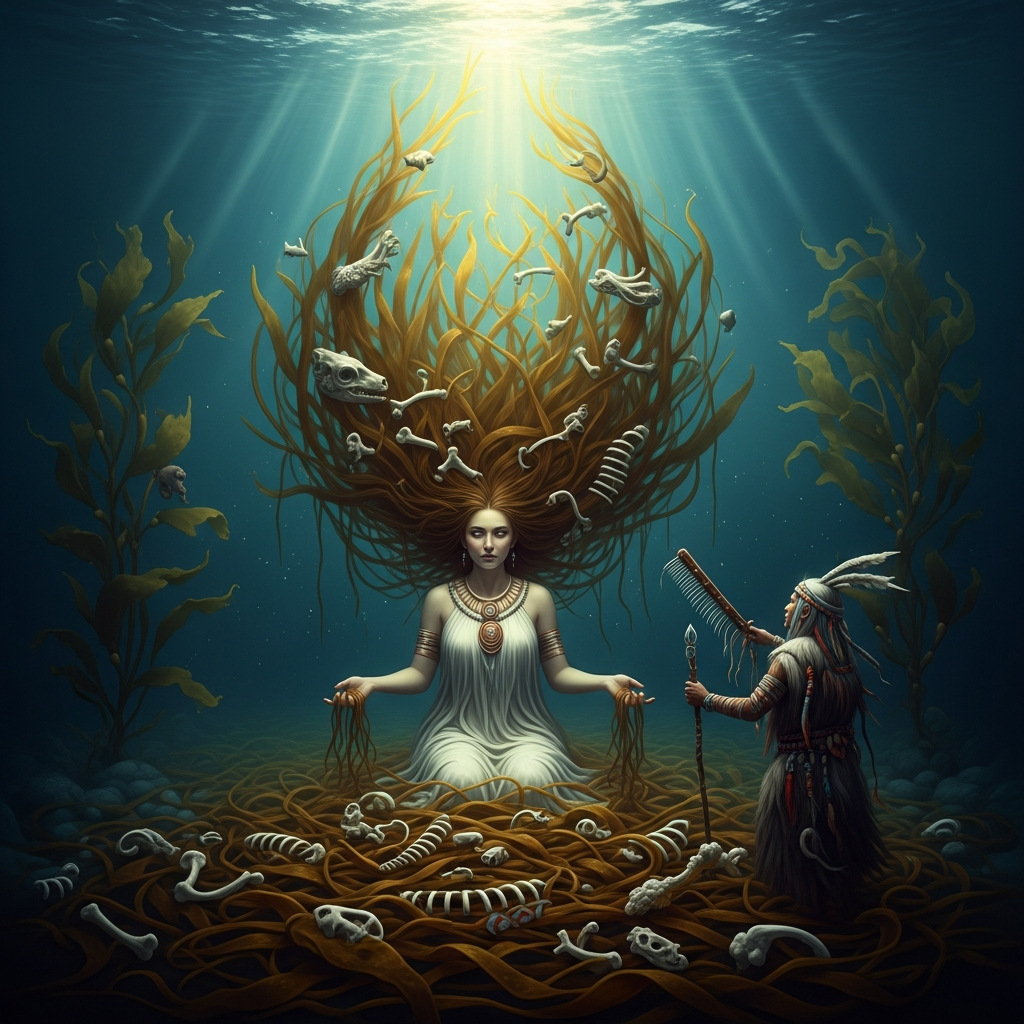
The sea does not work on her the way it works on the living. She sinks past the light, past the cold layers, past the place where even the whales do not go, and she comes to rest at the bottom. The world above her goes silent. The ice forms across the surface far overhead. She sits in the dark with her ruined hands in her lap and her hair floating out around her in the still deep water.
The hair begins to tangle.
This is what the Inuit hunters know, and what the Inuit hunters fear: Sedna’s hair is the record of every violation committed against the animals that came from her body. A seal killed without gratitude. A walrus mocked. Bones thrown away carelessly, without ceremony, without acknowledgment of what they cost. Every transgression works its way down through the water and catches in her hair, and as the tangles grow, the animals will not come. They are part of her; they feel her suffering. They stay deep. The hunters return empty. Children go hungry. The winter gets longer.
She sits at the bottom of the sea with her hair spreading around her like a net, like a grief, like an accusation, and she waits.
The angakkuq knows what the silence means.
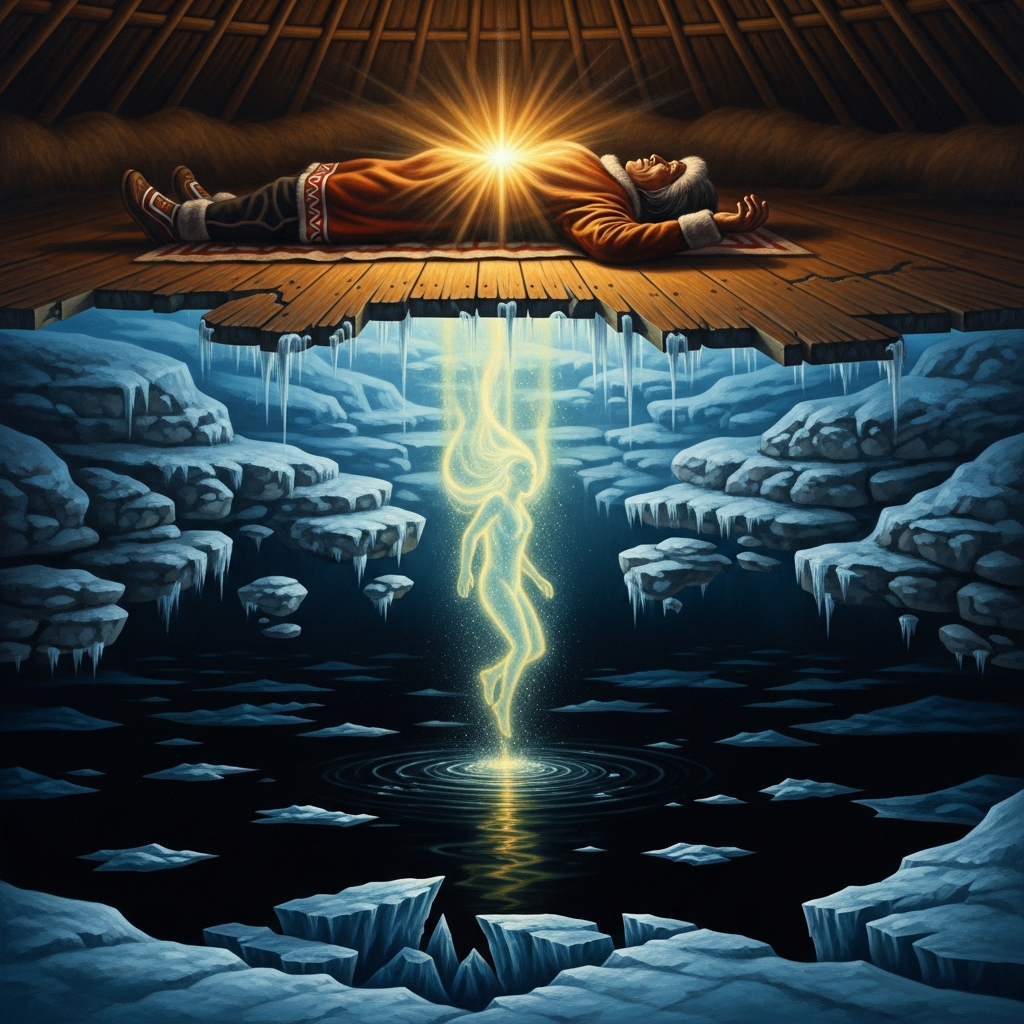
When the hunt fails — not once, not a week, but a failure that spreads over weeks and becomes a fear that spreads over the village — the shaman enters trance and descends. The drum beats in the sod house. The body stays behind. The soul goes down through the floor, through the permafrost, through the stone, through the darkness under the stone, into the water and down and down into the no-light where Sedna waits.
She does not always welcome the visitor. Why would she? The visitor comes because the people need something. She did not need anything when they threw her into the sea.
But the angakkuq who comes to Sedna comes prepared. The shaman comes with a comb, and with a list of every violation — every name of every animal that went unacknowledged, every bone discarded in disrespect, every hunter who took without thanks. The shaman kneels at the bottom of the sea and begins to work the tangles free. Knot by knot, name by name. The violations are spoken aloud in the dark. The comb moves through her hair.
This is the price of the sea’s abundance: someone must come down and tell the truth.
When the last tangle is free, Sedna’s hair floats out around her in the black water — clean, spread, weightless.
She does not speak. She does not nod. She does not forgive, because the debt is not a transaction that ends. She simply lets the hair settle, and the animals that are part of her feel the relief pass through them, and they rise. The seals find the leads in the ice. The walruses haul out on their familiar rocks. Far out at sea, a whale surfaces and breathes.
The shaman returns to the body in the sod house. The drum slows. The hunter who will go out tomorrow feels something change in the village — a loosening, a readiness, the particular quality of cold air that means animals are near. He checks his harpoon lines in the dark.
In the morning he will go out on the ice and take what is offered, and he will do it carefully, and he will return every bone to the sea, and he will say the words that need to be said.
And for a season, the sea will be generous.
The tangle grows back. It always grows back. This is not a story about a problem that gets solved — it is a story about a relationship that must be maintained, endlessly, because the cost of the world’s abundance is built into the world’s origin, and the woman at the bottom of the sea has not forgotten what her father’s paddle felt like, and never will.
Scenes
The father raises the paddle
Generating art… Each severed joint transforms as it sinks — first the seals, sleek and dark, spiraling up from her fingertips; then the broad-shouldered walruses; then, from the deepest joints, the slow enormous shapes of whales
 Generating art…
 At the bottom of the sea, Sedna sits with her hair spreading around her like kelp
 Generating art…
 Echoes Across Traditions
Entities
- Sedna
- Arnakuagsak
- the seals
- the walruses
- the whales

Sources
- Franz Boas, *The Central Eskimo* (Bureau of American Ethnology, 1888) — earliest systematic recording of the Sedna cycle
- Knut Rasmussen, *Intellectual Culture of the Iglulik Eskimos* (1929) — from the Fifth Thule Expedition
- Merkur, Daniel, *Powers Which We Do Not Know: The Gods and Spirits of the Inuit* (University of Idaho Press, 1991)
- Ann Fienup-Riordan, *Boundaries and Passages: Rule and Ritual in Yup'ik Eskimo Oral Tradition* (1994)