The Eland Dance and the Trance
Continuous practice — archaeological record extends 27,000 years · Kalahari Desert (Botswana, Namibia) and Drakensberg Mountains (South Africa, Lesotho)
Contents
The San people of southern Africa perform the eland bull dance — the most sacred ritual in San religion — in which communal singing and clapping drive the shamans into trance, across the boundary of death and back, and the healed carry the potency of the eland in their bodies. The rock paintings of the Drakensberg are a record of what they saw on the other side.
- When
- Continuous practice — archaeological record extends 27,000 years
- Where
- Kalahari Desert (Botswana, Namibia) and Drakensberg Mountains (South Africa, Lesotho)
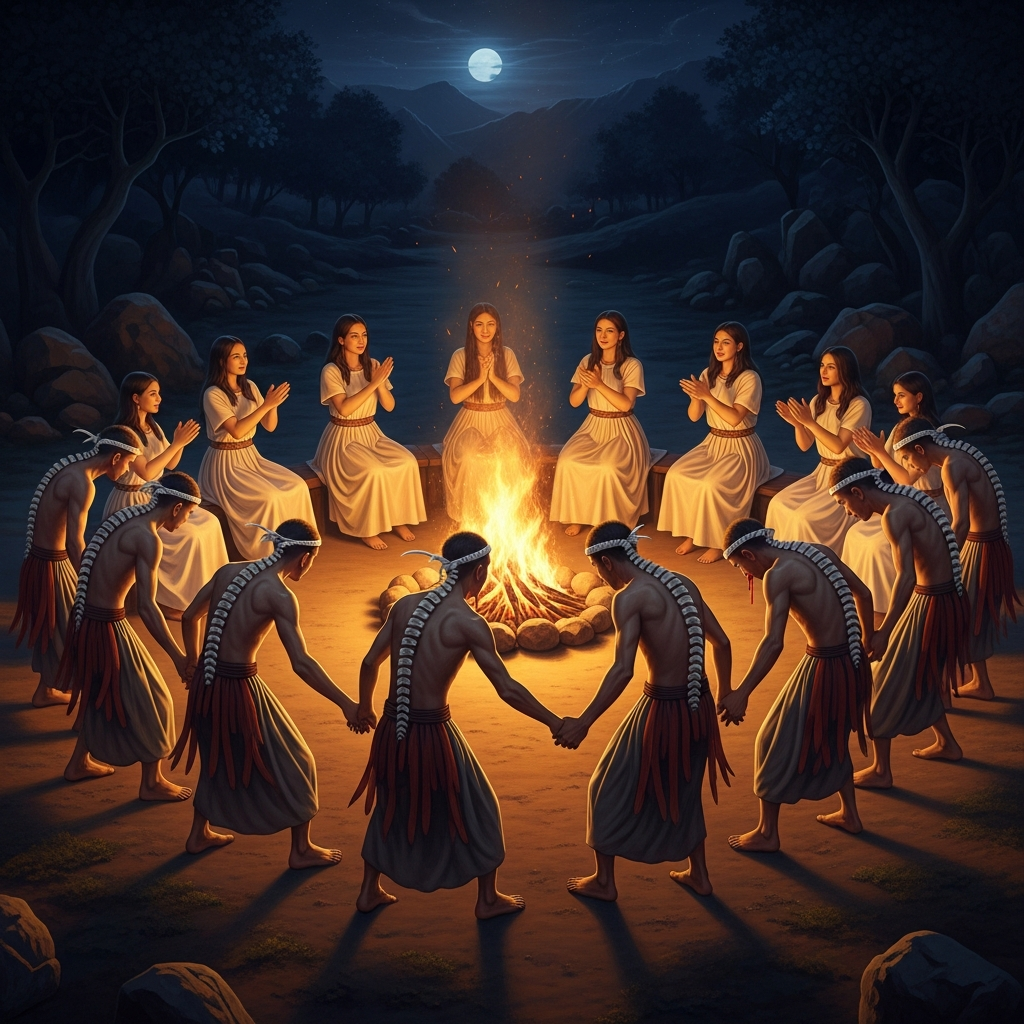
The dance begins with the women.
This is always where it begins — not with the shamans who will cross the boundary, not with the healing that may or may not happen, but with the women seated around the fire, their hands beginning to clap the rhythm that the San call the medicine songs. The songs are old. Nobody alive knows how old. The oldest of the living women learned them from women who are dead, and those women learned them from women deeper in the past, and the chain goes back through generations of Kalahari camps until it runs out of people and continues through the record of ochre on stone. The medicine songs are at least as old as the Drakensberg paintings. Some of the paintings are 27,000 years old.
The women clap. They begin to sing. The sound builds slowly, the way heat builds in a fire that has been lit with care.
The shamans — the !gi:xa, the owners of n/um — begin to move around the outside of the circle.
N/um is the potency. This is the word the !Kung San use for the substance that makes healing possible, that makes trance possible, that makes the passage across the boundary of death possible. It is not a metaphor for something else. The San describe it physically: it lives in the lower belly and in the base of the spine. When the medicine songs begin and the shaman’s body heats with the dance, the n/um also heats. It becomes liquid. It rises. It moves up the spine slowly, the way fluid rises through a heated tube, and when it reaches the base of the skull it causes the sensation the !Kung describe as n/um boiling — a heat in the neck and head so intense that it is nearly unbearable, that causes trembling, nausea, and temporary loss of control of the body.
Then it moves through the skull and into the space the San call the spirit world.
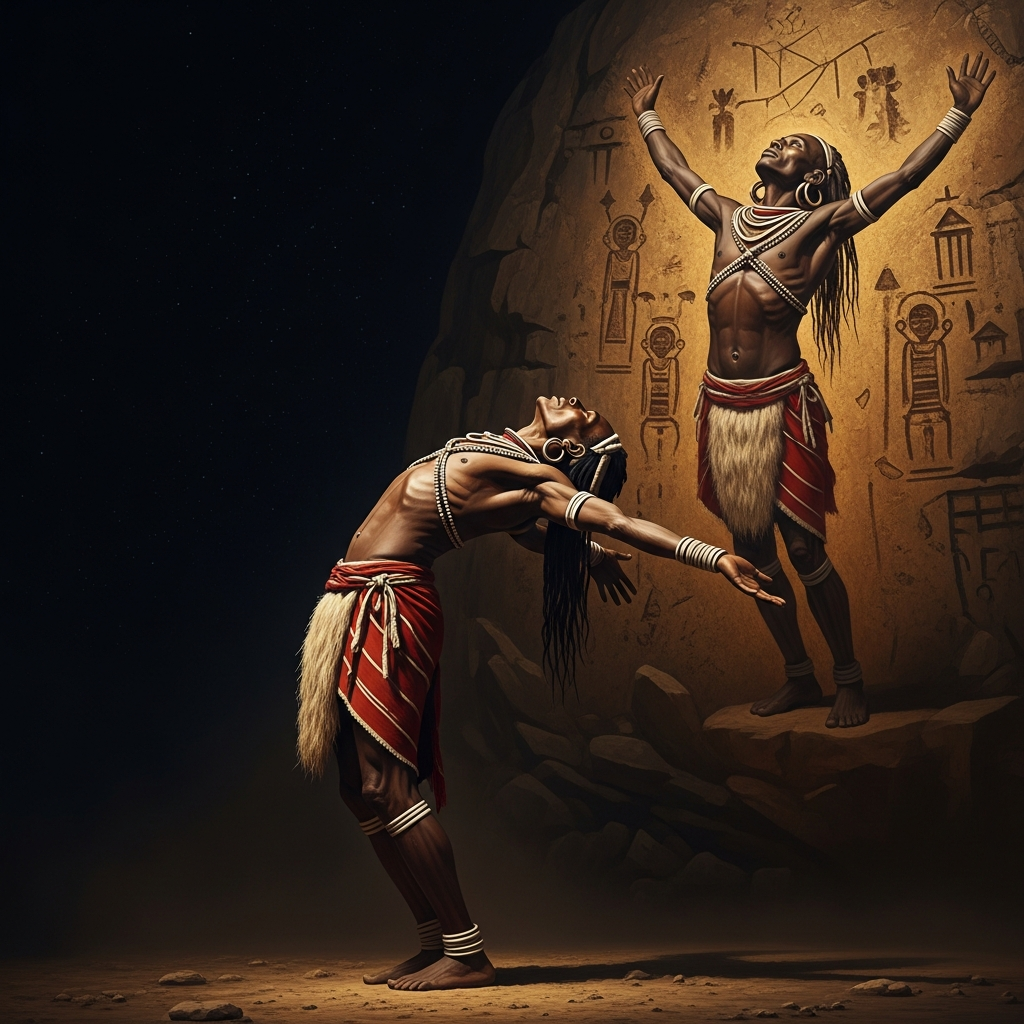
This is kia. This is the trance state, the death-crossing, the thing the dance exists to produce. The shaman in kia is not in ordinary consciousness. The San are precise about this: kia is not sleep, not dream, not the normal altered states that everyone experiences. It is the full crossing of the boundary between the living world and the dead world, accomplished while the body stays alive by the force of the n/um the women have been singing up through the circle for hours.
In kia the shaman can see what is making the sick person sick. This is the primary practical purpose of the dance, and it is not supernatural to the San in the way that Western observers have sometimes found it difficult not to call supernatural. The spirit world is real. The forces that cause illness — invisible arrows shot by the spirits of the dead, the presence of the Rain Animal in the wrong place, the disruption of the invisible threads that connect the living to one another and to the land — are real in the same way that the eland is real, in the same way that the fire at the center of the dance circle is real. The shaman in kia can see them because kia is the state of perception that makes invisible things visible.
He can also pull the illness out.
The !Kung healing gesture is physical: the shaman places his hands on the sick person’s body and pulls. He is pulling out the invisible arrow, the intrusive spirit, the disruption. The extraction costs him something. The thing he pulls out of the sick person goes into his own body, and he has to expel it — through his hands, through his breath, through the violent shuddering that observers describe in healing dances, through the blood that sometimes comes from his nose. The shaman bleeds for the patient. This is not metaphor. The blood is real.
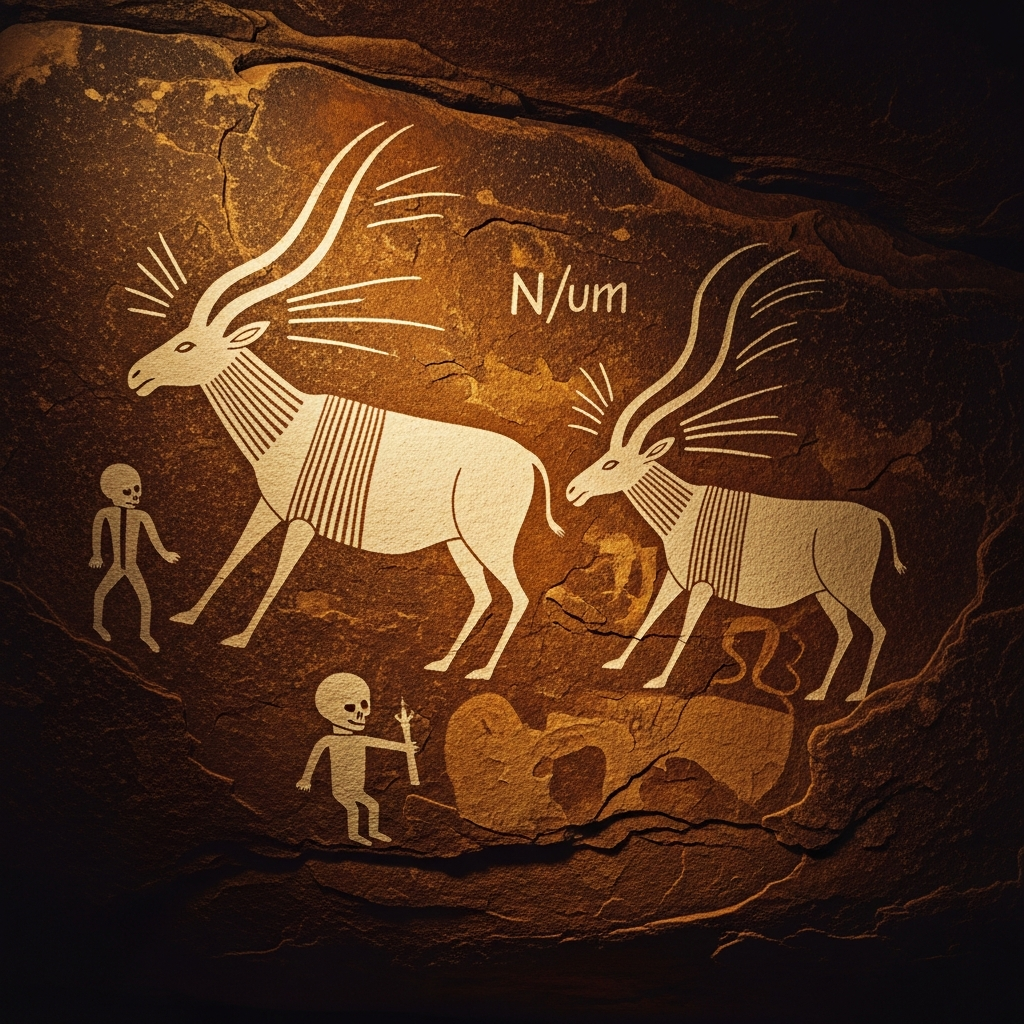
David Lewis-Williams is a South African archaeologist who spends decades looking at the San rock paintings of the Drakensberg and being nagged by a persistent question: why are so many of the figures therianthropic? Why do so many of the painted figures have human bodies and eland heads, or human bodies bending forward in postures that match the posture of a dying eland, or lines coming from their heads that look like nothing in the natural world?
The answer, when it comes, reorganizes everything.
He begins to read the ethnographic record of San shamanism carefully — the accounts of what !Kung shamans say they experience during kia. He reads the descriptions of n/um and the boiling and the crossing of the boundary. He reads about the out-of-body experience that shamans report, the sensation of leaving their physical form and moving through a different medium, sometimes described as flying, sometimes as traveling underwater. He reads about the therianthropic feeling — the sense during deep kia that the shaman is becoming the eland, or becoming part-eland, the most powerful of the trance animals, the one whose potency is greatest.
Then he looks at the paintings again. The bending figure with the eland hooves. The lines from the head — which are n/um, rising to the point of overflow. The figure in the posture of a dying eland at the moment of its death, the forelegs folding, the neck stretching down — this is the posture of the shaman at the moment of kia, the moment of crossing. He has seen it described. He has seen it drawn on rock. They are the same.
The Drakensberg paintings are not decoration. They are not hunting magic in the simple sense that early interpreters assumed — draw the prey and the prey will come. They are a systematic record of trance experience, made by people who experienced the trance, depicting what they saw and felt and became on the other side of the boundary.
The earliest known art is a record of altered consciousness. The first paintings were made by shamans reporting back.
The eland is the most sacred animal in San religion because the eland has the most n/um.
This claim has been examined and tested and found to be consistent across the entire San cultural record — Kalahari !Kung, Nharo, /Xam of the Cape, the people who made the Drakensberg paintings. The eland is fat with n/um, which is why its fat is used in every major ritual transition: first haircut, first kill, marriage, death. The fat of the eland carries the potency into the human body and community at every crossing. The eland dies well. Hunters who have killed eland describe the animal’s behavior at the moment of death as dignified, as resigned, as if the eland knows why this is happening and accepts it — the neck stretching forward, the forelegs folding in the posture that shows up on the cave walls.
The shaman in kia adopts the dying-eland posture because the shaman and the eland are doing the same thing: crossing the boundary of death in a way that makes return possible. The eland dies into the bodies of the hunters who will eat it, who will carry its potency forward. The shaman dies into the spirit world and returns carrying what was needed. The eland is the teacher of the crossing. It knows the way because it walks it every time.
The dance ends when it ends, which is not a fixed time. It may end at dawn or before. The women’s voices slow. The shamans return to ordinary consciousness — not all at once but one by one, the n/um cooling, the spirit world growing opaque, the fire at the center of the circle becoming just a fire. The sick person who has been laid near the fire, who has had hands placed on them and potency drawn through them, is quiet. Sometimes visibly changed. Sometimes not.
The question of whether it works in the biomedical sense is a question the San do not ask. The healing is not only physical. It is relational — between the sick person and the community, between the community and the land, between the living and the dead who are always present in the spirit world and who can be negotiated with by someone who knows the way across. The dance heals the network, not just the individual node. Sometimes this is enough to heal the body too.
The next time the medicine songs begin, the women will remember the rhythm from the time before, and the time before that, and the chain will extend backward through the camps and the caves and the painted walls of the Drakensberg, 27,000 years of the same practice, the same songs, the same fire, the same potency rising in the same spines.
The San called themselves the First People, and the archaeological record agrees with them more than it agrees with any other claim of priority. They were in southern Africa before anyone else arrived. Their paintings are the oldest continuous tradition of religious art on earth.
What the paintings show is what the dance feels like from the inside: the heat, the rising, the dissolution of the boundary between the human body and the eland body, between the living world and the world the dead inhabit, between the one who dances and the potency that dances through him.
They painted it so they would not forget. Or so that whoever came after would know where to look for the door.
Scenes
The dance circle at night, the fire at the center, the women seated and clapping and singing the songs that carry the n/um
 Generating art…
 A San shaman in full kia: arms back in the eland-dying posture, body arched, the face turned upward and inward toward the spirit world
 Generating art…
 The rock paintings at Game Pass Shelter, Kamberg, KwaZulu-Natal: therianthropic figures, half-human and half-eland, moving between worlds
 Generating art…
 Echoes Across Traditions
Entities
- The Eland
- !Kung San shamans
- n/um (potency)
- kia (trance)
- the Rain Animal
Sources
- David Lewis-Williams, *The Mind in the Cave: Consciousness and the Origins of Art* (Thames and Hudson, 2002)
- David Lewis-Williams and David Pearce, *Inside the Neolithic Mind: Consciousness, Cosmos and the Realm of the Gods* (Thames and Hudson, 2005)
- Richard Katz, *Boiling Energy: Community Healing Among the Kalahari !Kung* (Harvard University Press, 1982)
- David Lewis-Williams, *Believing and Seeing: Symbolic Meanings in Southern San Rock Paintings* (Academic Press, 1981)
- John Mbiti, *African Religions and Philosophy* (Heinemann, 1969)