Sila: The Intelligence the Wind Is Made Of
Traditional era, c. 1000 CE (oral tradition; ethnographic documentation c. 1921-24) · The Arctic circumpolar world; specifically Iglulik and central Arctic Inuit territory
Contents
Sila is the Inuit concept of the breath of the world — simultaneously weather, cosmic intelligence, and the animating force inside every living thing. Inua is the spirit-person that inhabits each entity: the seal has an inua, the rock has an inua, the wind has an inua. A hunter caught in a blizzard on the sea ice realizes he is not outside Sila but inside it — and that the intelligence of the storm is not opposed to his survival but indifferent to it in a way that is more philosophically demanding than hostility.
- When
- Traditional era, c. 1000 CE (oral tradition; ethnographic documentation c. 1921-24)
- Where
- The Arctic circumpolar world; specifically Iglulik and central Arctic Inuit territory
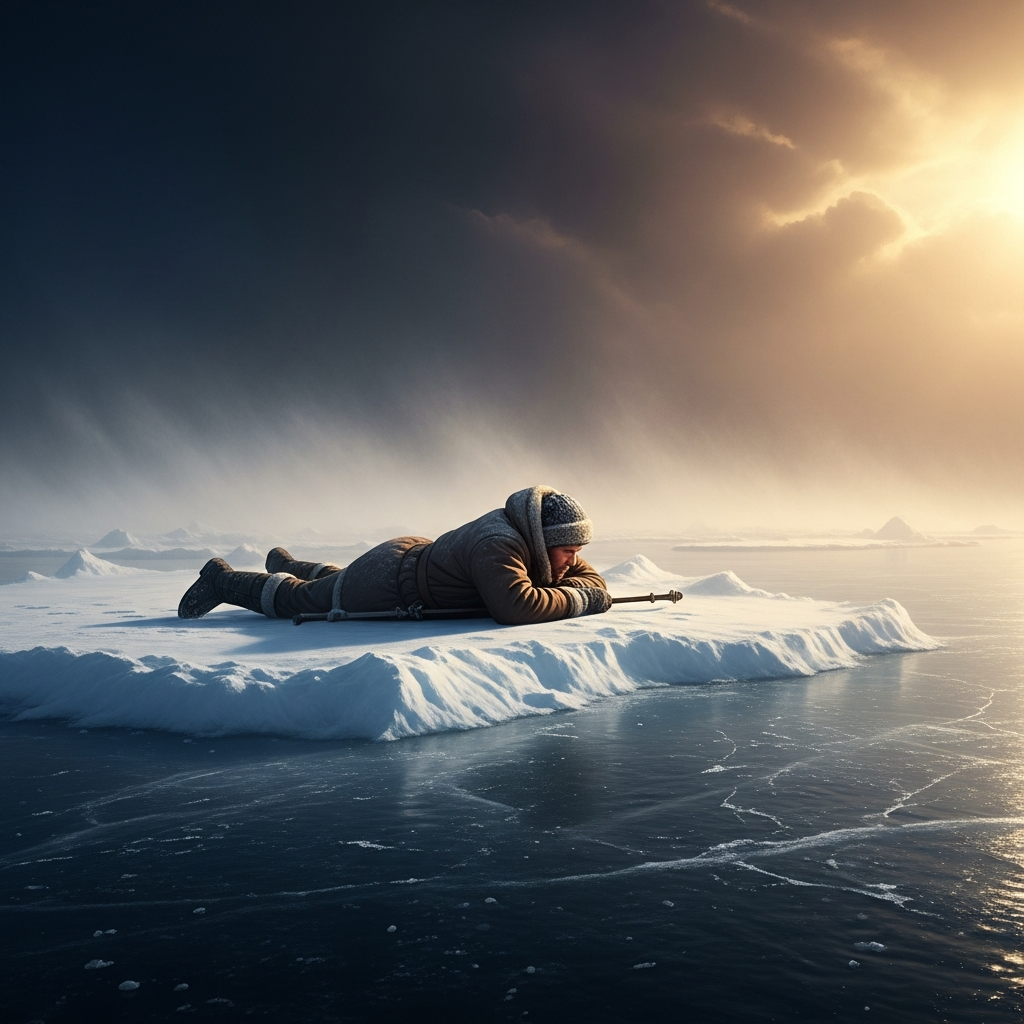
He has been on the sea ice for six hours when the blizzard arrives, and the question of whether he will survive the next six is not philosophical.
It is genuinely not philosophical. He is a hunter of experience, perhaps forty years old, and he has been in blizzards before on the sea ice and come home, and the reason he has come home is not luck but a very specific form of knowledge: the knowledge of when to lie down, when to wait, and how to read what the ice and wind are communicating. He lies down now. He lies flat on the ice with his face near the surface and his body arranged perpendicular to the wind, which reduces his profile and keeps him from being pushed.
In this position, with his cheek against the ice, he hears something he has heard before but never paid this quality of attention to. The ice speaks. Not metaphorically — the ice is under constant structural stress from the blizzard, from the movement of the water beneath, from the temperature differential between the surface and the sea, and the sound it makes is a complex acoustic event: percussion, groan, something that might be called rhythm if you are willing to extend that word beyond its ordinary domain.
He is willing. He has always been willing. This is what his wife calls his problem and the angakkuq calls his gift.
Sila is the word in Inuktitut that translates, inadequately, as ‘weather.’ It also translates as ‘breath.’ It also translates as ‘intelligence’ or ‘common sense’ — the word used for a person who can navigate complexity without losing their center. Sila is what the air is made of when the air is working correctly. Sila is what a wise person has more of than an unwise person. Sila is also the force that the angakkuq Aua pointed to when Rasmussen asked him what he believed, standing outside in a blizzard, gesturing at the storm as if the evidence were self-presenting.
The inadequacy of every translation is the point. Sila is a concept that operates across the boundary between what Western thought calls the physical world and what Western thought calls the mental world. It is simultaneously the substance of weather — the actual atmospheric phenomenon that is killing the hunter right now on the sea ice — and the intelligence that pervades the cosmos. It is not that weather is a metaphor for intelligence. It is that weather and intelligence are the same thing at different scales, the way water and ice are the same thing at different temperatures.
The hunter lies on the ice and listens to Sila.
Inside the inua there is something that looks like you.
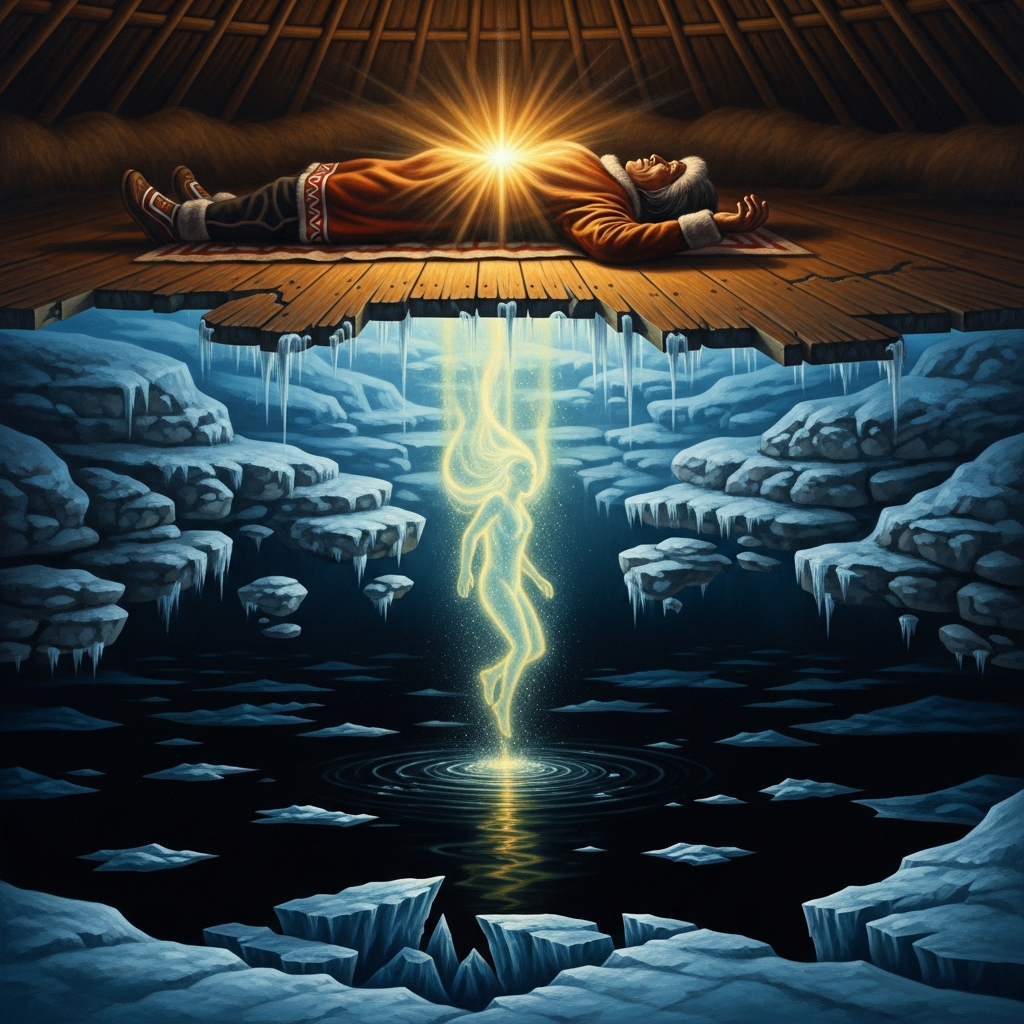
Every entity in the Inuit cosmos — every animal, every geographic feature, every weather system, every tool that has been used long enough to develop personality — contains an inua, an inner person. The seal’s inua looks like a small human being. The walrus’s inua looks like a small human being. The wind’s inua looks like something that cannot be described directly, which is true of Sila itself, which is everywhere at once and therefore not locatable in any particular position from which it could be viewed.
This is not animism in the sense that Western anthropology sometimes uses the term — the naive attribution of human consciousness to non-human entities. The Inuit tradition does not say that the seal thinks the way a person thinks, that the rock has opinions the way a person has opinions. It says that inside the seal, inside the rock, inside the storm, there is something that occupies the position of interiority — something that the seal is, from the inside, and that the seal experiences itself as being, even if what it is from the inside is not translatable into the language of human self-experience.
The philosophical precision of this distinction is remarkable. The Inuit concept of the inua is not panpsychism in the simple sense. It is more like the observation that subjectivity is a structural feature of being rather than a special property of nervous tissue — that wherever there is a thing, there is something it is like to be that thing, however alien to human comprehension that ‘what it is like’ might be.
He has been lying on the ice for perhaps an hour when the thought arrives.
It arrives with the quality of recognition rather than discovery, which is how the most important thoughts tend to arrive: not as new information but as the sudden visibility of something that was always there, waiting for the conditions that would make it seeable. The thought is this: he is not outside the storm. He is inside it. He is not a point of consciousness observing a weather event from an exterior position. He is a node in a system — his heat, his breath, his heartbeat, his fear, all of it part of the storm’s structure as surely as the wind and the ice and the dark above.
This is not consoling in the ordinary sense. A system is not necessarily interested in the survival of its components. The storm does not want him alive or dead. It does not want anything. It is Sila — intelligence without agenda, awareness without preference, the medium in which all things occur rather than a force directed at any particular thing. His survival matters to him, and to his family, and to the community that will search for him if he does not return. It does not matter to Sila.
And yet. The knowledge that he is inside rather than outside changes something in his posture. He stops bracing against the wind in the way that costs energy. He begins to read the storm’s rhythm the way you read a conversation partner’s breathing — not to fight it but to predict it, to find the spaces between the gusts, the micro-pauses where the ice gives different information, the direction of the wind’s slight and temporary shifts. He is not negotiating with the storm. He is attending to it. Attention, in the Inuit tradition, is the primary moral act.
He finds the shore by a method he cannot afterward fully explain.
The ice carries a different sound near the shore — the pressure against the land creates a resonance that the open-water ice does not have. He finds this frequency by lying still and listening until his ability to distinguish one sound from another, suppressed by the blizzard’s noise, reasserts itself in the way that the eye, in a dark room, eventually begins to find shapes. He moves toward the sound. He moves slowly, testing the ice with his weight before committing it, which is the technique that has kept him alive across thirty years of sea-ice travel and which has no mystical component except that it requires a quality of attention that most people cannot sustain for more than a few minutes.
He reaches the shore at the point where the community’s cache is located — not his home position, but close enough, and the cache contains food and, more importantly, a shelter he has built and maintained against exactly this contingency. He survives. He eats. He sleeps.
When he returns to the community three days later and they ask what happened, he says what happened. He says he lay on the ice and listened to Sila. His wife says this is what she expected. The angakkuq nods in a way that suggests the story confirms something he already understood. The children want to know what Sila sounds like.
He tells them: it sounds like the ice working, and underneath the ice working, it sounds like breathing, but very slow — so slow that one breath is a tide, and the next breath is a season, and the one after that is a generation, and you have to stay very still and listen for a very long time before you can hear the pause between the exhale and the inhale.
The Inuit do not pray to Sila. You do not address an atmosphere. You attend to it. You learn to read its variations the way you read a face — not for information that can be extracted and stored but for information that is alive only in the moment of attention. Sila is not a deity in any of the senses that word carries in the traditions that have deities. It is more fundamental than a deity: a deity can be absent, can withhold itself, can be pleased or displeased. Sila cannot be absent because it is the medium of presence itself. It cannot withhold itself because it is what breathing is made of. The hunter on the ice was never alone. He was inside the intelligence of the world, which is the only place anything has ever been, and he learned in those six hours what the angakkuq spends a lifetime trying to teach: that the way through is not across but through, not resistance but attention, not survival against the world but survival as part of it.
Scenes
A hunter alone on sea ice in a full Arctic blizzard
 Generating art…
 A seal surfacing at a breathing hole, its eye catching the low winter light
 Generating art…
 The Arctic sky at the moment the northern lights appear — the hunter on the ice below, the lights above, and the sense of being inside a system of intelligence so large that the word 'inside' loses its ordinary meaning
 Generating art…
 Echoes Across Traditions
Entities


Sources
- Rasmussen, Knud, *Intellectual Culture of the Iglulik Eskimos: Report of the Fifth Thule Expedition 1921-24*, vol. VII (Gyldendalske Boghandel, 1929)
- Merkur, Daniel, *Powers Which We Do Not Know: The Gods and Spirits of the Inuit* (University of Idaho Press, 1991)
- Fienup-Riordan, Ann, *Boundaries and Passages: Rule and Ritual in Yup'ik Eskimo Oral Tradition* (University of Oklahoma Press, 1994)
- Oosteran, Jarich, 'Sila: A Concept of Nature in Inuit Cosmology,' *Arctic Anthropology*, vol. 34, no. 1 (1997)
- Krupnik, Igor and Dyanna Jolly (eds.), *The Earth is Faster Now: Indigenous Observations of Arctic Environmental Change* (Arctic Research Consortium of the United States, 2002)