Shiva's Tandava — The Cosmic Dance
Mythic Time · Nataraja iconography crystallized in Chola bronzes, ~10th-12th century CE · Chidambaram — the cremation grounds and ancient temple in Tamil Nadu where the dance is said to occur eternally
Contents
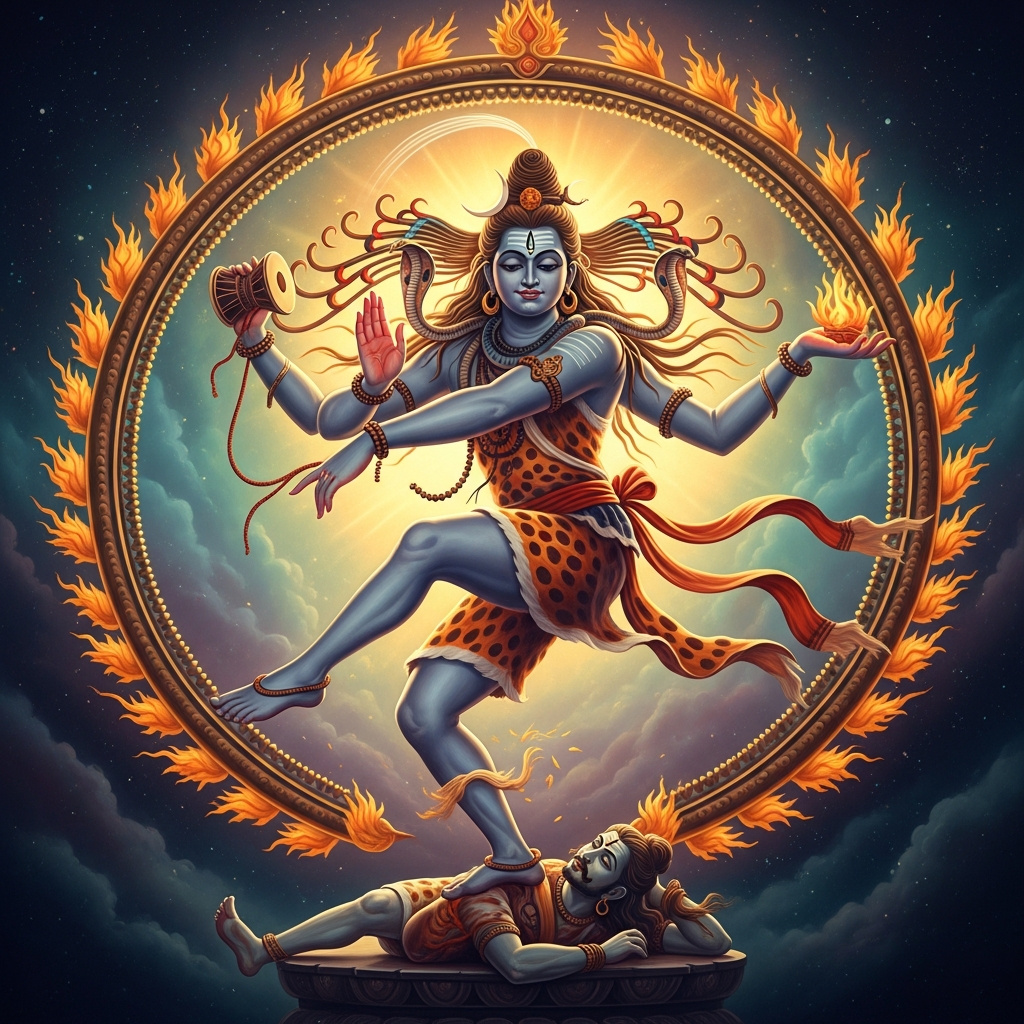
At the cremation grounds of Chidambaram, Shiva dances the cosmos into being and out again. Drum in one hand, flame in another, the dwarf of forgetfulness crushed beneath his right foot, his left foot raised in the gesture of liberation. Five activities in a single body. The whole universe is a step.
- When
- Mythic Time · Nataraja iconography crystallized in Chola bronzes, ~10th-12th century CE
- Where
- Chidambaram — the cremation grounds and ancient temple in Tamil Nadu where the dance is said to occur eternally
He dances on a cremation ground.
This matters. The first thing to understand about Shiva’s dance is where it happens — not in a temple, not in a heaven, but at the place where the dead are burned. Chidambaram is built on such a ground. The fires beneath the temple still burn in the imagination of every priest who serves there. The dance occurs above ash. The cosmos arises, in this iconography, from the place where the cosmos is also unmade.
He stands on one foot.
The other is raised — bent, lifted, suspended in the gesture the texts call gajahasta, the elephant-trunk pose. Beneath the foot that touches the ground, a small dwarf is pinned. The dwarf is named Apasmara. His name means forgetfulness. He represents the ignorance that holds the soul to the wheel.
Shiva is crushing him without violence. The dwarf is not dying. He is held — kept under the foot of awareness, which is the only thing that holds ignorance in place.
The dance begins.
The drum is in his upper right hand.
It is small — a damaru, the hourglass-shaped drum tied at the waist with a knot that lets two beads strike both heads at once. It sounds like a heartbeat heard from a distance. The texts say this drum is the first sound of creation. Not the Big Bang of physics, but the rhythmic pulse from which space, time, and matter are extruded. It is nada, primal vibration. The cosmos exists because Shiva is keeping the beat.
He shakes the drum.
The universe begins.
This is the first activity: srishti, creation. The drum hand on the upper right pulls the cosmos out of nothing the way a musician pulls a melody out of silence. There is no separate creator. There is a dancer with a drum, and the drum is making space, and space is making things, and things are listening for the next beat.
The flame is in his upper left hand.
It rests on his palm — a single tongue of fire shaped like a leaf, balanced as if weightless. This is agni, the destroying flame. It is the second pole of the dance. The drum makes; the flame unmakes. They are held by the same body. Shiva does not alternate between them. He carries both at once, in opposite hands, lifted in opposite directions, because creation and destruction are not stages — they are the two sides of a single act.
The flame does not consume the cosmos slowly. It cannot. The cosmos is being made and unmade in the same moment. Stars ignite and stars die. Cells divide and cells decay. The dancer holds the fire that will eventually take everything, and he is not anxious about it, because the drum in his other hand is already making the next thing the fire will take.
This is samhara, destruction. The third hand carries it. The dancer’s body is the meeting place.
The lower right hand is raised in abhaya mudra — the gesture that means do not be afraid.
This is the second activity: sthiti, preservation. To dance the cosmos is also to hold it steady long enough for things to live. The hand lifted palm-outward says: while the drum beats and the flame waits, you are protected. The dance is not careless. The cosmos is not falling. I am here.
This is the gesture every Hindu deity offers in iconography, and it is the central one. Mythology can be read as the long elaboration of why this gesture is needed and why it can be trusted.
The lower left hand points across the body to the raised foot — the gajahasta, the elephant-trunk hand pointing to the lifted foot. It is the gesture of refuge. The lifted foot is where you go. That foot is moksha, liberation. The dancer is saying: the place beyond the dance is right here, on the dancer’s own body, raised above the ground of forgetfulness.
Look at the foot. Step toward it. The dance does not end. You end the dance, in yourself, by recognizing where the foot already is.
There is a fifth activity. It is the strangest.
It is tirobhava, sometimes translated as concealment or illusion — the cosmic activity by which Shiva veils the truth from those who are not ready to see it. The same dancer who reveals also conceals. The same body that liberates also obscures. This is encoded in the dance’s overall flame-ring — the prabha, the circle of fire that surrounds the entire figure in every Chola bronze.
The ring is not a frame. It is part of the dance.
The flames are pointing outward. They are the visible cosmos — galaxies, atoms, all phenomena, all the dazzling appearance of difference. They are also a barrier. They are what the unawakened see when they look at the dancer: the show, not the dancer behind the show. To stand outside the ring and watch is to see maya, the play of forms. To step inside the ring is to see the still center, the dancer himself, who is not moving even though the dance is everything.
Five activities, then, in one body: creation (drum), preservation (abhaya), destruction (flame), concealment (the ring of fire), liberation (the raised foot). The Sanskrit term for this combined function is panchakritya — the five-fold cosmic act. Other gods perform some. Shiva performs all five at once.
The cremation ground is full of ash.
This is the part most often forgotten. Nataraja’s dance is not performed in a court. It is performed where the bodies are burned. In the older texts, Shiva is smeared with the ash of the dead. He wears a cobra around his neck — a creature that lives in the spaces other creatures fear. He has snakes in his hair. He is, by every conventional measure, the most inappropriate dancer in the cosmos.
That is the theological point.
The cosmos arises from the cremation ground. The dance occurs over the ash of everything that has already been. The drum sounds and a new universe is extruded from the residue of the last one. The flame waits to take this universe too. There is no separate workshop where creation happens cleanly. There is one ground, and the ground is ash, and the dance is on the ash, and the ash is the material from which the next dance will be assembled.
A culture that has understood this can no longer be afraid of cremation. It is what the dance is made of.
He dances eternally.
The Chola bronzes — cast from the tenth century onward in the workshops of Tamil Nadu — fix the dance in metal so that worshipers can carry it in procession, install it in a temple’s inner sanctum, anoint it with oil and milk and turmeric. But the bronze does not contain the dance. The dance contains the bronze. Every time the drum beats — somewhere in the cosmos, in the heart of every creature, in the rhythm of breath itself — Shiva is dancing.
The texts say: when the dance stops, the cosmos ends. There will be a final beat of the drum. There will be a final lift of the flame. The cosmos will collapse into a single point that the texts call bindu, and Shiva will stand still on the cremation ground for a long indrawn breath, and then the drum will sound again, and the next cosmos will begin.
This is not metaphor. In the tradition, it is the structure.
Coomaraswamy’s 1918 essay made the Nataraja famous to the West. He read it as the most philosophically condensed image in any religion — every Indian metaphysical principle encoded in a single bronze. He was right. Padma Kaimal’s later scholarship has shown that the iconography crystallized regionally, in Chola Tamil Nadu, before becoming pan-Hindu; the universality of the symbol is itself a historical achievement.
The image lives now beyond Hinduism. A bronze Nataraja stands at CERN in Geneva, gifted by India in 2004, the dancer who creates and destroys placed beside the particle accelerators that find the same patterns in matter. The plaque cites Capra and Coomaraswamy. The physicists touch its base before experiments. The dance continues in the place where the cosmos is being measured for its rhythms.
Heraclitus said you cannot step in the same river twice. Shiva said: that is because the river is dancing, and so are you.
Echoes Across Traditions
Entities
- Shiva
- Nataraja
- Apasmara

Sources
- *Tirumantiram* of Tirumular (Shaiva Siddhanta canon)
- *Chidambara Mahatmya*
- Ananda K. Coomaraswamy, *The Dance of Shiva* (1918)
- Padma Kaimal, *Shiva Nataraja: Shifting Meanings of an Icon* (1999)
- Heinrich Zimmer, *Myths and Symbols in Indian Art and Civilization* (1946)
- David Smith, *The Dance of Siva: Religion, Art and Poetry in South India* (1996)