Spider Woman and the First Loom
Time before memory · Dinetah — Navajo homeland, Canyon de Chelly region
Contents
Na'ashjé'ii Asdzáá — Spider Woman — teaches the Diné to weave. She gives them the first loom, whose structure is a map of the cosmos: the warp strings are rain, the heddles are sun rays, the batten is a white shell sword, the comb is a red shell comb. Every blanket woven on this loom is not a textile but a world made coherent.
- When
- Time before memory
- Where
- Dinetah — Navajo homeland, Canyon de Chelly region
Spider Rock rises eight hundred feet from the canyon floor.
It is a sandstone spire in Canyon de Chelly in what is now northeastern Arizona, twin columns of red rock lifting from the cottonwoods along the canyon bottom, and Na’ashjé’ii Asdzáá — Spider Woman — lives on its summit. She has always lived there. She was there before the Diné emerged from the lower worlds, and she was there to greet them when they came up, and she is there now, though her home is visible only if you know what to look for and how to look.
In the beginning, when the world was newly assembled and the Diné were learning what it meant to live in it, Spider Woman’s husband — Spider Man, the one who devises structures — told her what a loom would require. He told her: the warp sticks should be of sky. The warp should be of lightning. The heddles should be of sun rays. The batten should be a white shell sword. The comb should be of red shell. He was not being metaphorical. The loom is constructed from cosmological materials because it is a cosmological instrument.
Na’ashjé’ii Asdzáá built the first loom. Then she called the Diné women to her and taught them what a loom is for.
The teaching is physical and it is also everything else.
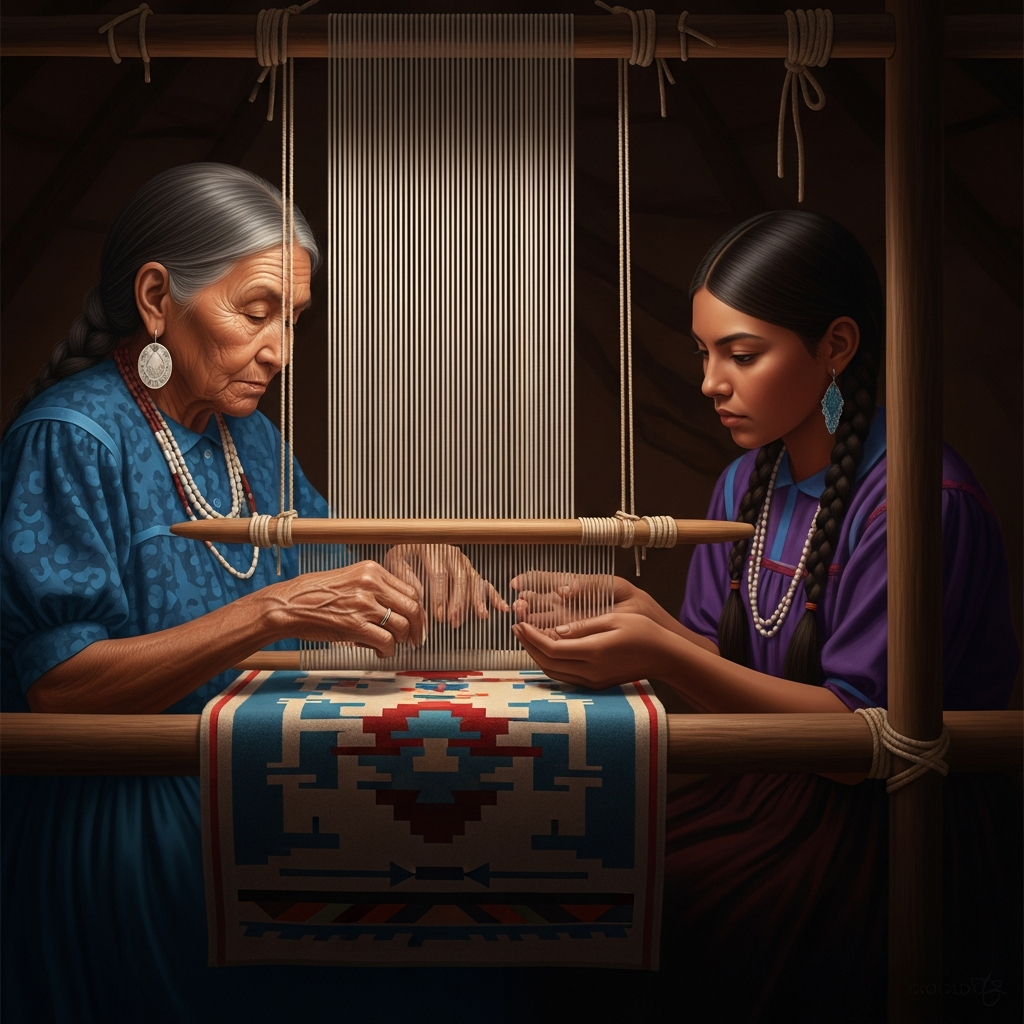
She teaches them to warp the loom — to string the vertical threads that will be the structure around which everything else is organized. This is the first act and it must be done with attention, because the warp is the sky and the warp is rain and the warp is the unseen architecture that holds visible things in relation to each other. A warp strung carelessly is a sky strung carelessly, which is not a thing the Diné want to live under.
She teaches them the heddles — the loops that separate the warp threads into two planes, allowing the shuttle to pass through. The heddles are sun rays. To work the heddles is to manipulate the light that orders the visible world. There is no irony in this statement. The Diné weaver working her heddles is doing what she understands her heddles to be: she is organizing light.
The weft — the horizontal threads that pass through the warp — is the earth. The completed cloth is the intersection of sky and earth, the place where the cosmic vertical meets the cosmic horizontal, the same intersection that every Diné hogan is designed to enact in three dimensions. The loom is a hogan laid flat. The blanket is the world as it must be assembled each time: careful, tight, geometrically coherent.
Na’ashjé’ii Asdzáá teaches them all of this. She teaches them through her hands, which move with complete economy, no motion wasted, the shed opening and the shuttle passing and the comb beating the weft down — each gesture precise and repeatable and ancestral.
The patterns are not decorations.
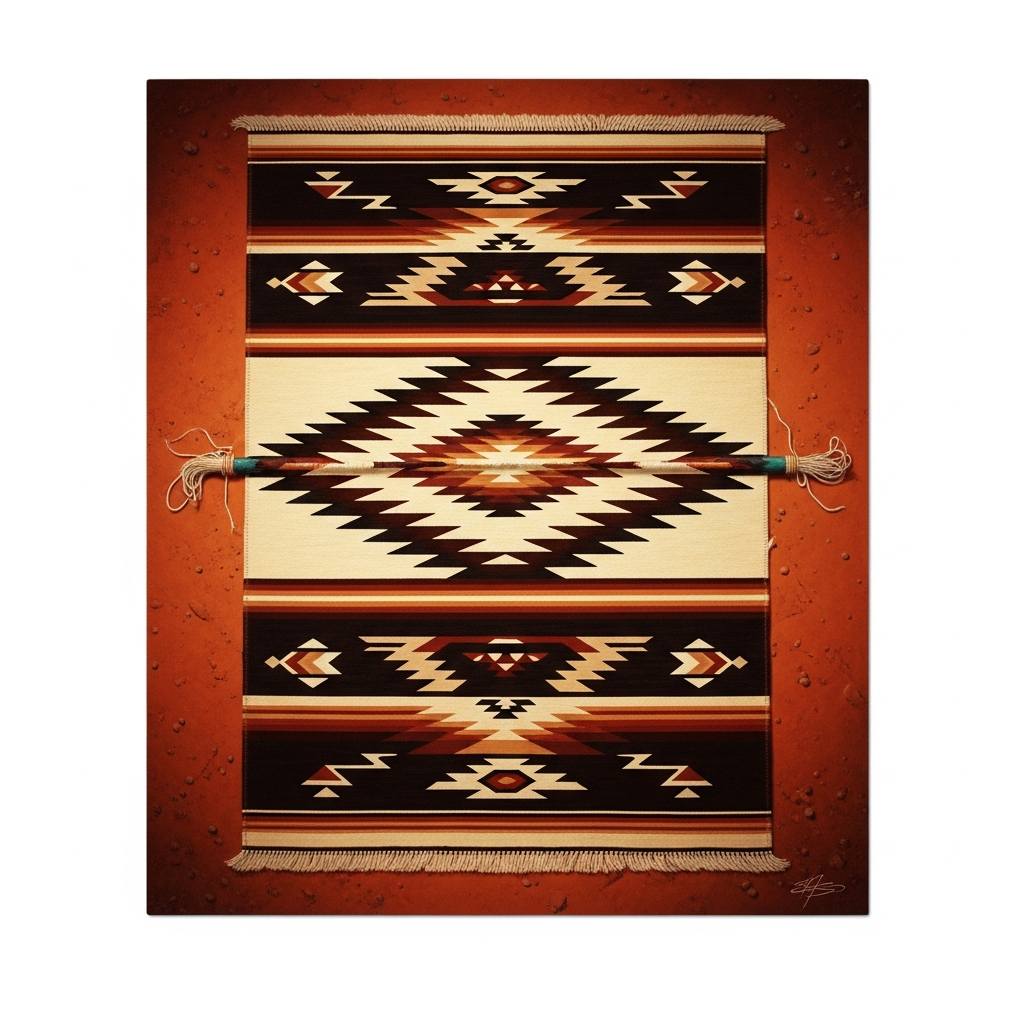
This is the thing most easily lost when Navajo weaving is removed from its context and placed in a gallery or a museum case. The stepped diamond, the lightning bolt, the terraced figure, the zigzag border — these are not aesthetic choices in the way that choosing a color for a wall is an aesthetic choice. They are geometric statements about the structure of the cosmos, encoded in a medium that preserves them with absolute fidelity across generations.
The Diné cosmos is organized by four sacred mountains — one at each cardinal direction — that define the boundaries of the homeland and give it its shape. The horizontal axis and the vertical axis and the diagonal that connects them are all present in every traditional Navajo textile. The color sequence moves from east to south to west to north in the same order that sacred spaces are addressed in ceremony. White for east and dawn and new beginnings. Blue for south and sky and the full height of noon. Yellow for west and the way the light goes amber at the end of the day. Black for north and the night that is not absence but the other face of the sacred.
A Navajo woman weaving a blanket is not making a blanket. She is making an argument about the structure of time and space, encoding it in wool and natural dye, and sending it out into the world where it will continue making that argument for as long as it holds together.
There is also the spirit line.
The border of a traditional Navajo blanket is not a complete border. There is a small break in it, usually in the corner, usually subtle enough to miss on casual inspection, called the ch’ihónít’i — the spirit line, or the weaver’s pathway out. The Diné understanding is that a completed, closed border would trap the weaver’s spirit inside the textile. The spirit line is the exit: a break in the pattern through which the weaver’s consciousness can move freely when the weaving is done, so that she is not imprisoned in her own making.
Na’ashjé’ii Asdzáá did not teach this because she made the mistake of weaving a closed border herself. She taught it because she understands the danger inherent in the act. The weaver who is deep in her work is not entirely separate from the work. Her attention is in the weaving; her pattern-sense, her spatial intelligence, her aesthetic judgment — all of it is threaded into the cloth as the work proceeds. The spirit line ensures that this investment of self does not become a permanent entanglement.
This is a theology of creation that takes seriously the risk of the creator. God who makes a world without a spirit line is trapped in it. Na’ashjé’ii Asdzáá, who made the loom that made the world, is still on Spider Rock because she left herself a way out.
Spider Woman is not a grandmother in the sentimental sense.
She is old and she is powerful and she is not gentle about the power. There are stories in which she consumes those who fail to remember what the spider’s web is: a trap as much as a teaching tool. She offers the knowledge of the loom to those who approach her correctly — with respect, with the willingness to learn the entire structure rather than just the surface of it. Those who approach badly get a different lesson.
This is consistent with the loom itself. The loom is not a forgiving instrument. A warp strung unevenly produces a blanket that will never lie flat, that will buckle and distort as it grows, that will encode the original error into every subsequent row. There is no correcting the warp once the weaving has begun. This is not metaphorical either: in Diné cosmology, errors in the proper orientation of things propagate forward and produce disorder that is very difficult to address after the fact. This is why ceremony exists: to re-align things that have drifted from their proper relation before the drift becomes structural.
Na’ashjé’ii Asdzáá is on Spider Rock, and she is not done teaching.
Every Diné woman who sits at the loom is sitting where Na’ashjé’ii Asdzáá sat when she made the first one. The hands that move the heddles are in a direct line of transmission from hands that understood the heddles to be sun rays — not symbolically, not as a poetic description, but precisely.
The blanket piled on the back seat of a car driving through Gallup, the rug in the museum case in Washington, the textile in the private collection in Santa Fe — they still have the warp of sky and the weft of earth in them, whether or not anyone in the room knows it.
Na’ashjé’ii Asdzáá put the cosmos in the structure and the structure is still there.
The spirit line is still open.
Scenes
An old woman with hands that move with perfect economy sits at a vertical loom in a canyon dwelling
 Generating art…
 Spider Rock in Canyon de Chelly at dusk: a red sandstone spire eight hundred feet tall, twin columns rising from the canyon floor
 Generating art…
 A completed Navajo blanket laid on red earth, its pattern of stepped diamonds and lightning forms perfectly symmetrical
 Generating art…
 Echoes Across Traditions
Entities
- Na'ashjé'ii Asdzáá
- Spider Man
- Changing Woman
- the First Loom
Sources
- Gladys A. Reichard, *Navaho Religion: A Study of Symbolism* (Bollingen Foundation, 1950)
- Leland C. Wyman, *The Windways of the Navaho* (Taylor Museum, 1962)
- Peter Iverson, *Dine: A History of the Navajos* (University of New Mexico Press, 2002)
- Noel Bennett and Tiana Bighorse, *Navajo Weaving Way: The Path from Fleece to Rug* (Interweave Press, 1997)
- Vine Deloria Jr., *God Is Red: A Native View of Religion* (Fulcrum Publishing, 1973; 3rd ed. 2003)