The Dead Sea Scrolls
1947 · scrolls themselves ~150 BCE - 70 CE · Qumran, the cliffs above the Dead Sea
Contents
A Bedouin boy throws a stone into a cave above the Dead Sea and hears something break. Inside: clay jars. Inside the jars: the oldest Hebrew Bible manuscripts ever found, hidden by a sect who did not survive the Romans but whose library did.
- When
- 1947 · scrolls themselves ~150 BCE - 70 CE
- Where
- Qumran, the cliffs above the Dead Sea
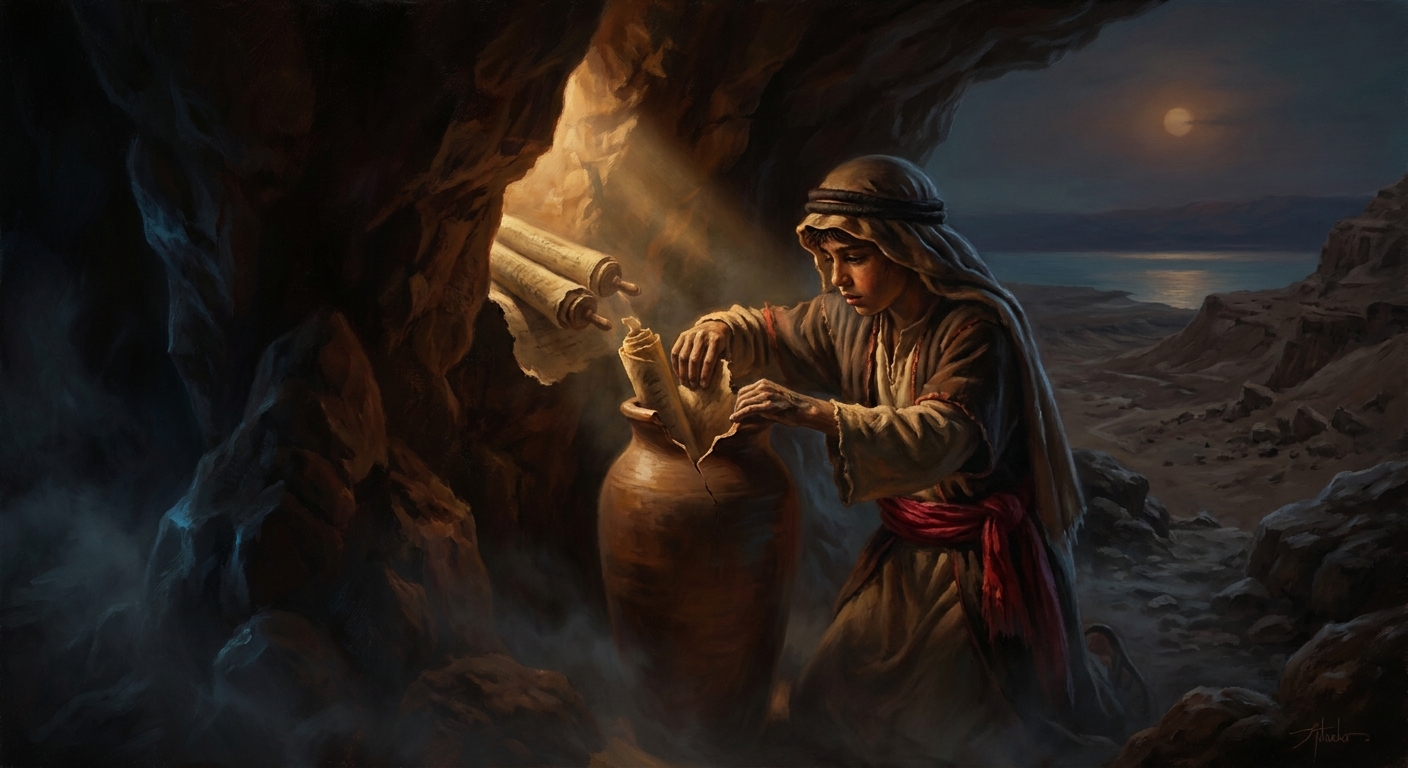
A boy throws a stone into a hole in a cliff.
He is fifteen, maybe sixteen. He is looking for a lost goat on the terraced slopes above the Dead Sea, in the Judean desert, in the first winter of 1947. The stone arcs into the dark. Something breaks. Not rock. Clay.
He does not go in immediately. He comes back the next morning with a cousin, and they climb through the opening — just wide enough for a slender body — and find themselves in a narrow cave that smells of old dust and animal dung and something else, something dry and specific, the smell of preservation. Eight tall clay jars line the walls. Seven are empty. The eighth is sealed.
Inside: leather scrolls wrapped in linen.
Muhammad edh-Dhib does not know what he has found. He and his cousin take three scrolls. They bring them to a Syrian antiquities dealer in Bethlehem named Khalil Iskander Shahin, known as Kando. Kando does not know what he has found either. He eventually routes two scrolls to the Syrian Orthodox Archbishop of Jerusalem, Mar Athanasius Samuel, who displays them to anyone who might know their worth.
On November 29, 1947 — the same day the United Nations votes to partition Palestine — an elderly Hebrew University professor named Eleazar Sukenik stands at a barbed-wire checkpoint between Arab and Jewish sectors of Jerusalem and holds a fragment of scroll through the wire. He is looking at ancient Hebrew script. He understands, before anyone else does, what he is holding.
He buys three scrolls for the Hebrew University. He cannot sleep. He writes in his diary: I looked and looked, and finally I said to myself: This is one of the oldest Hebrew manuscripts ever found.
He is not wrong. He is barely even close to the full truth.
Archaeologists excavate Cave 1 in 1949. Between 1951 and 1956 they find ten more caves in the same escarpment. Cave 4 alone yields tens of thousands of fragments — the shattered remains of perhaps five hundred separate documents, every piece needing to be identified, matched, deciphered. The scrolls are not a find. They are an archive. They are a library.
The library of Qumran.
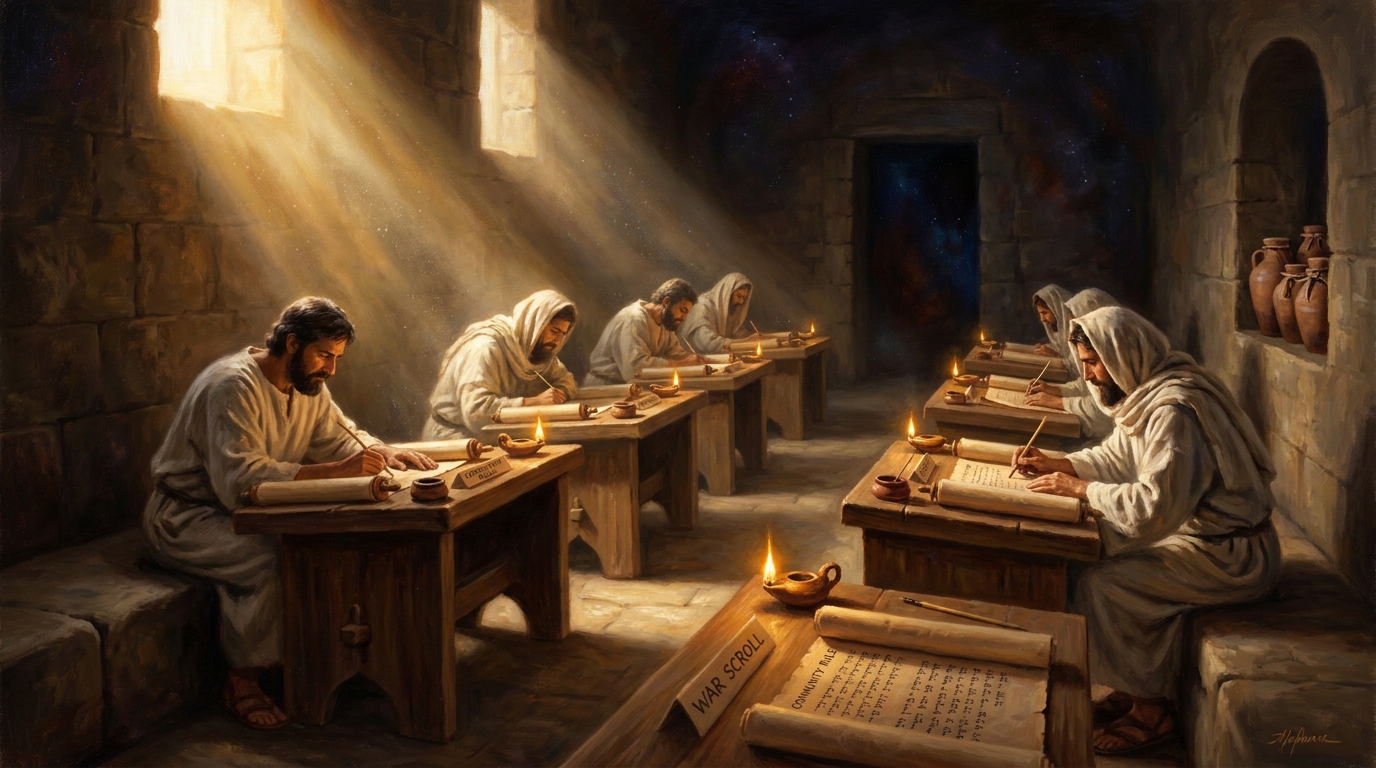
The ruins of a settlement sit a kilometer away — long rooms, a ritual bath, a watchtower, the plastered benches of what archaeologists identify as a scriptorium, the room where scribes sat and copied. Two inkwells. The site had been occupied from roughly 150 BCE until 68 CE, when the Roman Tenth Legion marched south during the First Jewish-Roman War and burned it flat.
Sometime just before the Romans arrived, the community carried their scrolls into the caves, sealed them in jars, and did not return.
The texts that emerge from two thousand years of sealed stone are not what anyone expects.
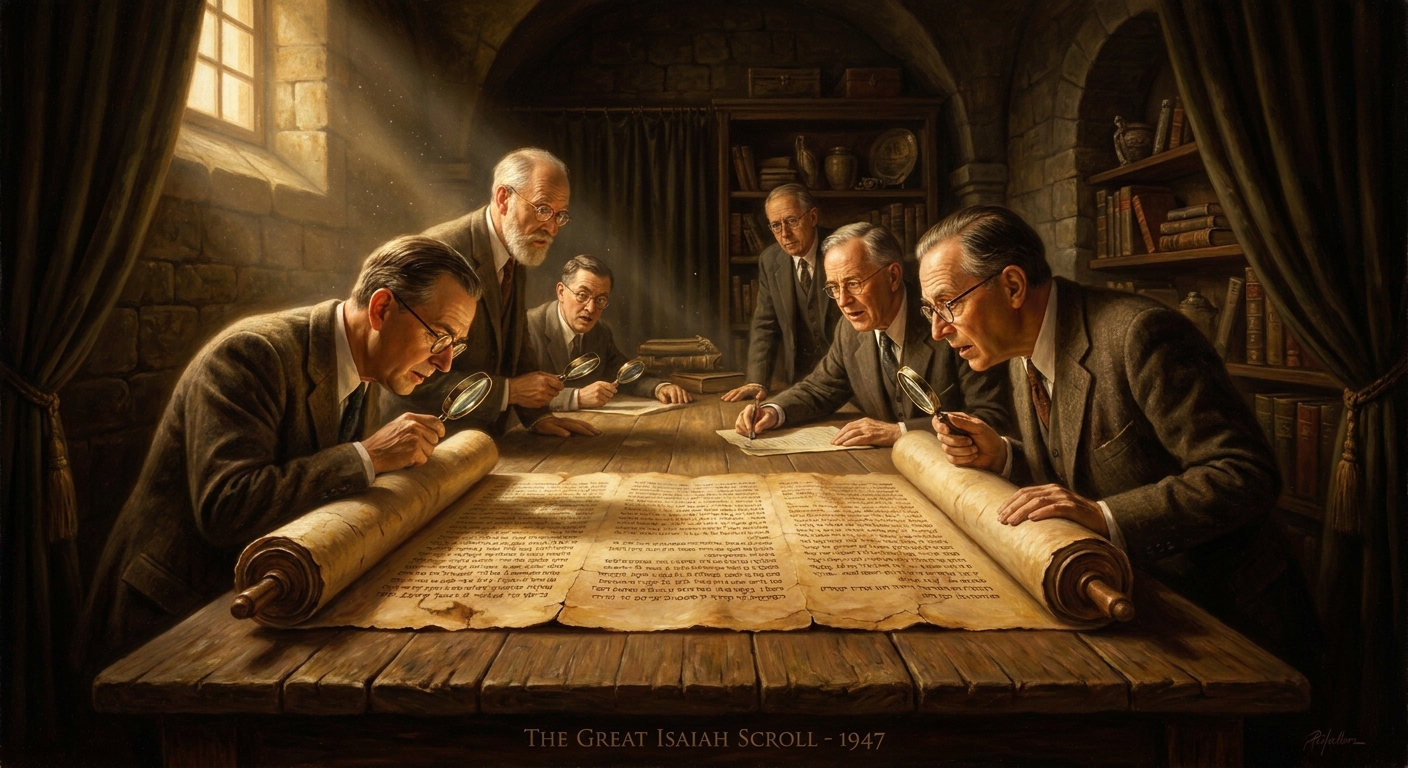
The Hebrew Bible is there — nearly every book, in manuscripts a thousand years older than the oldest previously known. The scribes of the Masoretic tradition, working in the ninth and tenth centuries CE, had been faithful beyond any reasonable hope. The Isaiah scroll is complete: all sixty-six chapters on a single strip of parchment seven meters long, dated to around 125 BCE. When scholars compare it word by word to the medieval manuscripts, the variation is less than one percent. The text had not drifted. It had been preserved with a precision that borders on the uncanny.
But the library is not only the Hebrew Bible.
There is the Community Rule — the governing document of the sect, laying out initiation rites, communal meals, purity laws, the hierarchy of the assembly. There is the War Scroll, which describes a final apocalyptic battle between the Sons of Light and the Sons of Darkness, arranged like a Roman military manual. There is the Damascus Document, which records the founding mythology of the movement — an exodus from Jerusalem, a new covenant in the wilderness, a leader called the Teacher of Righteousness who had interpreted the Law correctly and been rejected. There are biblical commentaries (pesharim) that read contemporary events as the fulfillment of ancient prophecy. There are hymns, liturgical texts, horoscopes, a copper scroll that lists buried treasure across the land of Israel in directions no one has been able to follow.
This is not a canonical library. This is a sectarian library. It reveals a Judaism far more fractured and various in the last two centuries BCE than anyone suspected — a world of competing groups arguing bitterly over calendar, covenant, priesthood, and prophecy. Pharisees, Sadducees, and whoever the Qumranites were. The Community Rule describes a group that held common property, practiced ritual immersion, ate communal meals, expected an imminent apocalypse, and organized itself around the interpretation of a charismatic teacher’s commentary on scripture.
Whether this was the Essenes — the group described by Josephus and Pliny — is still debated. Whether every scroll was written at Qumran or some were brought from Jerusalem is still debated. Whether the Teacher of Righteousness can be identified with any historical figure is still debated.
What is not debated is what the library means.
The borders shift.
The canon of scripture was not settled in the first century CE. The scrolls show a community using texts we now call deuterocanonical — Jubilees, 1 Enoch, the Temple Scroll — with the same reverence as Genesis or Isaiah. What counts as scripture, it turns out, was still being decided when the Romans arrived. The sect settled their own answer and sealed it in jars.
The New Testament begins to look different too. Not because the scrolls predict Christianity or because the Teacher of Righteousness is a prototype of Jesus — those arguments, popular in the 1950s, have not held up. But because the atmosphere of John’s Gospel, the dualism of light against darkness, the communal meal, the imminent kingdom, the commentary as revelation — these are not inventions of the first Christian communities. They are the air that the first century breathed. Qumran shows where that air came from.
John the Baptist preaches in the wilderness near the Dead Sea. Paul describes a community of goods and a common table. The Sermon on the Mount legislates community conduct. These are not parallels that prove dependence. They are windows into a shared world of sectarian Jewish expectation that the scrolls make suddenly, vividly visible.
Eleazar Sukenik dies in 1953 without seeing his country secure all of its scrolls. His son, the archaeologist Yigael Yadin, buys the remaining four in 1954 through an intermediary in New York, answering an advertisement in the Wall Street Journal. The State of Israel eventually acquires and houses all of the major scrolls in the Shrine of the Book at the Israel Museum in Jerusalem — a white domed building designed to echo the shape of the scroll lids.
The Bedouin boy Muhammad edh-Dhib lives until 2004. He tells his story many times. He is always asked: how much did you get for them? His answer varies. The scrolls, eventually, are worth everything anyone can name. He gets almost nothing. That, too, is a pattern the history of discovery tends to honor.
The scrolls survived because the desert is dry, the jars were sealed, and the Romans moved on. The community did not survive. They had expected the Sons of Light to win the final battle. They had laid out the battle plan in meticulous detail. The Romans did not follow it.
But their library did what libraries do. It outlasted them. It spoke for them when they could not speak for themselves.
It is still speaking. Teams of scholars are still publishing fragments. The argument about what exactly the scrolls are — who wrote them, what they used them for, what they believed — has not been resolved and probably will not be in any single lifetime.
They broke open a world that had been sealed for two thousand years. That world is not simpler than the one we thought we knew. It is stranger, richer, more contested, and more alive. That is what the best discoveries do. They do not answer the question. They reveal how much larger the question always was.
Scenes
Cave 1 at Qumran — the low opening in the limestone cliff where Muhammad edh-Dhib climbed in after hearing a clay jar shatter
Generating art… The scriptorium at Qumran — the long room identified by archaeologists Roland de Vaux and Lankester Harding, furnished with plastered benches and inkwells, where the sect's copyists reproduced scripture and composed their own documents across nearly two centuries
 Generating art…
 The Great Isaiah Scroll (1QIsa-a), unrolled — all 66 chapters of Isaiah on a continuous strip of parchment, seven meters long, dated to approximately 125 BCE
 Generating art…
 Echoes Across Traditions
Entities
- Muhammad edh-Dhib
- the Teacher of Righteousness
- Eleazar Sukenik
Sources
- Florentino García Martínez, *The Dead Sea Scrolls Translated* (1994)
- Geza Vermes, *The Complete Dead Sea Scrolls in English* (1997)
- Lawrence Schiffman, *Reclaiming the Dead Sea Scrolls* (1994)
- John J. Collins, *The Dead Sea Scrolls: A Biography* (2012)