Ambedkar at Nagpur: Half a Million Conversions
October 14, 1956 CE · Deekshabhoomi, Nagpur, Maharashtra, India
Contents
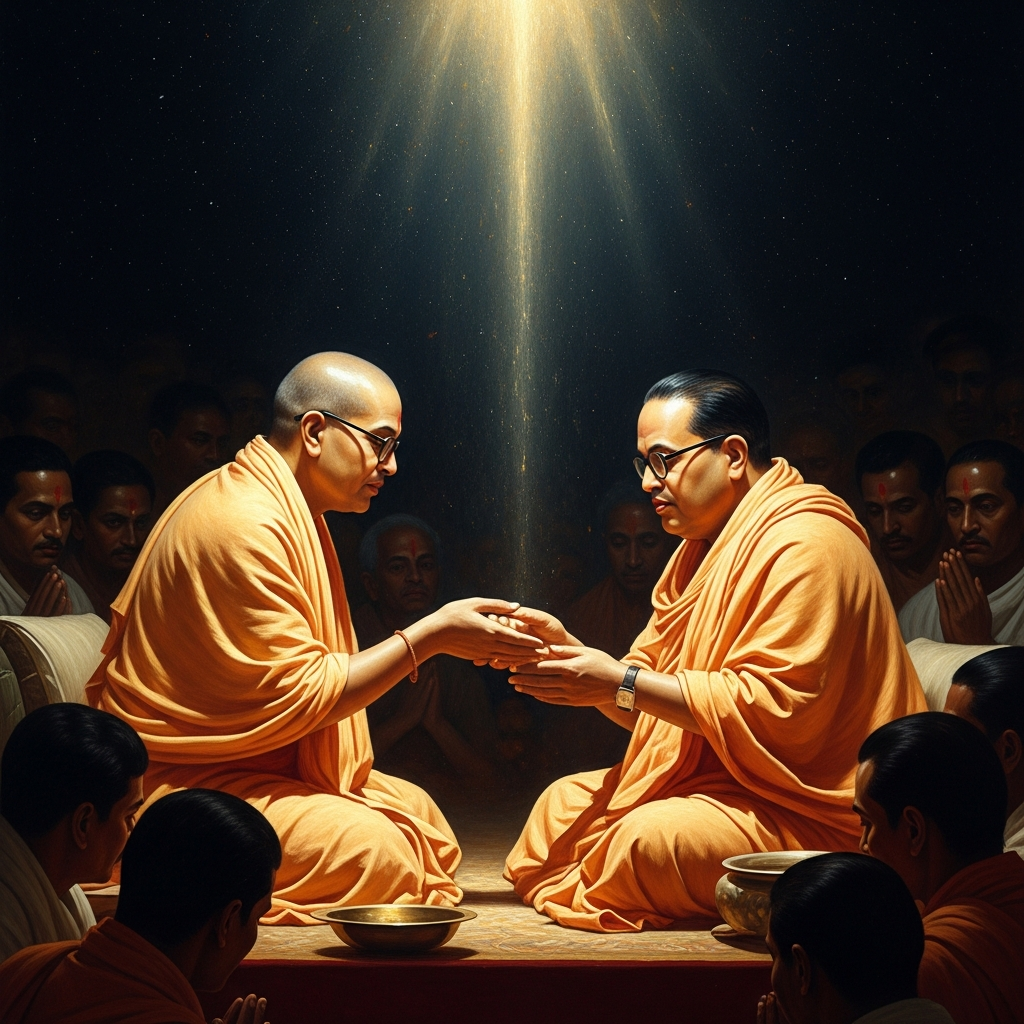
On October 14, 1956, on a wide field outside Nagpur in central India, the man who has written the constitution of independent India — the most highly educated person in the cabinet of the new republic, born untouchable, who has spent fifty years in litigation and protest and parliamentary debate trying to break the caste order from inside — walks onto a temporary platform with his wife at his side, takes the Three Refuges and the Five Precepts from a Burmese monk, and at the moment he formally becomes a Buddhist, half a million Dalits behind him stand and become Buddhists with him, and the largest single religious conversion in modern history happens in approximately ninety seconds.
- When
- October 14, 1956 CE
- Where
- Deekshabhoomi, Nagpur, Maharashtra, India
The field is enormous.
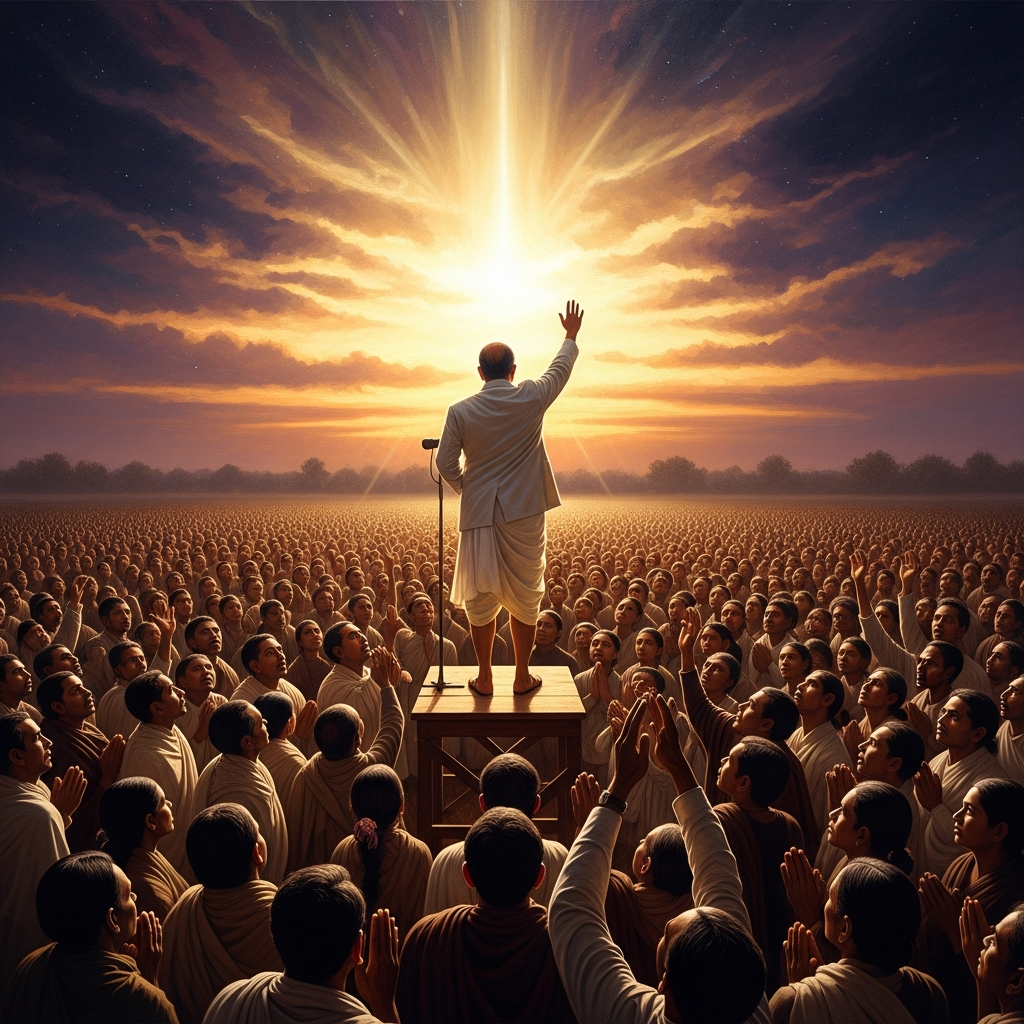
Half a million people have come to Nagpur. They have come by train, by bus, on foot. They have walked for days from villages in Vidarbha and the Deccan. They have left their work and their houses. They have brought their children. The local government has not been able to provide enough water. The vendors have run out of food by midday. The dust rises from the field in a thin, persistent cloud, and through the cloud the platform at the front of the field is visible only as a small white rectangle with a small dark figure on it.
The figure is sixty-five years old, barrel-chested, wearing a white kurta and a Western suit jacket against the autumn cool, leaning slightly on a cane because his diabetes has been worsening for years. His name, on every official document of the Republic of India, is Dr. Bhimrao Ramji Ambedkar. The people on the field call him Babasaheb. The word is honorific. It is also, by this date, possessive. He belongs to them. They have come to follow him into a different religion.
The day is the Vijayadashami — the day of victory in the Hindu calendar, traditionally the day of Rama’s defeat of Ravana, the day of the goddess Durga’s defeat of the buffalo demon. Ambedkar has chosen this date deliberately. He is, on the day his Hindu calendar marks as the festival of cosmic victory, ceasing to be a Hindu.
He has been preparing this moment for twenty-one years.
The preparation begins in 1935, in Yeola.
That year, Ambedkar — already a doctorate from Columbia, already a barrister of Gray’s Inn, already a doctorate from the London School of Economics, already the most highly educated Indian of his generation — stands before a conference of Dalits in the small Maharashtrian town of Yeola and announces a decision. He has spent his life trying to reform Hinduism from inside. He has tried temple-entry satyagraha. He has tried the Mahad water tank protest, where he led Dalits to drink from a public tank that caste Hindus had reserved for themselves. He has tried legislative pressure. He has tried argument. He has written Annihilation of Caste, a speech so direct that the organization that invited him to deliver it withdrew the invitation rather than print the text.
He has concluded that Hinduism, as a system, will not yield. The caste order is not an aberration on top of an otherwise egalitarian Hinduism. The caste order is structural to it. The Vedas legitimate it. The Manusmriti legalizes it. The reformers — Vivekananda, Gandhi, the Arya Samaj — have softened the surface and left the structure intact.
He says, at Yeola, the sentence that will define the rest of his life: I was born a Hindu. That was not in my hands. But I will not die a Hindu.
He does not announce, at Yeola, what he will become. He announces what he will not be. The choice of what he will become takes him another twenty-one years.
He studies.
This is the fact that has to be insisted on. The conversion is not impulsive. Between 1935 and 1956 Ambedkar reads, comparatively, the major religious traditions available to him. He studies Christianity — he is courted by Christian missionaries, who offer him institutional support, and he refuses, partly because he has watched the way Indian Christianity has reproduced caste even inside the church. He studies Islam — he reads the Qur’an, he meets with Muslim leaders, he is courted by leaders of the Indian Muslim community, and he concludes that Islam in South Asia, despite its theological egalitarianism, has not in practice broken the caste order either. He considers Sikhism — he meets with the Akali leadership, he respects the Sikh refusal of caste, and he has long conversations about whether the Dalits should convert as a body to Sikhism, but the negotiations break down over the question of how the converts will be politically protected.
He studies Buddhism. He has been studying Buddhism, in a sense, since childhood — he was given a biography of the Buddha as a school prize when he was a boy in a school where the caste teachers refused to touch him. He returns to it in his sixties as a scholar. He reads the Pali canon in translation. He reads the Dhammapada. He reads the Sutta Nipata. He reads the Mahayana texts. He talks with Burmese and Sri Lankan monks. He visits Buddhist sites.
He concludes that Buddhism is what he has been looking for. The Buddha’s teaching, as Ambedkar reads it, has four virtues that no other available tradition combines. It denies the authority of the Vedas. It denies the divine sanction of caste. It teaches the equal dignity of all sentient beings. And it does this not by appeal to revelation but by appeal to reason, ethics, and the verifiable conditions of suffering and its cessation.
It is a religion, he decides, that is also a method. The Dalits do not need a god to enthrone over their oppressors. They need a discipline by which to free themselves.
October 14, 1956.
He has been ill for years. His diabetes has worsened. He has had heart problems. His doctors in Delhi and Bombay have told him not to travel. He has come to Nagpur anyway, because he has decided that this conversion will be the public, formal, irrevocable act that closes his life’s argument with Hinduism, and he will not delegate it.
He has chosen Nagpur for a reason. It is the historic center of the Naga people, whose ancient connection to early Buddhism Ambedkar had argued in his scholarly writing. It is also the headquarters city of the Rashtriya Swayamsevak Sangh, the Hindu nationalist organization that opposes him. The choice of Nagpur is a deliberate confrontation: the conversion will happen on the doorstep of his enemies.
He arrives in the city the day before. He is exhausted. His wife Savita — whom he calls Sharada, who is a Saraswat Brahmin physician twenty years his junior, who has converted, intellectually, with him — is at his side throughout the journey. The platform has been built on a field outside the city. The arrangements have been made by a small organizing committee of Dalit leaders, mostly from Maharashtra, mostly Mahar by sub-caste, all of whom have been working on the logistics for months.
The ceremony is to be administered by Bhante U. Chandramani, an elderly Burmese monk who is the senior Theravada bhikkhu in India. Chandramani is in his eighties. He has come from Kushinagar, where he has been the principal monk at the site of the Buddha’s parinirvana for decades. He is the only person in India who can confer the formal Theravada conversion in unbroken lineage from the Burmese sangha.
Ambedkar and Savita ascend the platform. Chandramani is waiting, in saffron robes, with a small ceremonial table. The crowd — Ambedkar’s crowd, the half-million on the field — falls into a silence that the news photographs and the contemporary accounts both record as eerie. The dust hangs in the air. The microphones are working. The ceremony will be heard.
Chandramani begins the Pali. Buddham saranam gacchami. I take refuge in the Buddha. Ambedkar repeats it, in Pali, in his slightly accented voice, with Savita beside him. Dhammam saranam gacchami. I take refuge in the Dhamma. Sangham saranam gacchami. I take refuge in the Sangha.
The Three Refuges. Then the Five Precepts: not to kill, not to steal, not to commit sexual misconduct, not to lie, not to take intoxicants. He repeats each precept after Chandramani.
It takes about ninety seconds. At the end of it, in the formal sense, in the theological sense, in the legal sense, Bhimrao Ramji Ambedkar is no longer a Hindu. He is a Buddhist.
Then he turns to the crowd.
He has prepared twenty-two additional vows. They are not part of the standard Theravada conversion. They are his own composition. They are the most theologically aggressive part of the day. He reads them out, one at a time, and the half-million on the field repeat them after him, and the repetition is the conversion.
I shall have no faith in Brahma, Vishnu, and Maheshwara, nor shall I worship them.
I shall have no faith in Rama and Krishna, who are believed to be incarnations of God, nor shall I worship them.
I shall have no faith in Gauri, Ganapati, and other gods and goddesses of Hindus, nor shall I worship them.
I do not believe in the incarnation of God.
I shall not allow any ceremonies to be performed by Brahmins.
I shall believe in the equality of man.
The list goes on. Twenty-two vows. The crowd repeats them in unison. Each vow is a formal renunciation of a specific element of the Hindu inheritance. Each vow is a formal acceptance of a specific element of the Buddhist alternative.
When the twenty-two vows are finished, Ambedkar steps back. The half-million on the field have just become Buddhists. The administrative formalization will take days — the actual filling out of forms, the negotiation with district officers — but the religious act has happened. It cannot be undone.
The largest single religious conversion in modern history is over. It has taken less than half an hour.
Six weeks later, on December 6, 1956, Ambedkar is dead.
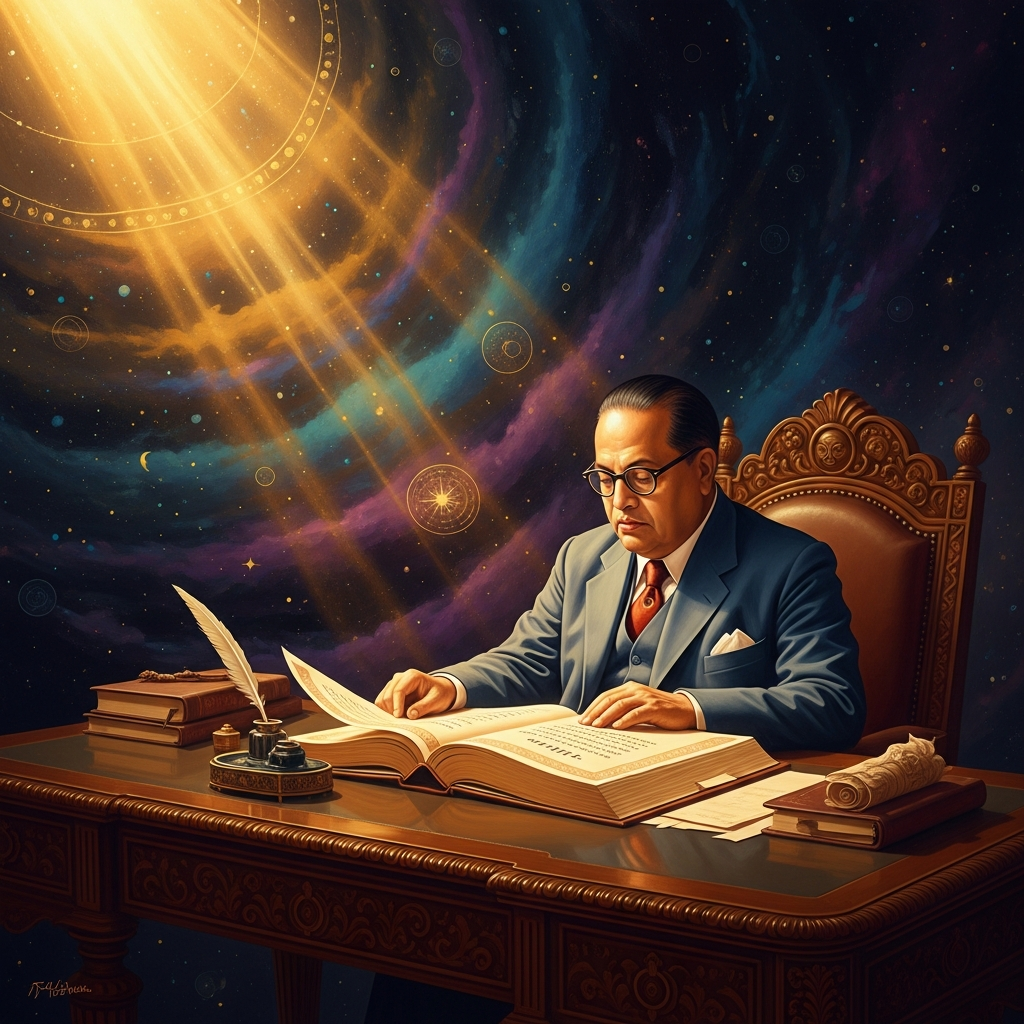
He dies in his sleep at his home in Delhi. He is sixty-five. He has been working, until the night before, on the manuscript of The Buddha and His Dhamma, his rewriting of the Buddhist tradition for the Dalit converts who now need it. The book is unfinished by the standards of academic completeness. It is, however, complete enough to be published the next year. It will become, in the decades that follow, the foundational text of Navayana — the new vehicle, the new yana — Ambedkarite Buddhism, the form of Buddhism practiced by the Dalit converts and their descendants.
The body is taken back to Bombay by train. Hundreds of thousands of Dalits line the route. The cremation happens on the beach at Dadar, attended by approximately a million mourners. His ashes are immersed in the sea.
The conversion movement that he had begun does not stop with his death. It continues. By the 2011 census, India has 8.4 million Buddhists, the great majority in Maharashtra, the great majority Dalit by birth, the great majority converted under the Ambedkarite tradition. Deekshabhoomi — the field at Nagpur — has been built up into a great memorial stupa, the largest hollow stupa in Asia. Every October 14, on the Dhamma Chakra Pravartan Din — the Day of the Turning of the Wheel of Dhamma — millions of Buddhists return to the field. They come, again, by train, by bus, on foot. They walk in processions. They take the Refuges and the Precepts again, in unison, on the spot where Ambedkar took them.
He had told them, in the months before his death, that this was the work. I have given you a religion, he said, that is yours. He had not founded a sect. He had not consecrated a clergy. He had given them, in his Buddha, a teacher who had also been born high and had walked away from his caste, who had also said that the old order was unjust, who had also organized the poor and the discarded into a sangha that did not ask whose father had been whose.
The wheel that turned at Sarnath, twenty-five centuries ago, had turned again on a dusty field in central India in 1956. Half a million people had been standing there to feel it move.
Scenes
B
Generating art… Half a million Dalits stand together on the field at Nagpur after Ambedkar's conversion — the largest single religious conversion in modern history, completed in minutes
 Generating art…
 Ambedkar at his desk with the manuscript of *The Buddha and His Dhamma*, finished six weeks before his death — the foundational text of the Dalit Buddhist movement
 Generating art…
 Echoes Across Traditions
Entities
- B.R. Ambedkar
- Savita Ambedkar
- Bhante U. Chandramani
- Jawaharlal Nehru
- the 500,000 Dalits at Deekshabhoomi
Sources
- B.R. Ambedkar, *The Buddha and His Dhamma* (1957, posthumous)
- B.R. Ambedkar, *Annihilation of Caste* (1936)
- Gail Omvedt, *Ambedkar: Towards an Enlightened India* (2004)
- Christophe Jaffrelot, *Dr. Ambedkar and Untouchability: Analysing and Fighting Caste* (2005)
- Dhananjay Keer, *Dr. Ambedkar: Life and Mission* (1954, revised editions)
- Eleanor Zelliot, *From Untouchable to Dalit: Essays on the Ambedkar Movement* (1992)