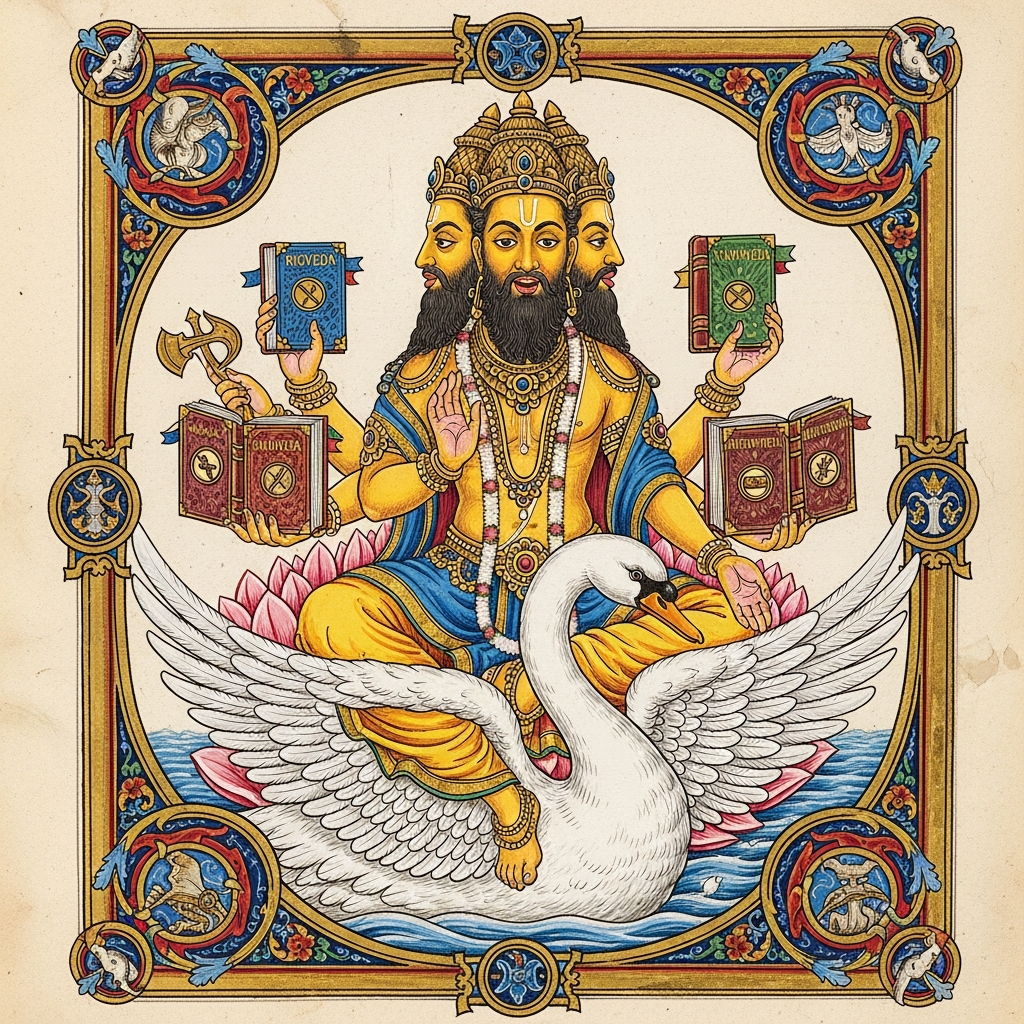
Phra Phrom and the Fulfilled Contract
1956 CE (shrine founding) — present day · The Erawan Shrine, Ratchaprasong Intersection, Bangkok, Thailand
Contents
Phra Phrom — the Thai form of the Hindu god Brahma — stands at the heart of the Erawan Shrine in Bangkok, receiving millions of petitioners who bargain with him for visas, babies, and business deals. A woman from Chiang Rai comes to pay her debt: her son recovered, as promised. She has brought the classical dancers she pledged. The dance is the payment. The theology is a fulfilled contract.
- When
- 1956 CE (shrine founding) — present day
- Where
- The Erawan Shrine, Ratchaprasong Intersection, Bangkok, Thailand
She has been holding the debt for eight months.
Her name is Nittaya. She is from a village outside Chiang Rai, in the north, where the hills begin and the roads narrow. She runs a small textile business — hand-woven fabric from the village women, sold to shops in the city. She is fifty-one years old, and practical in the way that women who have managed a business alone for twenty years become practical: she does not invest in things she has not researched, she does not make promises she cannot keep.
She made the promise in the emergency room.
Her son Arthit is twenty-three. He drove his motorcycle into the side of a truck on the road between Chiang Rai and Chiang Mai at seven in the morning in August, and the truck’s driver called the ambulance, and Nittaya got the call at nine-fifteen while she was opening the shop. She drove the three hours to the hospital as fast as the mountain roads permitted, arrived to find Arthit in surgery, and sat in the waiting room until the surgeon came out to tell her that the surgery was complete and that the next forty-eight hours would determine whether the damage to his spine was permanent.
She went, during those forty-eight hours, to every shrine in the hospital compound and made offerings at each one. This is not desperation or irrationality. It is the Thai understanding of due diligence: when the situation is serious, you make contact with every relevant party, you explain your situation to each one, you make clear what you are asking for.
At the small Phra Phrom image in the hospital’s garden, she made a specific bargain.
She said: if my son recovers fully and walks out of this hospital, I will hire the classical dancers and take them to the Erawan Shrine to dance in your honor. She said this precisely because Phra Phrom requires precision. The bargain must be specific. The payment must be specified in advance. You cannot say I will do something good later — you must say I will do this particular thing by this particular method.
She named the troupe she would hire, because she knew which troupe, because she had seen them perform at the Erawan Shrine when she visited Bangkok two years earlier and had noted, with the attention of someone who tracks quality, that their technique was excellent.
She burned the incense. She bowed three times. She went back to the waiting room.
Arthit walked out of the hospital eleven days later.
She paid the troupe’s fee in October.
The arrangement was straightforward: a specific program of classical dances, performed at the Erawan Shrine for a full hour, commissioned by Nittaya as fulfillment of a vow made to Phra Phrom during her son’s medical crisis. The troupe has done this many times. They know exactly what the shrine requires. They know how to position the performance so that the sound carries toward the image and the dancers face the correct direction and the full four-faced figure can see the full performance.
She arrived in Bangkok by overnight bus the night before, slept badly at a guesthouse near Pratunam, and was at the shrine by seven in the morning to make the preliminary offerings before the performance began.
The Erawan Shrine is not a quiet place.
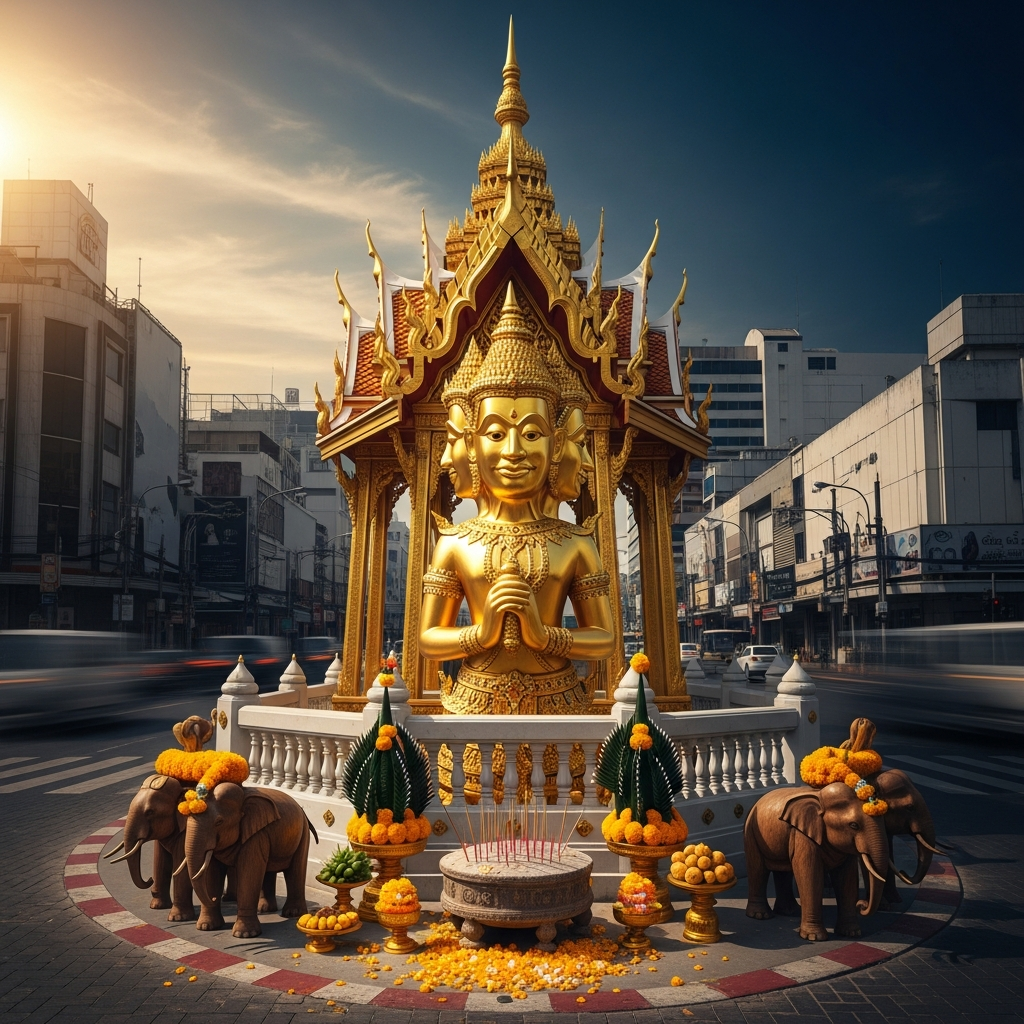
It sits at the corner of Ratchaprasong and Ploenchit Roads, in the middle of what has become one of the highest-value commercial districts in Bangkok. The Grand Hyatt is across the street. The CentralWorld shopping center towers behind the shrine compound. The Skytrain runs overhead. The traffic at the intersection is continuous, the noise is continuous, the air carries diesel exhaust and incense in approximately equal measure.
The shrine was built in 1956 as a remedy.
The Erawan Hotel — the building that preceded the Grand Hyatt on that site — was encountering problems during its construction: accidents, worker deaths, a general atmosphere of misfortune. The astrologers consulted identified the site as needing a protective spirit. A Brahma image was installed. The problems ceased. The Erawan Hotel opened successfully. Word spread.
Within a few years the shrine was one of the most visited sites in Bangkok. Within a few decades it was one of the most visited in Southeast Asia. The shrine has been restored and expanded multiple times; the original image was replaced in 2006 after a deranged man smashed it with a hammer and was immediately beaten to death by a crowd of bystanders, a scene that was described in news reports as a mob killing and in the neighborhood’s religious understanding as Phra Phrom defending his own honor.
The replacement image is identical to the original. The petitioners did not stop coming during the restoration. They left their offerings at the base of the scaffolding.
The dancers arrive at eight-thirty.
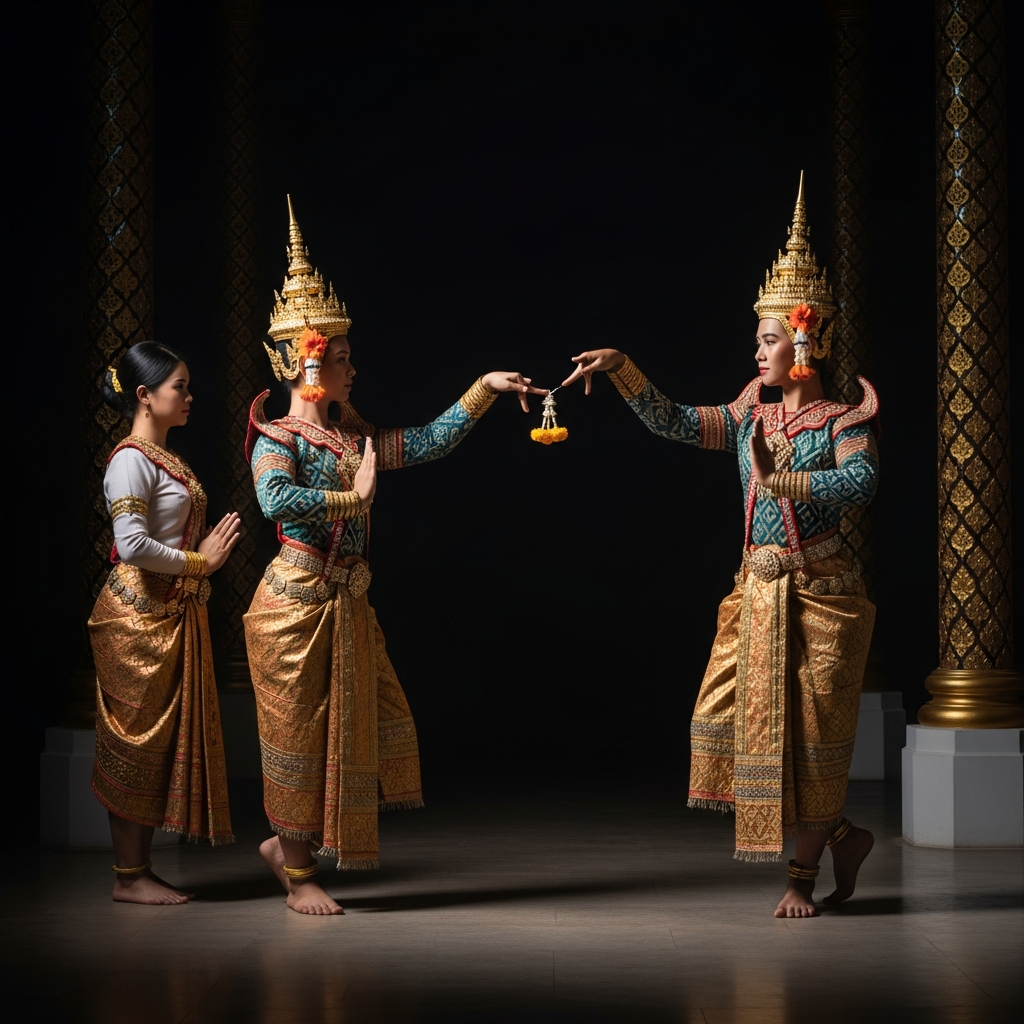
They are six women in full classical costume — silk brocade in red and gold, gilded headdresses that add another sixty centimeters of height, the layered ornaments of the court tradition. They set up their positions in the performance area immediately in front of the image. The troupe’s musician takes his place with the classical instruments. A small crowd has already gathered — shrine regulars, tourists, office workers cutting through on the way to the Skytrain.
Nittaya stands to the side, slightly behind the dancers.
The performance begins with the formal invocation. The lead dancer addresses Phra Phrom directly, acknowledging the occasion — a fulfilled vow, a debt being paid, a petitioner returning in gratitude rather than petition. The four-faced gold image looks in all four directions simultaneously. The morning light hits the western face first, then the northern, then the eastern as the sun climbs.
The first piece is a slow processional form, the gestures deliberate, the movement minimal by Western standards but dense with meaning in the classical vocabulary: hand positions derived from Sanskrit hand-gesture texts, body angles that encode relationships between the dancer and the figure she is addressing. This is not entertainment, though it can be appreciated as entertainment. This is communication in a formal register, the way the ritual address to the Neak Ta is communication in a formal register, the way the Latin mass is communication in a formal register — a mode of speech that requires training to produce and that carries information across the distance between the human and the sacred.
Nittaya watches.
She is not weeping. She is paying attention.
The theology of the fulfilled contract is not, in Thai understanding, cynical.
This is the misreading that Western commentators have made since the first European observers described the Erawan Shrine as a marketplace of prayer. The transactional structure — you ask, you receive, you pay — is not commerce degrading religion. It is religion taking seriously the nature of relationship.
In the Thai understanding, relationship with the sacred is not passive. It is not one-directional. The petitioner does not beg; the petitioner negotiates. The spirit does not give unconditionally; the spirit enters into a specific agreement. Both parties have obligations. The petitioner who does not fulfill their vow is in debt, and debt to a sacred being accumulates interest in the form of bad fortune. The petitioner who fulfills their vow has discharged the obligation fully and stands free — not in debt, not in credit, but in right relationship.
This is not commerce. It is stewardship of a relationship that has its own internal logic.
Phra Phrom receives the dance because the dance was promised and the promise was kept. The contract is now closed. Nittaya and her son are released from the specific obligation they undertook in the emergency room. They are free to begin new negotiations if new occasions arise, or to live without them if they do not.
This is not a low theology. It is an adult theology, premised on the idea that sacred beings are real, that relationships with them are real, and that real relationships have terms that must be honored.
The dancers move through the full program.
An hour of dance, the crowd thickening and thinning as the Bangkok morning advances. Office workers pause with their coffee cups. Tourists photograph. Shrine regulars circle the image three times clockwise with incense, the usual morning practice, moving around the dancers without disrupting them.
The shrine staff replaces the flowers at the base of the image. The carved wooden elephants — another traditional offering, specific to this shrine — are arranged and rearranged by the workers who manage the accumulated gifts. The incense smoke rises through the morning air and disperses into the diesel exhaust of the intersection.
The final dance is a sending-off form: the dancer formally signals the end of the performance, acknowledges Phra Phrom’s reception of the gift, and bows in the correct sequence. The lead dancer bows three times toward each of the four faces. The music ends. The crowd applauds lightly.
Nittaya bows to the image.
She burns the final incense. She says, in the formal Pali-derived Thai of prayer: the debt is paid, the promise is fulfilled, may this be accepted. She does not ask for anything else.
She collects her bag. She thanks the dancers individually, pressing the envelopes with their fees into their hands with both of hers. She walks to the Skytrain and rides back toward the bus terminal, past the towers of glass and steel, past the department stores, past the construction cranes building the next thing, through the city that Phra Phrom watches from his corner in all four directions simultaneously.
The shrine was built to fix a construction problem. It fixed the construction problem. It then became the place where millions of people brought every other problem they had, because a god who fixes construction problems can fix anything, and a relationship that works once is worth maintaining.
Brahma the Creator, the most abstract of the great Hindu trinity, the god of pure origination, the being too remote for ordinary petition — he has become, in the hands of Thai popular religion, the god who will hear your particular case. The four faces look in all four directions because the petitioner arrives from all four directions. The shrine works because it was always, in some form, going to be there: a place at the crossroads where a human being can stand and say I need something specific and be heard.
Arthit is back in Chiang Rai. He drives more carefully now. His mother made a bargain in an emergency room in August and fulfilled it on a Wednesday morning in Bangkok in the presence of six classical dancers and a hundred strangers. The contract is closed. The god acknowledged it from all four directions.
This is what it means for a relationship with the sacred to be real: both parties had to show up.
Scenes
The Erawan Shrine at Ratchaprasong intersection, Bangkok: a golden pavilion at the corner of one of the busiest commercial intersections in Southeast Asia, surrounded by offerings of flowers, incense, and carved wooden elephants
 Generating art…
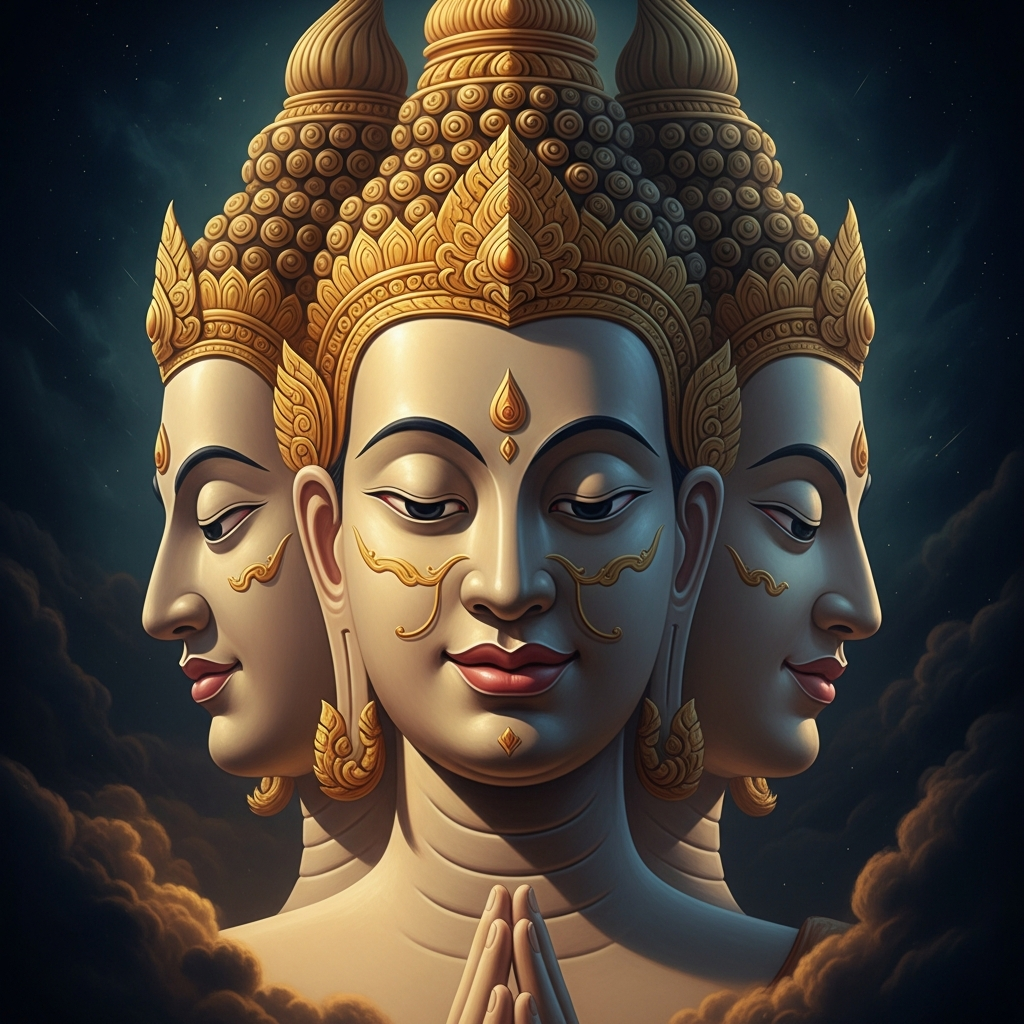
 The four faces of Phra Phrom, each wearing a different expression: benevolence, mercy, sympathetic joy, equanimity — the four divine attitudes of Theravada Buddhism mapped onto the Hindu four-headed Creator
 Generating art…
 The hired classical dancers at the Erawan Shrine, performing the khon repertoire in full costume — gilded headdresses, silk brocade, the precise hand gestures of a tradition trained for the court
 Generating art…
 Echoes Across Traditions
Entities
- Phra Phrom
- Brahma
- Erawan Shrine

Sources
- Justin McDaniel, *The Lovelorn Ghost and the Magical Monk: Practicing Buddhism in Modern Thailand* (Columbia University Press, 2011)
- Stanley J. Tambiah, *Buddhism and the Spirit Cults in North-East Thailand* (Cambridge University Press, 1970)
- Patrice Ladwig, *Remaking Buddhism for Medieval Nepal: The Fifteenth-Century Reformation of Newar Buddhism* (Routledge, 2011)
- Charles Keyes, *The Golden Peninsula: Culture and Adaptation in Mainland Southeast Asia* (1977)
- Andrew Alan Johnson, *Ghosts of the New City: Spirits, Urbanity, and the Ruins of Progress in Chiang Mai* (University of Hawaii, 2014)