I Loved All Those People
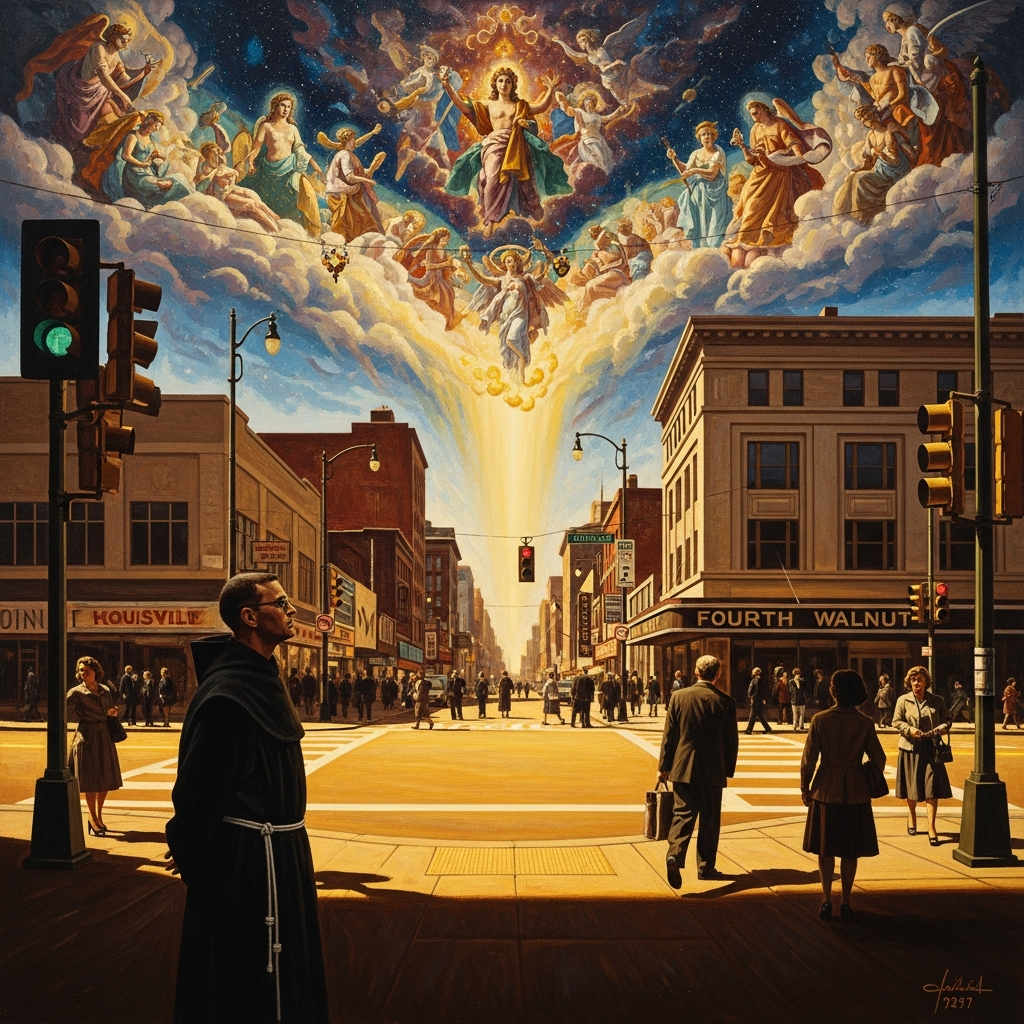
March 18, 1958 · the corner of Fourth and Walnut, Louisville, Kentucky · Louisville, Kentucky — the shopping district at Fourth Street and Walnut Street (now Muhammad Ali Boulevard)
Contents
On a bright March morning in Louisville, a Trappist monk steps off the monastery bus and onto a city corner — and is struck, without warning, by an overwhelming love for every stranger in front of him, a love that dissolves the wall he has spent fourteen years building between himself and the world.
- When
- March 18, 1958 · the corner of Fourth and Walnut, Louisville, Kentucky
- Where
- Louisville, Kentucky — the shopping district at Fourth Street and Walnut Street (now Muhammad Ali Boulevard)
He is in Louisville on abbey business.
This is the rare thing, the permitted thing — a monk with a reason to leave the enclosure, a signed permission, a task in the city. Thomas Merton has been at Gethsemani since December 10, 1941, sixteen years and three months. He entered at twenty-six, a Columbia graduate, a failed novelist, a man who found the monastic wall and ran toward it. He has kept his vows. He has written thirty books. He is the most famous monk in America and simultaneously, genuinely, enclosed — behind the grille, within the hours of the Divine Office, inside the silence.
The city is not his world. The city is what he left.
He steps off the bus at Fourth and Walnut and waits for the light.
The corner is ordinary.
It is 1958. The street is full of weekday shoppers — women with bags, men in hats, a child pulling at someone’s sleeve, the traffic of a mid-sized American city doing its mid-morning business. None of them are looking at the monk. None of them know what is about to happen to him. He is watching them the way a man watches a street he does not belong to, with the mild separateness of the enclosed religious — the sense that his real life is behind the wall back in Nelson County, that the world before him is the world he renounced, correctly, for God.
And then, without preparation, without warning, without any of the usual grammar of mystical experience — no light, no voice, no ecstatic dissolution — it arrives.
It is love.
Not sentiment, not goodwill, not the managed charity of a man who prays for the world at Lauds. It is love the way oxygen is oxygen — total, present, with no distance between him and the object of it. He loves every person on this corner. He loves them as his own. He looks at the strangers and feels, with the certainty of perception rather than the effort of prayer, that they are his and he is theirs, that the wall he built — the monastic wall, the spiritual wall, the wall of being set apart — is a dream from which he has just woken up.
He writes it in his journal that night, and years later in Conjectures of a Guilty Bystander, and the language barely holds what happened: I was suddenly overwhelmed with the realization that I loved all those people, that they were mine and I theirs, that we could not be alien to one another even though we were total strangers. It was like waking from a dream of separateness.
The dream, he realizes, was not the world. The dream was the wall.
For sixteen years he has lived inside a theology of flight — fuga mundi, the flight from the world, the monastic premise that holiness is achieved by putting maximum distance between the soul and the contaminations of history, politics, other people’s sufferings. He wrote The Seven Storey Mountain inside that theology. He climbed the levels of the mountain toward God by leaving the city below. The book sold six hundred thousand copies and sent young men to monasteries across the country.
He stands on the corner and understands, in the body, that the mountain was not above the city. The mountain was here. He is standing on it. Every face going past him is the face he has been seeking in the dark chapel at three in the morning. The shopping street is the burning bush. He is standing on holy ground and he is not required to take his shoes off because the ground has always been holy and the shoes have always been off.
He is not the monk set apart. He is the waking center of a world that was never asleep.
He goes back to Gethsemani that afternoon.
He carries the corner back with him. The wall of the enclosure does not fall — he will live behind it for the rest of his life, with one exception. But something has permanently shifted in what the wall is for. He begins to write differently. He writes about race in 1961, when almost no white Catholic writer is writing about race. He writes against nuclear weapons. He writes about Vietnam in terms that get him censored by his Cistercian superiors. He begins a correspondence that becomes a book, with D. T. Suzuki, on Zen and Christian contemplation. He writes to Boris Pasternak. He writes to Czesław Miłosz. He writes to the Dalai Lama.
The monk who fled the world becomes its most alert correspondent, because on a street corner in Louisville, in the middle of an ordinary Tuesday, he discovered he was never separate from it.
He is found dead in Bangkok on December 10, 1968.
He is at a conference on East-West monastic dialogue. He has just given a lecture on Marxism and monasticism. He is electrocuted by a faulty standing fan in his hotel room — an accident so mundane it seems like a rebuke to the grandeur of his theology. He dies on the twenty-seventh anniversary of the day he entered Gethsemani. He is fifty-three years old. His body is flown home to Kentucky in a U.S. Air Force plane carrying the dead from Vietnam.
He is buried in the monastery’s cemetery, under a plain white cross. The corner at Fourth and Walnut — now Fourth and Muhammad Ali Boulevard — has a bronze plaque on the wall. It quotes the journal entry. Thousands of people take photographs of it each year, most of them strangers to one another.
He was trying to flee the world, and the world was trying to find him. Both of them succeeded on the same morning.
The Louisville revelation is not a miracle in the technical theological sense. No laws of physics are suspended. Nothing appears in the sky. A man stands on a street corner and feels, suddenly and completely, what the mystics of every tradition had been insisting was simply true: that the separateness of the self is the illusion, and the love is the fact. The Vedantist calls it Atman recognizing Brahman. The Buddhist calls it the end of the illusion of a separate self. Merton called it waking up.
He spent the rest of his life trying to describe a Tuesday morning on a Kentucky street corner, and he never quite got it, and neither has anyone else.
Scenes
The corner of Fourth and Walnut, Louisville, 1958 — morning shoppers, a monk in black, and a vision no cloister wall could have produced
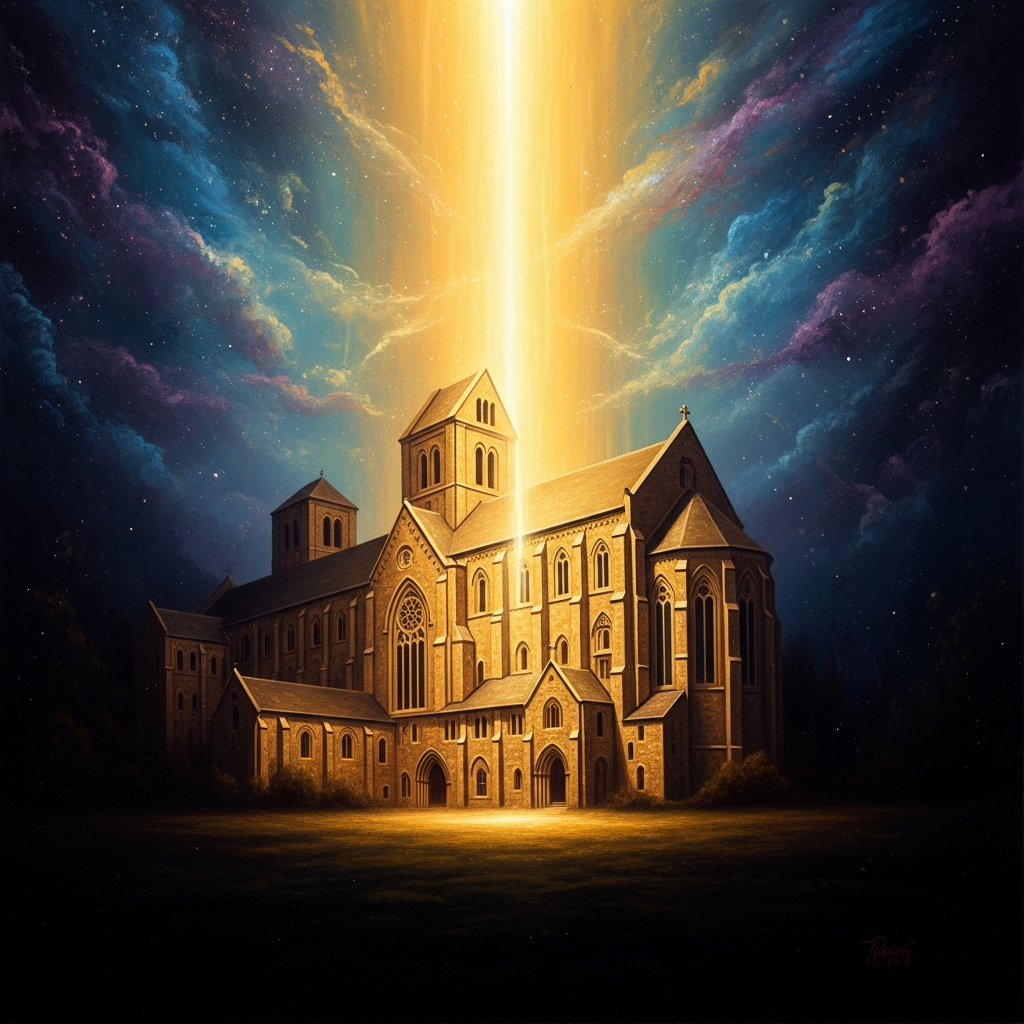
Generating art… Our Lady of Gethsemani, Kentucky — the abbey Merton entered in December 1941 and where he returned, changed, from Louisville
 Generating art…
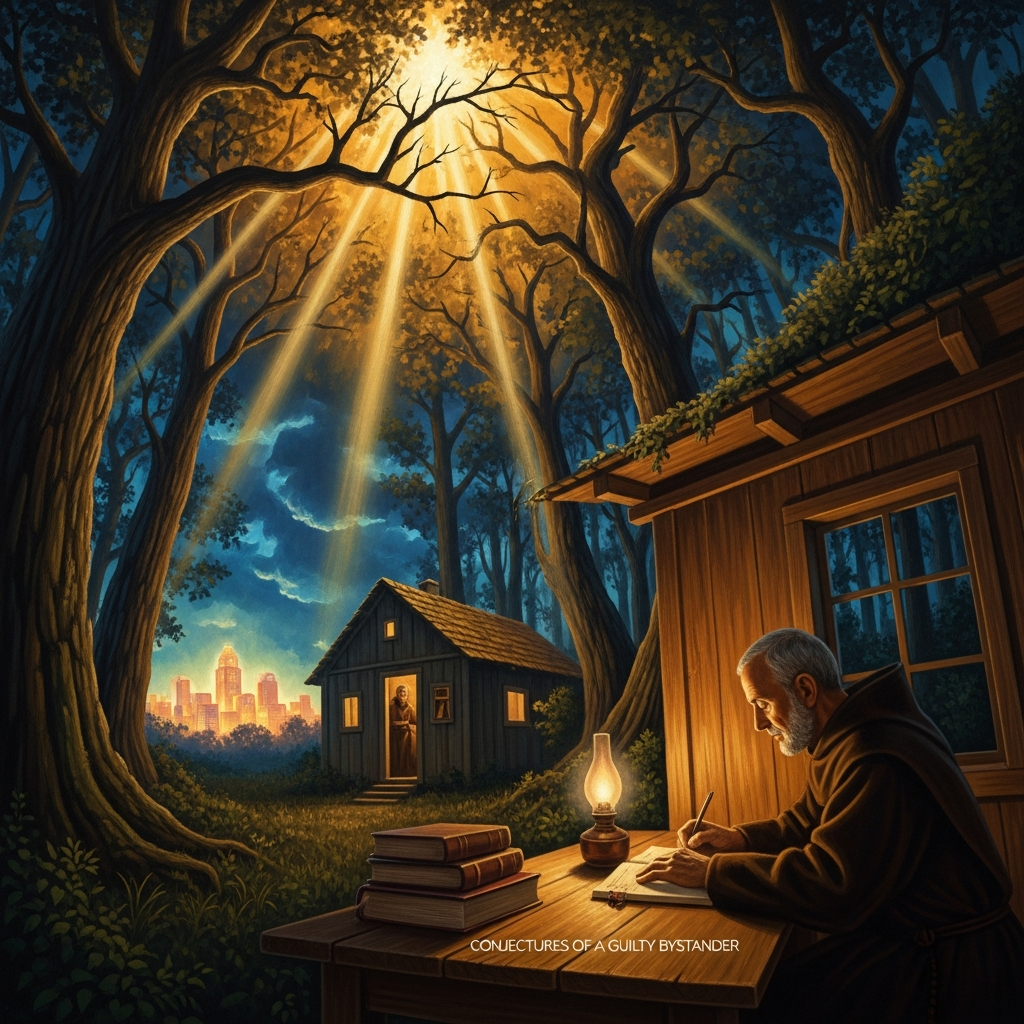
 The hermitage at Gethsemani — where Merton wrote *Conjectures of a Guilty Bystander* and named Louisville the center of his interior life
 Generating art…
 Echoes Across Traditions
Entities
- Thomas Merton
- Our Lady of Gethsemani Abbey
- the Fourth and Walnut Corner
Sources
- Thomas Merton, *Conjectures of a Guilty Bystander* (1966)
- Thomas Merton, *The Sign of Jonas* (1953)
- Thomas Merton, *The Seven Storey Mountain* (1948)
- Michael Mott, *The Seven Mountains of Thomas Merton* (1984)
- James Finley, *Merton's Palace of Nowhere* (1978)