What the Titans Left Inside Us
Mythic Time · Orphic theology systematized c. 6th century BCE · The cosmos before memory — the place before the earth took its current form
Contents
The Titans lure the infant Dionysus with toys — a spinning top, a mirror, knuckle bones. He reaches for the mirror and they tear him into seven pieces. From their ashes, humans are made. The god we killed is still inside us.
- When
- Mythic Time · Orphic theology systematized c. 6th century BCE
- Where
- The cosmos before memory — the place before the earth took its current form
Before the toys are set out, the faces must be painted.
The Titans are old — older than the Olympian gods, older than the arrangement of the heavens that Zeus imposed after the war. They are the generation before order, the powers that held the cosmos when the cosmos was a different shape. They know what they intend to do. They have been sent by Hera, in some tellings, or they have decided on their own, in others, because the child is too bright and too central and too loved, and these things have never sat well with the powers that predate him.
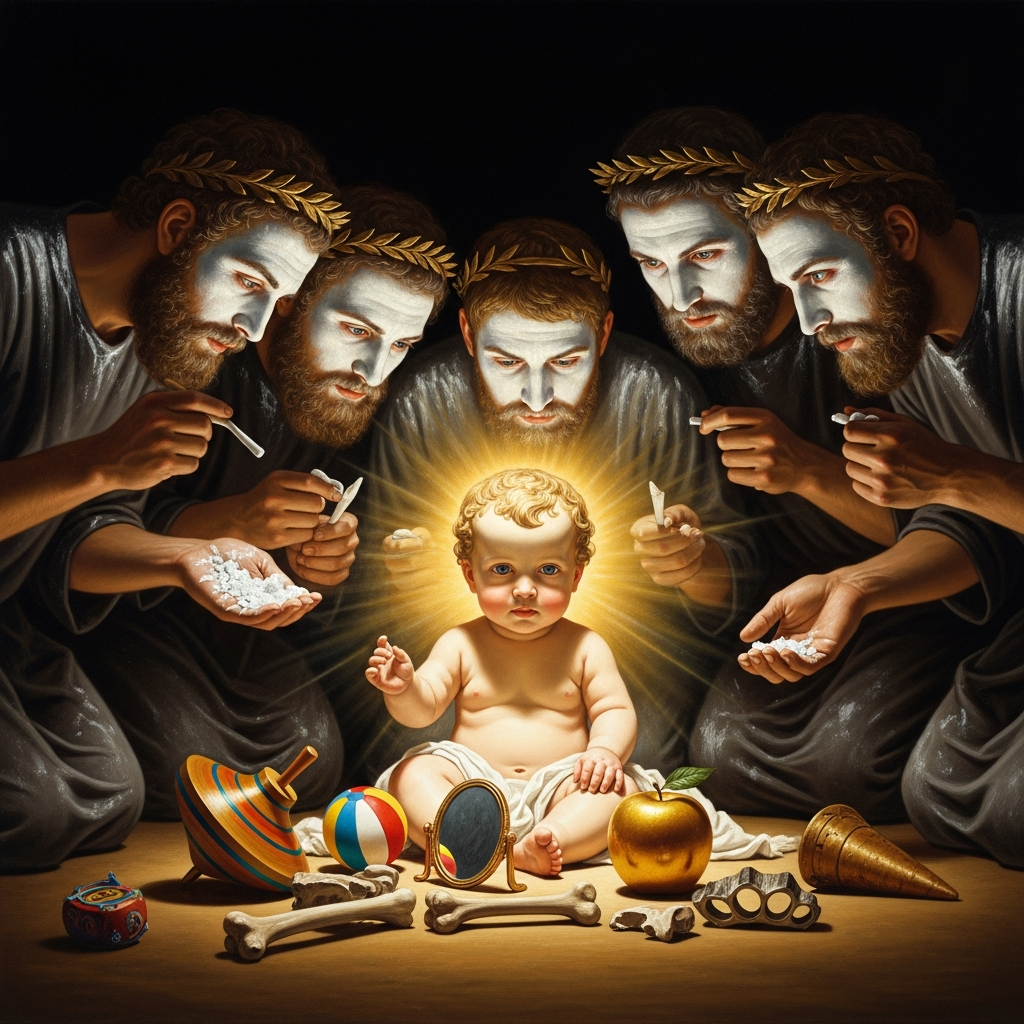
They paint their faces chalk-white. The Orphic texts call this the titanization of the face — the whitening that makes them something other than what they are, the ritual disguise of the world-breakers. Then they lay out the toys.
The toys are beautiful.
This is the cruelty of the story, and the Orphic teachers insisted on it: the Titans do not come at the infant god with weapons. They come with gifts. The spinning top — the strophalos — that hums when it spins and traces patterns in the air that look like they mean something. The golden ball, perfect, round, the kind of object that exists to be held. Knuckle bones, which are the ancient game, the original randomness, the way fate is practiced in miniature. A cone, a golden apple, mirrors.
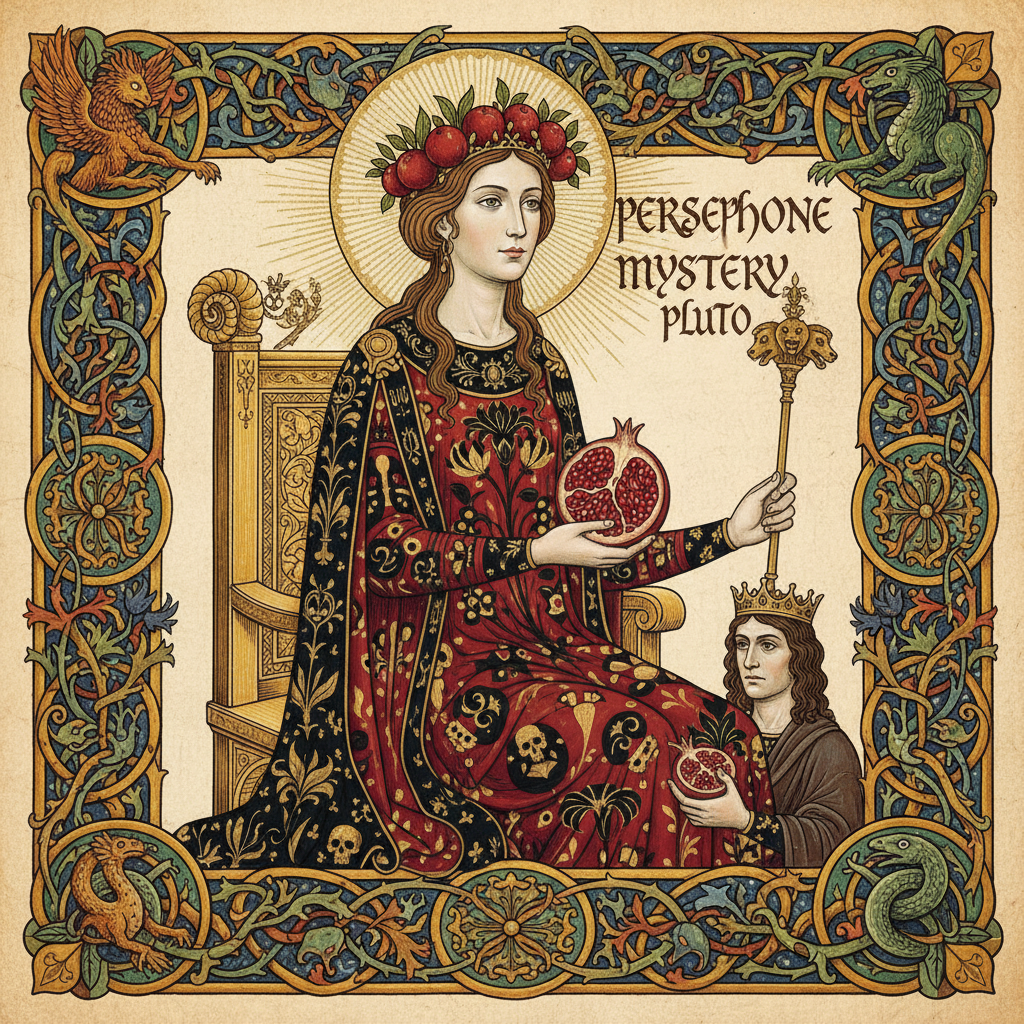
The infant Dionysus is the child of Zeus and Persephone — not the Semele of the Olympian stories, but Persephone, the queen of the underworld, which is why the Orphic Dionysus is doubly divine, born of the sky and the deep simultaneously. He is being raised in a hidden place. He is meant to inherit the cosmos from his father.
He sees the toys.
He is a child. He reaches.
The mirror is the critical object.
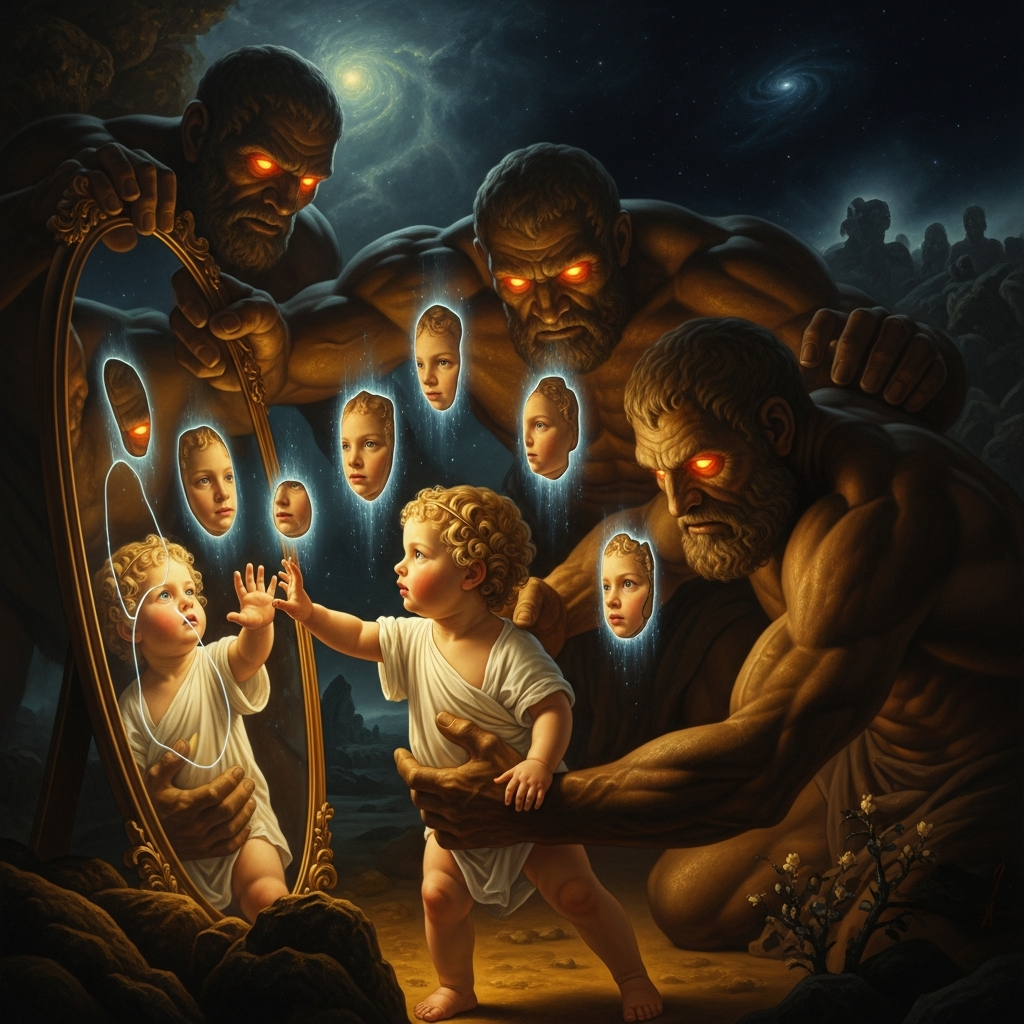
The Neoplatonists who later systematized the Orphic theology spent considerable effort on the mirror. Plotinus and Proclus wrote about it: the mirror is matter itself, the reflective surface that tricks the soul into seeing a self outside itself and reaching toward that image, falling into the material world the way a face falls into water when it leans too close. Dionysus reaches for his reflection. In that reaching, in the moment when the divine grasps for its own image in the world’s surface, the Titans have him.
They seize the child.
They tear him into seven pieces.
The accounts vary on the number — some say seven, some say fourteen, some do not specify. What they agree on is the dismemberment and what comes after: the Titans cook the pieces on spits and eat them. They eat the god. Athena — in some versions — arrives in time to save the heart, still beating, and carries it to Zeus. Zeus swallows the heart. From the heart, from the saved remnant of the killed divine, Dionysus is reborn — first from Zeus himself, then given to Semele, born into the mortal world through mortal flesh, born with the scar of the killing already written into the pattern of his existence.
Then Zeus looks at the Titans.
He raises the thunderbolt.
What falls from the sky is not punishment exactly.
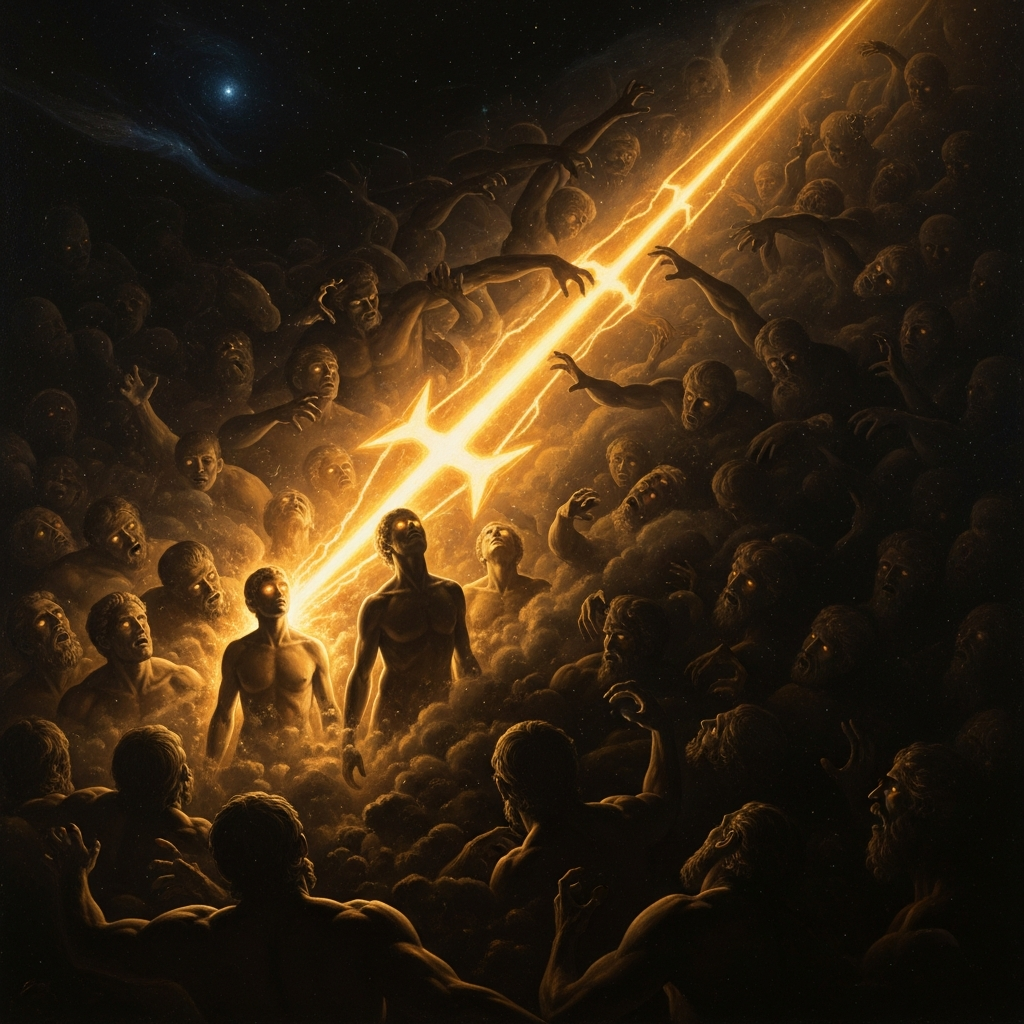
It is the original act of creation — the one the Orphic cosmology had been building toward since before the Titans painted their faces. The thunderbolt strikes the Titans and they burn. Not burn to nothing: burn to ash, to the specific grey residue that is the Titans plus the god they swallowed, inseparable now, commingled in the burning. And from the ash, from the mixed remains of the divine killers and their divine meal, the first humans rise.
This is the Orphic anthropology. This is why we are what we are.
We are made of Titans. We carry in us the earthly heaviness, the opacity, the hunger of beings who existed before the gods imposed order and who resented what they could not be. The Titanic element in us is matter, appetite, the body that wants and forgets and tears things apart. We recognize it. We know what it is to be Titanic: to see something beautiful and reach for it without asking whether reaching is the right response.
But the Titans had eaten Dionysus.
So we also carry, locked inside the Titanic ash of our bodies, a fragment of the divine fire that was in the god before they killed him. The Dionysiac element. The spark. The thing in us that recognizes music and grief and the smell of pine smoke and the particular beauty of a star. The thing that stands at the threshold of the mysteries and knows, before anyone explains it, that this is what it has been looking for.
The Orphic teacher in the golden tablets is very clear about the consequence of this cosmology. The soul is divine. It has been imprisoned in a succession of mortal bodies as a punishment for the Titans’ crime — a crime it did not commit, but carries, because it is made of the ash of those who did. It will keep cycling through bodies — human, animal, back to human — until the Titanic element is purged and only the Dionysiac remains.
Purification is the word they use. Catharsis. The same word Aristotle uses for what tragedy does to an audience — and Aristotle was writing about Dionysiac theater, the drama performed at the festivals of the god who was torn apart and reborn. He knew what word he was using.
The mysteries are the mechanism of purging. The initiate descends symbolically. The initiate eats and drinks — raw meat in the Dionysiac rites, the flesh of the animal that carries the god, the same eating the Titans performed but now reversed and sanctified, the human taking the divine in instead of destroying it. The initiate comes back up. Over enough lifetimes, over enough cycles of descent and return, the Titanic element burns away.
What remains is the spark.
What does it feel like to carry the spark?
The Orphic tradition was not interested in describing it in ordinary language, because ordinary language is a Titanic product — it divides and names and separates, which is what the Titans did to the god’s body. The spark is not something the Titanic vocabulary can reach. The mysteries were designed to bypass the vocabulary and produce a direct experience.
But the theology implies a shape for it. If the Titanic element is heaviness, opacity, hunger, appetite, the desire to possess and consume — then the Dionysiac element would be something like luminosity, permeability, the capacity to be moved without needing to possess the moving thing. The initiate who has done the work of many lifetimes does not tear apart the beautiful thing. They let it pass through them. They are permeable to the divine fire in a way the unpurged human is not.
Dionysus, after all, is the god of wine and ecstasy — which is to say, the god of the dissolution of the self’s hard edges. The god of the state in which you stop being Titanic, stop being opaque and possessive, and become briefly transparent. The festivals of Dionysus were not celebrations of drunkenness but of a specific experience that wine could approximate: the temporary dissolution of the boundary between the self and the divine.
The Orphic initiation was the permanent version.
Zeus still holds the thunderbolt.
The Orphic cosmology circles back to him at the end: after enough purifications, after the Titanic element is gone, the spark returns to the divine. The cycle closes. The god scattered in the killing is gathered back. This is what the philosophers called the apokatastasis, the restoration — the idea that everything that fell will be raised, everything scattered will be gathered, every spark of Dionysus distributed through the Titan-ash of human bodies will find its way back to the fire it fell from.
The Titans are not pardoned. The crime stands. But the consequence of the crime — the distribution of divine fire through mortal matter — is not a tragedy. It is a long project. The Orphic initiates are the humans who know what project they are part of.
They carry the toys in their minds: the spinning top, the mirror, the golden ball. They know the moment the child reached for the reflection. They have been reaching for it themselves, in body after body, and the initiation is the first time they have stopped reaching and recognized what they were doing.
The Orphic myth was not widely known in the ancient world. It circulated in written texts — the Rhapsodic Theogony, sometimes called the Orphic Theogony — and in the communities of initiates who used the gold tablets and performed the rites. Plato knew it: the Phaedo, the Meno, the Republic all carry Orphic assumptions about the soul’s imprisonment in the body and its gradual purification across multiple lives. The Neoplatonists systematized it. The Gnostics repurposed it, replacing the Titans with archons and the divine spark with pneuma but keeping the structure.
The deepest implication of the myth is the one the Orphic teachers worked hardest to convey: the divine is not out there, waiting. The divine is in here, already — inherited from a crime so old no individual committed it, locked in the ash-body like a coal banked in grey powder, needing only the right breath to glow. The Titan in us tears things apart. The Dionysus in us remembers what it was before the tearing.
Both are us. The work is knowing which is which.
Scenes
The Titans paint their faces white with chalk and set the toys before the infant god: spinning top, ball, mirror, knuckle bones, a golden apple, a cone
 Generating art…
 The child reaches for the mirror
 Generating art…
 Zeus's thunderbolt falls on the Titans
 Generating art…
 Echoes Across Traditions
Entities
- Dionysus
- Titans
- Zeus
- Persephone
- Athena

Sources
- M.L. West, *The Orphic Poems* (1983)
- Walter Burkert, *Ancient Mystery Cults* (1987)
- W.K.C. Guthrie, *Orpheus and Greek Religion* (1935)
- Olympiodorus, *Commentary on Plato's Phaedo* (6th c. CE) — the fullest extant account
- Radcliffe Edmonds, *Redefining Ancient Orphism* (2013)