The Brotherhood at Croton
c. 530–495 BCE · Croton, Magna Graecia · Croton, a Greek colony on the toe of southern Italy, later Metapontum
Contents
Pythagoras establishes his community at Croton in southern Italy around 530 BCE: no beans, no white roosters, five years of required silence, mathematics as religious practice. He claims to remember his previous lives. The brotherhood lasts four decades until a political crisis destroys it — and the surviving members scatter across the Greek world, carrying his ideas into Plato and Kepler and the modern physicist's faith that reality is mathematical at its base.
- When
- c. 530–495 BCE · Croton, Magna Graecia
- Where
- Croton, a Greek colony on the toe of southern Italy, later Metapontum
The first thing a new initiate learns is that he will not speak for five years.
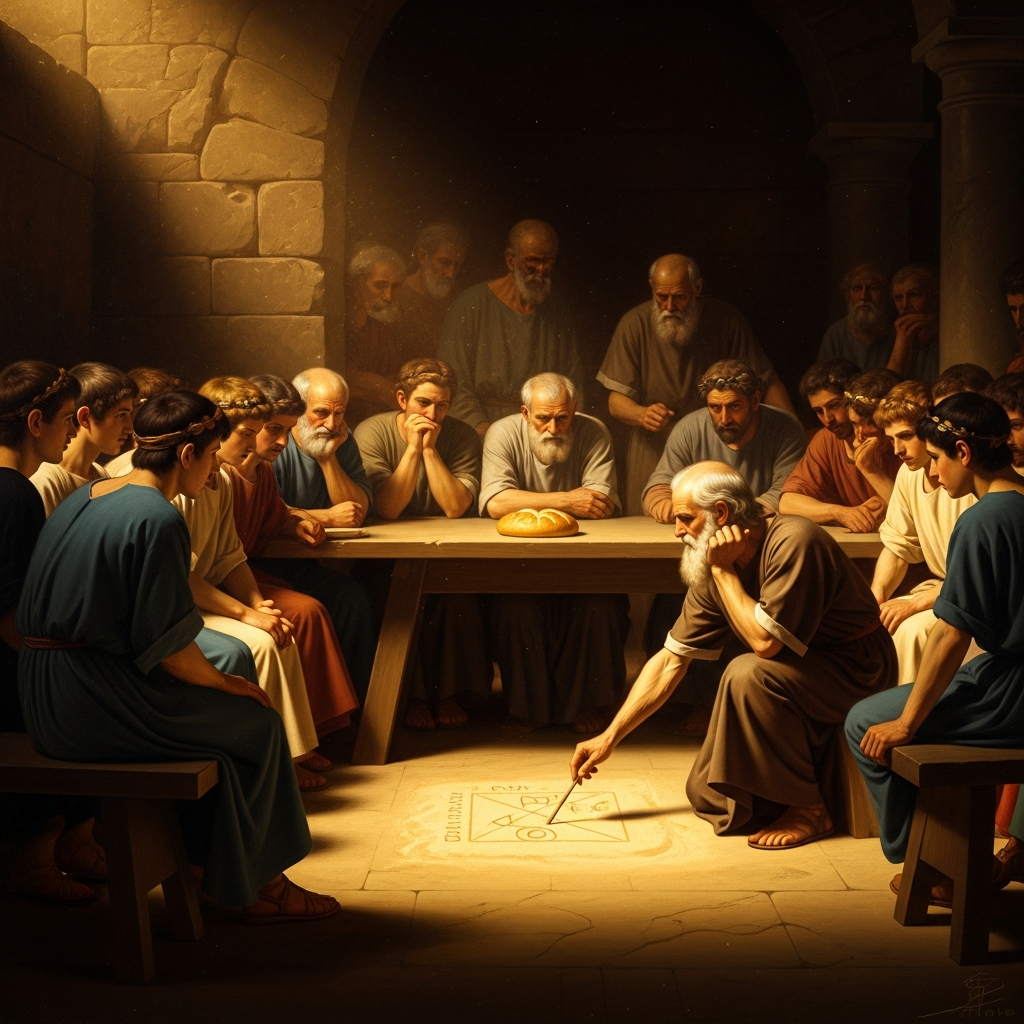
Not less. Not approximately. Five years. He may sit in the hall where Pythagoras teaches. He may watch the demonstrations on sand — the geometric proofs, the numerical ratios, the diagrams that prove the whole cosmos hums with mathematical proportion. He may eat at the communal table and sleep in the communal quarters. He may not ask a question. He may not correct an error. He may not agree aloud. He is an akousmatikos, a listener, and what he is learning — before any mathematics, before any cosmology — is how to listen without the interference of his own noise.
Pythagoras has a theory about what five years of silence does.
The theory is that most human cognition is reactive, and reactive cognition cannot perceive the structures that underlie appearances, because reactive cognition is too busy reacting to appearances to notice anything beneath them. The cosmos has a structure. The structure is mathematical. Mathematics is not a human tool for describing the world; mathematics is the language the world was written in, the grammar of being. To perceive this directly — not to calculate it, but to see it — requires a quieting of the reactive mind, and the instrument for that quieting is silence.
Five years. Then, if the silence has produced what silence is supposed to produce, you advance to the mathematikoi, the learners, and begin to speak.
The community at Croton occupies a large house near the center of the city with a garden, a meeting hall, communal sleeping quarters, and the central table.
The table is a sacred object. It is round, like the cosmos. The bread — artos, the round loaf — is never broken at this table. To break bread is to scatter what holds the dead together; the Pythagoreans take the dead with great seriousness, because they believe they have been the dead before and will be again, in other bodies, in other lives, the soul cycling through forms the way the musical interval cycles through octaves — the same ratio at different scales.
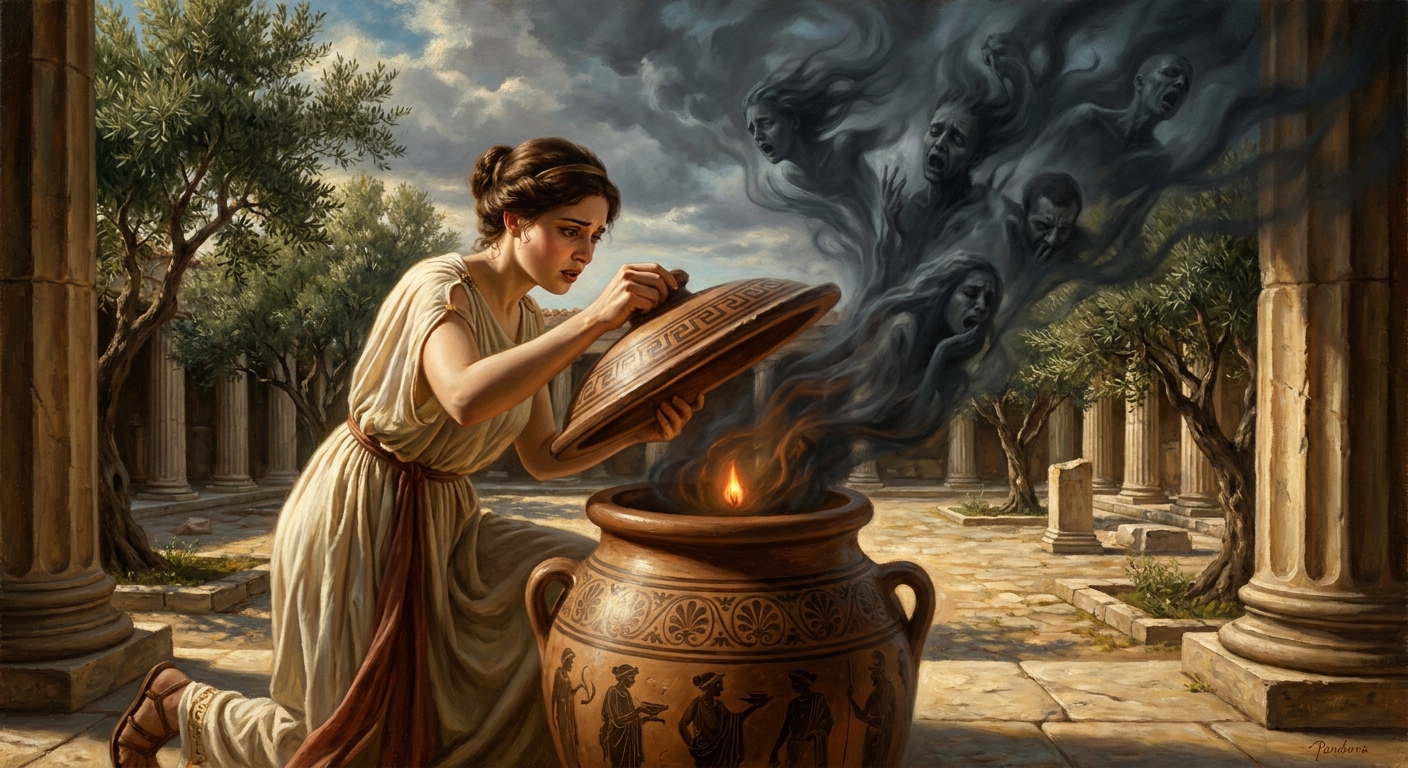
Pythagoras claims to remember four previous lives. He was, by his own account, Euphorbus, a Trojan warrior mentioned in the Iliad — he claims he can remember the feeling of the spear that Menelaus drove through his body. He was Hermotimus, a holy man of Clazomenae whose soul could leave his body during trances. He was Pyrrhus, a Delian fisherman. Before all of these, he was Aethalides, the herald of the Argonauts, who was granted by Hermes the boon of remembering all his lives in succession.
This is not presented as metaphor. He means it literally, and his followers believe him, and the belief structures everything else: if souls transmigrate, then purity of life in each incarnation affects the quality of the next; the mathematics of the cosmos is not merely an intellectual puzzle but the map by which the soul navigates its way back to the divine.
The akousmata — the things heard — are the rules of the community. There are dozens. They have been transmitted orally since the founding and will continue to be transmitted orally; the Pythagoreans do not write them down. The refusal to write is itself part of the teaching. Writing externalizes knowledge, puts it outside the student where anyone may pick it up without preparation, where it can be copied without understanding, where it becomes information instead of transformation.
The akousmata have the quality of riddles precisely because their purpose is not efficiency but contemplation. A rule that makes immediate sense requires no thought. A rule that makes no obvious sense demands that the student sit with the question until the question dissolves into something the question could not have predicted.
Do not eat the heart. The heart is the seat of grief. Do not consume your own grief. Do not make your grief into food.
Do not look in a mirror beside a lamp. Do not examine yourself by artificial light. The truth of the self is not available in the light you made; it is available in the light that was already there.
Do not stir a fire with iron. A fire is anger. Iron is a weapon. Do not stoke anger with force.
When you rise from a bed, smooth the sheets and leave no impression of your body. The form of the self should not persist in its own absence. Do not leave a mold of yourself for others to find.
Do not eat beans.
The bean rule is the most famous and the most debated. Beans contain, the tradition says, the souls of the dead — the hollow stems are roads the dead travel in transit between bodies. Beans resemble human embryos. Beans are used in Athenian jury selection, and randomized democracy offends Pythagorean order. Beans cause flatulence, and flatulence disturbs the contemplative mind at precisely the moments it most needs not to be disturbed. All of these explanations have been offered. None of them is definitively correct. The rule is the rule: do not cross a field of beans.
The mathematics is theology.
This is the distinction between the Pythagorean brotherhood and the schools that follow it. Plato admires the mathematics; Aristotle applies it; the later Neoplatonists mystify it. But for the brotherhood at Croton, in the sixth century BCE, the mathematics and the theology are the same thing. They are not two languages for the same idea. They are one language, the only language adequate to the idea.
The idea is this: the cosmos is not made of water (Thales), or fire (Heraclitus), or air (Anaximenes), or any material substance. The cosmos is made of number. Number is the form that things take before they take the forms we perceive. The ratio 2:1 exists in the octave and in the proportion of the cosmos and in the structure of the soul and in the geometry of the perfect triangle; it exists at every scale simultaneously, and it is the same ratio at every scale. This is what the Pythagoreans mean when they say number is divine: not that numbers are gods, but that the divine organizes itself through numerical proportion, and that a mind trained to perceive this proportion perceives something prior to the apparent disorder of the sensory world.
The discovery of irrational numbers disturbed this theology violently, and the Pythagoreans are supposed to have suppressed it. When Hippasus of Metapontum proved that the square root of two cannot be expressed as a ratio of integers — that the diagonal of a unit square is incommensurable with its sides — the brotherhood could not assimilate this. The discovery was kept secret. Hippasus, by some accounts, died at sea, the gods’ punishment for revealing what was not meant to be public. Whether this is true or legend, the legend is significant: a brotherhood whose theology rests on the rationality of the cosmos cannot survive the discovery that reality contains irrational structures.
But the day of that discovery has not arrived yet.
Pythagoras has been at Croton for thirty years when the trouble begins.
Cylon is a rich man of Croton, politically ambitious, who applied for membership in the brotherhood and was refused. The refusal is a wound he carries the way some men carry their worst defeats — not forgotten, not metabolized, turned instead into a grievance that organizes everything around it. Over years, he builds the opposition that a rich man with a political talent can build: he identifies the oligarchs who resent the brotherhood’s influence over the city’s governance, the democrats who object to the secrecy of the inner circle, the ordinary citizens who find the rules absurd and the members’ superiority intolerable.
The brotherhood, in this period, has expanded its political influence beyond philosophy. Pythagoreans hold civic offices in Croton and in other cities of Magna Graecia. They make decisions according to Pythagorean principles that the non-Pythagorean population did not consent to and cannot examine because the deliberations are private. This is not sustainable in a Greek polis. The polis runs on argument and consensus, on the public accountability of its governing class. A brotherhood that keeps secrets and wields power is exactly the kind of institution that produces, eventually, Cylon of Croton.
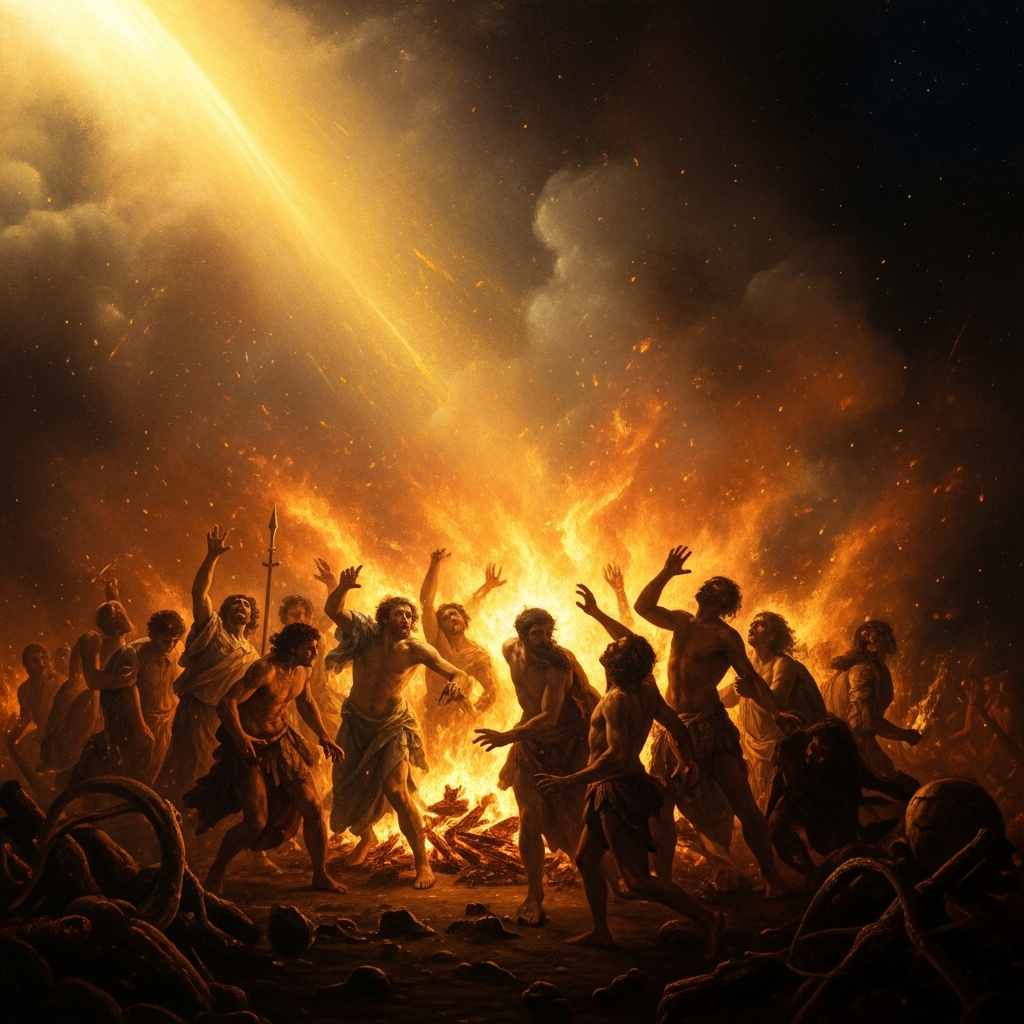
The torches move through the city at night.
The meeting house of the brotherhood is burning.
Not this house — the house of Milo, their patron and the most celebrated wrestler in Croton’s history, where forty members of the brotherhood have gathered. Milo’s house is burning. Some accounts say Milo himself escaped because he was physically strong enough to break through a burning wall. The other accounts are less optimistic. How many of the forty died in the fire is not clearly established. The sounds from the direction of Milo’s house do not leave room for optimism.
Pythagoras has a path out of the city. He knows every road. There is a way to the north gate, and beyond the north gate the road to Metapontum, and at Metapontum he is known, and he will be received.
The path goes through the bean field.
He stands at the edge of it. Late spring, the beans at full growth, the plants knee-high, the pods swelling, the field extending from the city wall to the river. The road through it is sixty feet of planted ground between him and the road north. The torches are closer. He can hear the voices of Cylon’s people.
He has not crossed a bean field in forty years.
The rule is not ambiguous and contains no emergency exceptions. A rule you keep only when it is convenient is a preference. A philosophy that abandons its principles at the moment of maximum cost is a lifestyle. He has spent forty years teaching this distinction to people who had to sit in silence for five years before they were allowed to question it.
The ancient sources disagree about what happens next. In Porphyry’s account, he stops at the field and is captured there by Cylon’s men. In Iamblichus’s account, he is taken back to the burning city. In another version, he escapes by a different route, flees to Metapontum, and starves himself to death in a temple, choosing — the way Cato will choose, two centuries later — to die on his own terms in a city he controls rather than live in one controlled by those who destroyed what he built.
What all the accounts agree on is the field.
The brotherhood scatters but does not disappear.
The survivors carry their mathematics and their cosmology and their rules into exile. They go to Thebes, to Phlius, to Athens. A generation later, Plato meets Pythagoreans in southern Italy — Archytas of Tarentum, the mathematician and statesman who seems to have embodied exactly what Pythagoras was trying to build — and absorbs the structure of Pythagorean thought so thoroughly that it is difficult, in the dialogues, to isolate where Plato ends and Pythagoras begins.
The Timaeus is a Pythagorean cosmology in Platonic dress: the Demiurge constructs the world-soul from mathematical ratios, the orbits of the planets hum with number, the proportions of the cosmic body mirror the proportions of the human body. The Phaedo assumes the transmigration of souls. The Republic builds its city on the idea that a community organized around correct principles can produce souls organized around correct principles. These are all Croton, twenty years on, after the fire.
Aristotle inherits the structure and disagrees with most of it, but even Aristotle cannot discuss form without discussing the Pythagorean conviction that form is prior to matter, that what makes a thing the kind of thing it is cannot be reduced to what the thing is made of. The disagreement keeps the idea alive. The idea that reality is, at its base, mathematical — that what underlies the apparent chaos of phenomena is structure, ratio, number — survives the destruction of the community that first articulated it in the Western tradition and travels through seventeen centuries into Kepler, who wrote Harmonices Mundi in 1619 and proved that the planets move in ellipses with mathematical precision, and who cried when he found the ratios, because the ratios confirmed what the brotherhood at Croton had been trying to say.
The universe is a piece of music. The math is real. The spheres hum.
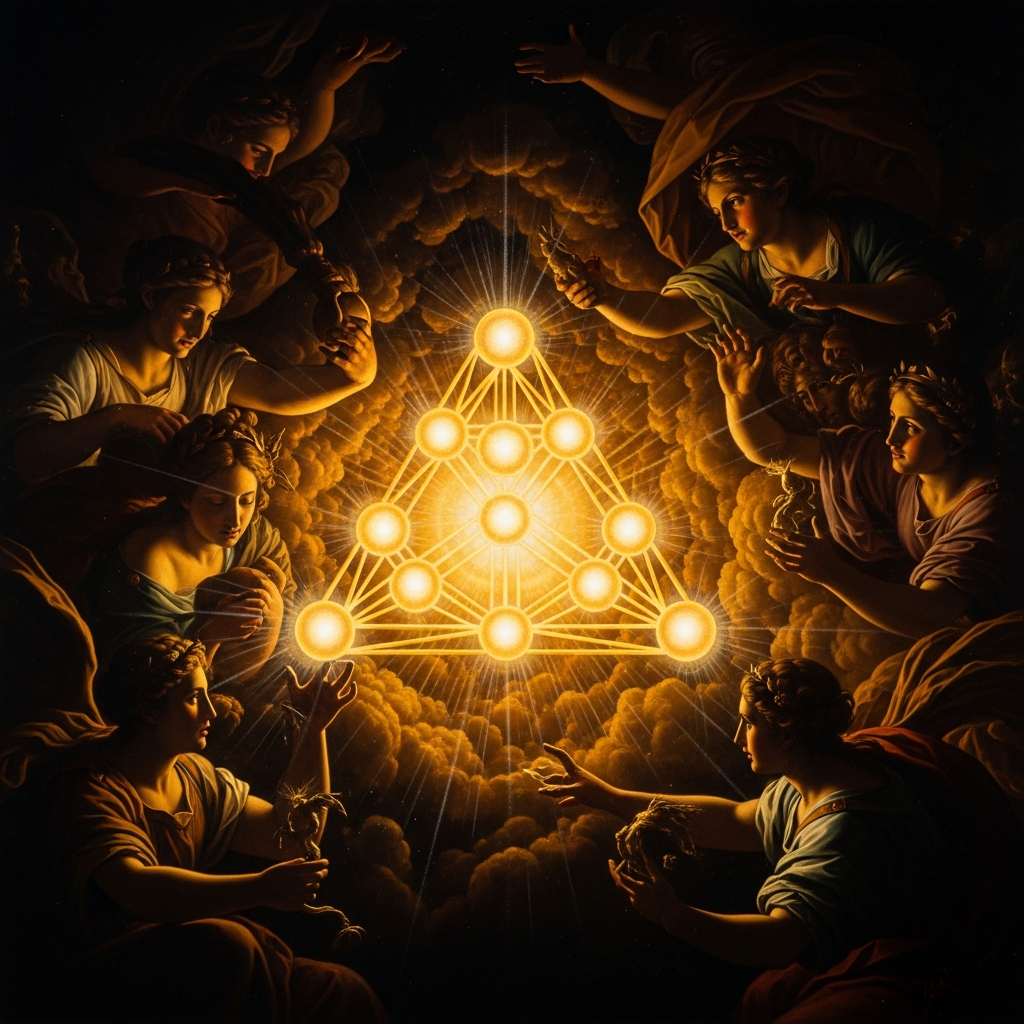
The tetraktys — the triangular arrangement of ten points in four rows (1, 2, 3, 4) that the Pythagoreans swore their oaths by — contains the fundamental ratios of Western musical harmony: 2:1 is the octave, 3:2 is the fifth, 4:3 is the fourth. These ratios are not cultural conventions. They are physical facts about vibrating strings, about the physics of standing waves. The Pythagoreans discovered them by experiment: by dividing a string at the halfway point and hearing the octave, at the two-thirds point and hearing the fifth. The cosmos, they concluded, must be organized by the same ratios, because beauty is not accidental, and the beauty of music is too precise to be a coincidence.
Every time a physicist writes an equation that describes reality more accurately than any word can — every time the mathematics turns out, to the physicist’s own surprise, to correspond to something in nature — they are repeating the Pythagorean experiment with the string. The string is longer now. The ratios go deeper. But the faith that there is a ratio, that the cosmos is not chaos but music heard from too close to identify the key — that faith is Croton’s, six centuries before Christ, in a community that kept its silence for five years and its rules until the fire came.
The field of beans is still somewhere between us and the road out. The question Pythagoras died answering — whether the principle is worth more than the life that held it — has not been answered any more definitively in the twenty-five centuries since.
Scenes
The Pythagorean brotherhood at Croton: the communal table where bread is never broken, the five-year initiates listening in silence, the master demonstrating mathematical ratios on sand — philosophy organized as a total form of life
 Generating art…
 The tetraktys: the triangular arrangement of ten points in four rows — 1, 2, 3, 4 — the most sacred figure in Pythagorean theology, containing the ratios of the musical intervals and, in the brotherhood's conviction, the hidden structure of the cosmos
 Generating art…
 The burning of the brotherhood's meeting house at Croton: torches moving through the city at night, the figures of the Pythagoreans fleeing or not fleeing, the smoke rising over a community that chose its rules over its survival
 Generating art…
 Echoes Across Traditions
Entities
- Pythagoras
- the Mathematikoi
- the Akousmatikoi
- Cylon of Croton
Sources
- Walter Burkert, *Lore and Science in Ancient Pythagoreanism* (Harvard, 1972)
- Iamblichus, *Life of Pythagoras* (c. 300 CE, trans. Gillian Clark, 1989)
- Porphyry, *Life of Pythagoras* (c. 270 CE)
- Diogenes Laertius, *Lives of the Eminent Philosophers* VIII (c. 225 CE)
- Christoph Riedweg, *Pythagoras: His Life, Teaching, and Influence* (Cornell, 2002)