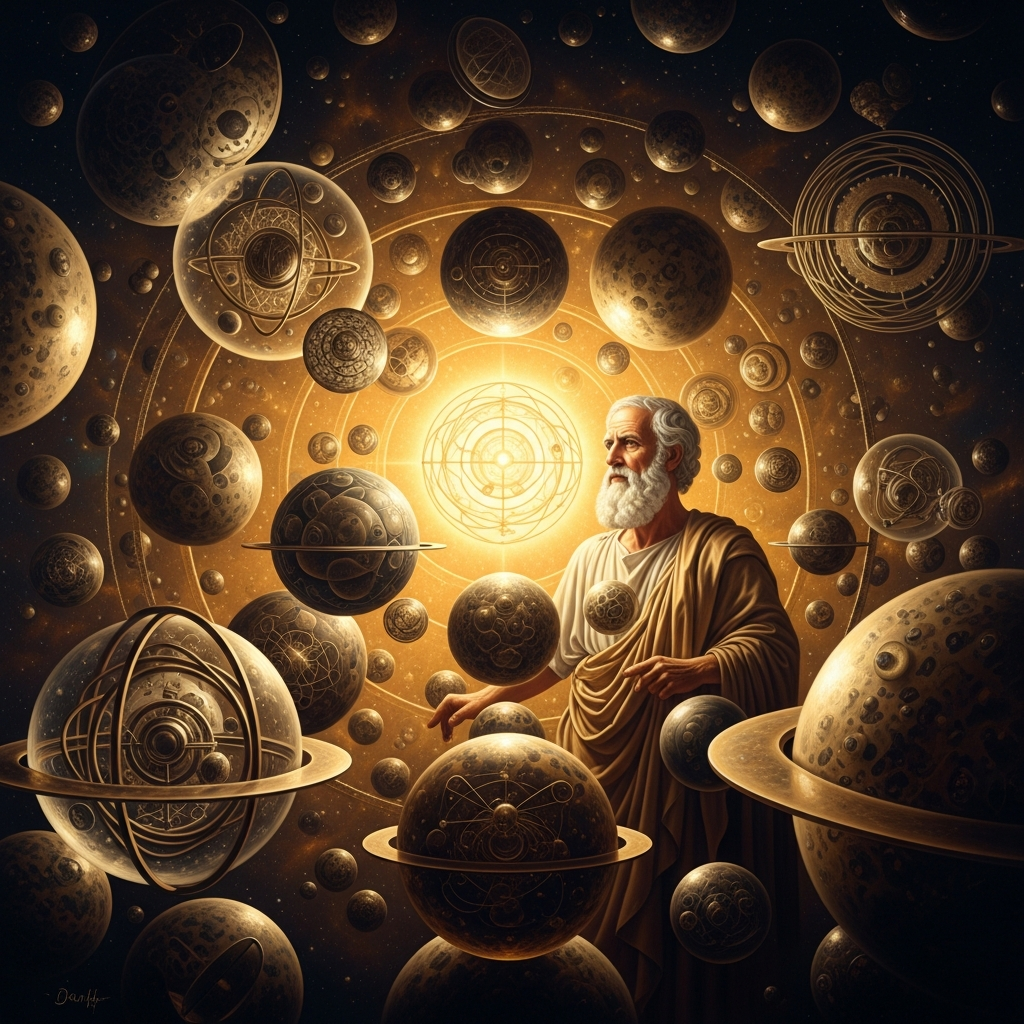
Pythagoras and the Music of the Spheres
c. 530 BCE · Croton, Magna Graecia (southern Italy) · Croton, on the instep of the Italian boot — a Greek colony on the edge of a foreign world
Contents
At Croton in southern Italy, Pythagoras founds a community that is part school, part religious order — teaching that numbers are the essence of all things, the soul transmigrates, and the planets produce a music the trained philosopher can almost hear.
- When
- c. 530 BCE · Croton, Magna Graecia (southern Italy)
- Where
- Croton, on the instep of the Italian boot — a Greek colony on the edge of a foreign world
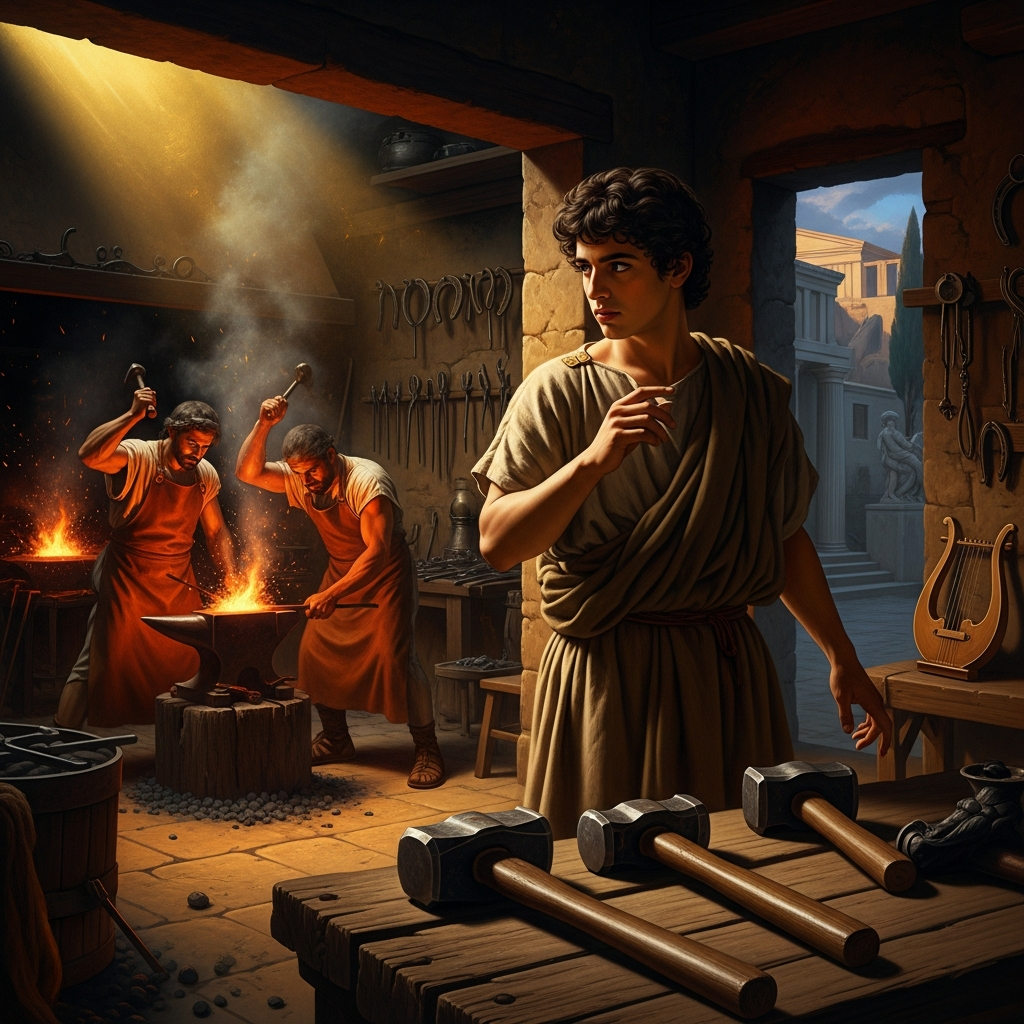
He hears it in a blacksmith’s shop.
He is young still, passing through the town, and the hammers on the anvils are ringing in a way that stops him in the street. Not a cacophony — a chord. The blacksmiths are striking in sequence and the sound is not noise but music, low and iron-dark, and he stands listening until they notice him and stop. He asks them to continue. He asks them to let him weigh their hammers. They do, because something in the way he asks makes refusal seem absurd.
The hammers that produce harmonious sounds have weights that relate by simple ratios. Two hammers whose weights are in the ratio 2:1 produce a sound an octave apart. The ratio 3:2 produces a fifth. The ratio 4:3, a fourth. The structure of musical harmony is not convention, not cultural preference, not the particular character of the human ear. It is number. It is there in the iron, in the weight, in the physics of the thing.
He runs back to his house and picks up the lyre.
He has already traveled half the known world.
Born on Samos, possibly around 570 BCE, he studied under the philosopher Thales at Miletus, then went to Egypt and stayed there — some sources say twenty-two years — studying with the temple priests, learning what they knew of mathematics and astronomy and the immortality of the soul. He may have gone to Babylon. He may have encountered Persian Magi. He returns carrying things that have no Greek word for them yet.
He comes to Croton in the late 530s, a city on the heel of Italy, rich from its port, anxious about its neighbors. The city is in a kind of moral and intellectual disrepair — not unusual for a Greek colony at the edge of a foreign world, far from the philosophical ferment of Miletus and Athens. He addresses the people of Croton from a public place. He does not advertise. He speaks. By the time he is finished, the accounts say, three hundred citizens have asked to become his students.
He says: come, then. But understand what you are entering.
The community has rules.
Do not eat beans. Do not walk on highways. Do not step over a crossbar. Do not touch a white cock. Do not look in a mirror beside a lamp. Do not let swallows nest under your roof. These rules have puzzled scholars since antiquity. Some may be primitive taboos absorbed in Egypt or Babylon. Some may be symbolic — the bean, in one interpretation, represents the political vote (beans were used as ballots in some Greek cities), and to refuse the bean is to refuse the corruptions of political ambition. Some may simply be tests of obedience: the student who cannot follow an arbitrary rule will not follow a difficult one.
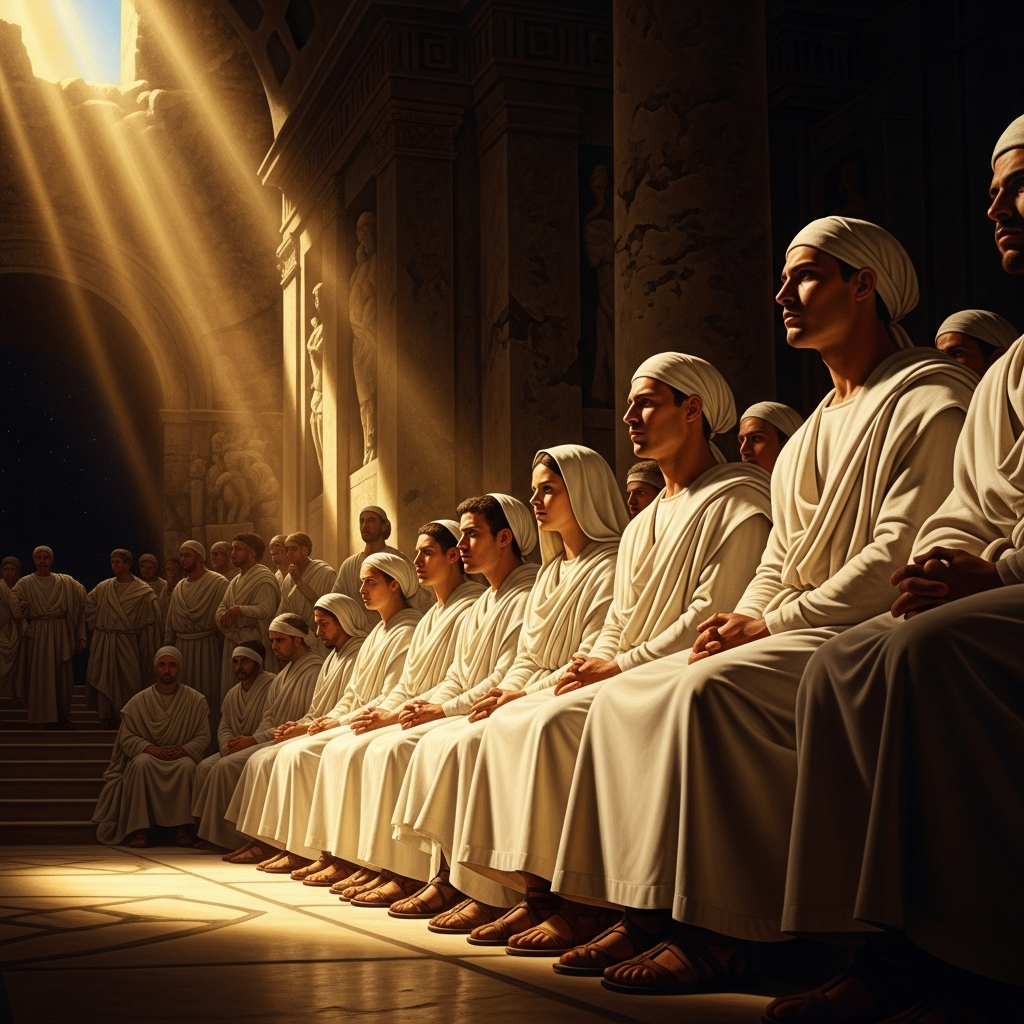
The deeper rules are more austere. For the first five years, the student is an akousmatikos — a listener. He may not speak during the teaching. He sits, in white, and listens. He will not see Pythagoras during this period — the teacher speaks from behind a curtain, so the student cannot be distracted by personality and appearance, cannot become a follower of the man rather than a student of the ideas. He must learn to hear the argument on its own terms.
The community holds property in common. The members live together. They sleep, eat, exercise, and study at fixed hours. It is a monastery before monasteries exist.
The teaching.
At the center of everything: number is the essence of things. Not a description of things, not a tool for measuring things — the essence. The ratio 2:1 does not describe the octave; the octave is the ratio. The triangle does not approximate the Pythagorean theorem; it is the theorem. Reality has a mathematical structure all the way down, and the philosopher who learns to read that structure learns to read the cosmos itself.
The soul is immortal. It migrates from body to body across multiple lives. Pythagoras himself claims to remember his previous incarnations — he is said to have recognized the shield of a warrior named Euphorbus in a temple at Argos, a shield from the Trojan War, and claimed it was his in a previous life. Whether he believed this literally or used it as a teaching device, the doctrine is serious: the soul is not native to any one body. It is working through the cycle of existence toward something. What it is working toward, Pythagoras does not say clearly. Purification, perhaps. Escape from the cycle. Reunion with the divine.
The Music of the Spheres.
The cosmos, Pythagoras teaches, is organized by mathematical harmony. The planets and stars move through the heavens on crystalline spheres, and as they move — vast bodies traveling vast distances at tremendous speeds — they produce tones, the way a plucked string produces a tone. The distances between the spheres correspond to musical ratios. The cosmos is a musical instrument of perfect proportion.
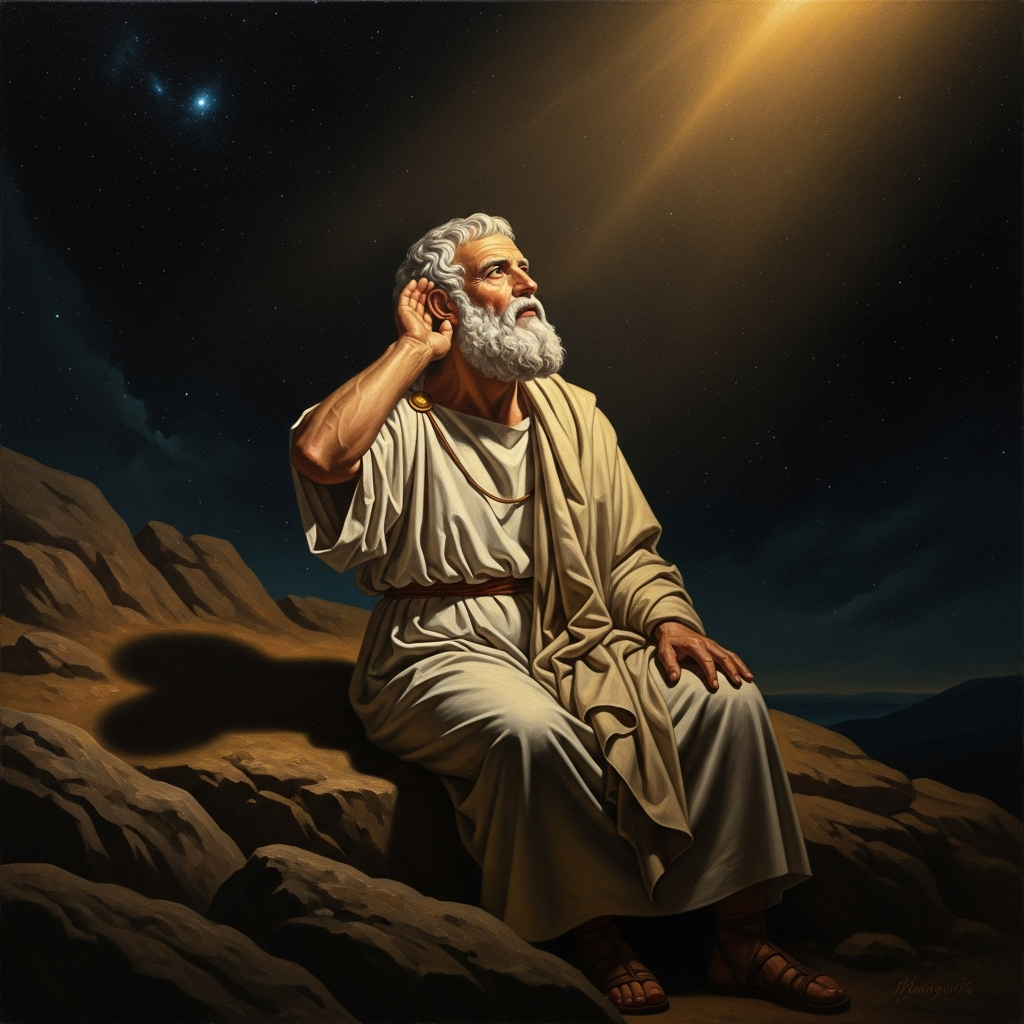
Most people cannot hear it. They were born into the sound and have never known silence, the way a man who has lived all his life near a waterfall no longer hears the water. The philosopher who trains the soul properly — who purifies it through mathematics and music and the community’s discipline — may, at the edge of hearing, catch it. Not hear it clearly, not the way he hears a lyre. But something. A vibration in the structure of things that is not quite sound and is not quite sight and has no name in Greek.
Pythagoras claims to hear it.
He is the first to call himself a philosophos.
The story is told by Cicero and others: Pythagoras was asked by the tyrant of Phlius whether he was a sophos — a wise man. He said no. He said: I am a philosophos. A lover of wisdom. Not a possessor of it. Not a wise man — a man who runs after wisdom the way a lover runs after the beloved, always a step behind, always reaching. The wise men are the gods. Humans may only love wisdom; they may not own it.
It is a distinction that sounds modest but is in fact radical. The sophos claims to have arrived. The philosophos claims only to be in pursuit. The pursuit has no end. The cosmos is so structured that the man who understands it most clearly also understands most clearly how much more there is to understand. Mathematics: the discipline that shows you both the answer and the infinity of further questions behind it.
He is expelled from Croton eventually — the political entanglements of the community, the jealousy of powerful families, a fire that some accounts blame on rivals, some on internal conflict. He goes to Metapontum. He dies there, sometime around 495 BCE. The school does not die. The Pythagoreans scatter across Magna Graecia and the Greek world, carrying the number-doctrine, the soul-doctrine, the dietary rules, the communal discipline.
Johannes Kepler publishes Harmonices Mundi in 1619 — the Harmony of the World — in which he demonstrates that the planets do not travel uniform circles but ellipses, and that the ratios of their maximum and minimum velocities are expressible as simple musical intervals. Earth’s ratio corresponds to a minor second; Saturn’s to a major third. He writes: the heavenly motions are nothing but a continuous song for several voices. He has spent his entire career looking for the Music of the Spheres, and he has found it — found it in the same place Pythagoras found harmony in the blacksmith’s shop, in the ratios, in the mathematics underneath the thing.
Pythagoras was not wrong. The cosmos is built on number. The planets do produce a music, though not the kind any ear can hear. The soul may or may not transmigrate. But the mathematical harmony — that the universe has a deep structure expressible in ratio and proportion, that this structure is not imposed from outside but is the nature of the thing — this is the most durable idea a single human being has ever had.
It is still the operating premise of physics.
Scenes
Young Pythagoras passes a blacksmith's shop and stops — the hammers ringing on anvils are producing harmonies
 Generating art…
 The Brotherhood assembled at Croton: students in white, seated in silence, listening to a teaching they will not repeat outside the community for five years
 Generating art…
 Pythagoras alone at night, ear tilted to the sky, listening for the tone the planets produce as they travel their courses — a music no unschooled ear can hear
 Generating art…
 Echoes Across Traditions
Entities
- Pythagoras
- the Pythagorean Brotherhood
- the Harmony of the Spheres
Sources
- Diogenes Laertius, *Lives of the Eminent Philosophers* VIII.1-50 (trans. R.D. Hicks, 1925)
- Iamblichus, *Life of Pythagoras* (~300 CE, trans. Thomas Taylor, 1818)
- Porphyry, *Life of Pythagoras* (~300 CE)
- Walter Burkert, *Lore and Science in Ancient Pythagoreanism* (Harvard, 1972)
- Peter Gorman, *Pythagoras: A Life* (Routledge, 1979)