Skin, Flesh, Bone, Marrow
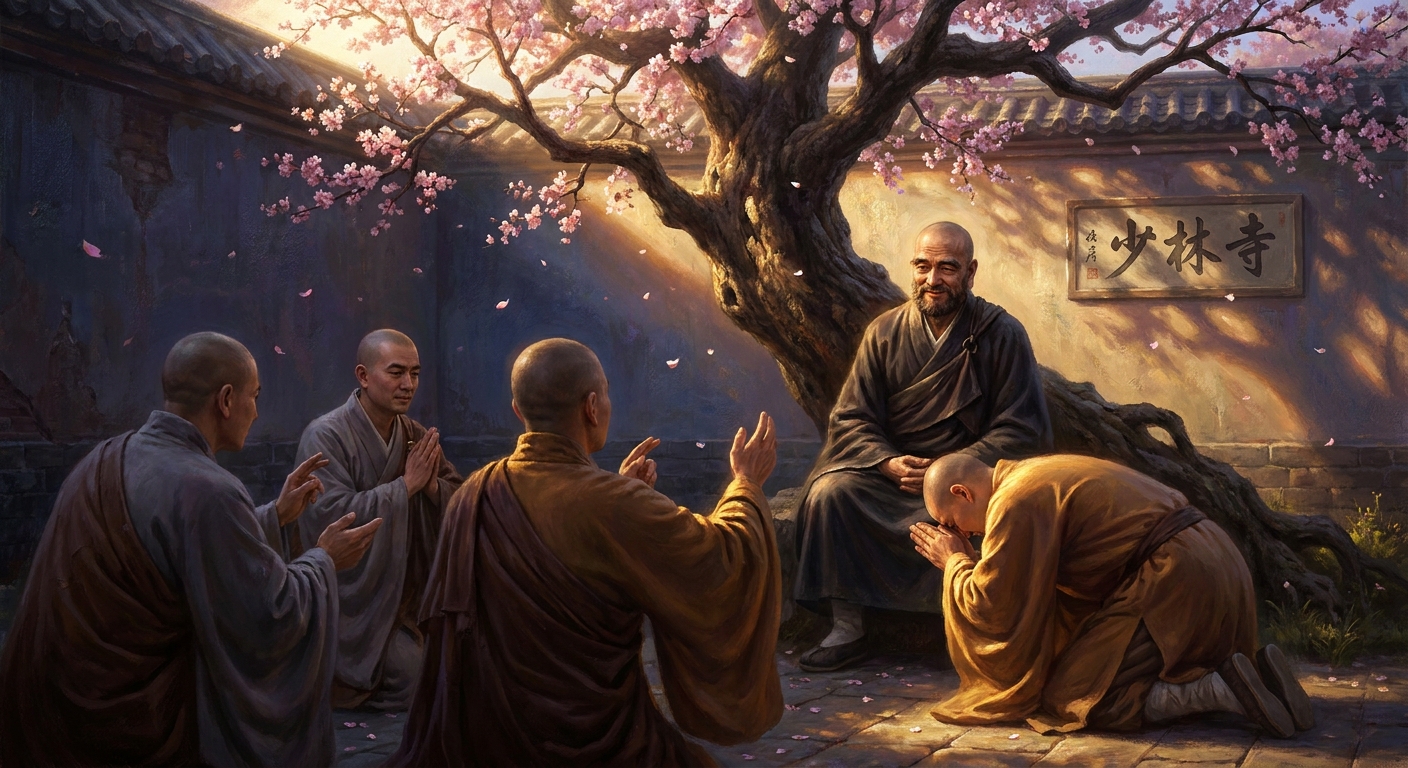
c. 530 CE — Northern Wei dynasty China · Shaolin Monastery, Mount Song — the master's cell, four students summoned for a final examination before the patriarch leaves
Contents
Bodhidharma assembles his four chief disciples and asks each what they have understood. Three speak. One bows. The deepest answer is the one that does not use any of the master's words.
- When
- c. 530 CE — Northern Wei dynasty China
- Where
- Shaolin Monastery, Mount Song — the master's cell, four students summoned for a final examination before the patriarch leaves
The master is leaving.
Bodhidharma has been at Shaolin for years — nine of them facing the cave wall, more after, training the small circle of students who climbed the mountain to find him. The Northern Wei dynasty is fracturing. The persecution of foreign monks is rumored. He is old. He has decided to go back west, or to die, or to disappear in the way patriarchs disappear when their work is done.
Before he goes, he must transmit. The robe and the bowl — the marks of the patriarchate, the lineage running back through twenty-eight Indian masters to the Buddha himself — cannot be left without an heir. He summons his four chief disciples to his cell.
The cell is small. A wooden bed. A water bowl. A scroll he has not unrolled in a decade. The four students enter — Daofu, the nun Zongchi, the layman Daoyu, the one-armed Huike — and kneel in a half-circle on the cold floor. The autumn light comes in through the slatted window in bars. Bodhidharma sits in the middle, hands folded, eyes the color of weather.
He speaks. “The time has come. Each of you, tell me what you have understood.”
Daofu speaks first.
He is the eldest, the most accomplished scholar, the one who has read the most sutras. He has prepared an answer; the four of them have known this question would come, and Daofu, who is good with words, has chosen his carefully.
“As I understand it, the truth is not bound by words, and yet not separate from them. It uses words as the way functions through the body. The teaching cannot be captured in language, but neither can it be transmitted without language. This, master, is what I have understood.”
It is a fine answer. It is, in fact, a correct answer. Any examiner in any sutra-school in China would mark it the highest grade. The other three students glance at Daofu with a flicker of something that is not quite envy.
Bodhidharma is silent for a moment.
“You have my skin,” he says.
Daofu bows. He cannot decide, on the way back to his place in the half-circle, whether the master has just praised him or buried him.
Zongchi speaks next.
She is the only nun in the four, the daughter of an emperor who renounced her position to enter Shaolin, sharper than Daofu in the dharma-debates, slower in the ego. She has watched the master’s silence after Daofu’s answer; she has read what the silence meant. She does not try to outdo Daofu in cleverness. She tries to go underneath him.
“Master,” she says, “as I understand it, our experience of the truth is like Ananda’s vision of Akshobhya’s Buddha-land — seen once, in a flash, and then gone. It cannot be held. It cannot be returned to. It can only be witnessed and let pass.”
The image is from a sutra Bodhidharma has quoted before. Zongchi has chosen well. She has named the truth as a flicker, not as a function — and she has named her own understanding as the witnessing of a flicker, not the possession of a function. It is a humbler answer than Daofu’s. It is also, in its way, a more dangerous answer, because it claims less and therefore admits more.
Bodhidharma considers it.
“You have my flesh,” he says.
Zongchi bows. She does not glance at Daofu. She has gone one layer deeper into the master’s body, and she knows it, and she is not interested in the comparison.
Daoyu does not speak.
He has watched the first two answers. He has weighed his own. He had a sentence prepared — something about the unfindable nature of the mind, something elegant — and he discards it now, in the half-second before it would have left his mouth, because he sees what the room is doing.
The master is not asking for answers. The master is asking each of them to perform their understanding in the very act of speaking. Daofu performed the relationship between words and truth and got the skin. Zongchi performed the briefness of insight and got the flesh. To answer at all is to demonstrate the form of one’s grasp; the form is the answer.
So Daoyu, who is a quieter man than the other two, does something none of them expect. He looks at Bodhidharma. He does not bow. He does not speak. He simply does not answer.
The silence stretches.
Bodhidharma’s eyes shift to him. The eyes do something the master rarely does — they soften, fractionally, a smile that does not reach the mouth.
“You have my bones,” Bodhidharma says.
Daoyu does not bow either. The bones do not bow. He simply lowers his eyes.
Huike has been waiting.
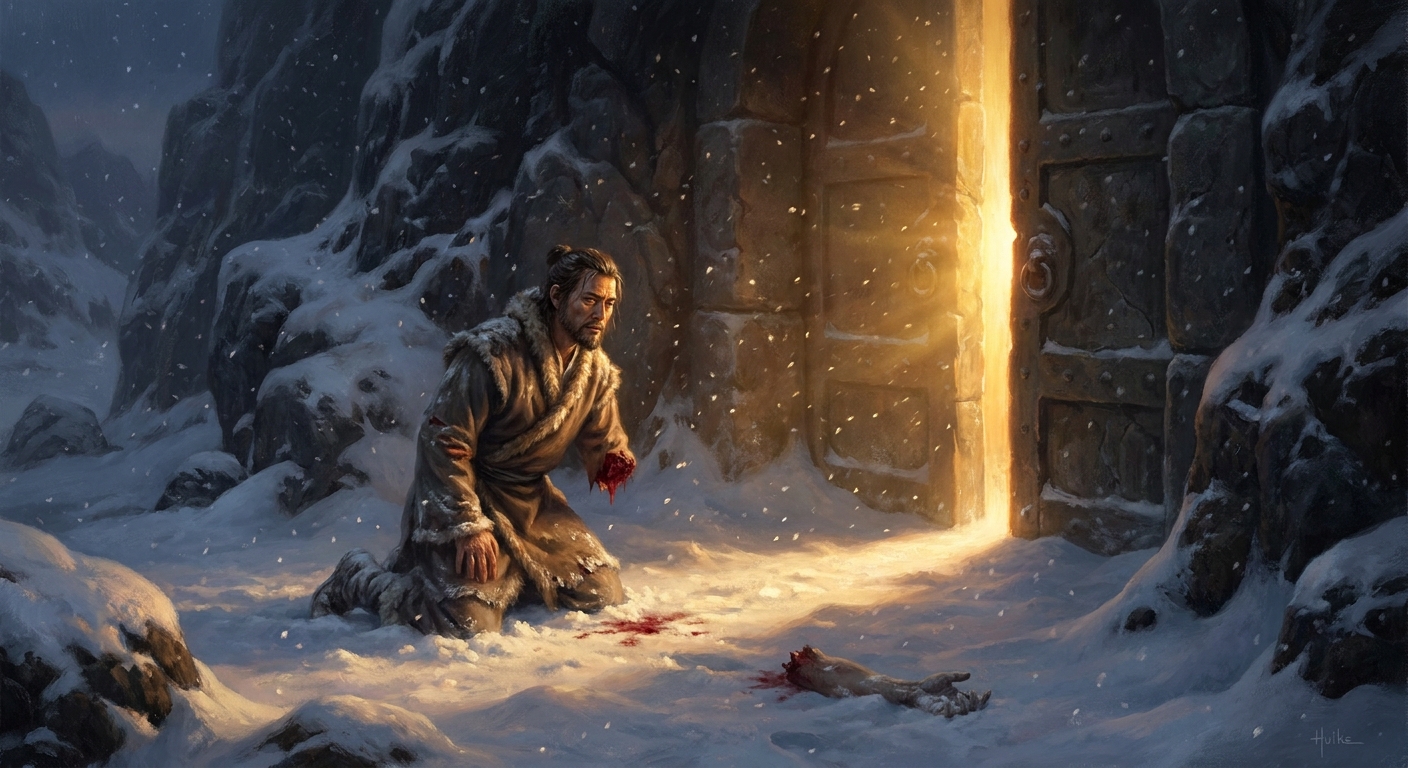
He is the one with one arm. He is the one who stood in the snow until his own blood turned the snow red, the one to whom the master gave the cave teaching about the unfindable mind. The other three students know, in some part of themselves, that whatever the master is doing in this room, Huike has already passed it. They have been answering for the skin and the flesh and the bones because Huike was always going to take what was left.
Bodhidharma turns to him. “And you?”
Huike rises. He walks the three steps to where the master sits. He stops. He bows — one bow, the deep formal bow, the bai, the same bow he gave the master in the snow when he had just severed his own arm. He holds the bow long enough that the other three can count the breaths. He straightens. He returns to his place in the half-circle. He sits down. He does not speak. He does not look at the master again.
The cell is silent. The autumn bar of light has moved a hand’s width across the floor.
Bodhidharma’s eyes close. When he speaks, the voice is so low the other three almost miss it.
“You have my marrow.”
The transmission is complete.
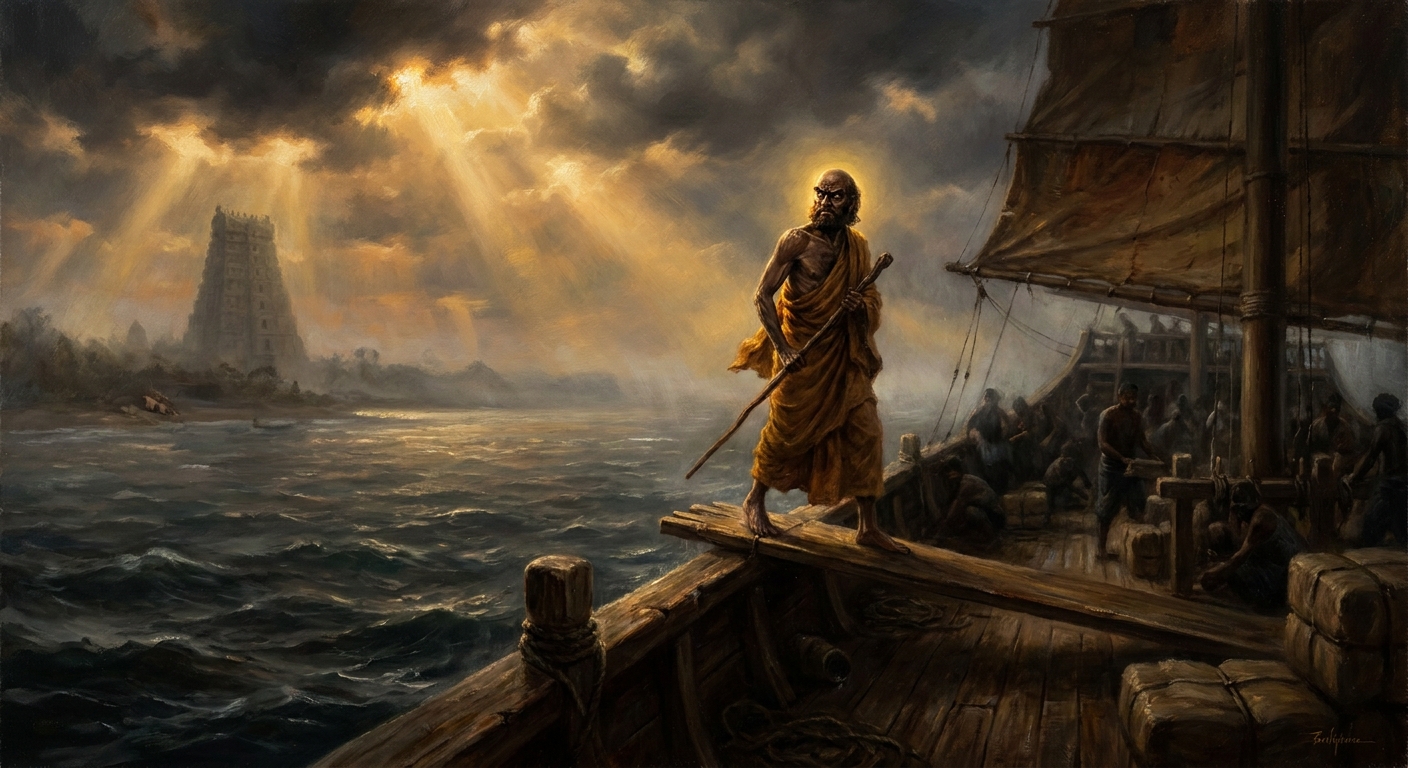
The robe and the bowl pass to Huike that evening. Bodhidharma leaves the monastery within the week — back to the west, the chronicles say, though some accounts have him poisoned by jealous rivals on the road, and one strange story has a Wei envoy meeting him three years later walking back to India carrying one sandal, having left the other on his own grave at Shaolin where his disciples had buried him.
Daofu, Zongchi, Daoyu each go on to teach. They are remembered as accomplished masters. They produce students. Their lineages run for a generation or two and fade. Huike’s lineage runs for fifteen hundred years and becomes Chan, becomes Zen, crosses the sea, crosses two seas, becomes the way half the modern world first hears the word meditation.
The fragment of the master’s body each disciple was given becomes the diagnostic the lineage uses for itself. Skin — eloquent and correct, but on the surface. Flesh — alive, but still describable. Bones — silent, structural, the form holding the form. Marrow — what is inside the bone, what makes the bone make blood, what is given without speech because it cannot survive translation.
The genius of the scene is that the master does not rank the answers wrong-to-right. The skin is also true. The flesh is also true. The bones are also true. The marrow is just the deepest layer — the one closest to whatever the body is for.
Christianity guards a similar gradient. John 21 has Christ ask Peter three times if he loves him; the third time Peter is grieved, because the question itself is the test, and the grief is the right answer. The structure of the threefold question — and Bodhidharma’s fourfold one — is the same: language is offered as a ladder, and the depth of the climb is measured by how soon the climber stops needing it.
Apostolic succession argues over chains. Chan argues over what passes through the chain. Both are right to argue. The chain matters because the marrow does not travel in books. It travels in rooms.
Four students knelt in a Shaolin cell. One of them did not speak. The lineage that walked out of that cell is still walking, and the silence Huike kept is the load-bearing silence at the center of every Zen hall ever built.
Scenes
Four disciples kneeling in a half-circle
Generating art… Huike rises, bows once at the master's feet, returns to his place, and does not speak
 Generating art…
 The patriarch's robe folded on a stone, the bowl beside it, the gate of Shaolin open onto the road back to the west
 Generating art…
 Echoes Across Traditions
Entities
- Bodhidharma
- Daofu
- Zongchi
- Daoyu
- Huike
Sources
- *Jingde Chuandeng Lu* (*Jingde Era Record of the Transmission of the Lamp*), Daoyuan, 1004 CE
- *Lidai Fabao Ji* (*Record of the Dharma-Jewel Through Generations*), ~774 CE
- Andy Ferguson, *Zen's Chinese Heritage: The Masters and Their Teachings* (2000)
- Heinrich Dumoulin, *Zen Buddhism: A History, Volume 1: India and China* (1988)
- John R. McRae, *The Northern School and the Formation of Early Ch'an Buddhism* (1986)
- Bernard Faure, *The Will to Orthodoxy: A Critical Genealogy of Northern Chan Buddhism* (1997)