Enheduanna and the Hymn She Had to Write Twice
c. 2285-2250 BCE, Akkadian Empire · Ur, Mesopotamia — the temple complex of Nanna and the surrounding steppe
Contents
In 2285 BCE, Enheduanna, daughter of Sargon of Akkad and high priestess of the moon god at Ur, is expelled from her temple by a rebel general. Stripped of office and rank, she composes the Nin-me-sara, her great hymn to Inanna, as an act of political desperation and theological transformation. The goddess answers. Enheduanna returns.
- When
- c. 2285-2250 BCE, Akkadian Empire
- Where
- Ur, Mesopotamia — the temple complex of Nanna and the surrounding steppe
Her father gave her the office when she was sixteen.
Sargon of Akkad had just conquered the Sumerian south — the ancient city-states of Ur, Uruk, Nippur, Lagash — and understood that military conquest without administrative theology is temporary. The Sumerians had their own gods, their own priestly lineages, their own logic of divine right that had nothing to do with Akkadian military success. He installed his daughter as en, high priestess of Nanna, the moon god of Ur, the most prestigious religious office in the Sumerian world. He gave her a Sumerian name — En-hé-du-an-na, High Priestess, Ornament of Heaven — and sent her south to mediate between the Akkadian political reality and the Sumerian divine order. She was sixteen years old and she had a stylus. She had been using it since she could hold one.
For thirty years she serves Nanna and serves the empire and serves literature, though no one has invented that word yet. She writes hymns to each of the major Sumerian temples, forty-two city-cult hymns that circulate through the scribal schools as curriculum texts — the first standardized literary anthology. She writes personal hymns to Inanna, the goddess of love and war, in a voice of such peculiar directness that the scribes who copy her tablets centuries later can feel the heat of a specific woman inside the lines. She runs the Giparu, the high priestess’s residence and cultic center, with the administrative competence of a provincial governor — which is precisely what she also is.
Then her nephew’s wars come home.
Naram-Sin is attempting to consolidate the empire his grandfather built, and the consolidation is producing rebellions across the Sumerian south. Lugal-Ane is one of those figures who surfaces in the gaps between certainties — a general, a usurper, a man with soldiers and ambitions that extend to the priesthood. He takes Ur. He occupies the Giparu. He informs Enheduanna that she is no longer high priestess of Nanna. She is to leave.
The texts do not record her departure in detail. We have only what she later writes: that she walks into the edin, the steppe beyond the city walls, with whatever she can carry. That she makes offerings at night that Nanna does not accept. That she feels the specific texture of divine abandonment, which she describes as being made to walk in a field of thorns. Her body feels it like a physical sickness: the leper’s garment has been put on me.
She prays to Nanna, her patron. Nanna is silent.
This is the theological crisis at the center of the poem she is about to write. She has served the moon god for thirty years. She has been his en, his intermediary, his human anchor in the city of Ur. And when the test arrives, he does not move. Whether this is divine indifference or divine strategy, whether Nanna is testing her or simply absent, the result is the same: she is in the steppe with a stylus and nowhere left to appeal except one level higher.
She turns to Inanna.
Nin-me-šara — Lady of All the Me, of All the Divine Powers — begins in the way hymns have always begun: the third person, the catalog of titles, the architecture of praise. Inanna who overturns the sacred mountains. Inanna who puts on the garments of the underworld and ascends again. Inanna in whose hand the seven divine decrees are held. For fifty lines it is indistinguishable from any temple hymn composed in Sumer for the past five hundred years. The scribe who receives it does not yet know what is coming.
Then the voice changes.
Me, Enheduanna. Yes, me.
She writes herself into the poem. She names herself, describes her office, names her crime — nothing: she has committed no crime — and names her accuser, Lugal-Ane, in the text itself, which is the legal equivalent of filing suit. She describes what he has done to the sacred office. She describes what she feels. She asks Inanna directly: Tell Anu about this. Anu loves you. Tell him what has been done to me. She is asking a goddess to be her legal advocate before the divine assembly. She has turned a hymn into a brief.
She signs it. I, Enheduanna. The first time anyone in history signs a text with their own name.
The hymn works. Or the politics shift. Or both, which may be the same thing from the goddess’s perspective.
Naram-Sin defeats the rebels. Lugal-Ane is removed from Ur. Enheduanna returns to the Giparu. She resumes her office. She is in her fifties now and she is back in the city that drove her out, and she does something that no other author in human history has done quite this way: she writes the ending of her own story into the poem she composed in exile.
The final lines of the Nin-me-šara record her restoration. Nanna has given Enheduanna her office again. The dawn is radiant. The day is made beautiful. Holy Inanna, how great is your praise. She has been composing this hymn for months, perhaps years — beginning in desperation in the steppe, ending it in gratitude in the temple. The text we have is the finished version, which means the version she wrote twice: once in crisis and once in relief, revised until the form holds both.
The scribal schools adopt it within a generation. For six hundred years, boys nine and ten years old learn the cuneiform script by copying Enheduanna’s lines. Me, Enheduanna. Yes, me. They reproduce her first person thousands of times, pressing her voice into thousands of tablets, sending it forward through the centuries the way seeds are sent forward through birds: carried, deposited, grown again somewhere the original plant never stood.
The clay she pressed is in the Penn Museum now.
Disc-shaped, white limestone, about ten inches across, with a cuneiform inscription around its base and a carved scene on its face: four figures at a ziggurat, one of them a woman in a flounced robe, one arm raised in the gesture of a priest performing a libation ritual. The inscription names her. En-hé-du-an-na, wife of Nanna, daughter of Sargon, king of the universe. She commissioned this object for the Giparu. She knew she was creating a record.
The oldest thing in the museum with a woman’s name on it. The oldest signed artwork in the world. She put her name on it in the same decade she put her name on the Nin-me-šara, and what both objects share is the same impulse: I was here. I did this. This was mine.
The hymn she had to write twice survives because it was worth copying. The crisis that produced it — the exile, the silence of Nanna, the turn toward Inanna, the first-person address that broke every convention of the hymn form — survives because she was specific enough, furious enough, desperate enough to name herself, name her enemy, and name the goddess she needed to save her. She did not write a generic plea. She wrote her own situation.
That is why the schoolboys copied it. Not because it was pious, but because it was real.
There is a reading of the Nin-me-sara in which Enheduanna is simply a skilled theological politician, using the hymn form to advance her family’s religious-administrative agenda by binding Inanna’s cult more tightly to the Akkadian imperial project.
That reading is probably true. It is also completely beside the point. Whatever her political motives, she wrote a poem in which a named human being addresses a deity in the first person, in her own voice, about her own specific crisis, and signs it. She turned the instrument of impersonal praise into the instrument of personal witness.
The first person in literature did not begin as an aesthetic choice. It began as an emergency.
Scenes
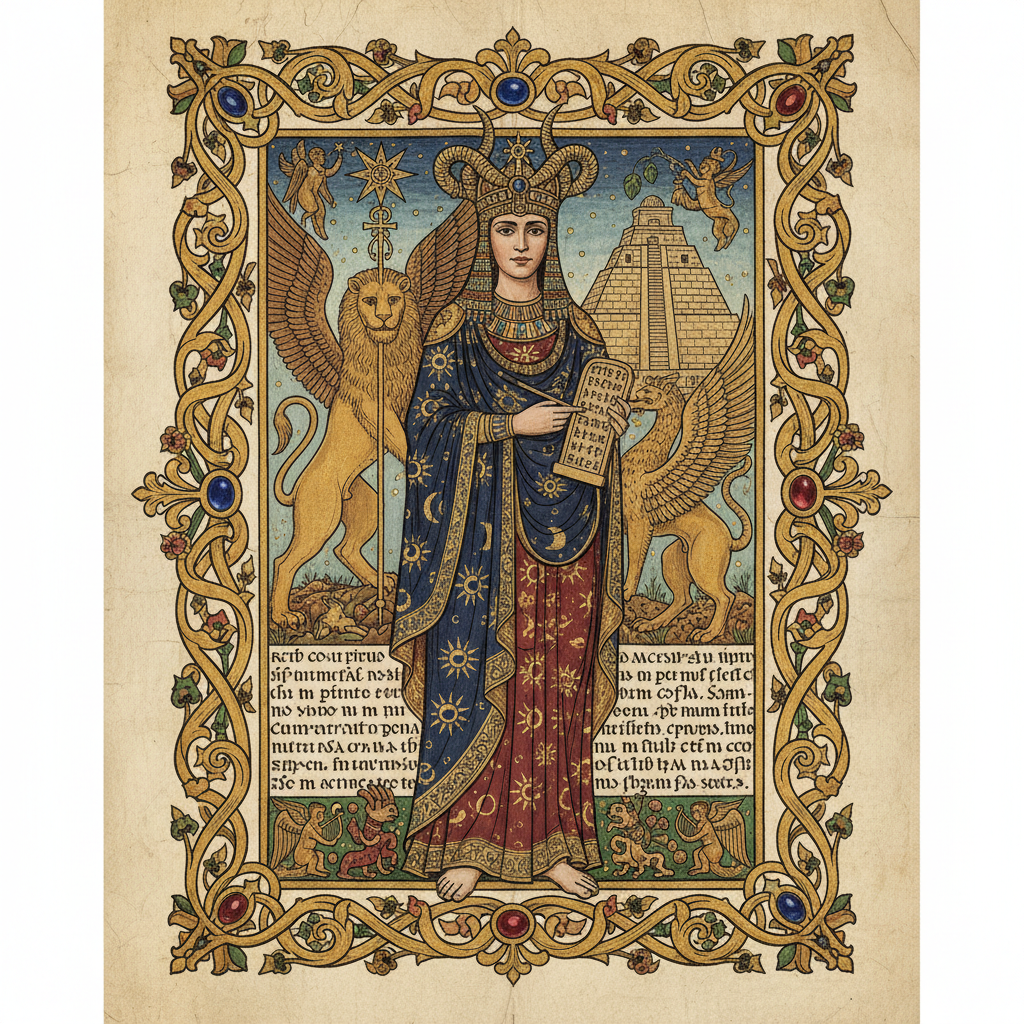
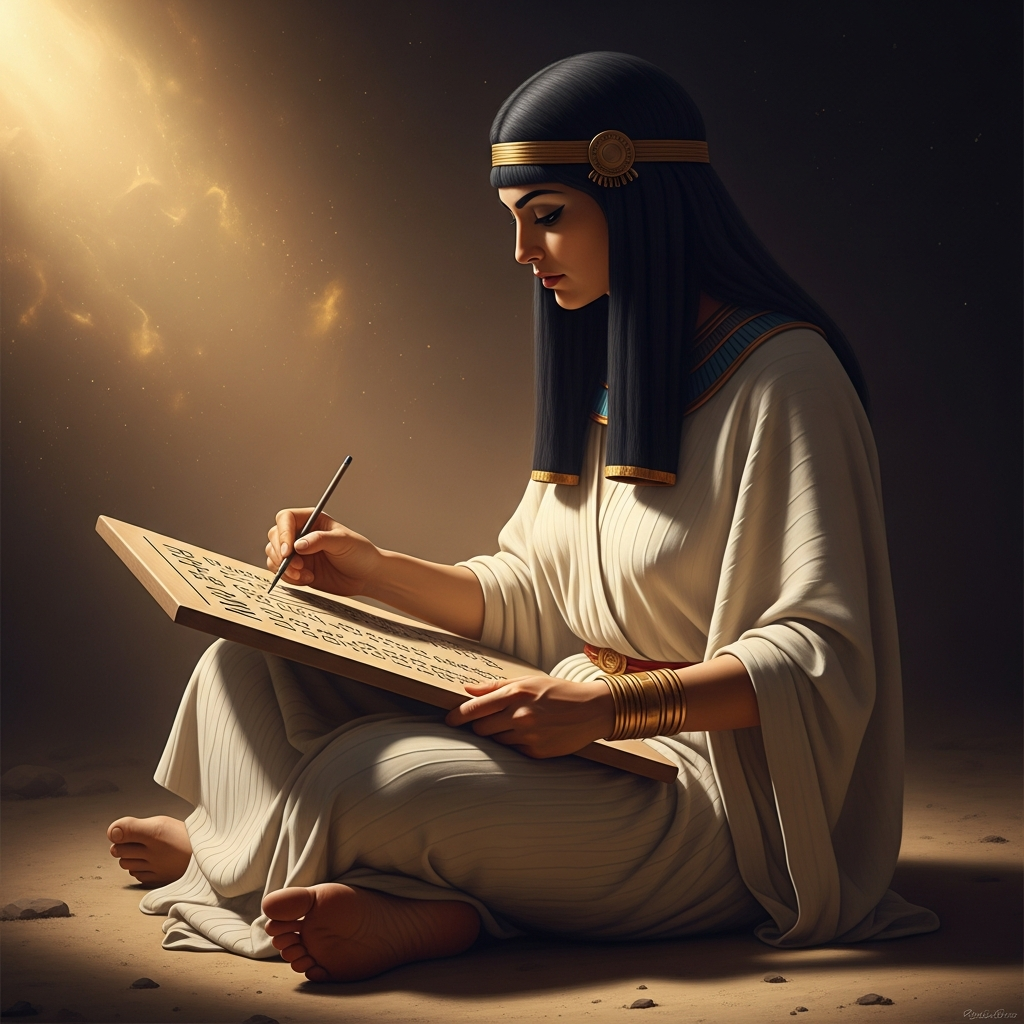
Enheduanna in the steppe beyond Ur, a clay tablet across her knees, composing the Nin-me-sara in the dust and heat of exile
 Generating art…
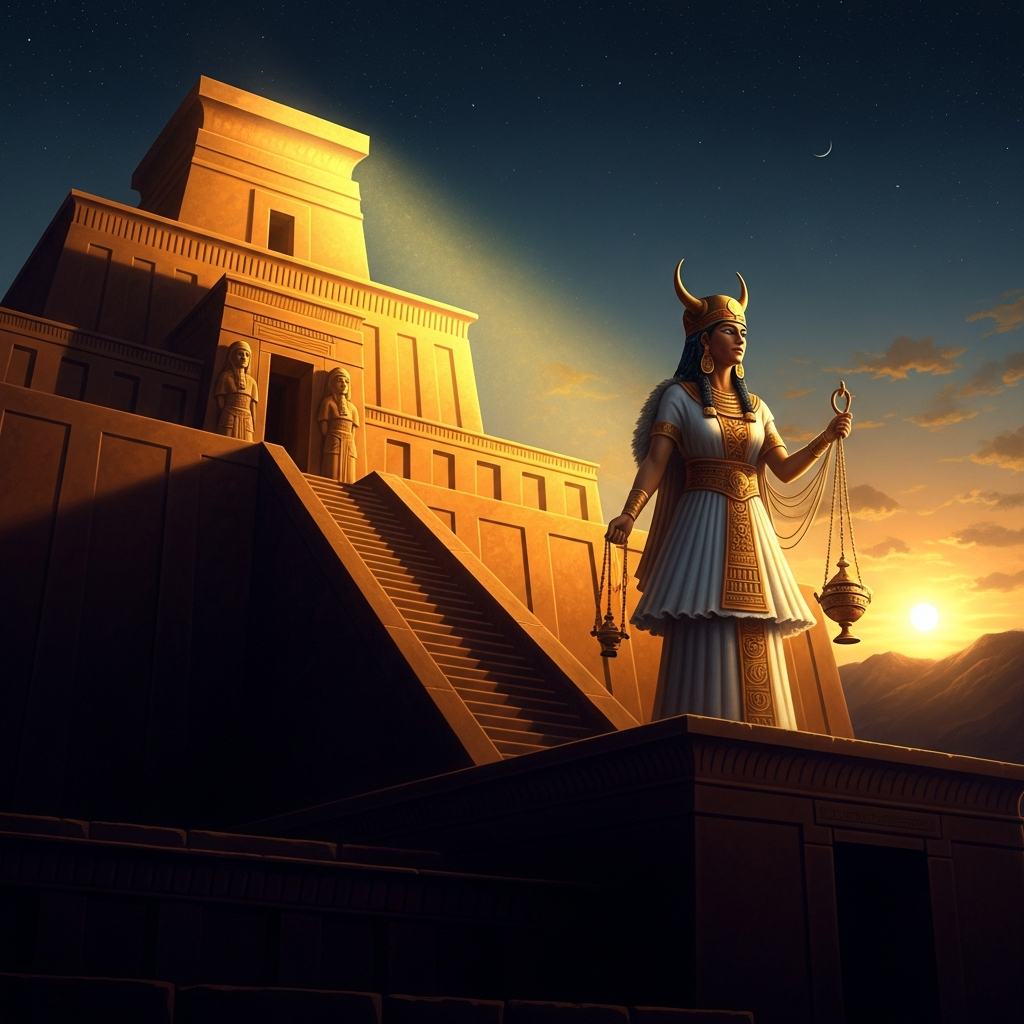
 The Giparu at Ur at dawn, the high priestess's residence and cult center where Enheduanna had officiated for decades, now occupied by Lugal-Ane's men
 Generating art…
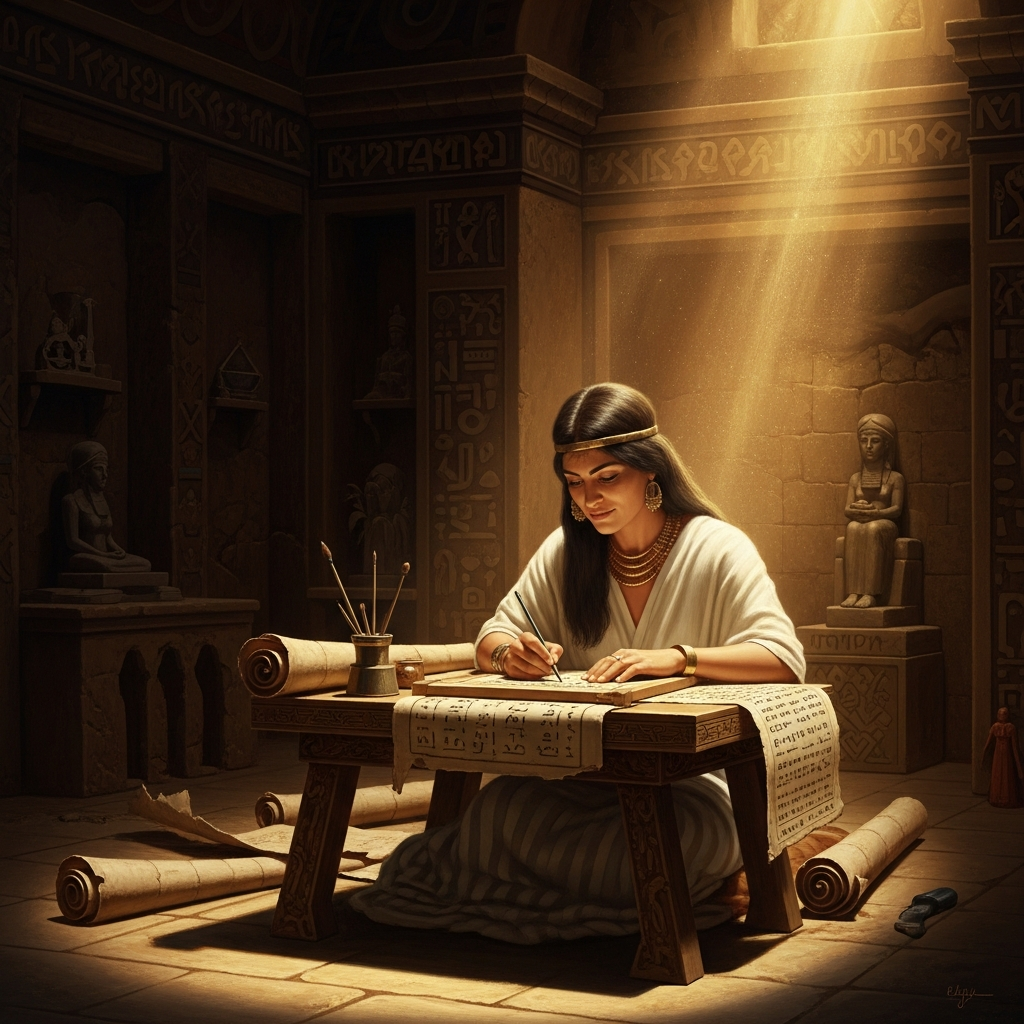
 Enheduanna restored to office, composing the final section of the Nin-me-sara inside the Giparu — the second writing, the hymn she rewrites now that it has worked
 Generating art…
 Echoes Across Traditions
Entities
- Enheduanna
- Inanna
- Sargon of Akkad
- Nanna
- Naram-Sin
- Lugal-Ane

Sources
- Betty De Shong Meador, *Inanna, Lady of Largest Heart: Poems of the Sumerian High Priestess Enheduanna* (University of Texas Press, 2000)
- William W. Hallo and J.J.A. van Dijk, *The Exaltation of Inanna* (Yale University Press, 1968)
- Thorkild Jacobsen, *The Treasures of Darkness: A History of Mesopotamian Religion* (Yale University Press, 1976)
- Andrew George, *The Epic of Gilgamesh* (Penguin Classics, 2003)
- Annette Zgoll, *Der Rechtsfall der En-hedu-Ana im Lied nin-me-sara* (Ugarit-Verlag, 1997)