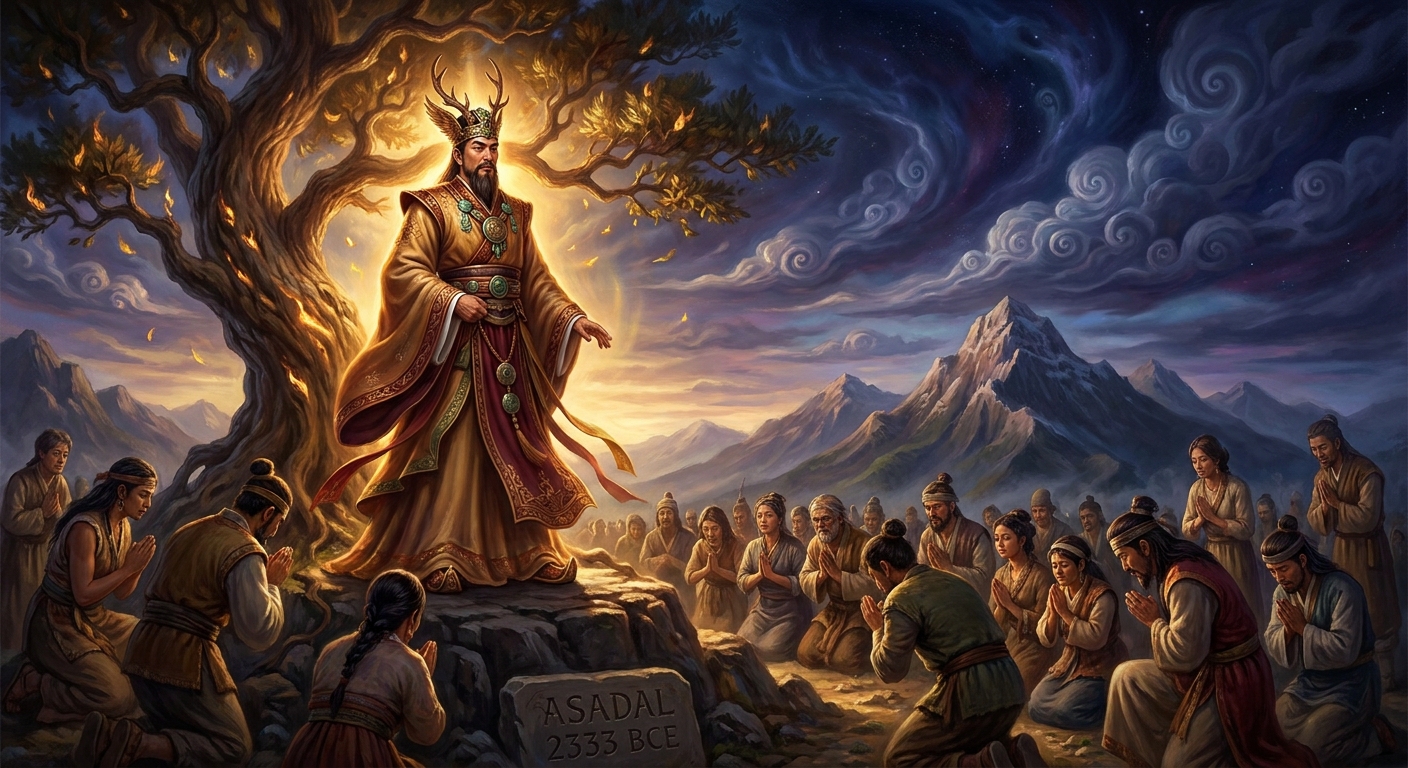
Dangun Founds Korea
Mythic Time · traditional date 2333 BCE · recorded 1281 CE · Mount Taebaek and the kingdom of Gojoseon (the Korean peninsula and southern Manchuria)
Contents
2333 BCE, by tradition. A bear endures twenty-one days in a cave on mugwort and garlic to become a woman. She bears a son to a god who has descended Mount Taebaek. The son founds Korea.
- When
- Mythic Time · traditional date 2333 BCE · recorded 1281 CE
- Where
- Mount Taebaek and the kingdom of Gojoseon (the Korean peninsula and southern Manchuria)
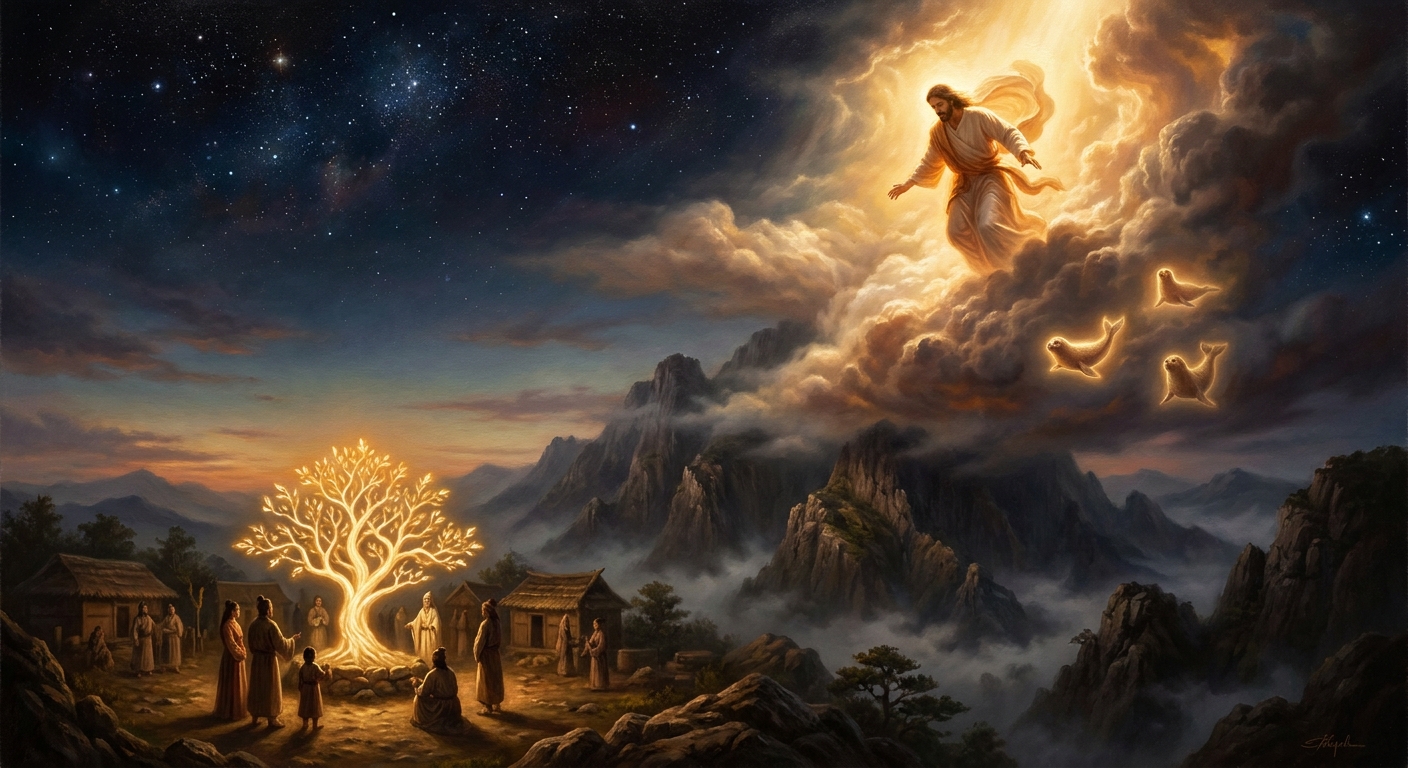
The sky opens above Mount Taebaek.
Hwanin, Lord of Heaven, has a son who looks down at the world too often. Hwanung is what later traditions will call restless — a god who finds his father’s court too still, too perfect, too uninterested in the small green continent below. He asks. His father consents. Hwanung descends with three thousand spirit-followers and three heavenly seals — wind, rain, cloud — and lands on the sandalwood-shaded peak of the highest mountain on the peninsula.
He builds the Sacred City. Sinsi. He takes dominion over the agricultural triad — the rains the rice needs, the winds that carry pollen, the clouds that withhold or release. He governs three hundred and sixty matters of human life. He has come down to do something.
A bear and a tiger live near the sandalwood tree.
They have watched the god arrive. They have watched the spirit-court raised among the cedars. They have seen what humans look like — upright, fingered, talking — and they want it. The bear wants it more. The tiger wants it differently.
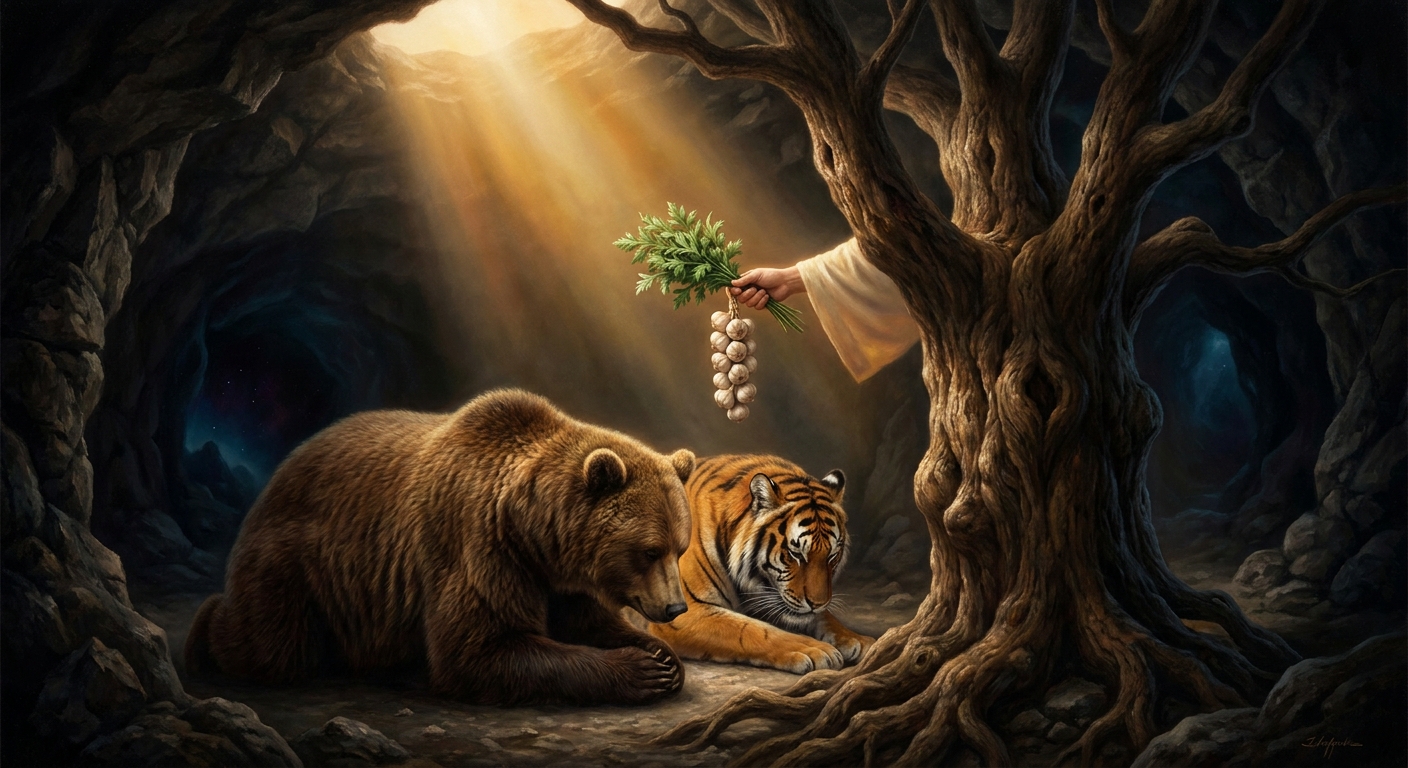
They come to Hwanung together. They pray to be made human. The god looks at them the way you look at children who have asked for something genuinely difficult and considers refusing. He does not refuse. He gives them, instead, a test.
A bundle of mugwort. Twenty cloves of garlic. A cave. One hundred days inside, eating nothing else, seeing no sunlight.
The tiger laughs. The bear does not.
The cave is colder than either of them expected.
The mugwort is bitter the way medicine is bitter — the kind of bitterness that gets worse the more you eat. The garlic burns the tongue and then the throat and then the stomach. By the third day the tiger is pacing. By the seventh day the tiger leaves. The cave-mouth admits a square of blue sky for one breath and the tiger is gone, back into the forest, back into the body it had wanted to leave.
The bear stays.
The bear stays through hunger that becomes a separate occupant of the cave, sitting beside her, breathing with her. She stays through cold that goes into the marrow and stops moving. She stays through the dark that becomes, after a while, not the absence of light but a substance of its own — thick, watchful, almost companionable.
On the twenty-first day, she walks out.
She is a woman.
The fur is gone. The claws are gone. The body is upright, fingered, talking — though there is no one to talk to. She stands at the cave-mouth in the morning light and looks at her hands the way a newborn looks at its hands, except she remembers what they were before.
The Samguk Yusa calls her Ungnyeo — the Bear-Woman. It does not say the transformation was complete. It says only that she was now able to bear a child, and that no man would marry her, because there were no men yet, or because she was still strange enough that the few who existed would not.
She returns to the sandalwood tree. She prays. She prays for a child the way she once prayed to be human — patiently, without flinching, in the same posture she had held in the cave. Hwanung hears her. The god takes briefly the form of a man, marries her under the tree, and a son is born.
His name is Dangun Wanggeom. He is half-bear, half-god, and entirely Korean.
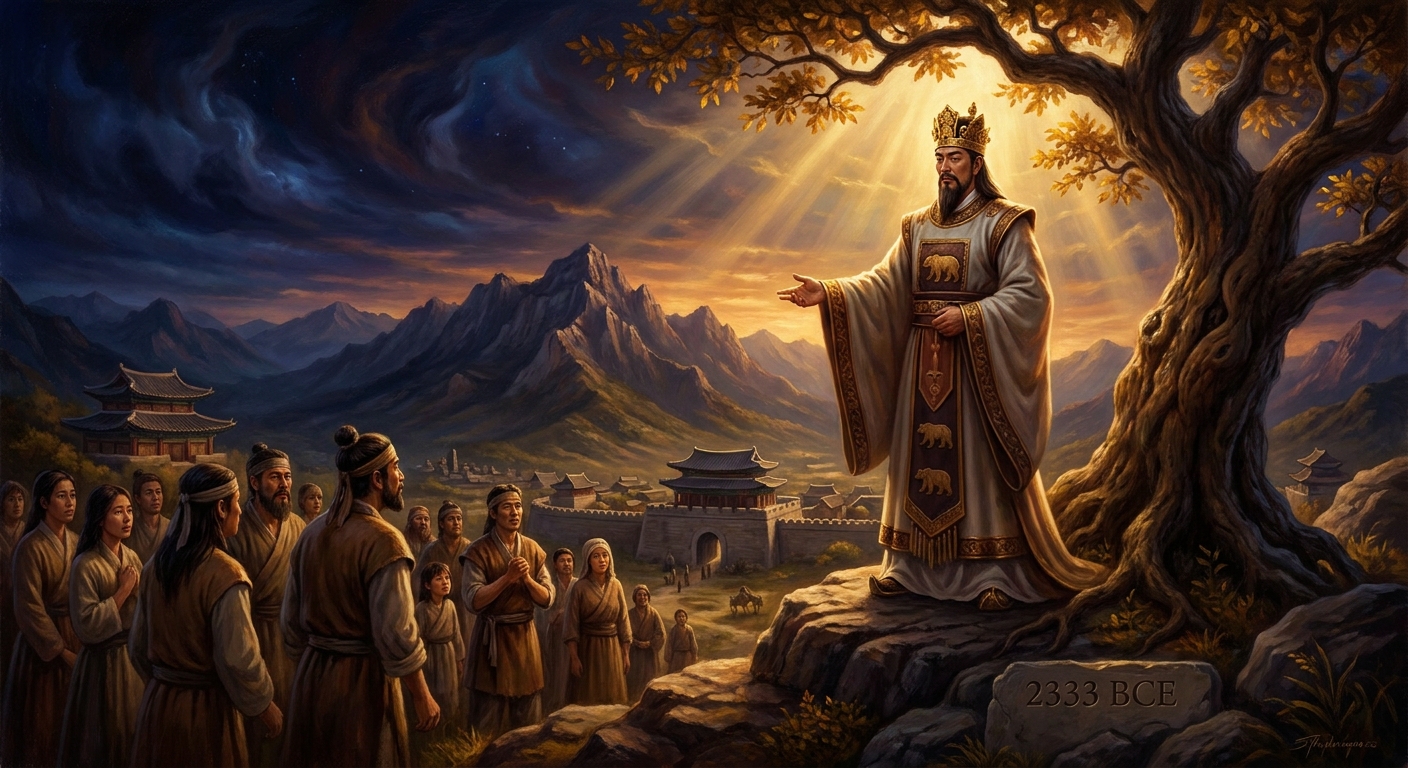
He founds the kingdom in 2333 BCE.
He calls it Joseon — what later historians will call Gojoseon, Old Joseon, to distinguish it from the dynasty that will take the name three thousand years later. He establishes his capital at Asadal, a place whose location scholars still argue about — somewhere on the Liao River, or perhaps on the Taedong near modern Pyongyang, or perhaps in two places successively. The myth does not specify because the myth is not concerned with cartography. It is concerned with descent.
He rules, the chronicles say, for 1,500 years.
This is the kind of number that signals something other than counting. It says: long enough that no one alive remembers when he was not king. It says: the kingdom and the king were the same thing for as long as memory holds. He institutes the sacrificial calendar, the agricultural cycle, the laws that bind the eight clans, the rituals at Mani-san. He is a father in the literal genealogical sense and in the constitutional one.
When he is finished — or when the kingdom is — he walks back up the mountain.
He does not die.
He becomes the sansin — the mountain spirit — of Mount Taebaek, and of every mountain by extension, because in Korean shamanic geography all mountains are versions of one mountain, and he is its guardian. He is still there. The shrines on the peaks are addressed to him. The shamans who climb to receive their initiation climb in his presence. October 3 is still Gaecheonjeol, the day the heavens opened, when his grandfather first looked down and consented to send his son.
The Samguk Yusa was compiled in 1281, during the Mongol occupation, by the Buddhist monk Iryeon. He was writing in a moment when Korea needed to remember it had been Korea before anyone arrived to take it. He recorded the bear and the cave and the sandalwood tree because they were the oldest answer to the question what makes us a people, and the answer was: a woman who waited inside the dark long enough to come out human, and a god who climbed down from the sky to meet her.
Every nation needs a story for its own beginning. Most pick a war. Korea picked a fast.
The bear is the central figure, not the god. She is the one who does the work — the staying, the eating-nothing, the refusing-the-light. The god provides the test and the seed; she provides the willingness. This is unusual in foundation myths, which tend to credit the masculine and the heavenly. The Korean myth credits the patience of the animal that consented to be remade.
Twenty-one days is not a hundred. The original instruction was a hundred. The bear left early — and the myth approves. The lesson is not that endurance must be total but that it must be sufficient. She stayed long enough to become what she came to become. The cave released her when the work was done, not when the calendar said.
Scenes
Hwanung descends Mount Taebaek with three thousand spirit-followers and three heavenly seals
 Generating art…
 The bear and the tiger pray at the foot of the sandalwood tree
 Generating art…
 Dangun Wanggeom founds Gojoseon — the first Korean state — at Asadal in 2333 BCE by tradition
 Generating art…
 Echoes Across Traditions
Entities
- Dangun Wanggeom
- Hwanin
- Hwanung
- Ungnyeo
Sources
- Iryeon, *Samguk Yusa* (Memorabilia of the Three Kingdoms), compiled c. 1281 CE — the earliest surviving written account of the Dangun myth
- *Jewang Ungi* (Songs of Emperors and Kings), Yi Seunghyu, 1287 CE — parallel late-13th-century recording of the foundation narrative
- Peter H. Lee (ed.), *Sourcebook of Korean Civilization*, vol. 1 (Columbia, 1993) — translations of the foundation texts
- James Huntley Grayson, *Myths and Legends from Korea: An Annotated Compendium of Ancient and Modern Materials* (Curzon, 2001)
- Hong-key Yoon, *The Culture of Fengshui in Korea* (Lexington, 2006) — on the geomantic significance of Mount Taebaek