Samudra Manthan: The Churning of the Cosmic Ocean
Mythic Time — Kshirasagara (the age before ages) · Bhagavata Purana ~9th century CE composition · The Kshira Sagara — the cosmic ocean of milk, at the center of creation
Contents
Gods and demons coil the serpent Vasuki around Mount Mandara and churn the milk ocean together, tearing open creation to find immortality. What pours out is everything — beauty, poison, medicine, death — and only Shiva can swallow the halahala that would destroy the universe before the nectar arrives.
- When
- Mythic Time — Kshirasagara (the age before ages) · Bhagavata Purana ~9th century CE composition
- Where
- The Kshira Sagara — the cosmic ocean of milk, at the center of creation
The gods and the demons have forgotten what they are fighting about.
That is the first thing to understand. They have been fighting since before the current age, since before the stars were fixed, and the fighting itself has become a kind of weather — expected, continuous, total. The Devas, led by Indra, hold the heavens. The Asuras, led by Bali, hold the depths. Between them, creation staggers along, battered by its own custodians. Then the sage Durvasa gives a garland to Indra. Indra gives it to his elephant. The elephant drops it. Durvasa curses them all into weakness. The Devas, suddenly mortal in their vigor, begin to lose. They go to Vishnu.
Vishnu listens from his couch on the serpent Ananta, which floats on the ocean of causality. He already knows what he will say. He tells them: you cannot win this by fighting. You must churn the ocean of milk. You must churn it until the amrita — the nectar of immortality — rises from the deep. And to do that, you will need the Asuras.
The proposal reaches the demon kings like cold water in a dream.
Work with the gods? Every calculation of pride and strategy says no. But the amrita is real, and Bali is not a fool — he accepts. The truce is not warm. It is practical, the way the edge of a knife is practical. They will cooperate exactly as long as the goal requires it and not a moment longer, and everyone at the shoreline of the milk ocean knows this.
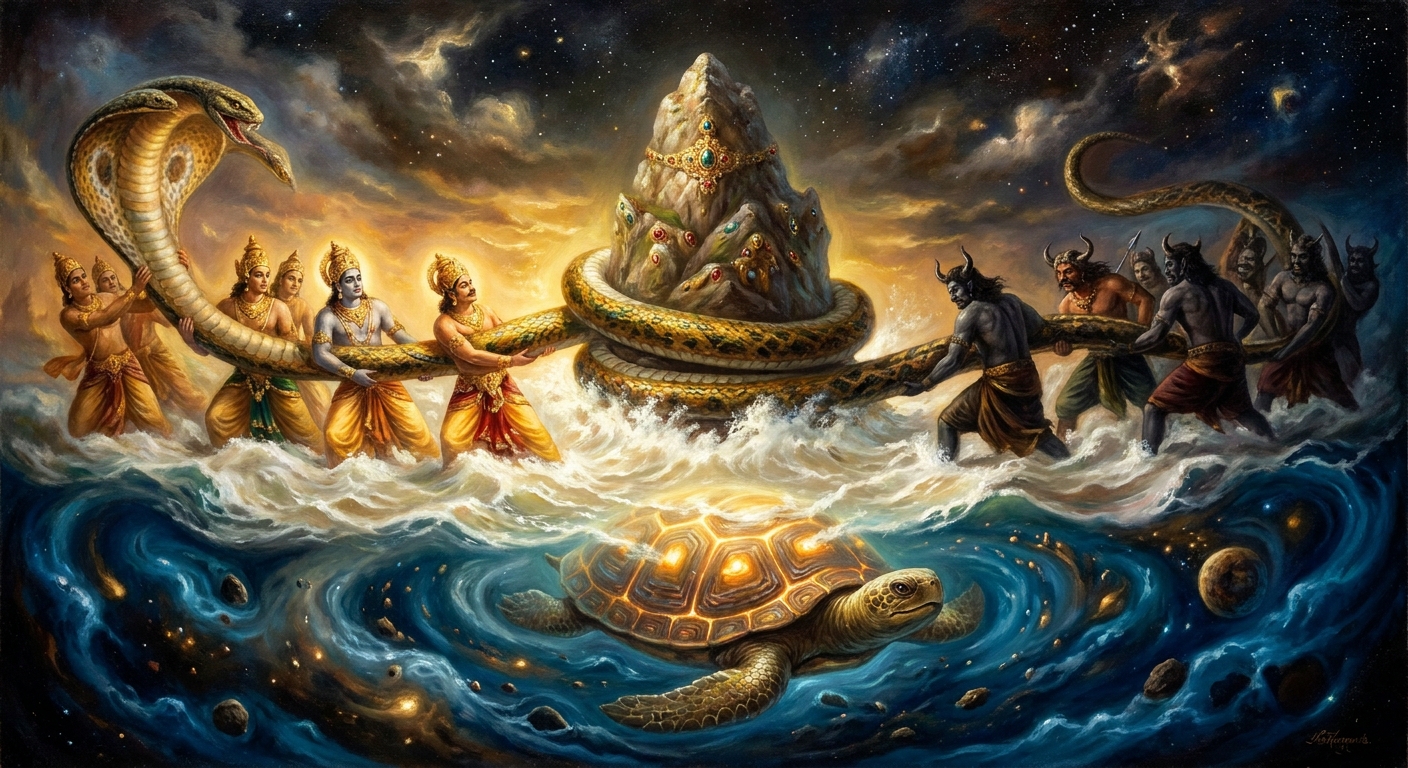
They uproot Mount Mandara. This alone is an act that should not be possible — a mountain torn from its foundations and carried to the coast, the earth behind it scarring like a wound. They wrap the serpent Vasuki around the mountain as a churning rope. The Devas take one end. The Asuras take the other. Vasuki — who is old enough to remember when there were no mountains — writhes under the weight without complaint.
Then the mountain sinks.
No one accounted for the depth of the milk ocean. Mandara descends through white water and keeps descending, and the churning has not even begun before the instrument of churning disappears into the seafloor. Vishnu, who was watching, simply acts. He takes the form of a Kurma — a tortoise immense as a continent — and descends into the deep, and the mountain rests on his back, and the bottom holds.
They churn for a thousand years.
Back and forth: Devas haul, Asuras haul. The ocean of milk, which has been still for ages, begins to move. The surface foams. Below the foam, the contents of creation stir. The milk ocean holds within it every possibility that the cosmos has not yet expressed — plants, animals, gods, poisons, medicines, stones, music, fire — and the churning is the act of calling them forward, one by one, into existence.
The first things that rise are not the amrita.
Surabhi, the wish-granting cow, emerges from the foam. The white horse Ucchaishravas. Kaustubha, the jewel of divine radiance. The tree Parijata that perfumes all three worlds. The apsaras, heavenly dancers, shining with a light that has no source the eye can identify. Each one rises from the churned sea and takes its place in the order of things. The gods and demons barely pause. They are not here for the accessories. They want the nectar.
Then the halahala rises.
It does not rise the way the others rose.
It does not emerge from foam or light. It comes up from below the below — from the stratum beneath the milk ocean’s floor, which is the place where the oldest things are stored. It is black-violet, the color of a bruise on the face of the universe. It is liquid but it moves like intention. The ocean of milk stops churning of its own accord. Every god and every demon on the shore steps back. The serpent Vasuki begins to retch — this is the poison from Vasuki’s own mouth, amplified by the churning, made into something that has no category.
The halahala does not threaten life. Life is too small a category. It threatens the structure within which life exists — the organizing principle, the basic grammar of cause-and-effect that allows the cosmos to cohere. If it spreads, there is nothing to spread into. The poison and the universe become one undifferentiated thing, which is indistinguishable from the universe ceasing to exist.
Every god looks at every other god. No one moves.
Then Shiva comes to the shore.
He comes without announcement.
He has been sitting on Kailash, watching — because Shiva watches everything, the god whose gaze is never fully closed, who exists in the still point around which the churning revolves. Parvati sees him stand. She sees the direction he is walking. She takes his hand. He pauses. He looks at her face and sees that she already knows what he is about to do, and that she is not asking him to stop, only to let her be present.
He walks to the shore of the milk ocean.
He kneels beside the halahala.
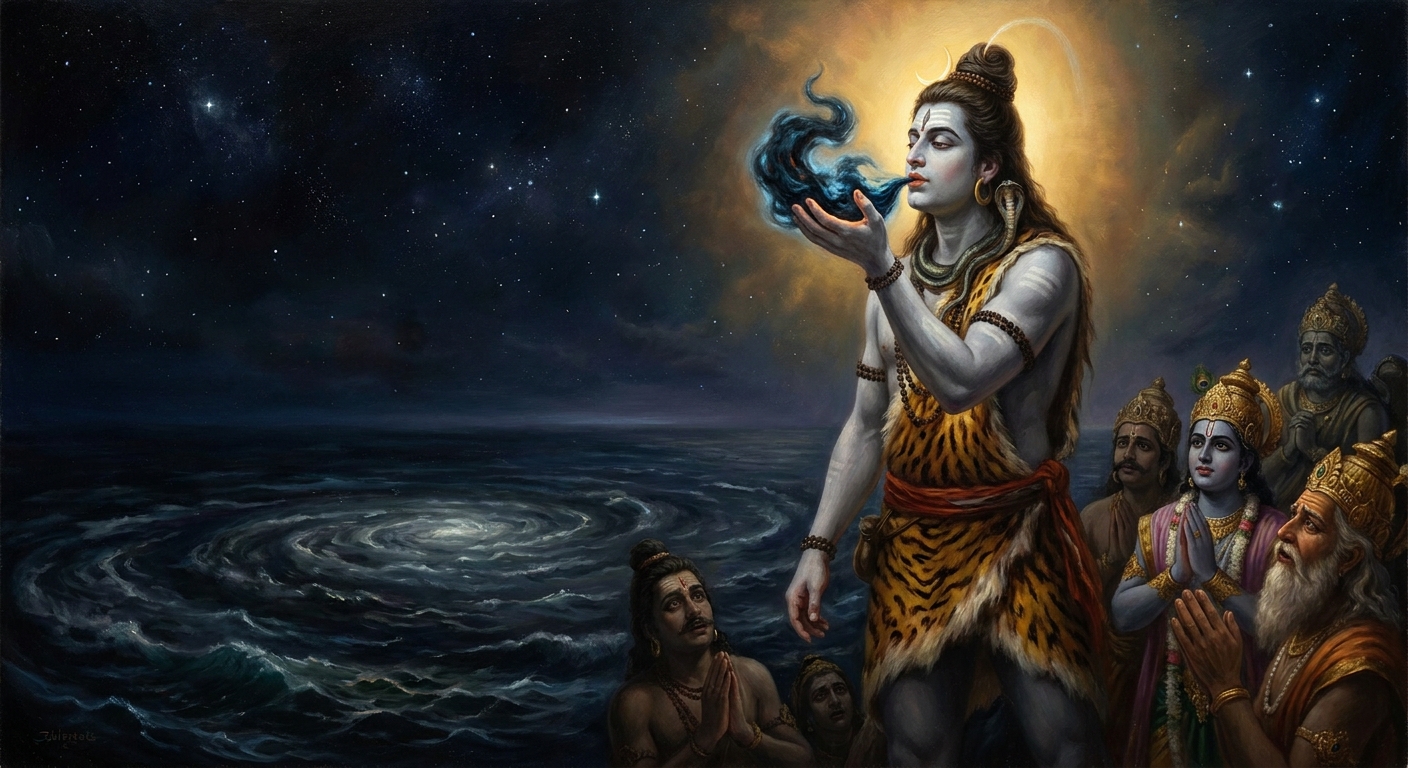
He cups it in his hands and drinks.
The gesture is unhurried. It looks nothing like heroism. It looks like a father drinking something a child cannot finish — matter-of-fact, total, complete. The black-violet tide runs down his throat, and the gods on the shore hold the kind of stillness that comes before something irreversible. The poison that would unmake existence passes into the god of transformation and stops. It does not kill him — Shiva cannot be killed by annihilation; he is annihilation’s landlord. But it does not simply pass through either. It stays in his throat, held there by the will of Parvati, who wraps her hands around his neck the moment he swallows — a physician’s grip, a lover’s grip — preventing the poison from descending further.
His throat turns blue.
He will be called Nilakantha from this moment: the Blue-Throated One. The color never fades. It is there in every image ever made of Shiva, the evidence of what he agreed to hold so that the rest of creation could continue.
The churning resumes.
The Devas and Asuras return to their ends of Vasuki. The ocean of milk, purged of its deepest poison, begins to yield its gifts again. Dhanvantari rises from the foam in blazing white, holding the vessel of amrita — the divine physician, the father of Ayurveda, the being whose very emergence is the announcement that healing is now possible in the world. The amrita glows like distilled sunrise.
What follows is not the story the poets prefer to linger on: the Asuras seize the amrita and run, and Vishnu takes the form of the enchantress Mohini to deceive them, and the nectar ultimately reaches the gods, and the cosmic balance that was the point of the whole operation is provisionally restored. The Devas are strengthened. The Asuras are not. The truce ends.
But none of that is the center of the story.
The center is Shiva at the shore of the milk ocean, kneeling over the poison that no one else could hold, holding it — not destroying it, not transforming it, not sending it somewhere else, but containing it in his own throat, keeping it from the rest of creation by becoming its vessel.
The amrita makes the gods immortal.
Shiva’s act keeps the universe alive long enough to receive it.
The Samudra Manthan teaches one thing above all others: before the nectar, the poison — and there is no nectar without first someone willing to swallow what cannot be survived by anything less than the divine.
Scenes
The gods and demons haul opposite ends of Vasuki, churning Mount Mandara like a spindle through the white ocean of milk while Vishnu as the Kurma Tortoise braces the mountain's base against the cosmic deep
Generating art… Shiva catches the halahala poison in his palm and drinks — the blue-black tide of annihilation is swallowed entirely, staining his throat the color of midnight, and the universe exhales
 Generating art…
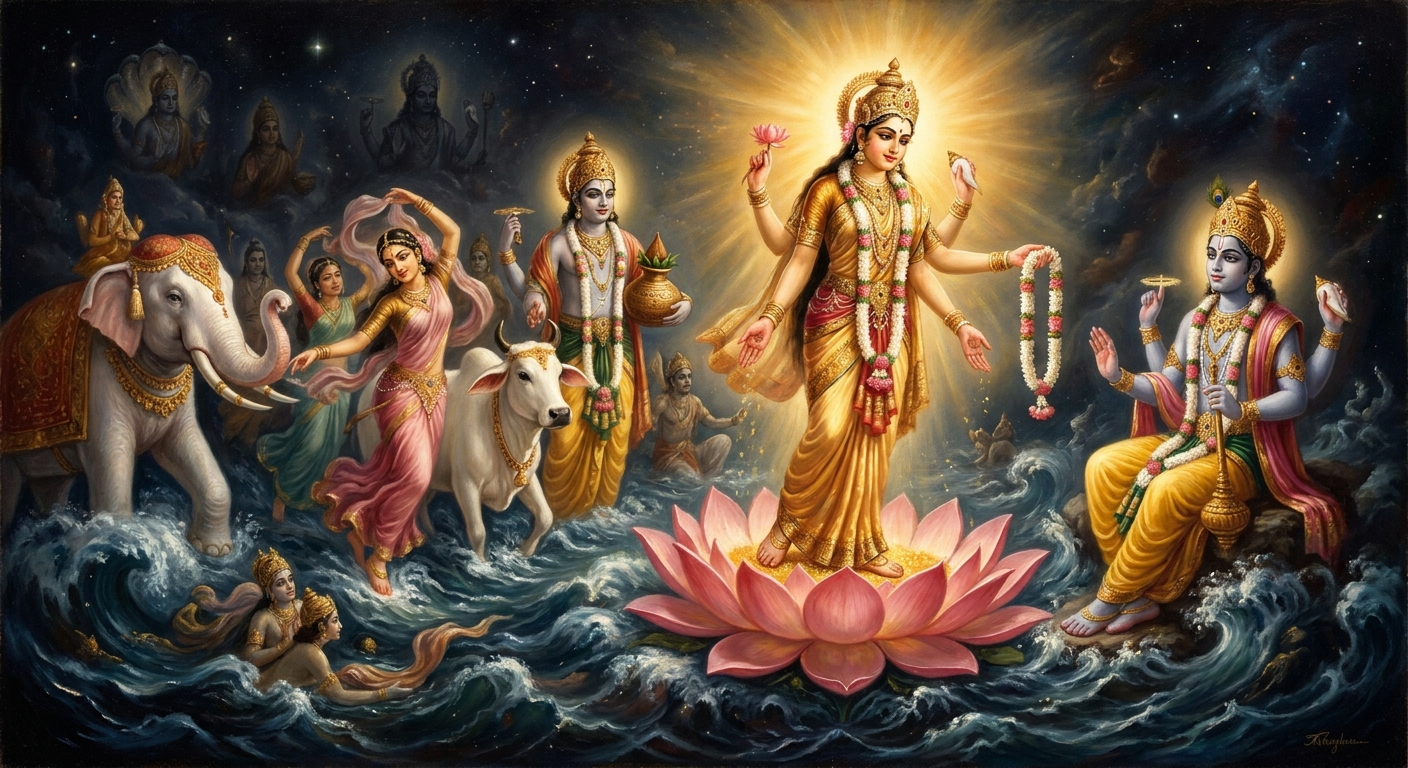
 Lakshmi rises from the churned sea standing on a lotus, draped in gold light, the oceans and rivers pouring over her in benediction — beauty itself emerging from the labor of opposites
 Generating art…
 Echoes Across Traditions
Entities


Sources
- *Bhagavata Purana* 8.5-12
- *Vishnu Purana* 1.9
- *Mahabharata* Adi Parva 15-17
- Wendy Doniger, *The Origins of Evil in Hindu Mythology* (1976)
- Alain Daniélou, *The Myths and Gods of India* (1991)