Jonah in the Belly
Narrative date ~8th century BCE · composition ~5th-4th century BCE post-exile · Joppa, the Mediterranean, the belly of a fish, and Nineveh — capital of the Assyrian Empire
Contents
A prophet runs the wrong direction, gets thrown overboard, lives three days inside a great fish, preaches to the city he hates, and then sulks under a vine because God forgave it.
- When
- Narrative date ~8th century BCE · composition ~5th-4th century BCE post-exile
- Where
- Joppa, the Mediterranean, the belly of a fish, and Nineveh — capital of the Assyrian Empire
The word of the Lord comes to Jonah son of Amittai, and Jonah goes the wrong way.
“Arise, go to Nineveh, that great city, and cry against it; for their wickedness is come up before me.”
Nineveh is the capital of Assyria. Assyria is the empire that will, within a generation of Jonah’s birth, deport the northern tribes of Israel and erase them from the map. The Hebrew word Nineveh is, for an eighth-century Israelite, roughly what Berlin was for a Polish Jew in 1938. God tells His prophet to walk into it and preach.
Jonah pays his fare for a ship to Tarshish — Spain, the far western edge of the world, the opposite end of the Mediterranean. He goes down to Joppa. He goes down to the ship. He goes down below decks. He lies down to sleep. The Hebrew is relentless: yārad, yārad, yārad — down, down, down. A man can run from God only by descending.
The Lord throws a wind onto the sea.
The ship is about to break up. The pagan sailors — Phoenicians, perhaps, polytheists with a god for every wave — are each crying to his own god and throwing cargo overboard. The captain comes down into the hold and finds the prophet asleep.
“What meanest thou, O sleeper? Arise, call upon thy God!”
They cast lots. The lot falls on Jonah. They interrogate him. He admits everything in one sentence — I am a Hebrew, and I fear the Lord, the God of heaven, who hath made the sea and the dry land — and the sailors, who have been afraid of the storm, become more afraid of him.
“What shall we do unto thee?”
“Take me up, and cast me forth into the sea.”
They try to row to land first. They cannot. They pray, finally, to Jonah’s God — let us not perish for this man’s life, lay not upon us innocent blood — and they pick him up and throw him over the side, and the sea stops the instant he hits the water.
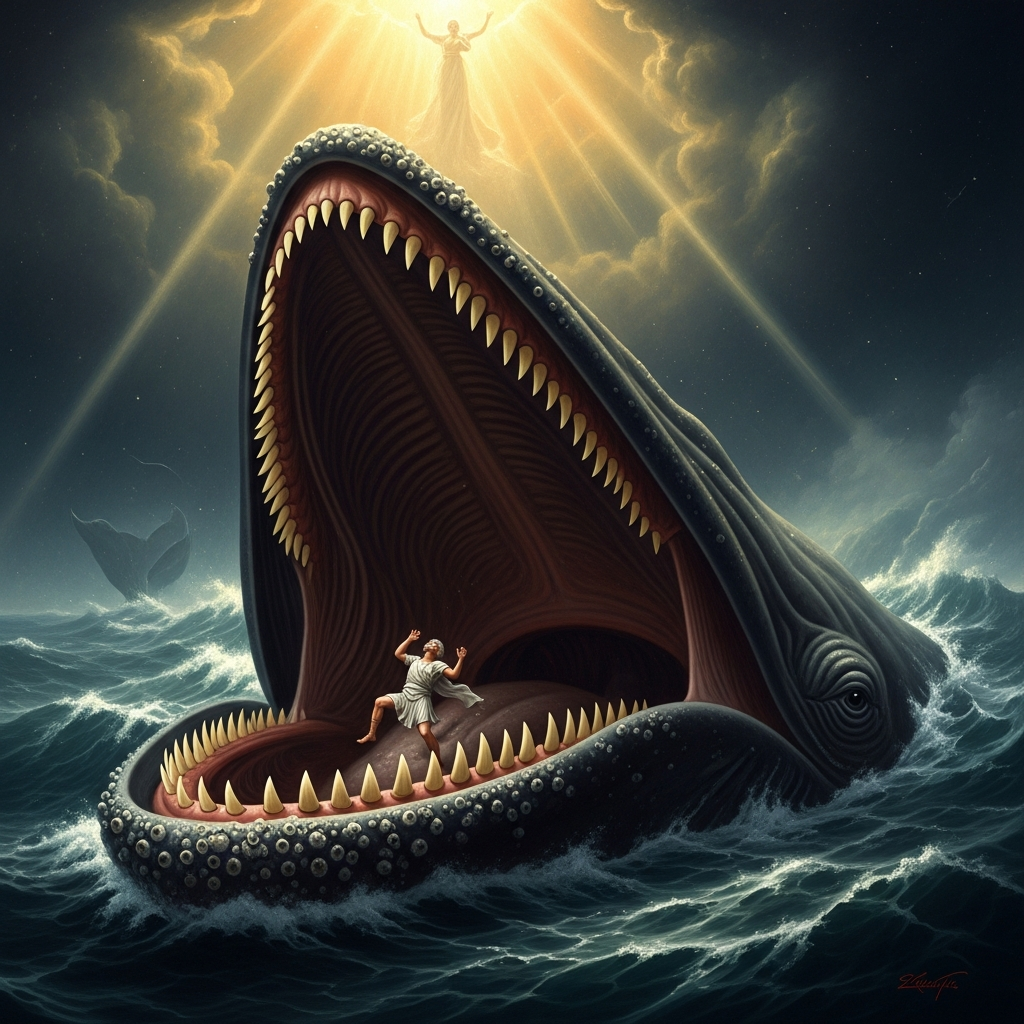
“Now the Lord had prepared a great fish to swallow up Jonah.”
He is in the belly three days and three nights. The text does not describe what he sees. The text gives instead a psalm — Jonah, in the dark, in the salt, surrounded by the bones of swallowed mackerel and the muscle of a thing he cannot name, prays.
“Out of the belly of hell cried I, and thou heardest my voice. The waters compassed me about, even to the soul. The weeds were wrapped about my head. I went down to the bottoms of the mountains; the earth with her bars was about me forever.”
It is the only prayer in the book. He prays it from inside the digestive tract of a fish. He thanks God for not letting him drown — apparently unaware that being eaten alive is a more specific form of drowning. He promises to pay what he has vowed.
The Lord speaks to the fish. The fish vomits Jonah out onto the dry land.
He goes to Nineveh.
It takes three days to walk across. He goes one day in, opens his mouth, and delivers the shortest sermon in prophetic history — five words in Hebrew, eight in English: “Yet forty days, and Nineveh shall be overthrown.”
That is the entire sermon. No call to repentance, no offer of mercy, no theology. Just the deadline.
The city believes him.
The whole city. Top to bottom. The king of Nineveh comes down off his throne, takes off his royal robe, puts on sackcloth, and sits in ashes. He proclaims a fast — and not just for humans. Let neither man nor beast taste anything; let them not feed, nor drink water. But let man and beast be covered with sackcloth. The cattle of Nineveh fast in mourning sacks. The sheep of Nineveh stand in the streets in burlap. Who can tell if God will turn and repent, and turn away from his fierce anger, that we perish not?
God sees what they do. God repents of the evil he had said he would do. He does not destroy the city.
Jonah, who has just delivered the most successful sermon in human history, is furious.
He goes outside the city, builds himself a little booth, and sits down to sulk. “O Lord, was not this my saying, when I was yet in my country? Therefore I fled before unto Tarshish: for I knew that thou art a gracious God, and merciful, slow to anger, and of great kindness, and repentest thee of the evil. Therefore now, O Lord, take, I beseech thee, my life from me; for it is better for me to die than to live.”
He confesses, in the open, the reason he fled in the first place. He did not run because he was afraid of Nineveh. He ran because he was afraid God would forgive Nineveh. He wanted them dead. He suspected God did not.
God grows a vine over the booth — a qiqayon, a fast-growing gourd — to shade Jonah’s head from the sun. Jonah, briefly, is delighted with the vine. Then God appoints a worm. The worm eats the vine. The vine withers in a morning. The east wind comes. The sun beats on Jonah’s head until he faints, and again he asks to die.
The book ends with a question.
“Thou hast had pity on the gourd, for the which thou hast not laboured, neither madest it grow, which came up in a night, and perished in a night. And should not I spare Nineveh, that great city, wherein are more than sixscore thousand persons that cannot discern between their right hand and their left hand — and also much cattle?”
That is the last line. There is no answer. The reader is the one being asked.
The book of Jonah is a comedy. The Hebrew is full of jokes — the prophet running from omniscience, the fish-prayer that thanks God for not letting him drown while he is being digested, the cattle in sackcloth, the worm that the universe appoints with the same verb used for the fish. Every actor in the story obeys God instantly except the prophet — the storm obeys, the sailors obey, the fish obeys, the gentile city obeys, the vine obeys, the worm obeys, the wind obeys. The prophet sulks under a dead plant.
The point is the question. God’s mercy is wider than the prophet’s. The book was written, scholars suspect, in the post-exilic period when the surviving Jews were debating how exclusive their covenant should be. Jonah is the dissent. The empire that destroyed your people, the storyteller insists, has a hundred and twenty thousand souls in it who do not know their right hand from their left. And much cattle.
Christ would call it the sign of Jonah. The Qur’an would call him Yunus. Pinocchio would meet his father in a fish-belly twenty-six centuries later. The shape of the story has carried.
Echoes Across Traditions
Entities
- Jonah
- the great fish
- the people of Nineveh
- the worm and the gourd
Sources
- *Jonah* 1-4 (Hebrew Bible / Tanakh)
- Robert Alter (trans.), *The Hebrew Bible* (2018)
- Uriel Simon, *Jonah* (JPS Bible Commentary, 1999)
- Phyllis Trible, *Rhetorical Criticism: Context, Method, and the Book of Jonah* (1994)