Contents
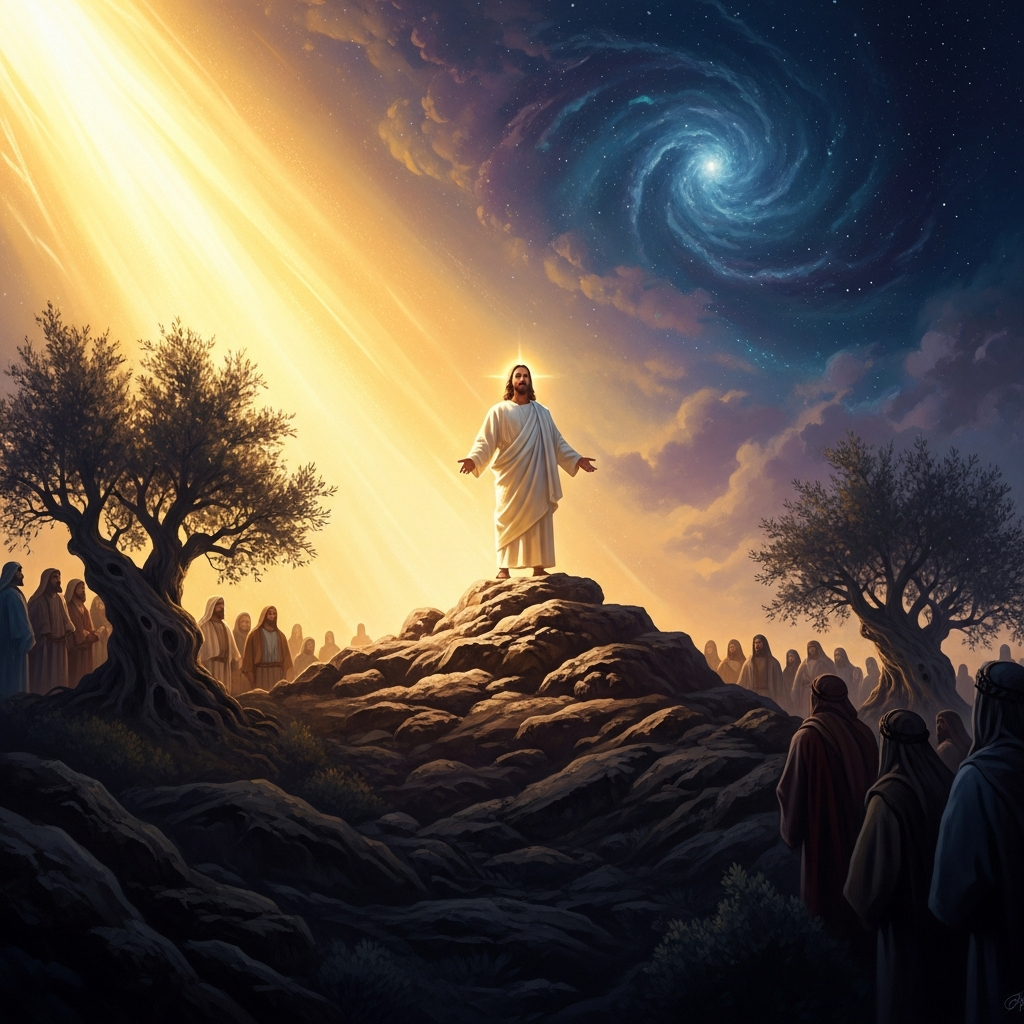
The dying-and-rising god pierced and suspended on wood — Christ sacrificed on the cross for the salvation of the world, dead three days, then raised. The deliberate parallel to Odin-on-the-tree.
- When
- ~30 CE · recorded ~70-100 CE
- Where
- Golgotha — outside Jerusalem
He climbs the hill at noon.
Not alone. Two thieves with him — Gestas and Dysmas, the Gospels will name them later, though no one knows who names them now. Roman soldiers carry the cross-beam, the timber still slick with resin. The crowd follows. Some curse. Some weep. His mother Mary stands silent, and John says she speaks no word the whole way, just walks, just watches.
The path is Golgotha: “the place of the skull.” There is no mystery in the naming. They crucify here daily.
He arrives at a place prepared for death. The soldiers strip him. The Gospels say this matter-of-factly. They divided his clothes, casting lots. His mother’s eyes do not leave him. One of the soldiers — a centurion, tradition will name him Longinus — is about to hammer the nails.
He does not resist. This is the detail that breaks the frame of every other dying-god story. Prometheus rages against his chains. Odin seizes the runes with both hands. Inanna descends to the underworld on her own terms, demanding the me (the sacred powers). But this one — the God-man, the one who could call a legion of angels and they would come — spreads his arms and lets the soldiers do their work.
“Father, forgive them, for they know not what they do.”
The nails go through the flesh. There is no theology in the nails, only iron and blood and the particular suffering of a human body giving itself over to torture.
The first hour: the inscription. IESUS NAZARENUS REX IUDAEORUM. Jesus of Nazareth, King of the Jews. Pilate’s joke, written in Hebrew, Greek, and Latin so everyone can read it — so no one can mistake the claim the Romans are executing: a king in a kingdom not Rome’s. The soldiers beneath the cross cast lots for his clothes. Routine. A man dying on wood is not remarkable in the empire.
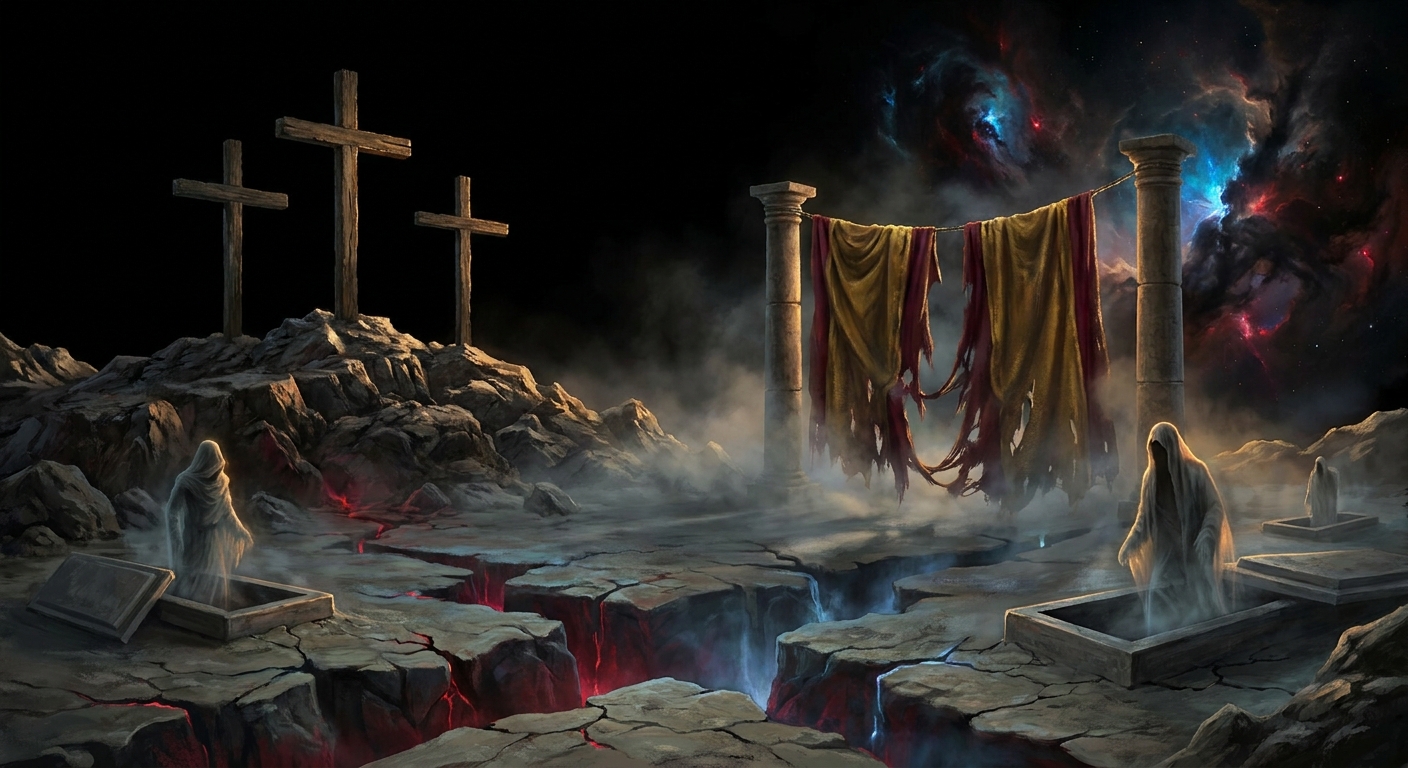
The second hour: darkness. All four Gospels agree, though they do not explain it. The sun withdraws. At midday, the sky goes black. In the streets below, people light lamps. The darkness is not metaphor. The darkness is written down.
The third hour: he thirsts. I thirst. A soldier puts a sponge soaked in vinegar — sour wine, posca, the drink given to slaves — to his lips. In John’s account, it is sop: bread dipped in wine. The detail might not matter except that the Psalms had said it first (Psalm 69:21), and the early church read the Psalms as a map written in advance.
Around the cross, the friends of Jesus have dispersed or hidden. Peter thrice denied he knew him. Judas hanged himself. The Twelve broke and ran. Only John stands with Mary at the foot. The soldiers stand off. The crowd that had cried Hosanna on Sunday now cries Crucify him. A city’s mood is a thin thing. Fickle. Quick to turn. The Gospels do not spare this detail.
There is a moment — the sixth hour, the texts say, though no clock marks it — when the man on the tree cries out in a language the crowd knows: Eloi, eloi, lama sabachthani. My God, my God, why have you forsaken me? The Psalm again — the Psalm that will map this whole story before the story is done, as if God had written the passion narrative into the temple liturgy centuries before any cross was built.
Some in the crowd think he is calling for Elijah. Let’s see if Elijah comes to take him down. But no one comes.
Then: the centurion’s spear.
The soldiers want to make sure the condemned are dead before sunset — the Passover festival is coming, and the law forbids bodies to hang on the holy day. They break the legs of the two thieves. The tibia shatters. The men cannot push themselves up on their feet anymore; they suffocate where they hang, the full weight of the body pressing down on the lungs. Death in minutes.
But the man in the middle is already dead, the Gospel says. So the centurion — Longinus, tradition names him, though the text does not — drives a spear upward into the side to be sure. The spear pierces to the heart. Water and blood flow out together, and John is the only evangelist who records this detail with the exactness of a witness: one of the soldiers pierced his side with a spear, and at once there came out blood and water.
The sign of the Resurrection, the church will say later. The spear-wound that will not kill him because he is already dying the kind of death that ends in rising.
The soldiers keep vigil. A man named Joseph from Arimathea — a man of means, the texts say, which means a man of power, which means a man risking power by asking Pilate for a body — wraps him in a linen shroud and buries him in a garden tomb, carved stone, sealed with a stone.
Mary stays. She does not leave. John’s Gospel says she stands at the cross till the end; Luke’s says she follows the young men to the tomb and sits opposite the sepulcher. She watches her son put into the earth. There is no resurrection theology here, only a mother watching. The Pietà has not yet been painted, but it is here: this moment, this vigil of a woman who has lost everything because her son said yes to a thing she did not understand.
And then: three days.
Nothing.
No text records what happens in the darkness. The Gospels skip from the burial to the Resurrection as if there is nothing to say about the gap. The church will later imagine it — Christ descending into the hell of the dead, binding the strong man, leading the captives captive. But the Gospels themselves are silent. For three days the tomb is simply a tomb.
Then: the stone rolls away.
The accounts diverge on details. Matthew says an angel sits on the stone. Mark says the women find the stone already rolled. Luke says they wonder who will roll it away, then find it rolled. John says Mary Magdalene comes in the dark and sees it gone. But all four say the same thing: the body is not there.
In Matthew: He is not here, for he has risen, as he said.
In Mark: See the place where they laid him.
In Luke: Why do you seek the living among the dead?
In John: They have taken away my Lord, and I do not know where they have laid him. Then she turns, and Jesus is standing there, and she does not recognize him, and then she does, and everything changes.
The Resurrection is not described. It is announced. It is discovered as an absence — the absence of a body in a place a body should be. And from that absence, every theology that follows.
Knowledge has a price. Every god in every tradition teaches this: Odin pays it with nine nights. Inanna pays it with three days in the underworld’s dark. Mithras is born on the winter solstice, dies, and is reborn. Tammuz descends. Adonis falls. They all hang or descend or die, and then they return.
Christianity claims not mythology but history. Not pattern but fact. The Resurrection is not a metaphor for the return of spring. It is not a theological principle. It is, according to the earliest Christian sources (Paul, 1 Corinthians 15: “he appeared to Cephas, then to the twelve… then to more than five hundred brethren…”), a thing that happened on the third day to a body that had been dead.
Whether that claim is true or false, historically recoverable or not, remains the fundamental argument of Christian thought. Everything else follows from how you answer: Was the tomb empty? Did the disciples really see him? Or did they see a vision, a ghost, a legend that hardened into doctrine?
The Odin parallel is real. Whether it precedes this story or was shaped by it — whether the mythologies borrowed from Christianity or Christianity borrowed from the mythologies — remains, like the Resurrection itself, a question scholars have not settled and likely will not.
What survives both readings is the claim: A god dies. A god is pierced. Three days. And then the god returns. If that is pattern, it is written in the deepest places of human religious longing. If that is fact, it is the event on which all Christian hope rests.
To know which, you have to believe. And belief, like the Resurrection, is not visible in tombs.
Echoes Across Traditions
Entities
- Christ
- Mary
- Pilate
- Longinus
- the Disciples
Sources
- Matthew 27 (Passion narrative)
- Mark 15 (Passion narrative)
- Luke 23 (Passion narrative)
- John 19 (Passion and Resurrection)
- 1 Corinthians 15:3-4 (earliest Creed: 'Christ died, was buried, was raised')
- Tacitus, *Annals* 15.44 (first non-Christian reference to crucifixion under Pilate, ~120 CE)