Contents
After feeding five thousand, Jesus sends the disciples ahead by boat across the Sea of Galilee, goes alone to a mountain to pray, and comes to them at three in the morning walking on the water. Peter steps out to meet him — and sinks.
- When
- ~30 CE · Galilee
- Where
- The Sea of Galilee
The crowd is finally gone.
Five thousand men — plus women, children, the whole enormous hunger of Galilee — fed from five loaves and two fish, the baskets of fragments more than the baskets of bread had been, and Jesus dismisses them all. He pushes the disciples into a boat and sends them across toward Bethsaida. He needs the mountain. He needs the dark and the quiet and whatever passes for solitude in a God who contains multitudes.
He goes up alone to pray.
Below him, the Sea of Galilee is a mirror going to pieces. The wind comes up from the southwest the way it does when the air cools fast off the Golan hills, and by the time the disciples reach the middle of the crossing they are pulling against it — oars in, oars out, the hull slapping sidelong waves, twelve men who have fished this lake their whole lives now reduced to fighting it. John is at the oar. James bails. Peter leans into the stroke and leans into it and gets nowhere. The far shore stays where it was.
This is the fourth watch. Somewhere past three in the morning. The stars are still up. The far lamps of Tiberias give no comfort.
Then someone sees the figure.
It is walking on the water.
Not swimming. Not standing on a submerged sandbar — there is no sandbar here, the lake runs thirty meters deep in the crossing. Walking. The way you walk a road. Moving toward the boat with the calm stride of someone who has somewhere to be and is in no particular hurry about the water beneath his feet.
The disciples cry out.
Every one of them. Fishermen who have hauled nets in the dark, who have gutted fish since childhood, who are not afraid of the lake at night — they see this figure and they cry out like children. The word they use is phantasma. A ghost. A shade. Something that should not exist walking toward them across a surface that should not hold weight.
Jesus speaks.
“Take heart, it is I; have no fear.”
Three sentences in the Greek. Short. No drama. He says it the way a man says it when he means it, not the way a man says it when he is trying to convince himself.
Peter hears it.
Peter always hears everything first and speaks before the hearing has finished. He is the one who said you are the Christ at Caesarea Philippi, and Jesus called him the rock the church would be built on. He is also the one who will say I do not know the man three times before cockcrow, warming his hands at the enemy’s fire. He is both of these things, and he is both of them at once, and that is why the church is built on him rather than on someone steadier — because the church is built for people who are both of these things.
“Lord,” Peter says, “if it is you, bid me come to you on the water.”
If. The word sits there in the middle of the sentence. The same Peter who just this afternoon watched five thousand people fed from nothing, who has seen the lepers clean and the paralyzed walking, who has heard you are the Christ come out of his own mouth — he still says if it is you. The doubt is not a defect. It is the gap between testimony and experience that every believer lives inside.
Jesus says one word.
Come.
Peter steps over the gunwale.
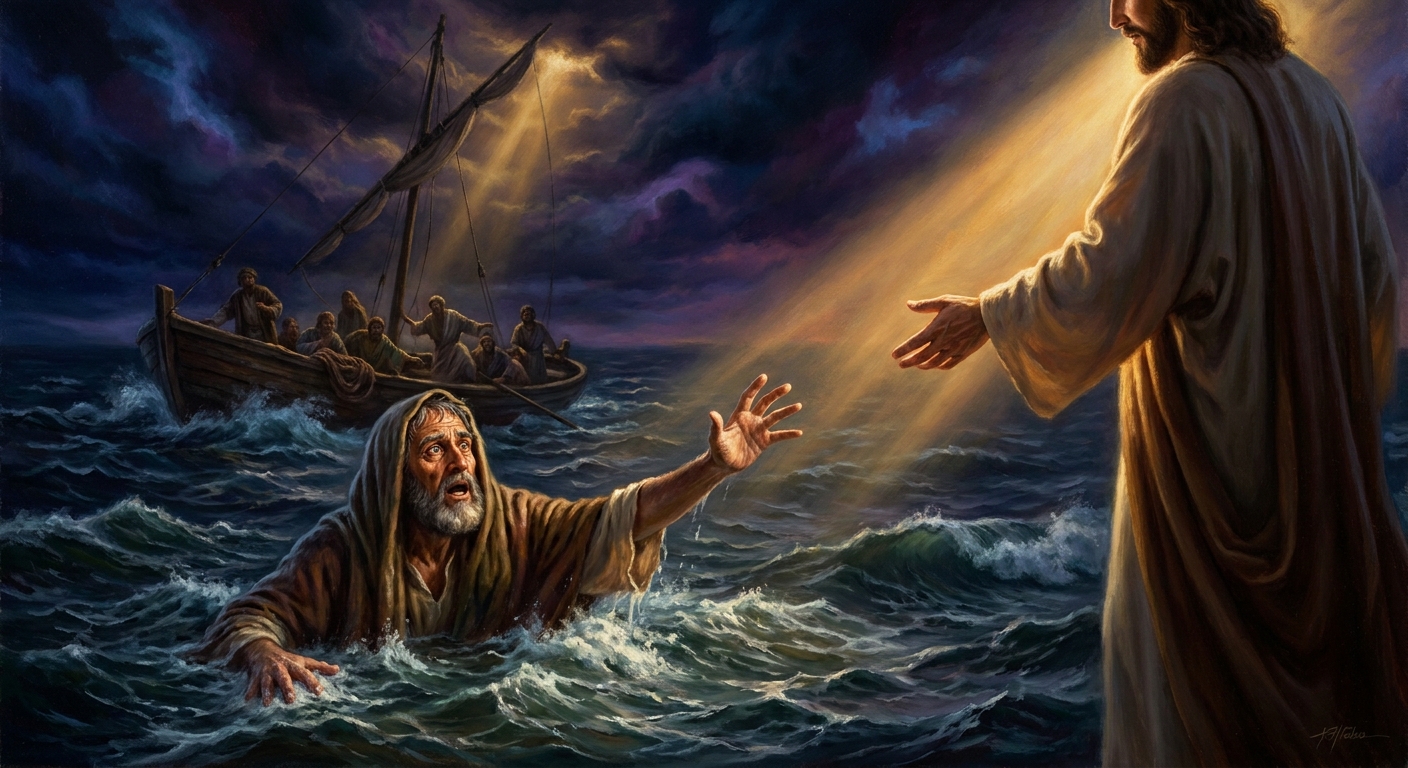
He puts his weight on the surface of the Sea of Galilee and the surface holds. He stands. He is standing on water in the middle of a storm in the fourth watch and it holds. He takes a step toward Jesus and it holds. He takes another step.
He looks at the wind.
This is the whole story in four words. Not the miracles before. Not the crowd fed, the demons driven out, the years of following. The whole story is: he looks at the wind. The moment his attention moves from the figure ahead to the facts around him — the whitecaps, the darkness, the five-meter waves, the physical impossibility of what he is doing — the facts take over. The water stops holding him. He goes in.
“Lord, save me.”
Two words this time. No if. No bid me come. No negotiation. Just the name and the need, which is what prayer usually collapses to in the moment it is actually required.
Jesus reaches out his hand immediately — Matthew is specific about the word, eutheos, at once — and takes hold of him.
“O you of little faith, why did you doubt?”
The question is not rhetorical. Jesus means it as a question, the kind a teacher asks because the student has the answer and needs to hear themselves say it. Peter, soaking, held up by the hand of the man on the water, probably does not answer. The Gospels do not record an answer. Some questions take a lifetime to work out.
They climb into the boat together.
The wind stops.
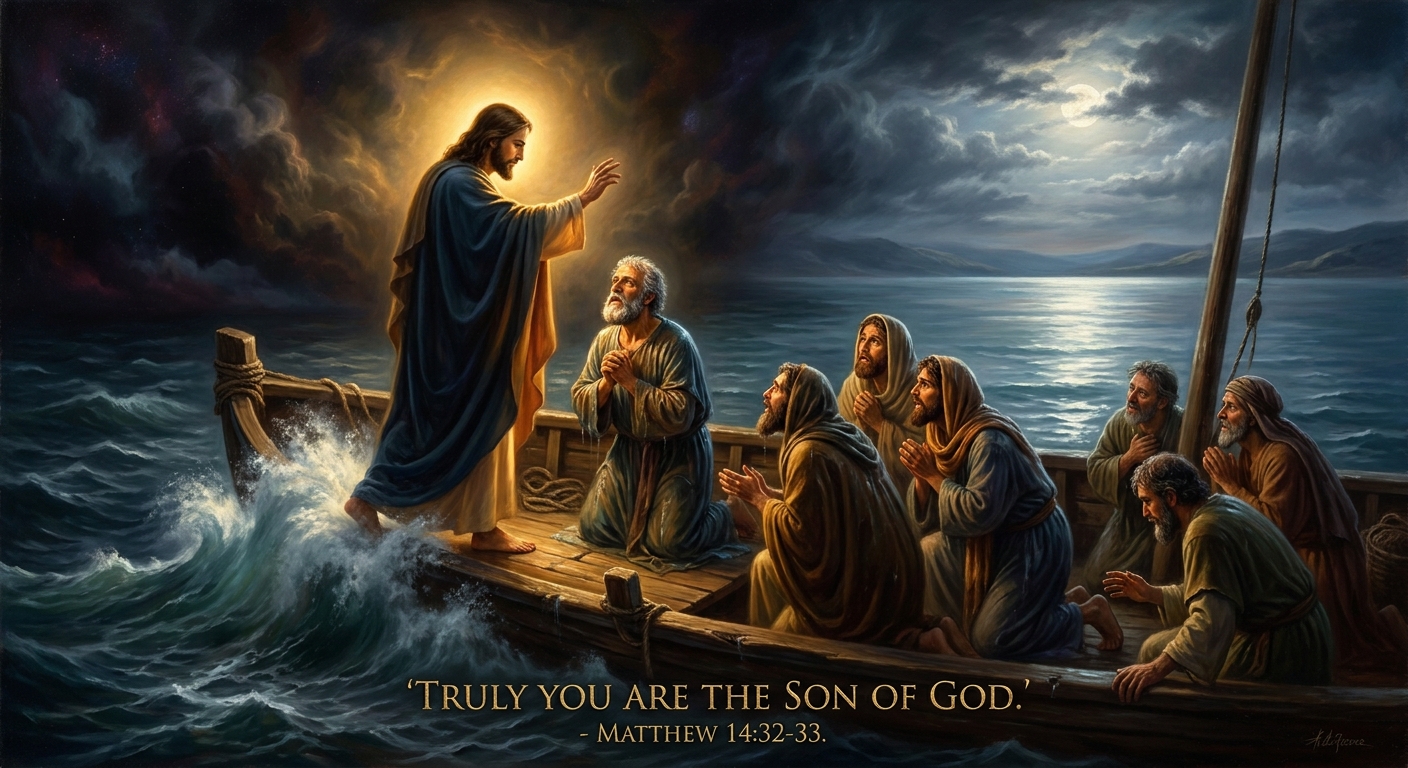
Not fades. Stops. The Greek word is ekopasen, the same word used in Mark 4 when Jesus stills the storm on this same lake and the disciples ask who is this, that even the wind and sea obey him? The disciples fall on their faces. They worship. They say it together: Truly you are the Son of God.
This is the only place in the Synoptic Gospels where the disciples use that title before the cross. It costs them a storm and a sinking to get there. It costs Peter going under to get there — to the place where the only word left is Lord, and the hand reaches out immediately, and the question that follows them back into the boat is the one they will still be working out at the end of their lives.
Why did you doubt?
John’s account leaves out the walking. In John 6, the disciples are terrified, Jesus speaks, the boat is immediately at the shore. John collapses the miracle into arrival. He does this sometimes — the long way around becomes the moment you are already there. But Matthew keeps Peter in the water, because Matthew is writing for a community that has to cross its own impossible distances and needs to know exactly where the sinking happens.
It happens when you look at the wind.
Every generation of this tradition since has had to decide whether that is a psychological observation or a metaphysical one. The scholars note: Bart Ehrman reads the episode as a post-resurrection vision transposed backward into the ministry. John Meier reads it as a nature miracle in the same category as the sea-stilling and the feeding. The text itself is agnostic about the mechanism and insists on the meaning.
The figure is walking toward you. The wind is very loud. The wave next to the boat is higher than your head.
Come.
Peter is the only human being in recorded history to have walked on water. He did it for approximately three steps before he remembered he could not. The church he was built to anchor has been doing the same thing ever since: a few steps, then the wind, then the reaching hand, then the question that does not let you go. This is not a failure mode. This is the mode. The miracle is not that he walked. The miracle is that the hand was already reaching before the cry was finished.
Scenes
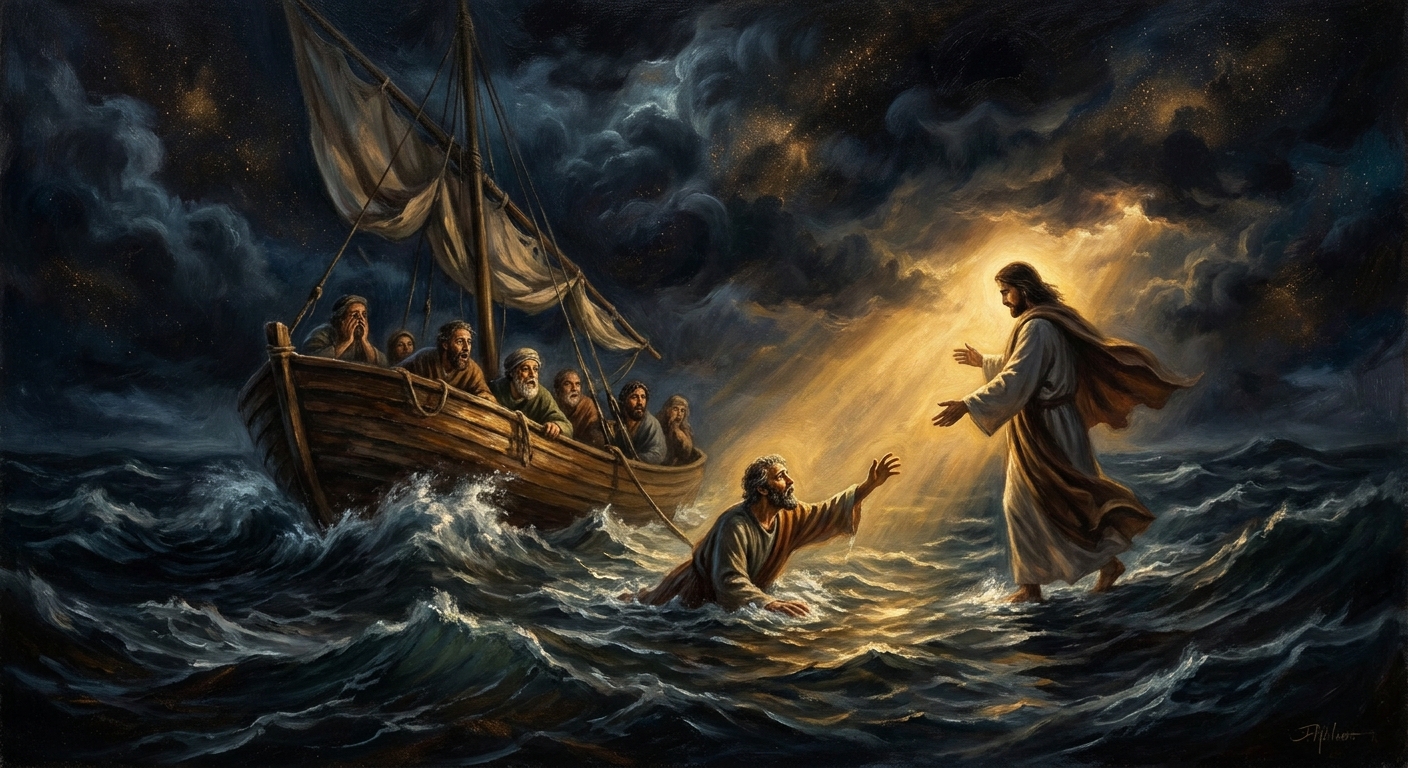
Jesus crosses the Sea of Galilee on foot at the fourth watch — roughly three in the morning — while the disciples strain at the oars against a headwind
Generating art… Peter steps out of the boat and walks toward Jesus
 Generating art…
 Jesus takes Peter's hand and they climb into the boat together
 Generating art…
 Echoes Across Traditions
Entities
- Christ
- Peter
- John
- James
Sources
- Matthew 14:22-33
- Mark 6:45-52
- John 6:15-21
- John P. Meier, *A Marginal Jew*, Vol. 2 (Doubleday, 1994)
- Bart Ehrman, *Jesus: Apocalyptic Prophet of the New Millennium* (Oxford, 1999)