The Last Supper: Bread, Cup, and Betrayal
~30 CE · Passover Eve, Nisan 14 · An upper room (ἀνώγεων) in Jerusalem, traditional location: Mount Zion
Contents
Jerusalem, Passover Eve. In a borrowed upper room, Jesus washes his disciples' feet, breaks bread and names it his body, pours wine and names it his blood, watches Judas walk into the dark, and gives eleven men something to do after he is gone. The meal that becomes the center of a religion.
- When
- ~30 CE · Passover Eve, Nisan 14
- Where
- An upper room (ἀνώγεων) in Jerusalem, traditional location: Mount Zion
Before he breaks the bread, he gets on his knees.
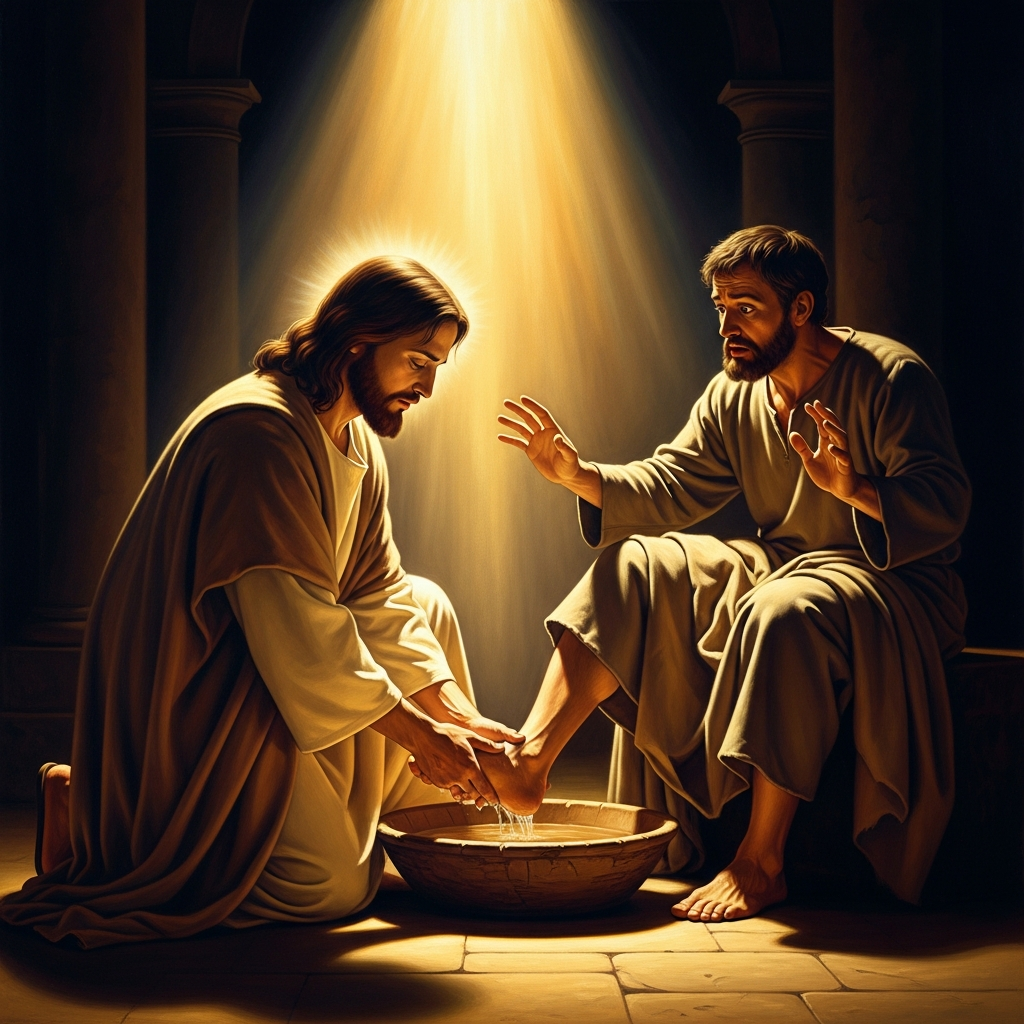
John 13 sets this before the meal begins — during supper, before the betrayal, the hour already come, Jesus knowing where he came from and where he is going, knowing the Father has put all things into his hands. He rises from the table, removes his outer garment, ties a towel around his waist, pours water into a basin. Then he goes around the table and washes the feet of each disciple. Twelve pairs of feet. Twelve men who have spent three years following a teacher they believed to be the Messiah of God, and the Messiah is now crouching at their feet with a servant’s cloth in his hands.
Peter refuses. Peter almost always refuses first. Lord, you shall never wash my feet. And Jesus answers: if I do not wash you, you have no part in me. Peter pivots immediately — then wash my hands and head as well. Jesus, somewhere in this exchange, is almost amused. He wipes the feet dry. He puts his robe back on. He returns to the table.
Do you know what I have done to you? He looks around at them. You call me Teacher and Lord, and you are right, for so I am. If I then, your Lord and Teacher, have washed your feet, you also ought to wash one another’s feet. I have given you an example.
The example is the thing. Not the teaching about the example. The thing itself: the floor, the water, the kneeling.
The meal has a script and he follows it and rewrites it simultaneously.
It is Passover Eve in Jerusalem — Nisan 14 by the Jewish calendar, the night when every family in Judea retells the story of Egypt, eats the bitter herbs, drinks the four cups, breaks the unleavened bread. The city below the upper room holds a hundred thousand pilgrims; the smell of burnt sacrifice from the Temple courts drifts north on the wind. This feast is older than the monarchy, older than the Temple, anchored in the night God passed over the houses marked with lamb’s blood and death passed with it.
Jesus knows the Seder by heart. He has kept this feast every year of his life. He keeps it now.
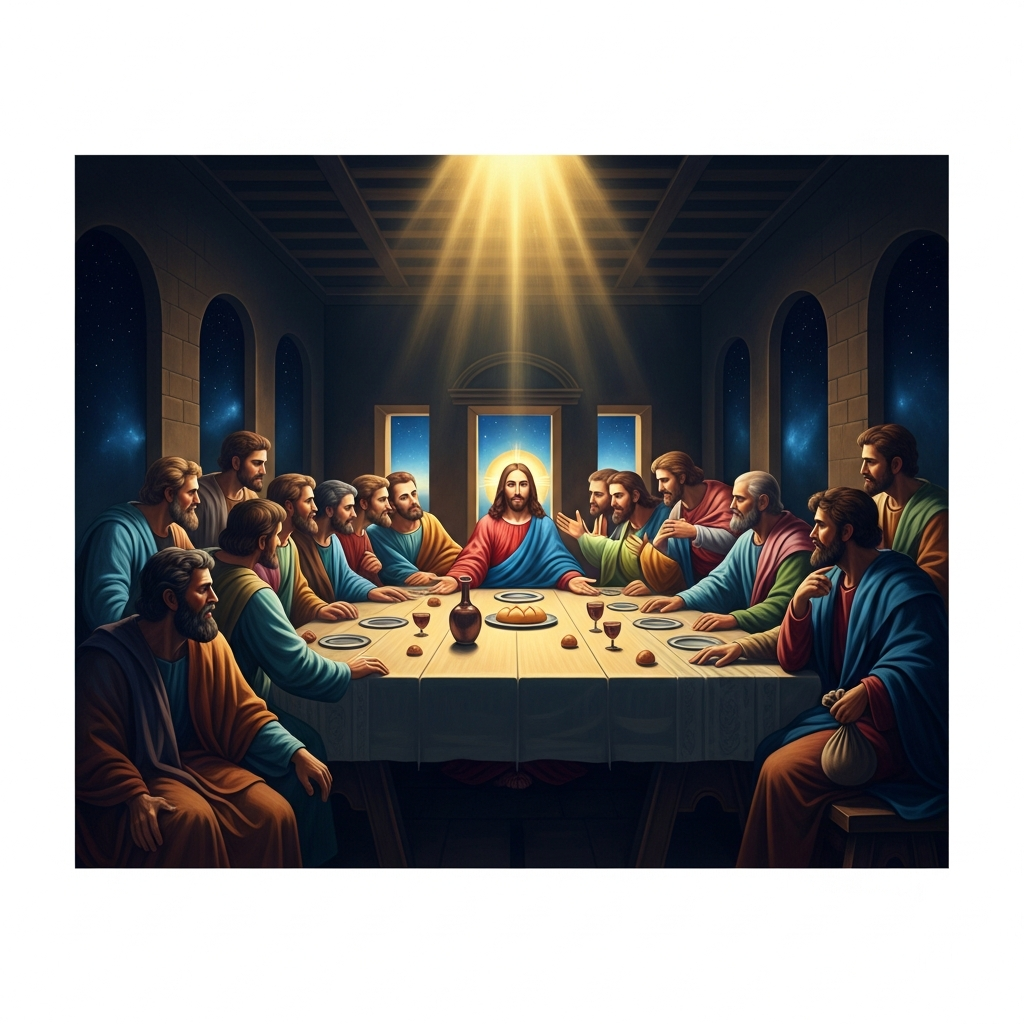
When the cup of blessing comes — the third cup, after the meal, the one the Seder calls the Cup of Redemption — he lifts it and speaks differently than the script says. This cup is the new covenant in my blood, which is poured out for you. The cup passes around the table. Eleven hands receive it, or twelve — they are not yet sure about Judas. They drink. No one fully grasps what they are holding. The Didache, written a generation from this night, will try to prescribe the exact words for communities repeating the act and will not quite succeed. The argument over what the bread and wine are — symbol, presence, substance transformed — will run for twenty centuries and remains unsettled. But the act is settled. Bread broken. Cup shared. Do this in remembrance of me.
The unleavened bread comes first.
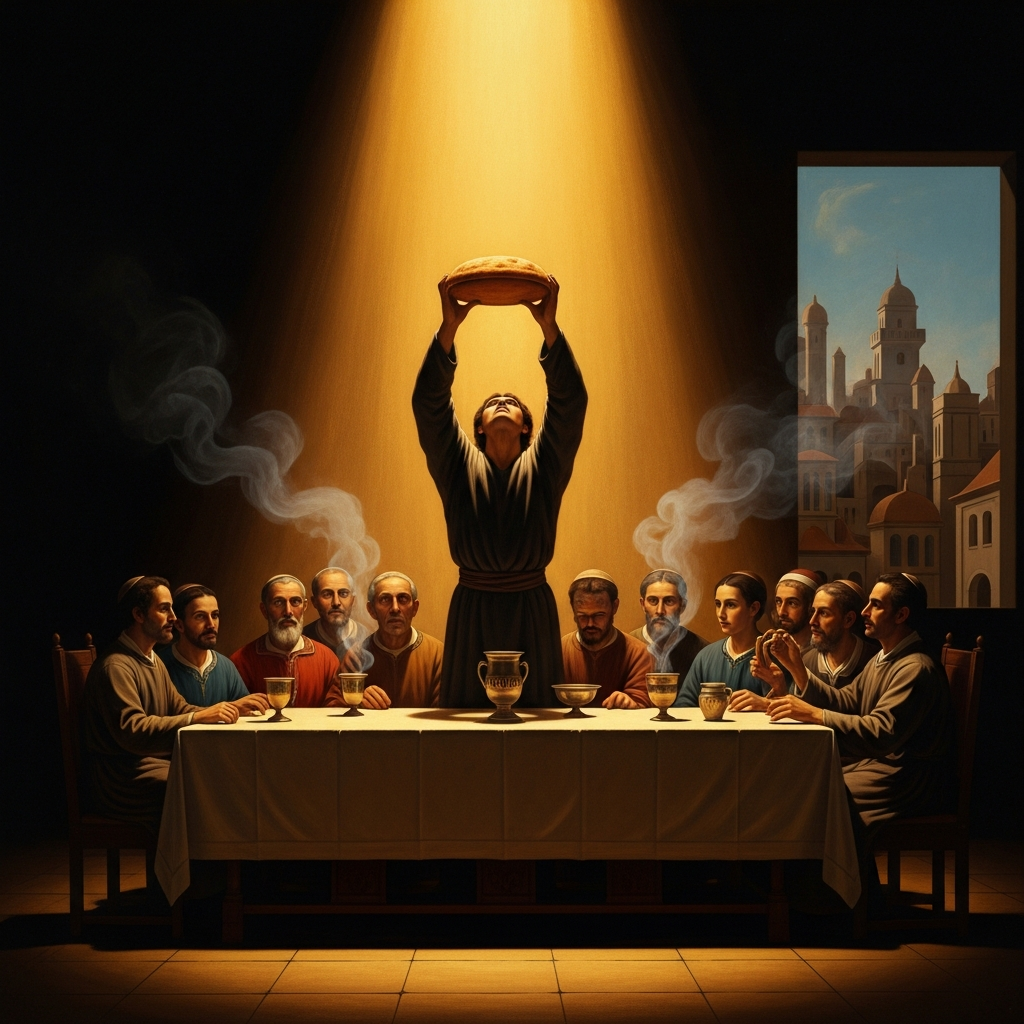
He lifts it — flat, pale, fragile in a way leavened bread is not — gives thanks in the Aramaic his mother taught him, breaks it cleanly across the middle, and holds out the pieces. Take this and eat. This is my body, given for you. Twelve portions. Twelve men in an upper room, oil lamps throwing shadows up whitewashed walls, and the sentence lands like stone into water. Peter reaches for his piece. John takes his. The bread is eaten.
Luke 22:19 adds the four words that will haunt the church through every schism: in remembrance of me. The Greek is anamnēsis — not mere recollection, not nostalgia, but the liturgical act of making the past present, the same word used in the Septuagint for God’s remembrance of the covenant, a remembrance that is also a re-enactment. Every time the church breaks bread after this night, it does not only recall what happened. It does something the tradition argues is the thing itself, happening again.
Judas leaves before the singing.
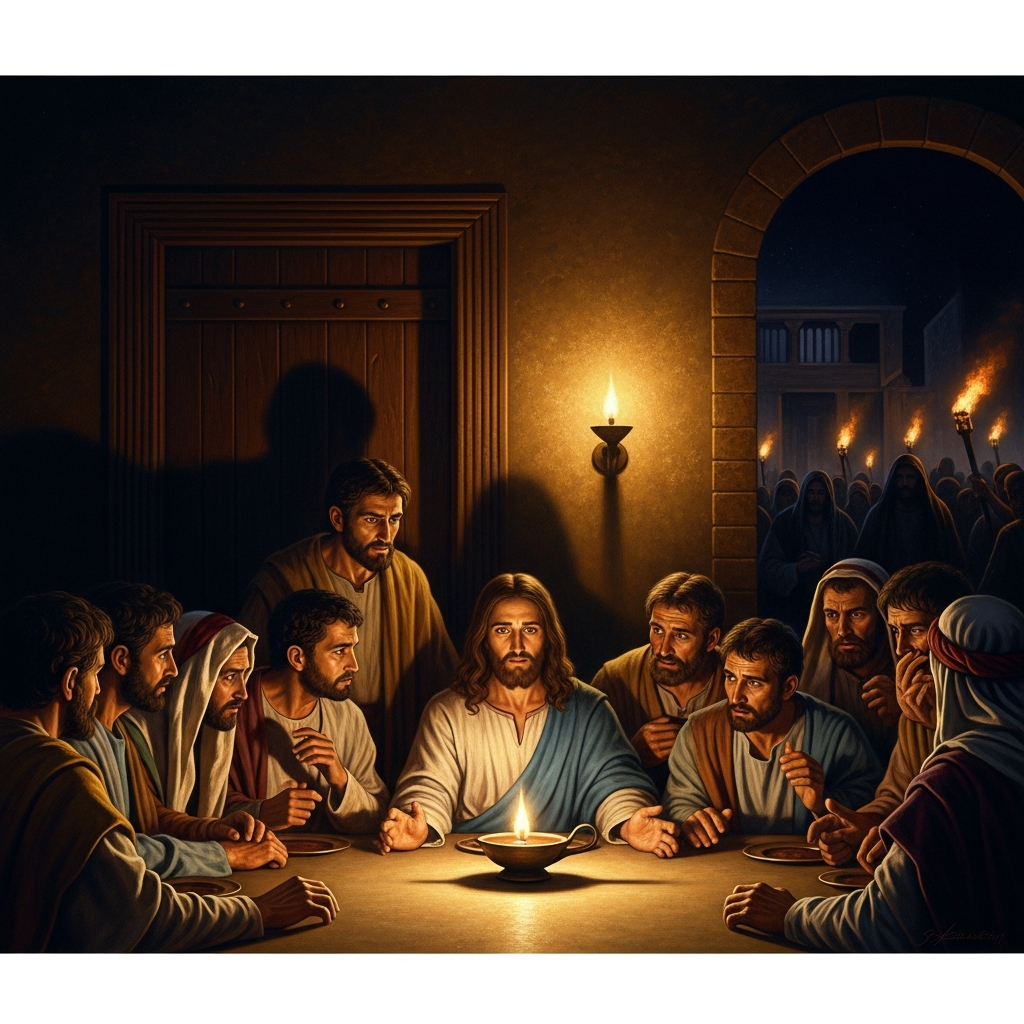
John’s account is the sharpest on the mechanism. Jesus dips a morsel of bread in the dish and hands it to Judas Iscariot — the morsel an act of honor, the guest of distinction receiving the host’s gift first. Something passes between them as Judas takes it: a look, and a sentence just audible to John, who is leaning against Jesus at the table. What you are going to do, do quickly. The others assume he is being sent for supplies, or to give to the poor. The Passover city needs both. The door opens. The lamp flame bends. The door closes.
He walks into the Passover crowd — torchlight, families, the smell of roasting lamb — and disappears into the machinery of the arrest. The thirty pieces of silver are already agreed. The kiss is already decided on as the signal. He moves through streets full of pilgrims who are eating and celebrating the liberation of their ancestors, and he goes to arrange a capture.
At the table, eleven men do not yet know what has been set in motion. Jesus knows. He sits with it, and continues the meal.
Peter swears the oath in the room, or on the road down — the gospels differ on the exact location and it does not matter. What matters is the swearing itself.
Lord, I am ready to go with you both to prison and to death.
He means it completely. Simon Peter, who left his nets at Galilee, who named Jesus the Messiah at Caesarea Philippi when everyone else was equivocating, who walked on water for three steps before he looked down — he offers this with everything he has. It is not a performance of courage. It is an actual gift.
Jesus receives it and returns a fact: before the rooster crows tonight, you will deny me three times.
Peter does not believe this. The belief would require a knowledge of himself that he does not yet have and will not have until the moment in the high priest’s courtyard when a servant girl looks at him in the firelight and says you also were with him, and he hears his own voice say woman, I do not know him. That moment is hours away. Right now, Peter believes he is the kind of man who does not break. He is wrong, and the wrongness is not stupidity or cowardice — it is the ordinary human incapacity to know in advance what you will do when the fear is real and the cost is your life and the question comes from someone who is not afraid of you at all.
They sing before they go out.
The Hallel psalms — 115 through 118, the ancient praise songs that close the Seder — rise from the upper room. This is the day the Lord has made; let us rejoice and be glad in it. Thirteen voices in a borrowed room, the bread already eaten, the cup already emptied. Psalm 118 is the last and it contains the line that will echo at the trial: The stone the builders rejected has become the cornerstone. They sing it. They have sung it every Passover since childhood. This year the stone is in the room with them, singing.
Then they go out into the night and cross the Kidron Valley to the garden called Gethsemane. The garden means the olive press. Jesus takes Peter, James, and John deeper in, tells the others to sit and wait, and begins to pray in a way none of them have ever witnessed: Father, if it is possible, let this cup pass from me. The same word. The cup he poured at the table, the cup of blessing, the cup that is the new covenant in his blood — he asks if it can be lifted. He asks three times. Three times the silence answers.
He stands, wakes the sleeping three, and tells them to rise. Torches are moving through the trees at the garden’s edge. Judas is in front of them.
The Last Supper becomes the most repeated meal in human history. Two billion people perform its gestures — the bread broken, the cup lifted, the words spoken — across every language, every continent, every century since. Some believe the substance changes at the moment of consecration. Some believe the memory is the presence. The argument has produced councils, schisms, wars, martyrs, and more theology than any other question.
But the meal begins with kneeling. Before the bread, before the cup, before the word that names them body and blood — the teacher takes the basin and the towel and gets on the floor. The order is deliberate. The Eucharist is incomprehensible without the foot-washing. You cannot understand what he does at the table without first watching him on his knees.
The upper room holds both: the gesture of ultimate servitude and the gift that outlasts death. He gave them something to do after he was gone. They have not stopped doing it.
Scenes
Jesus kneels before Peter with the basin — the teacher washing the feet of the student, the lord serving the servant, before the bread is ever broken
 Generating art…
 He lifts the unleavened bread above the table: twelve faces in lamplight, the city's Passover smoke drifting through the window, the silence before the words
 Generating art…
 The door closes behind Judas
 Generating art…
 Echoes Across Traditions
Entities
- Christ
- Peter
- Judas
- John
- Mary
Sources
- Matthew 26:17–30
- Mark 14:12–26
- Luke 22:7–38
- John 13:1–17:26
- *Didache* 9–10 (~late 1st century CE)
- *Mishnah Pesachim* 10 (Passover Seder order)
- Raymond Brown, *The Death of the Messiah*, vol. 1 (1994)
- N.T. Wright, *The Resurrection of the Son of God* (2003)