Lazarus: Come Out
~30 CE · Weeks before the Passover at which Jesus is arrested · Bethany, a village approximately two miles from Jerusalem on the eastern slope of the Mount of Olives
Contents
Mary and Martha send word: the one you love is sick. Jesus waits two days before leaving. By the time he arrives at Bethany, Lazarus has been dead four days. Martha meets him on the road with the sentence every mourner has ever thought: Lord, if you had been here, my brother would not have died. Jesus weeps at the tomb. Then he calls Lazarus by name.
- When
- ~30 CE · Weeks before the Passover at which Jesus is arrested
- Where
- Bethany, a village approximately two miles from Jerusalem on the eastern slope of the Mount of Olives
The message that reaches Jesus is careful. It does not ask him to come. It does not say: our brother is dying, hurry. It says only: Lord, he whom you love is sick.
Mary and Martha know what they are doing. They are not informing Jesus of a fact he might have missed. They are handing him the relationship as a claim. The one you love. They trust that the love itself will move him, that no further argument is necessary. The message is sent from Bethany, a village two miles east of Jerusalem on the slope of the Mount of Olives — close enough to the city that the risk of Jesus returning is real, and the disciples know it. When Jesus announces he is going to Judea, they remind him that the authorities there just tried to stone him. He tells them Lazarus has fallen asleep and he is going to wake him.
They say: Lord, if he is asleep, he will recover.
He says plainly: Lazarus is dead.
Then he says the strange thing, the sentence that will not stop reverberating through John’s account: And I am glad for your sakes that I was not there, so that you may believe. He has waited two days after hearing the news. He has let the death happen, let the burial happen, let the mourners gather. He arrives, as he intended, on the fourth day. Four days past the death, which in the Jewish understanding of his time means past every threshold of possible return.
Martha goes out to meet him on the road.
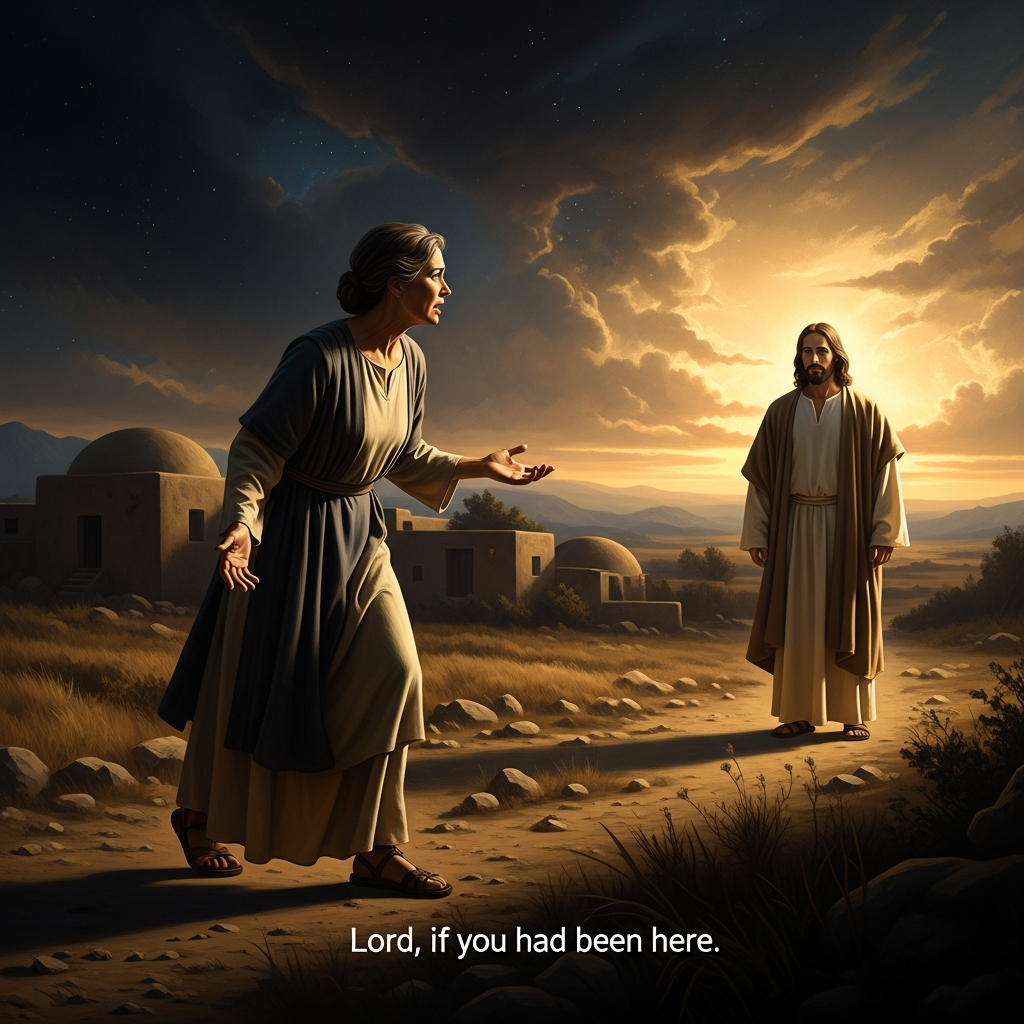
She does not wait. She leaves the house — full of mourners who have come from Jerusalem, full of condolence visits and ritual weeping — and she walks out alone to the edge of the village and meets Jesus before he enters. The grief and the accusation arrive in the same sentence: Lord, if you had been here, my brother would not have died.
This is the sentence every mourner has thought toward every absent God. You could have come sooner. You knew. You loved him. You did not come. The sentence is not an argument — it is the sound of a person who believed something and is still deciding what to do with the belief now that it has been tested to breaking point. Martha is not losing her faith in this sentence. She is handing it to Jesus still burning and asking him what it means.
Jesus says: your brother will rise again.
Martha says: I know that he will rise again in the resurrection on the last day. This is correct Pharisaic theology, the settled Jewish hope for end-time resurrection, and it is also a polite way of saying: yes, later, I know, but right now he is dead and you were not here.
Jesus says: I am the resurrection and the life. Whoever believes in me, though he die, yet shall he live, and everyone who lives and believes in me shall never die. Do you believe this?
Martha says: Yes, Lord; I believe that you are the Christ, the Son of God, who is coming into the world.
The profession of faith is complete and exact. Then she goes back to the house to get her sister.
Mary comes out and falls at his feet.
She uses the same words. Lord, if you had been here, my brother would not have died. Word for word, the same sentence Martha used. Two women, two encounters, the same sentence — as if the whole household has been saying it to each other for four days, unable to say it to the one who could have prevented it, and now they can finally say it to his face. He has to hear it twice.
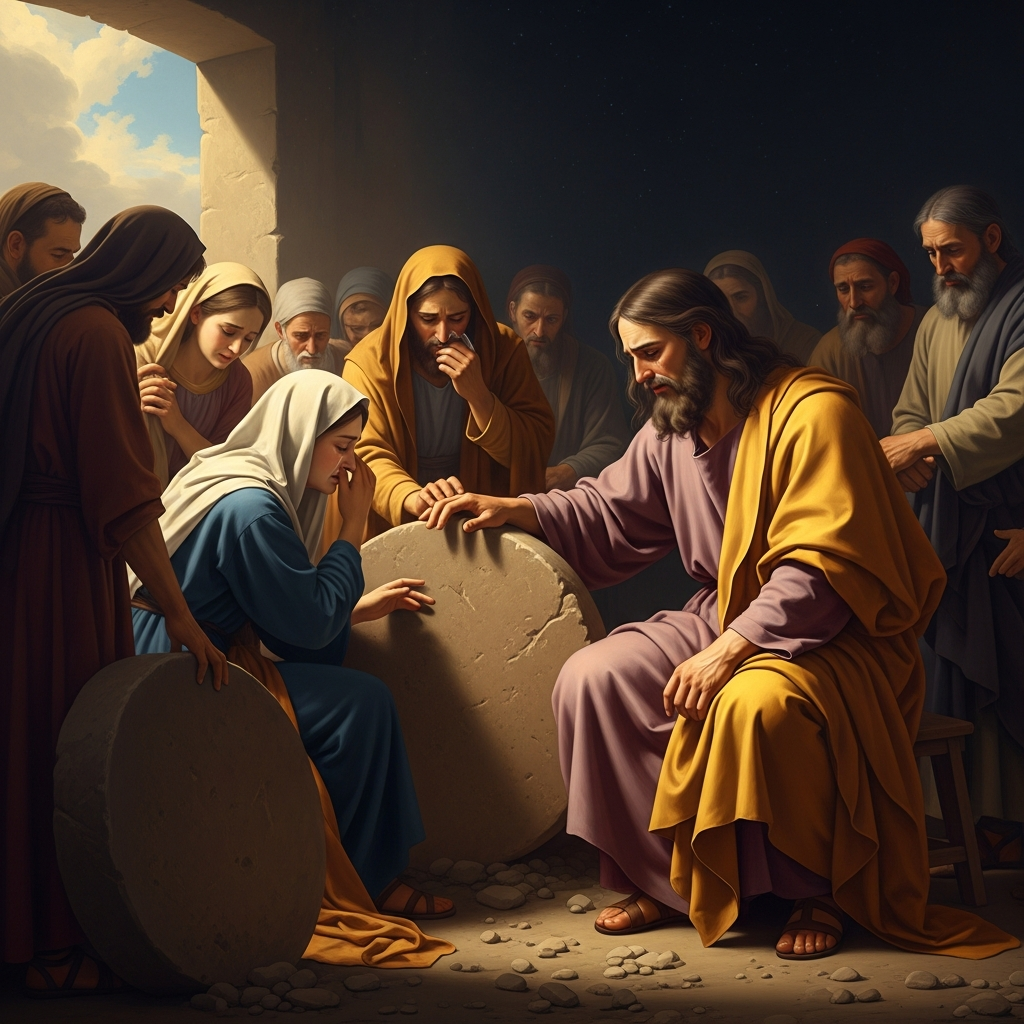
He sees her weeping. He sees the crowd of mourners who came with her from the house, weeping. And he is embrimaomai in the spirit — the Greek word is powerful: moved in grief, troubled, indignant in a way that is hard to translate cleanly. He asks where they have laid him. They say: come and see. He follows them to the tomb.
Then he weeps.
Edakrysen ho Iēsous. The shortest verse in the New Testament: two words in Greek. The bystanders see it and some of them say: see how he loved him. Others say — and this is the sentence that edges into accusation — could not this man who opened the eyes of the blind man have kept this man from dying?
The question is the same as Martha’s sentence, compressed to its logic. Yes. He could have. He did not. He is here now, weeping at the tomb he could have prevented.
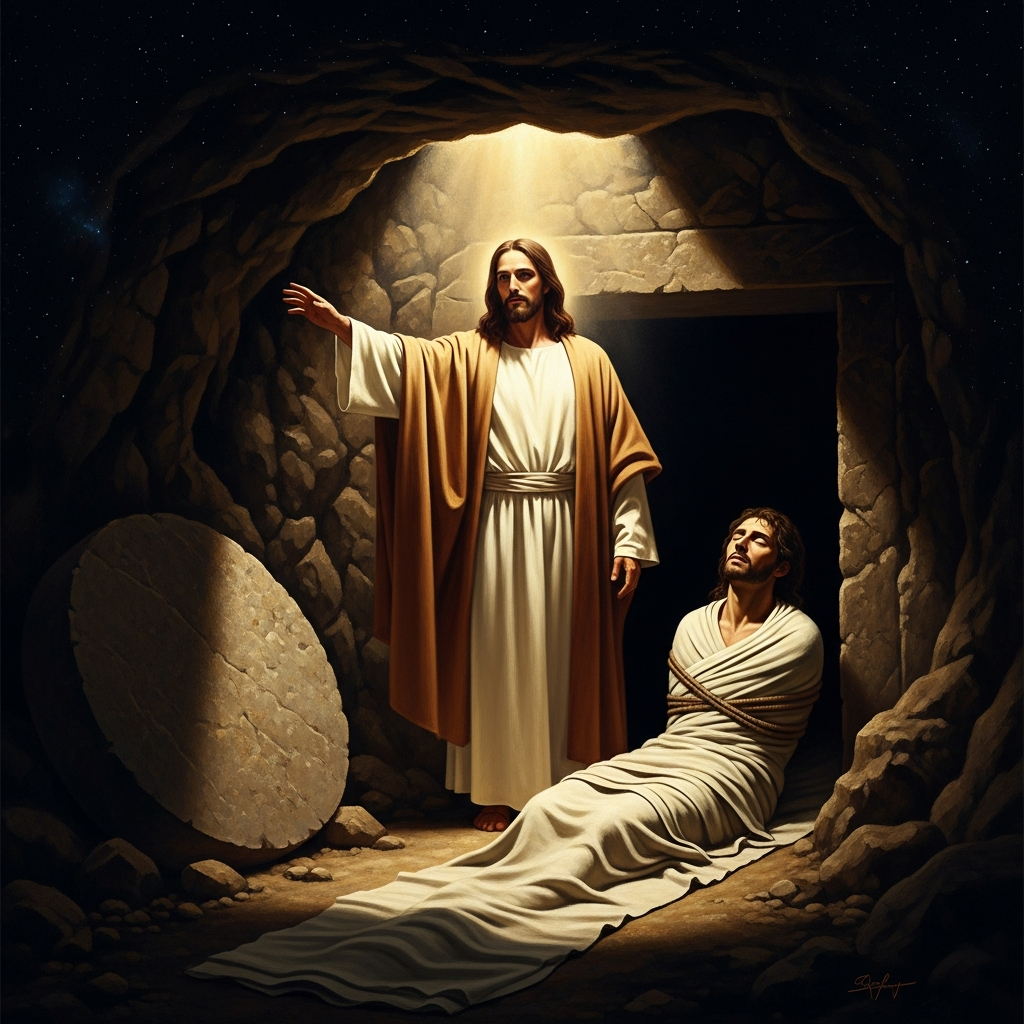
The tomb is a cave with a stone rolled across the entrance.
Jesus says: take away the stone.
Martha protests. This is practical and desperate and human. Lord, by this time there will be an odor, for he has been dead four days. Four days in a sealed cave in a Judean climate. She is not being timid. She is naming the full weight of what has been said. You want us to open the tomb of a man who has been dead four days. Jesus says: did I not tell you that if you believed you would see the glory of God?
They take away the stone.
Jesus looks up — the prayer is addressed upward, to the Father, and it is brief, spoken aloud for the crowd’s benefit, an explanation rather than a petition. He thanks the Father. He states that the Father always hears him. Then he turns to the tomb.
The crowd is behind him. The sisters are somewhere near. The stone is rolled away and the darkness of the cave is open in front of them.
He calls in a loud voice — phōnē megalē, a great voice, not the intimate word of the bedside but the shout of a command that carries: Lazarus, come out.
The dead man comes out.
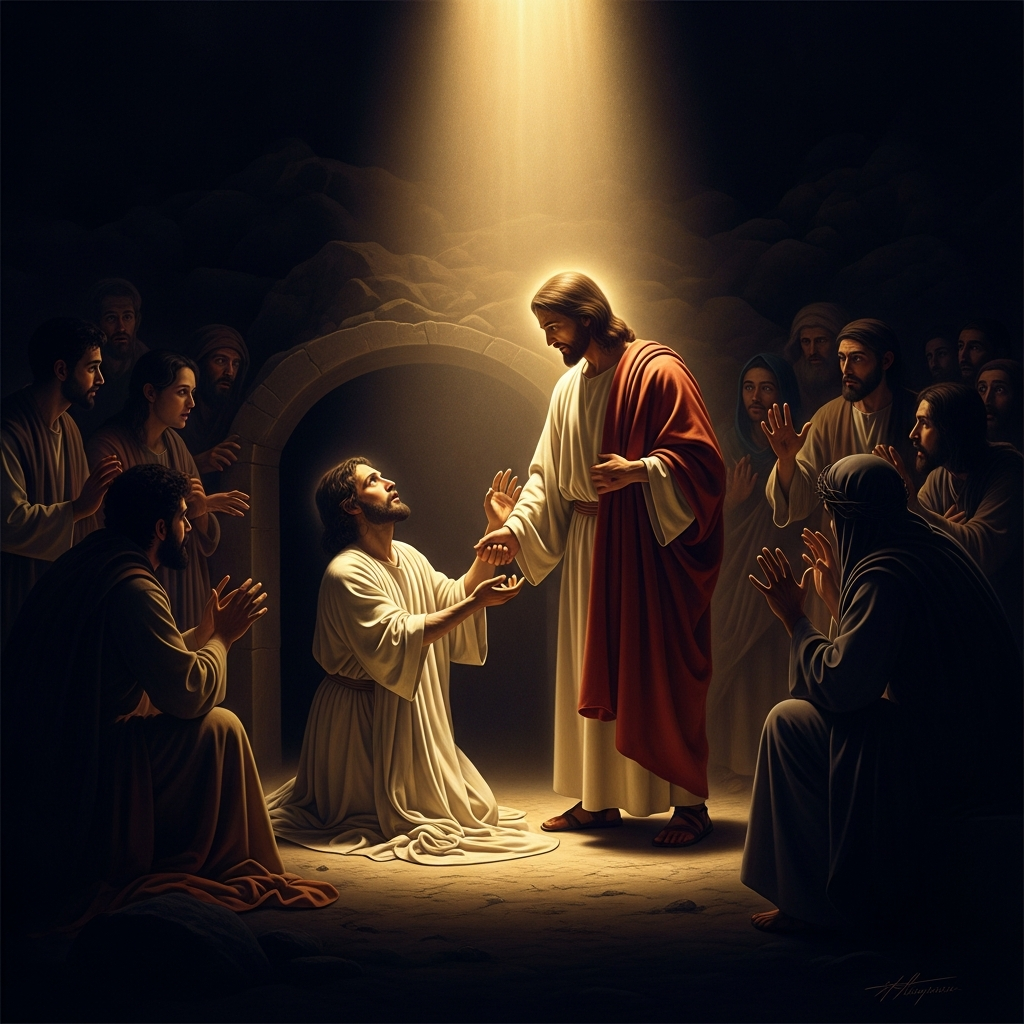
He is still bound — the burial cloths wrap his hands and feet, a cloth covers his face, the linen strips wound tight in the first-century Jewish burial custom. He comes to the entrance of the cave and stands there: alive, wrapped, unable to move freely.
Jesus says to the people standing around: Unbind him, and let him go.
John’s account ends there. No description of Lazarus’s face, his first breath, what he says, what the sisters say. No scene of reunion. The text has been building to come out and when the command is answered the story stops. What follows — Lazarus walking into the arms of his sisters, the crowd’s reaction, the unbinding of the grave cloths — is left entirely to the reader’s imagination, as if the miracle itself is so sufficient that to continue would be to diminish it.
The crowd that witnesses this goes into Jerusalem and tells people what happened. The chief priests and Pharisees convene the council. Caiaphas says: it is better for one man to die for the people than for the whole nation to perish. From that day they plan to put Jesus to death.
The raising of Lazarus is the reason for the arrest. The man called out of a four-day tomb sets in motion the sequence that puts Jesus in a tomb of his own.
The detail John keeps is not the miracle. It is the weeping. Omniscience weeps at a grave it is about to open — not performing grief for the crowd, but overtaken by it, unable to stand at the edge of death without the body registering what death is, even when the next sentence is the reversal of it.
Lazarus says nothing in the gospel of John. He is raised, he eats supper with Jesus in the next chapter, the chief priests plot to kill him too because his existence is inconvenient evidence. He walks through the rest of the text without a single line of dialogue — a man who has been dead four days, who has been inside the thing that ends everything, and comes back wrapped in linen strips, blinking in the light, and says nothing at all.
Scenes
Martha walks out alone to meet Jesus before he reaches the village — not waiting, not patient — with the sentence she has been holding for four days: Lord, if you had been here
 Generating art…
 He sees Mary weeping and the crowd weeping with her, and he is deeply moved in spirit and troubled, and he asks where they have laid him
 Generating art…
 The stone is rolled away
 Generating art…
 Echoes Across Traditions
Entities
- Christ
- Lazarus

Sources
- John 11:1–44
- Leviticus Rabbah 18:1
- *Mahabharata*, Vana Parva 293–299 (Savitri and Satyavan)
- N.T. Wright, *The Resurrection of the Son of God* (2003)
- Raymond Brown, *The Gospel According to John* I–XII, Anchor Bible (1966)