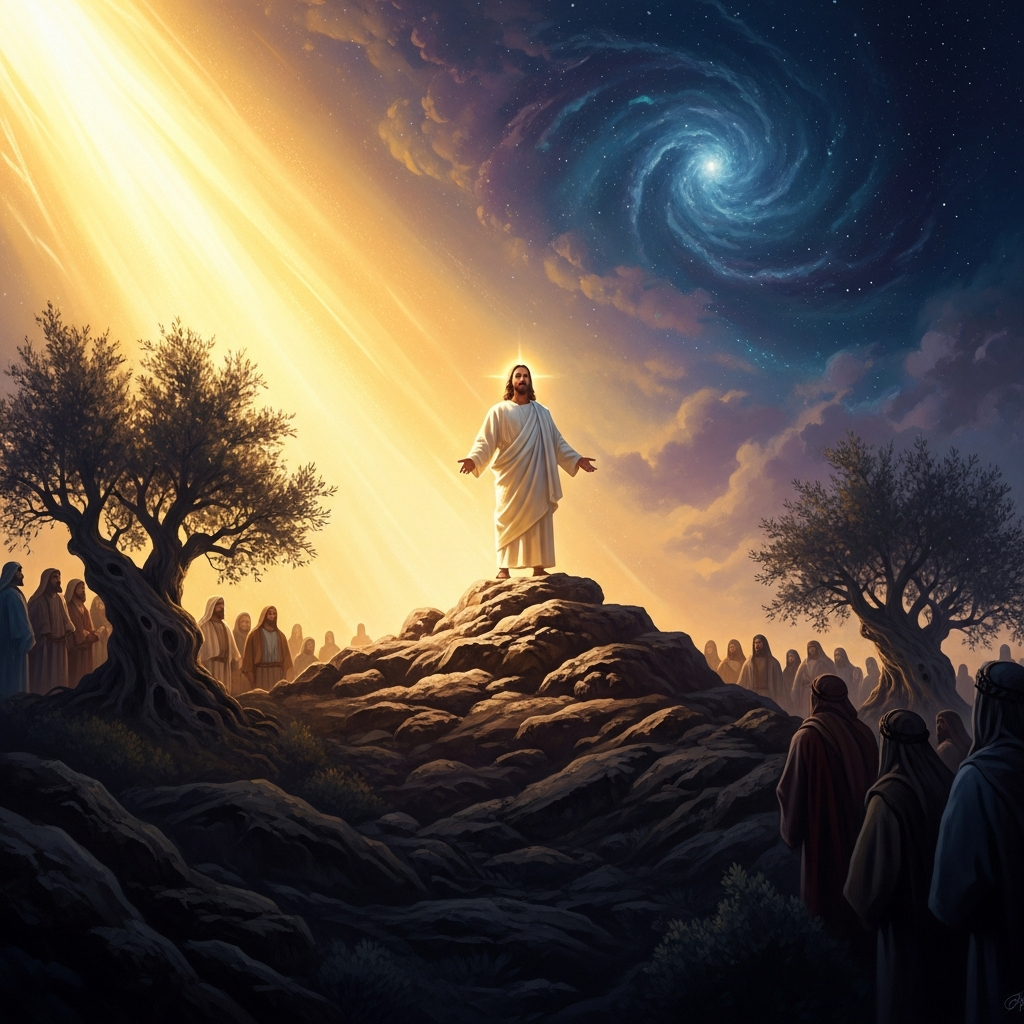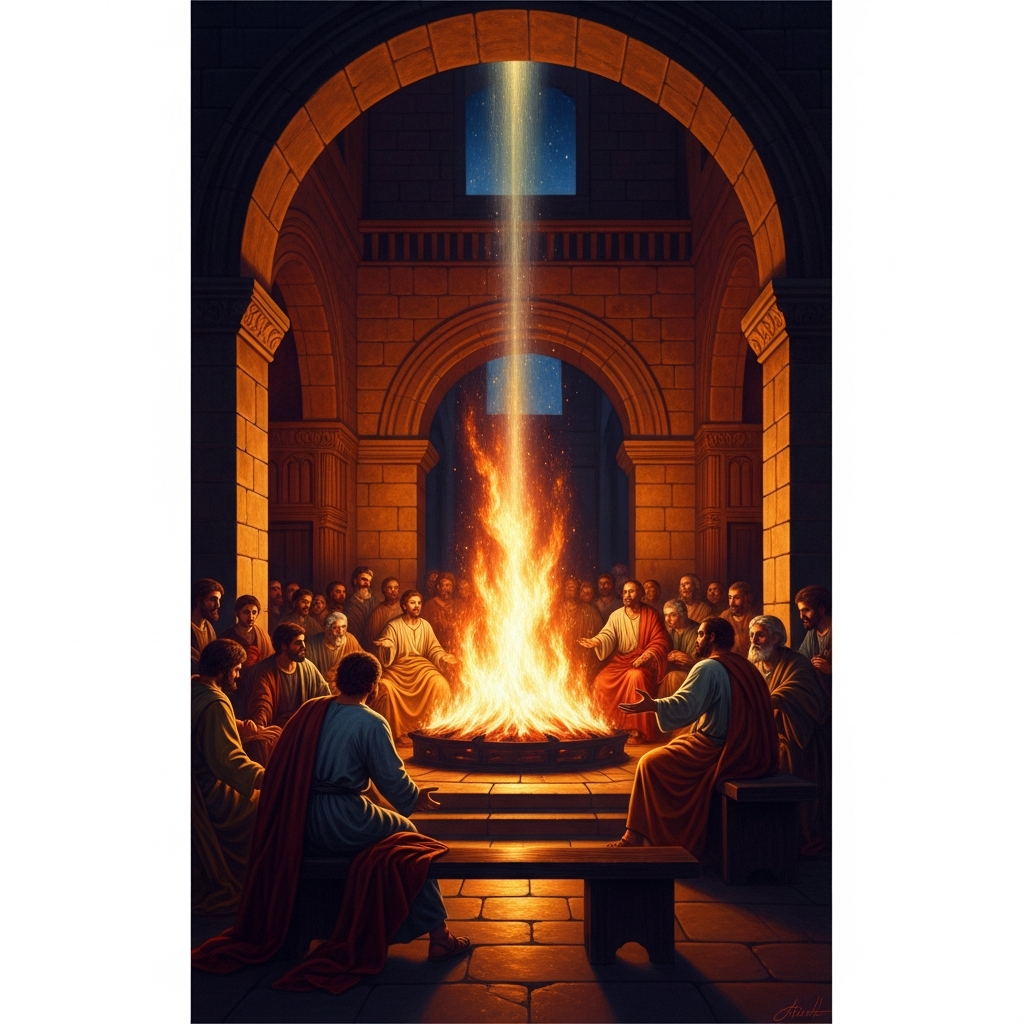
Pentecost in Jerusalem
~30 CE · Shavuot / Feast of Weeks, 50 days after Passover · An upper room, Jerusalem — then the streets of the city
Contents
Fifty days after the resurrection, the disciples gather in Jerusalem for Shavuot. A sound like a rushing wind fills the room. Tongues of fire descend on each head. They pour into the streets speaking every language in the known world. Three thousand are baptized by evening. The church begins.
- When
- ~30 CE · Shavuot / Feast of Weeks, 50 days after Passover
- Where
- An upper room, Jerusalem — then the streets of the city
The room has been waiting for fifty days.
They number about a hundred and twenty — the eleven remaining apostles, the women who followed Jesus from Galilee, his mother Mary, his brothers. Since the ascension they have been together in an upper room in Jerusalem, praying, waiting for what he promised: you will receive power when the Holy Spirit comes upon you. He did not say when. He said wait. So they wait in a city that has just executed their teacher, in a room that smells of the fifty days since Passover, praying in a register that has no name yet for what it expects.
Outside the room, Jerusalem is alive with Shavuot — the Feast of Weeks, the fiftieth day after Passover, the anniversary of the revelation at Sinai. Pilgrims from every nation under heaven fill the streets: Jews of the Diaspora who left the land generations ago and carry the faith in languages their grandparents brought home from exile. The festival city and the locked room share a wall, and neither knows what the other is holding.
Then the sound comes, and the wall dissolves.
It does not begin small.
There is no creak of a door, no rustle building toward a roar. The sound arrives the way a breaking wave arrives — full size, from everywhere, all at once. Luke reaches for the closest image he has: like a rushing mighty wind (Acts 2:2). But the lamps do not gutter. The shutters do not bang. The wind-analogy is the closest available approximation for something that has no prior name, a sound that the body feels before the ear processes, a pressure that occupies every cubic inch of the room from the floor to the ceiling without leaving any space for the air that was there before.
Then the fire.
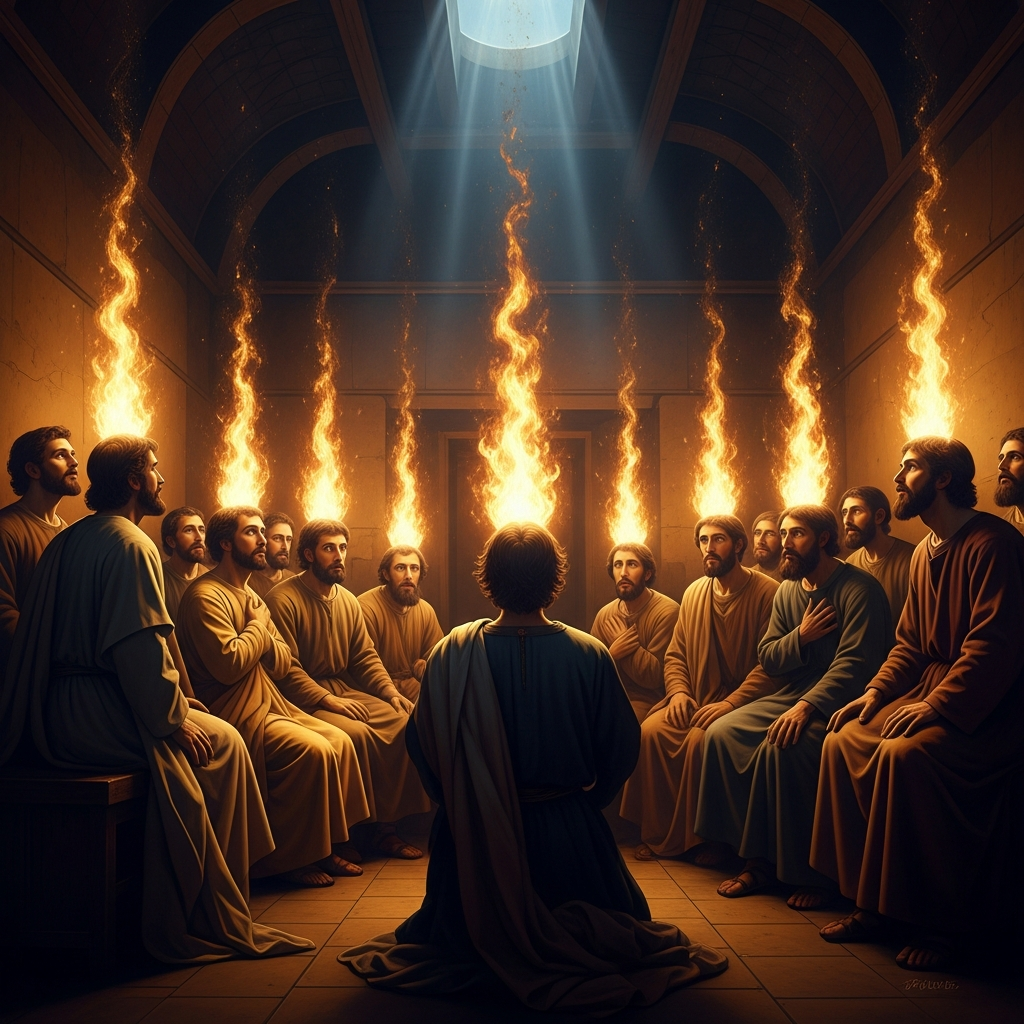
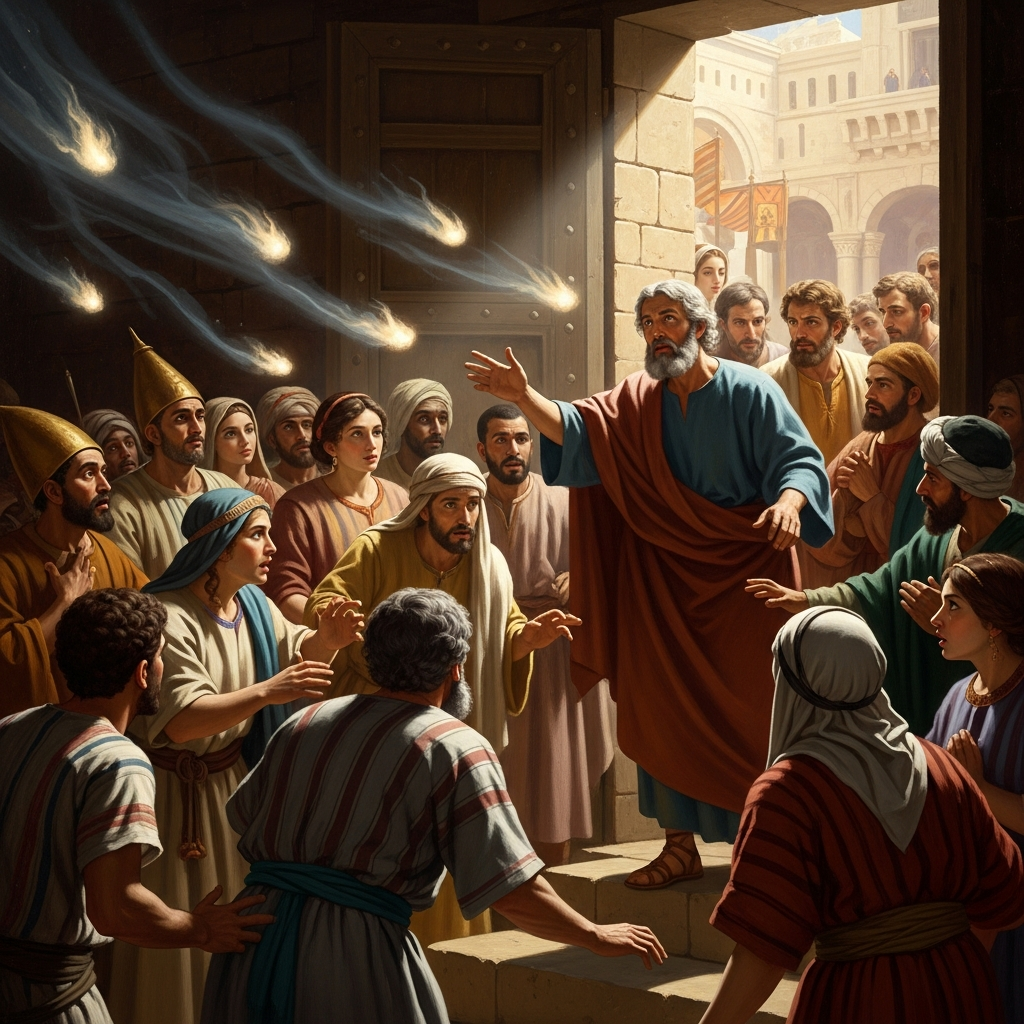
Not one flame leaping from a lamp. Not a single torch lit from another. Above each person in the room — the eleven, Mary, the hundred and twenty — something descends that looks like a flame and has the shape of a tongue. It is individual. It is specific. Not one fire for all of them, which would be a crowd phenomenon, but one for each, which is the grammar of an encounter that addresses persons rather than mobs. It comes to rest above each head and does not burn. The hair smells of nothing. The ceiling is not scorched. What the fire does is not what fire does. What it does is fill.
The hundred and twenty open their mouths, and the filling comes out as speech.
They are Galileans, almost all of them — fishermen, women, tradespeople.
Their Aramaic is native. Their Greek is workable, the educated traveler’s Greek of the eastern Mediterranean. Their Hebrew is liturgical, sufficient for the synagogue and the Psalms. They have no Parthian. No Elamite. No Egyptian Coptic. No the dozen other tongues that Diaspora Jews brought into Jerusalem on the feast days. They know what they know, which is not enough for what is now happening.
The Spirit does not ask what they know.
Peter opens his mouth and Parthian comes out. John speaks and the words are Egyptian. Mary speaks and the syllables carry the accent of some region none of the people near her can identify. They are not translating — there is no pause, no search for the word, no the careful approximation of a man trying to say a thing in a language he learned from a book. The fluency is total, unearned, and running faster than any of them can think. They cannot explain it and do not try. The fire is above their heads and the words are true and they cannot stop.
The room cannot contain it. They pour into the Shavuot street.
Here is what the crowd hears.
Acts 2:9–11 lists fifteen regions: Parthia, Media, Elam, Mesopotamia, Judea, Cappadocia, Pontus, Asia, Phrygia, Pamphylia, Egypt, Libya near Cyrene, Rome, Crete, Arabia. Fifteen means all — the known compass of the Diaspora, the entire map of where Jews have been scattered since Assyria and Babylon and Egypt and Rome. They are speaking among themselves in the particular music of home — the language their mothers used, the words they dream in, the dialect of the specific village they or their grandparents left — and then from the disciples they hear that language returned to them. Not translation. Not Koine with a local accent. Their own tongue. The actual sound.
We hear them speaking in our own tongues the mighty works of God.
Every man hears his native language. The Parthian hears Parthian. The Egyptian hears Egyptian. The Cretan hears the syllables of home. Not approximations, not the educated Greek that serves as the empire’s common tongue — the actual, private, irreplaceable sound of the place they were children.
This is the reversal. This is what the morning is for.
At Babel (Genesis 11:1–9), God scattered one language into many and the builders dropped their bricks and could not finish what they had started. That fracture has been running through human history ever since: every empire that forces its tongue on the conquered, every exile who loses something in the translation, every war that begins when people cannot understand each other. The rabbis taught that at Sinai the divine voice split into seventy languages — Exodus Rabbah 5:9 — so that every nation could hear the Torah simultaneously. The Pentecost event is the New Testament’s claim that Sinai is happening again, not on a mountain but in a street, and the voice has not gone silent. Babel runs one direction. What happens in Jerusalem reverses the current, not by making everyone speak the same language — that would be just another empire — but by speaking all of them at once, by the Spirit that does not simplify but fills.
Some in the crowd sneer: they are full of new wine.
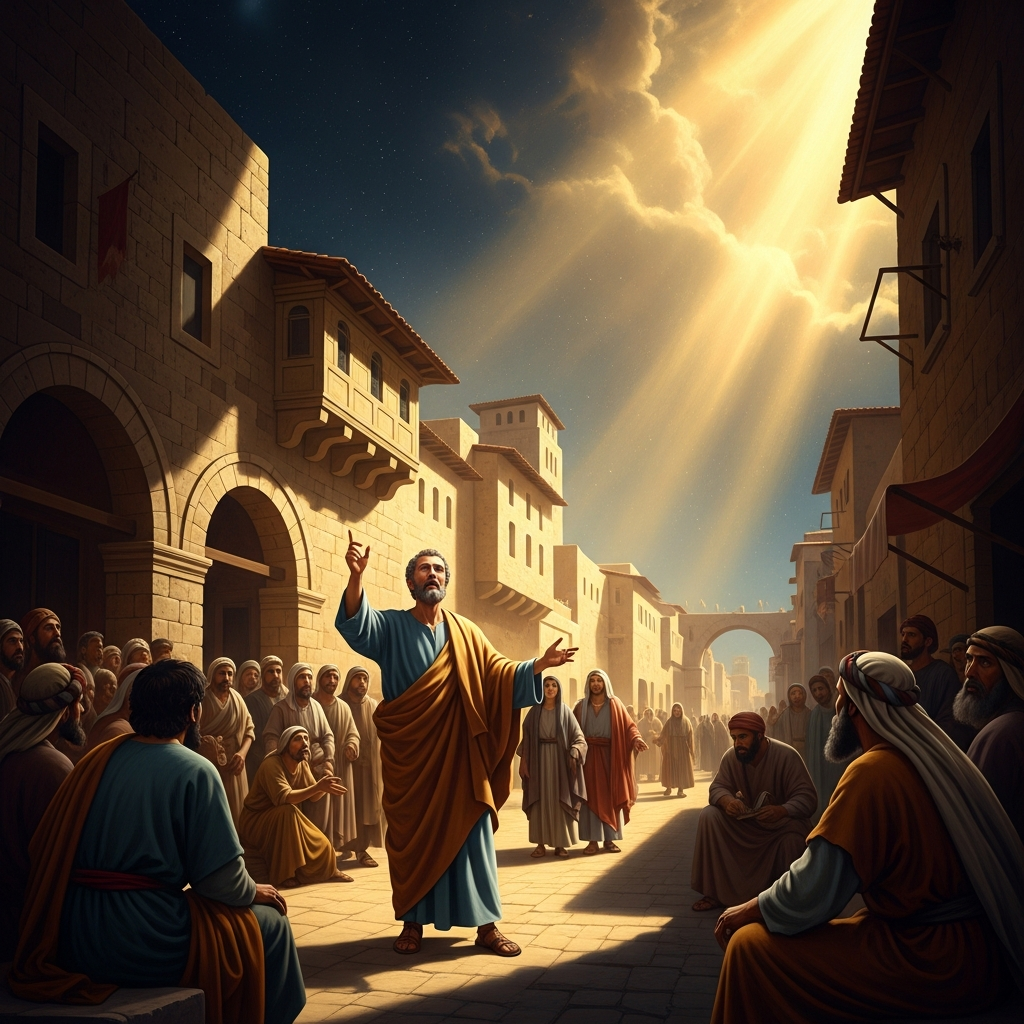
It is the ancient heckle — when a thing is too strange to explain, call it drunk. Peter, who three weeks ago denied three times that he knew Jesus, stands up and answers for all of them. He is not the same Peter. Something has changed in the chamber behind his fear. He quotes Joel 2:28–32 from memory: your sons and daughters will prophesy, your old men dream dreams, your young men see visions, and even on my male and female servants in those days I will pour out my Spirit. Not on the learned only. Not on the priests and the Pharisees. On all flesh. On servants.
Then he says the thing that could still get him killed in this city: Jesus of Nazareth, handed over and crucified by the authorities of this very city, has been raised. We are witnesses. The whole house of Israel must know with certainty that God has made him both Lord and Christ — this Jesus whom you crucified.
The crowd is cut to the heart. Brothers, what shall we do?
Repent, Peter says. Be baptized. You will receive the Holy Spirit. The promise is for you and your children and for all who are far off, as many as the Lord our God calls. Three thousand people are baptized before the day ends.
The question of what exactly happened in that room will occupy the church for centuries.
Whether the tongues were human languages or ecstatic glossolalia. Whether the gift was for that generation or for all time. Whether the fire was physical or metaphorical. These arguments are not without weight, and they have produced denominations and revivals and theological libraries. But they are downstream of the thing itself, which is this: a group of frightened people in a locked room are filled with something larger than their fear, and what they say crosses the border that has stood since Shinar.
The border between one mind and another. The border Babel built.
The wind fills the house. The fire comes to rest above each head — not one flame for all but one for each, the Spirit’s grammar of the individual addressed within the collective. They go into the street. The Shavuot crowd that came to Jerusalem to celebrate the Sinai revelation discovers that Sinai has happened again, fifty days after the Passover lamb was killed, in a room no one thought was important, and the fire is still moving.
By evening, three thousand people have walked into the water.
Joel’s prophecy says the Spirit will be poured on all flesh — not on the learned, not on the ritually pure, not on the officially authorized. All flesh. The old and the young, sons and daughters, servants male and female. That is the scandal of Pentecost: the fire does not sort by the criteria anyone would choose. It lands where it lands.
The Babel reversal is subtler than the obvious reading. God does not make everyone speak the same language at Pentecost — that would be a new empire, a new Babel by a different name. Instead the Spirit speaks through all the languages at once. The Parthian keeps his Parthian. The Egyptian keeps his Egyptian. The wall between them falls without taking their particularity with it.
The tower at Shinar was never finished. The feast of Shavuot comes around every year, fifty days after the lamb is slain, and in Jerusalem on that morning in 30 CE, something decides there is another way to reach the height. Not by building up toward heaven, but by the fire coming down.
Scenes
The sound arrives like a rushing wind that fills every corner — walls, floor, ceiling — while the flame descends above each head, precise and particular
 Generating art…
 The disciples pour through the door into the Shavuot crowd — Galilean accents giving way to Parthian, Egyptian, Arabic, the languages of fifteen nations pouring from a single source
 Generating art…
 Peter stands in the Jerusalem street and speaks: the man who denied Jesus three times in a courtyard now names him the risen Lord before the crowd that crucified him
 Generating art…
 Echoes Across Traditions
Entities
- Peter
- John
- Mary
- the Disciples
- Holy Spirit
Sources
- Acts 2:1–41
- Joel 2:28–32 (the prophecy Peter cites in his sermon)
- Genesis 11:1–9 (Babel)
- Exodus 19–20 (Sinai)
- *Exodus Rabbah* 5:9 (the Torah given in seventy tongues)
- F. F. Bruce, *The Book of the Acts* (NICNT, 1988)
- Luke Timothy Johnson, *The Acts of the Apostles* (Sacra Pagina, 1992)
- James D. G. Dunn, *Baptism in the Holy Spirit* (1970)