The Cost of Conspiracy
May 1942 · Stockholm — followed by arrest April 5, 1943 · Stockholm, Sweden — the hotel meeting rooms of the German resistance's contact with Allied intelligence; then Tegel military prison, Berlin
Contents
A Lutheran pastor and theologian sits across from a German resistance operative in a Stockholm hotel room and passes intelligence to the Allies — fully aware that he has crossed the line his own theology demands he cross, fully aware that crossing it may cost him everything, and writing the theology of costly discipleship with the pen of a man who has just paid the deposit.
- When
- May 1942 · Stockholm — followed by arrest April 5, 1943
- Where
- Stockholm, Sweden — the hotel meeting rooms of the German resistance's contact with Allied intelligence; then Tegel military prison, Berlin
The Abwehr gives him a cover.
It is a practical irony of the kind that Germany in 1942 produces in quantity: the Lutheran pastor who published the most searching theological critique of cheap grace is now an intelligence operative for German military counterintelligence. His cover identity is that of a man doing his patriotic duty. His actual work is the opposite. He travels on behalf of the resistance — to Rome, to Geneva, to Stockholm — making contacts, passing names, carrying information about assassination plans that he cannot write down and must commit to memory.
His theology says that the world must be confronted on the world’s own terms. Who is Christ for us today? He has been asking the question since his seminary at Finkenwalde was shut down in 1937. He has an answer now, and the answer has a gun in it.
He arrives in Stockholm in May 1942.
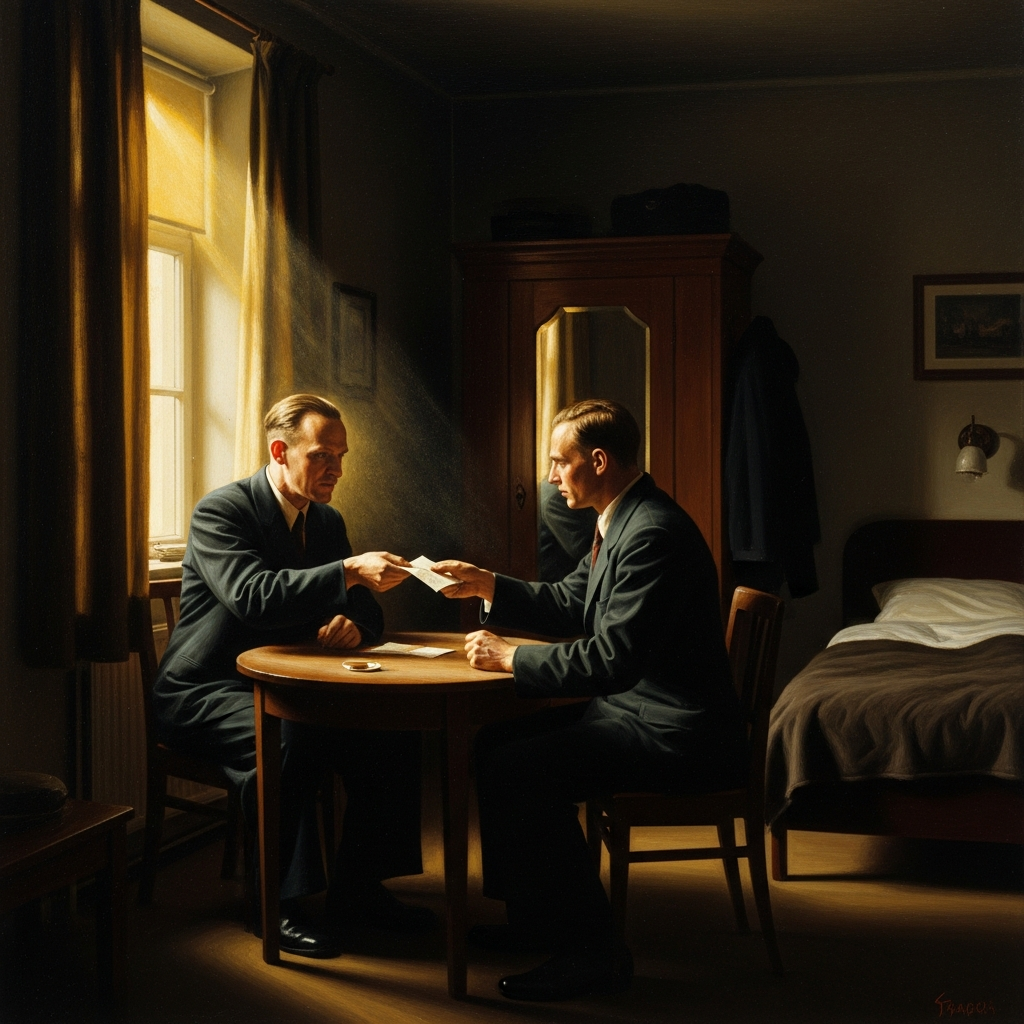
He meets Fabian von Schlabrendorff, the young lawyer and officer who serves as a courier between the German military resistance and the Allies. The meeting is in a hotel — careful, brief, the kind of conversation that keeps itself to topics a listener could not indict. Bonhoeffer carries what he has been given to carry: the names of German officers who are prepared to remove Hitler, the request for an Allied commitment not to exploit the resulting power vacuum, the signal that the resistance is real and organized and needs to know that the sacrifice will matter.
The Allies do not send the signal back. Churchill and Roosevelt are committed to unconditional surrender and do not negotiate with internal German factions. The resistance makes contact again. And again. The commitment never comes. The conspirators proceed anyway.
He has written his theology of the moment already.
The Cost of Discipleship was published in 1937, when he was thirty-one. The argument is simple and has no comfortable implications: the German Protestant church has confused grace — God’s unconditional love — with license, the permission to sin without consequence. Cheap grace means forgiveness without repentance, baptism without discipline, salvation without the cross. It makes the Christian comfortable and the church complicit.
Costly grace means the cross is not decorative. It means the disciple follows into the same territory the master entered. It means that a German pastor looking at the machinery of the Third Reich cannot produce a theology that justifies neutrality.
He wrote this in 1937. He is living it in 1942. He knows the distance between the desk and the act, and he has crossed it.
He does not cross it without crisis.
He writes to Eberhard Bethge — his closest friend, his biographer, his theological sparring partner — about the turn his life has taken. The letters are carefully worded but honest about the interior weight. He is a man of peace, trained in the Sermon on the Mount, formed in the Quaker and ecumenical peace movements of the 1930s. He knows that what he is doing violates the pacifism he once held as a near-absolute. He knows that the killing of Hitler — if it succeeds — will be killing. He knows that the theology of costly discipleship does not provide a clean exemption from the commandment Thou shalt not kill.
He proceeds. He believes that the commandment against killing cannot be discharged by watching the mechanisms of mass murder proceed uncontested. He believes — and writes this carefully in later letters from prison — that Christian ethics must sometimes involve the willingness to take guilt upon oneself for the sake of others. This is not a clean position. He does not want it to be clean. Clean positions are what cheap grace produces.
He is arrested on April 5, 1943.
The Gestapo has been watching the Abwehr for months. They have not found the conspiracy directly. They have found financial irregularities — the cover funds used to help Jews escape to Switzerland through Operation 7. Bonhoeffer is taken to Tegel military prison, not to a death camp. His family’s connections — his father is Germany’s most eminent psychiatrist, his brother-in-law Hans von Dohnanyi is also arrested but is well-connected — give the interrogators pause.
He does not confess. He stalls. He is a trained theologian and a careful reader of documents and he knows that the interrogators know less than they are pretending to know. He buys time. He writes.
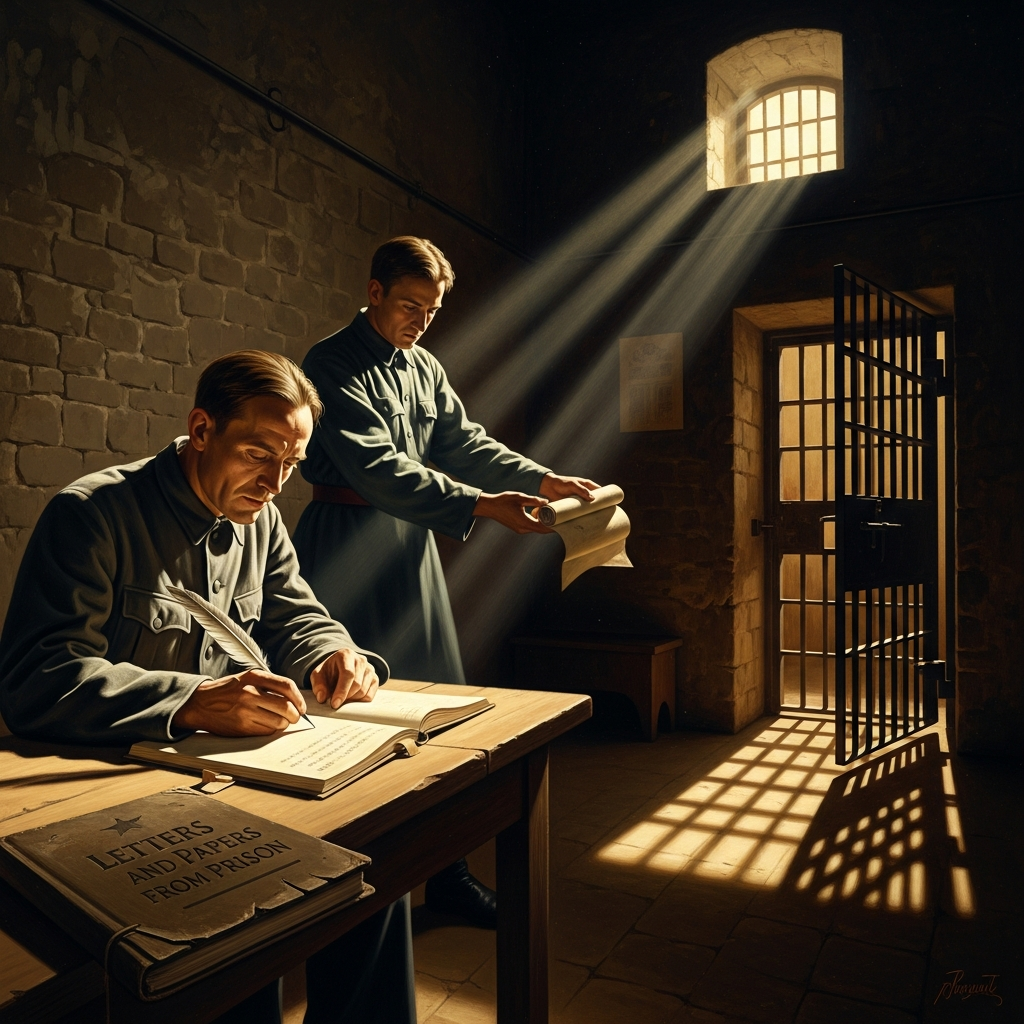
The letters from Tegel become Letters and Papers from Prison.
He writes theology. He writes poetry. He writes a play. He writes about music and about his parents and about what the church ought to be when it comes out the other side of catastrophe. He writes about what he calls religionless Christianity — the faith that does not depend on the church’s institutional survival, that meets God in the center of life rather than at its edges, that finds Christ not in the gaps where human knowledge fails but in human strength and suffering and solidarity.
He writes on July 21, 1944 — the day after the Stauffenberg bomb has failed to kill Hitler — that he is not afraid. He has been afraid, he admits. But the thing he feared has been clarified into something he can see clearly: the path runs forward. Whoever he was before 1939 — the pacifist, the academic, the safely ecumenical theologian — has been left behind somewhere in the previous five years. The man who remains is the man who agreed with his theology.
He has paid the price his theology named.
Cheap grace would have been available. He could have accepted the Union Seminary post he was offered in New York in 1939 — his friends arranged it specifically to remove him from danger. He took the ship to America, felt wrong, and sailed back to Germany six weeks later. He wrote to Reinhold Niebuhr: “I have made a mistake in coming to America. I must live through this difficult period of our national history with the Christian people of Germany. I will have no right to participate in the reconstruction of Christian life in Germany after the war if I do not share the trials of this time with my people.”
That sentence is the Cost of Discipleship in autobiography. He had named the price. He had looked at it. He had sailed back toward it across the Atlantic.
His theology was not the justification for his action. His theology was the description of what it cost and why it was required. He did not die for an idea. He died as the idea’s proof of concept.
Scenes
Stockholm, May 1942 — the hotel room where Bonhoeffer meets Fabian von Schlabrendorff and passes coordinates of the German resistance to Allied intelligence
Generating art… Cell 92, Tegel military prison — where Bonhoeffer writes *Letters and Papers from Prison* and is smuggled correspondence by a guard named Corporal Knobloch
 Generating art…
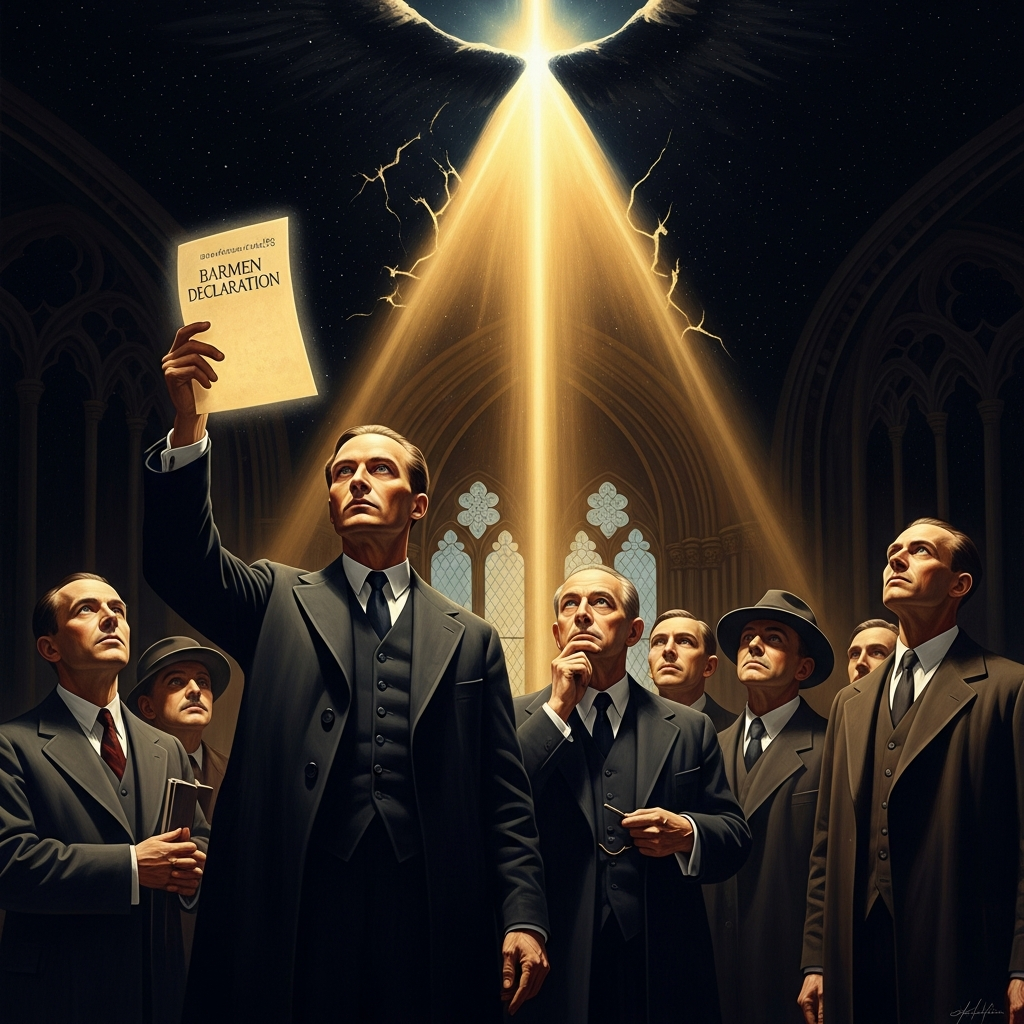
 Barmen, May 1934 — the Confessing Church's Declaration that Christ, not the Führer, is the one Word of God
 Generating art…
 Echoes Across Traditions
Entities
- Dietrich Bonhoeffer
- Fabian von Schlabrendorff
- Admiral Wilhelm Canaris
- the Abwehr
- the German resistance
Sources
- Dietrich Bonhoeffer, *The Cost of Discipleship* (Nachfolge, 1937)
- Dietrich Bonhoeffer, *Letters and Papers from Prison* (Widerstand und Ergebung, 1953, ed. Eberhard Bethge)
- Eberhard Bethge, *Dietrich Bonhoeffer: A Biography* (rev. ed. 2000)
- Eric Metaxas, *Bonhoeffer: Pastor, Martyr, Prophet, Spy* (2010)
- Fabian von Schlabrendorff, *The Secret War Against Hitler* (1965)