The Hammer and the Void
December 1934 – August 1935 · Paris factory floors · Renault factory at Boulogne-Billancourt and Alsthom electrical works, Paris — the factory floors of inter-war industrial France
Contents
A philosophy professor with an elite French education and a gift for abstract thought walks into a Renault factory floor and submits herself to the most degrading, repetitive labor she can find — not as research, but as self-punishment, as a way to touch the suffering her intellect has only theorized.
- When
- December 1934 – August 1935 · Paris factory floors
- Where
- Renault factory at Boulogne-Billancourt and Alsthom electrical works, Paris — the factory floors of inter-war industrial France
She applies for the job in December 1934.
She is twenty-five years old. She is a graduate of the École Normale Supérieure — the most selective institution in France — where she studied under Alain and graduated first in her class. She has taught philosophy at lycées in Le Puy, Auxerre, Rouen. She is brilliant in the way that occasionally generates its own problems: too fast, too thorough, too much. She is a political activist, a trade union theorist, a writer for labor journals. She has traveled to Spain to fight in the Civil War and burned her leg on a pot of boiling oil beside the front line, rendering herself a casualty before firing a shot. She is, on every available evidence, a person for whom thinking is the primary mode of being in the world.
She decides this is the problem.
She cannot think her way to the suffering of the poor. She can describe it, analyze it, organize around it. She cannot feel it. She will go to the factory and let the factory teach her.
The foreman at Alsthom does not want her.
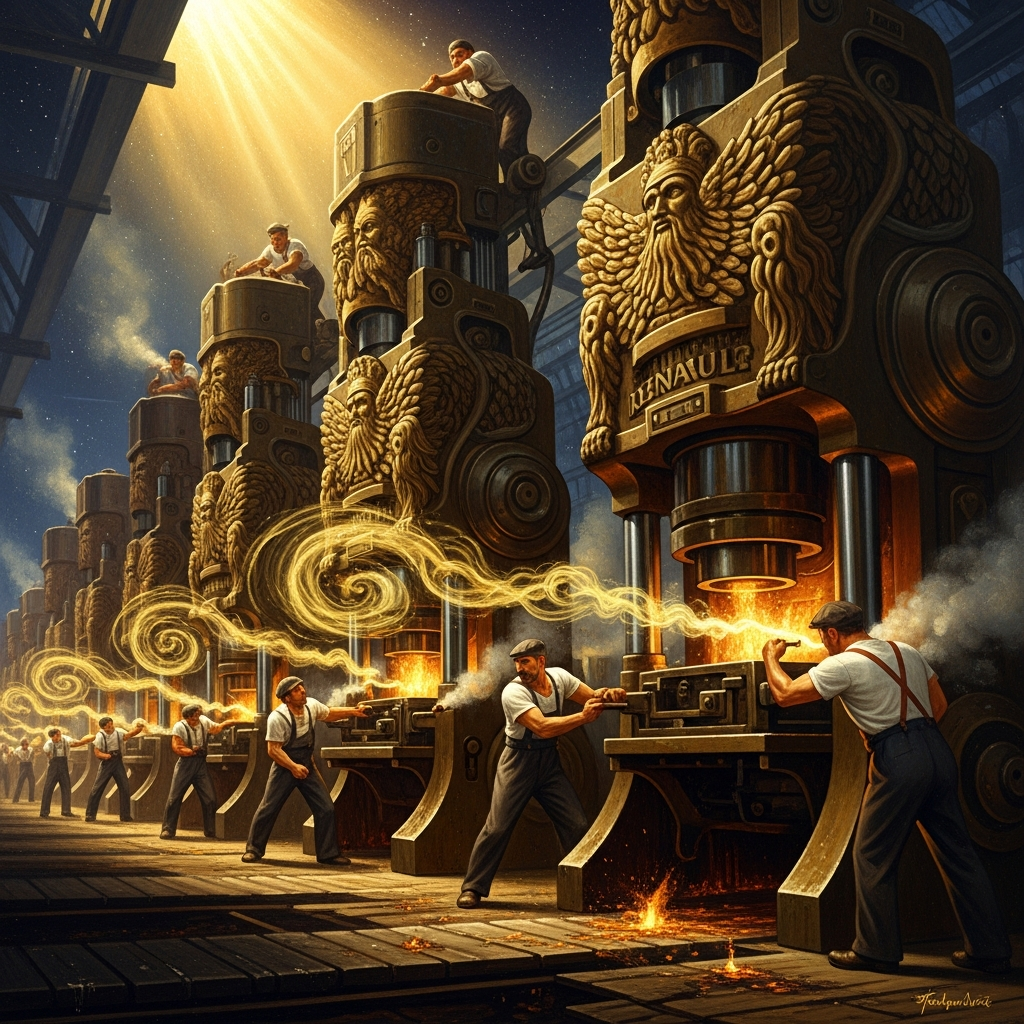
She is frail, myopic, prone to the migraines that will torture her entire adult life. She has no experience with machines. She does not know how to stand for eight hours. She convinces him. She begins on the stamping press — the loudest, most mechanical task available, a job that requires no thought and punishes any inattention with injury. The stamp comes down. The stamp comes up. The stamp comes down. The quota is stamped in red above the machine and she is always behind it.
She writes in the journal she keeps in the evenings, in her apartment, in the few hours before the headache claims her: I am a slave. Like the slaves of antiquity, I obey. Like a slave, I have no time to think about anything but the fastest way to accomplish the order I have been given.
What she does not expect is the identity.
She expected physical suffering. She got it — the migraines are worse; the exhaustion is structural, not incidental; the noise from the presses prints itself inside the skull and stays there through the night. What she did not expect is the category. The factory does not treat her as a person who is doing factory work. The factory treats her as a production unit who is insufficiently productive. The foremen correct her. They correct her again. She is slow, she is wrong, she is behind quota, she is costing the line. She has been, for her entire life, the most capable person in whatever room she is in. She is now, inarguably, the least capable person in this room.
Something breaks. Not her will — her self. The part of her that said I with confidence, the part that knew its own worth because the École Normale had stamped its grade on it. The press stamps it out.
She writes: I received there the mark of a slave, a mark I have felt I was unable to get rid of since then.
She moves to the Renault plant in Boulogne-Billancourt in the spring.
The work there is an electric push-button machine — the job is to push the button, pull the handle, move the piece, push the button. She does this for hours. She does this for days. The rhythm is not meditative. It is the opposite of meditative — it requires just enough attention to prevent injury but not enough to think. It is designed to evacuate the mind. It succeeds.
She is beginning to understand something she could not have understood in a library. She has a word for it already in her notebooks — malheur. Affliction. But she is learning what it means from the inside, in the body, from the stamping of the press and the pull of the handle and the foreman’s whistle and the red number above the machine she cannot reach. Affliction is not pain. Pain has an object and an end. Affliction is the grinding that becomes impersonal — that stops feeling like something happening to you and starts feeling like what you are. The machine does not suffer. The machine is stamped. She is being stamped.
She nearly breaks in the summer.
She writes to her friend Albertine Thévenon in the most unguarded letter she will ever send: What I went through there left such a mark on me that still today when anyone speaks to me, no matter who it is, roughly or kindly, or simply without attention, I can’t help thinking that the world can treat me in any way it likes. The feeling of my personal dignity, of my rights, which the foremen had taken from me, has never returned.
This is the revelation. She was not looking for this. She was looking for solidarity — the worker’s experience from the inside, material for political thought. Instead she found the erasure of the self. She found what she will later call the point at which suffering stops being my suffering and becomes simply suffering, weight pressing without a presser, affliction without a face.
And here, in the place she did not expect to find it, she finds God.
Not the God of consolation. Not the God who arrives at the end of suffering to make it meaningful, to give it a redemptive arc, to balance the accounts. She finds the God of the cross — the God who is in the affliction without stopping it, who is present in the abandonment as the abandoned, who has himself been stamped and weighted and pressed and named a slave. The God who did not come down from the cross.
She leaves the factories in August 1935, her health broken. She goes to Portugal for convalescence. She enters a chapel during a fishermen’s procession — the singing, the candles, the ancient poverty of the scene — and feels, for the first time in her life, that Christianity is for afflicted people and not for people who study affliction. She is afflicted. She has been stamped. She belongs.
She is never baptized. She refuses. She will wait at the threshold, she says, as a witness for those whom the Church excludes. She eats the bread of the afflicted and refuses the table set for those who have been rescued.
She dies in Ashford, England, on August 24, 1943.
The coroner records the cause of death as cardiac failure, self-induced starvation. She has refused to eat more than the estimated ration of an occupied French citizen. She is thirty-four years old. The manuscripts she has written — the essays on affliction, on waiting, on decreation, on the love of God in the factory and the fishing village and the cross — are in the hands of Father Perrin, her Dominican confessor. He publishes them after the war under the title Waiting for God. The Factory Journal is published later, in her collected works.
Albert Camus, who publishes her work at Gallimard, writes: She is the only great spirit of our time.
She went to the factory to understand suffering. She came out understanding that suffering understood you — that it pressed its mark into you and the mark did not come off. What she learned is what theology calls the passive night: the stripping of the self’s props one by one, not as punishment, but as the condition under which love without object becomes possible.
The factory was not a detour from her theology. The factory was her theology. Everything she wrote afterward — about affliction, about decreation, about the void at the center of the good — she wrote with the hands that had worked the stamping press and pulled the handle and watched the red quota number above the machine.
She refused rescue. She refused comfort. She refused baptism and survival and the extra food her friends left at her door. She had learned at the factory that God’s presence in suffering is not the same as God’s removal of suffering, and she decided to test whether she believed it.
She did.
Scenes
A Renault assembly line, Boulogne-Billancourt, mid-1930s — the stamping presses, the foremen's whistles, the smell of hot metal and machine oil
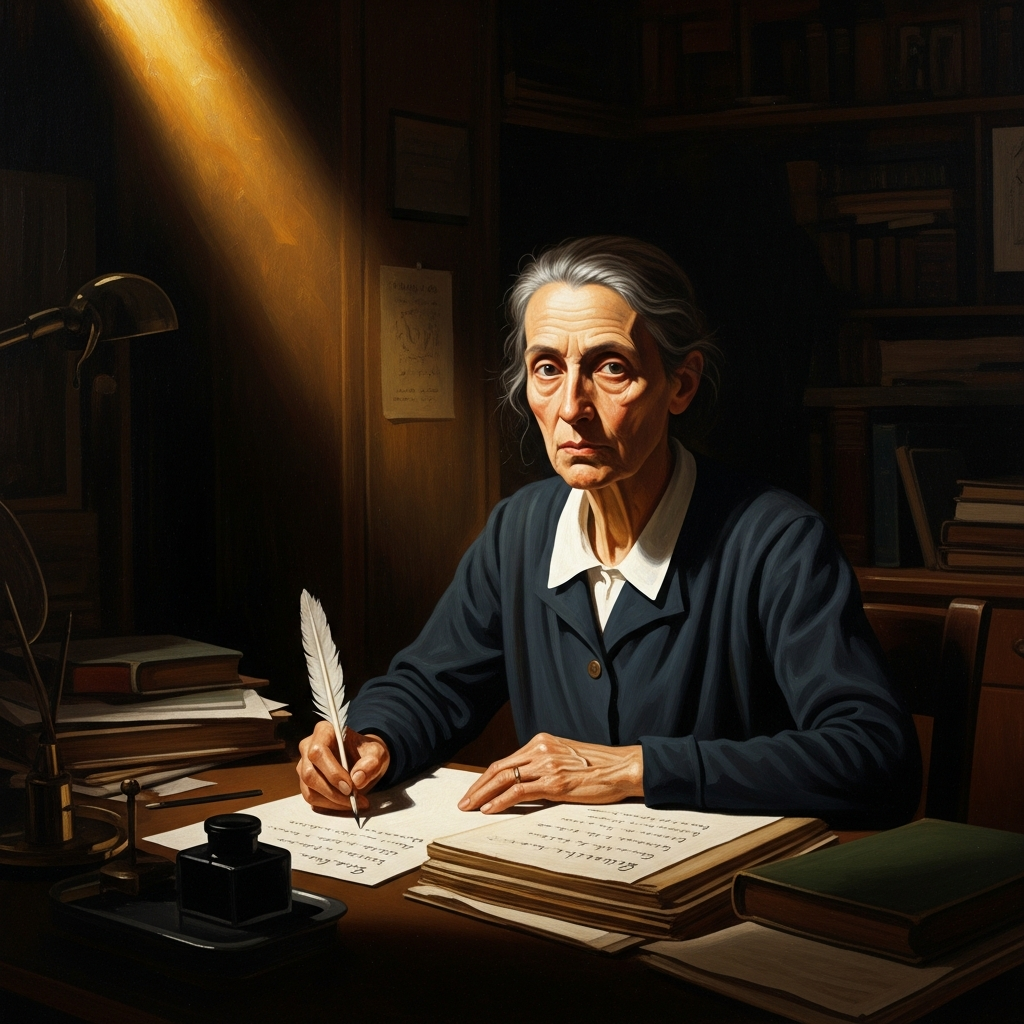
Generating art… Simone Weil at her desk, Paris — the philosopher who submitted her body to the factory and then wrote what the body had learned
 Generating art…
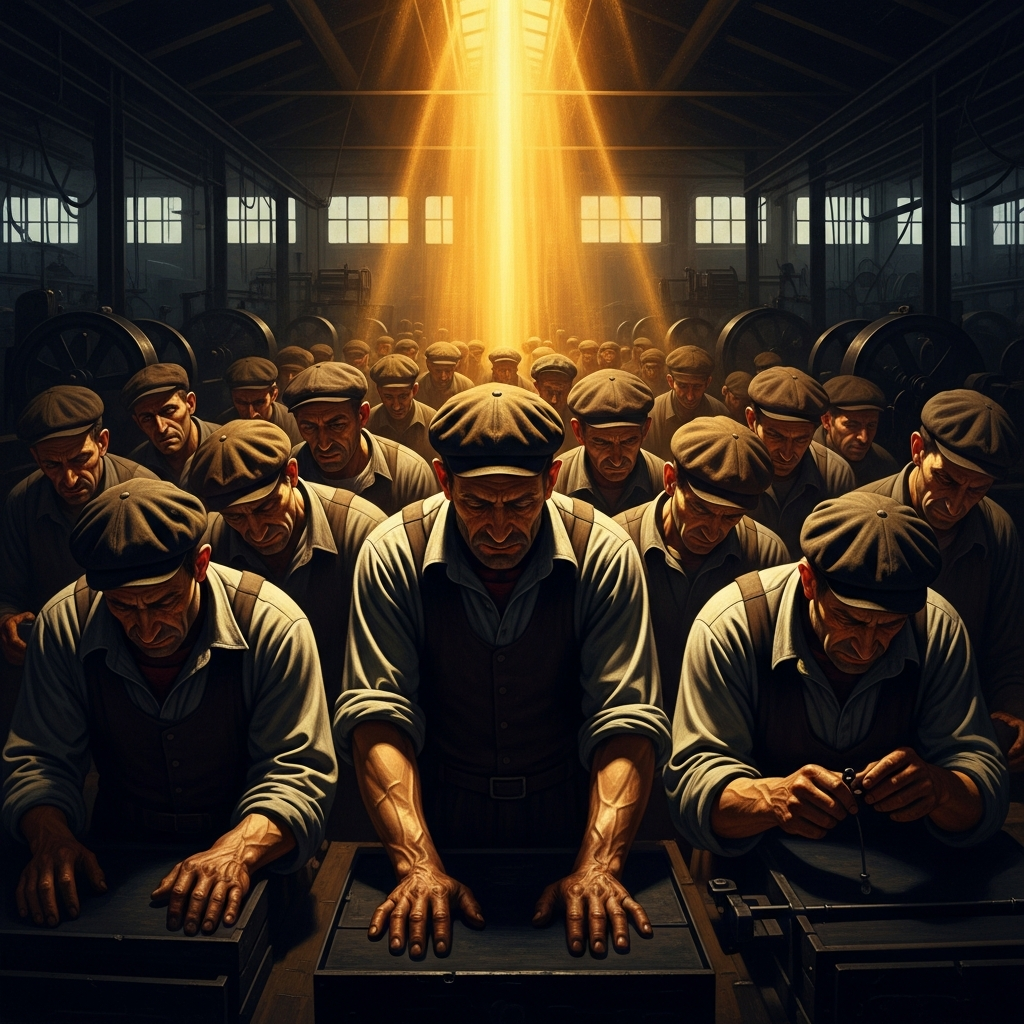
 French factory workers, 1930s — the faces Weil worked beside and could not organize or save, and whose suffering became her theology
 Generating art…
 Echoes Across Traditions
Entities
- Simone Weil
- Renault factory, Boulogne-Billancourt
- Alsthom electrical works
- the foremen
Sources
- Simone Weil, *Waiting for God* (Attente de Dieu, 1951, posthumous)
- Simone Weil, *The Need for Roots* (L'Enracinement, 1949, posthumous)
- Simone Weil, *Factory Journal* (Journal d'usine, written 1934-35, published posthumously)
- Simone Pétrement, *Simone Weil: A Life* (1973, trans. 1976)
- Francine du Plessix Gray, *Simone Weil* (2001)