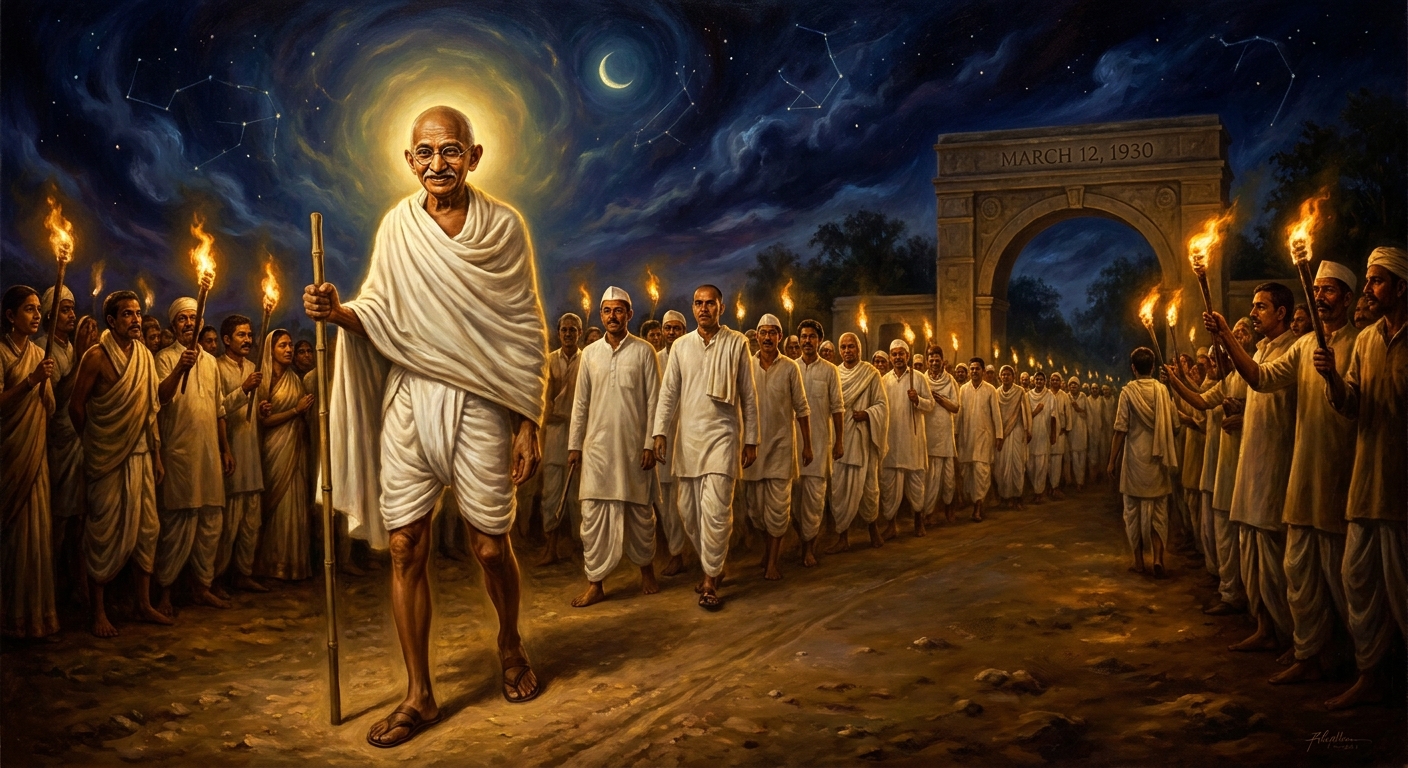
A Fistful of Salt
March 12 – April 6, 1930 · the Dandi March · Sabarmati Ashram to Dandi, Gujarat — 240 miles along the dust roads of western India
Contents
For twenty-four days a barefoot lawyer in a homespun loincloth walks two hundred and forty miles to a beach on the Arabian Sea, stoops, lifts a handful of crystallized salt, and breaks the British Empire's monopoly with a gesture a child could understand.
- When
- March 12 – April 6, 1930 · the Dandi March
- Where
- Sabarmati Ashram to Dandi, Gujarat — 240 miles along the dust roads of western India
The letter goes to the Viceroy ten days before he leaves.
Dear Friend, it begins. Before embarking on Civil Disobedience and taking the risk I have dreaded to take all these years, I would fain approach you and find a way out. Lord Irwin, in the marble palace at Delhi, reads it and dismisses it. The little man at Sabarmati, sixty years old, four-and-a-half feet of brown skin and white khadi, is going to walk to the sea and pick up some salt. The Empire is not afraid of salt.
The Empire should be afraid.
He leaves on the morning of March twelfth.
Seventy-eight satyagrahis fall in behind him — every name vetted, every man a vegetarian, every man pledged to celibacy and prayer for the duration. They walk twelve miles a day in dust that gets into the throat and stays there. Gandhi rises at four. He prays. He spins thread on the charkha. He addresses villages from the porches of dharamshalas. He tells them: I want world sympathy in this battle of right against might.
The villagers come out with marigolds. The dirt roads are watered down ahead of him so the dust will not rise. Schoolchildren scatter rose petals. The British report — internally, in cables — that the man is making it impossible to arrest him.
The press follows.
There are foreign correspondents now — UPI, Reuters, the New York Times — and they are filing every day. The world reads, for the first time, what satyagraha looks like in practice: an old man with a walking stick refusing to hate the Empire that taxes his salt. Every village he enters, more men join the column. By Dandi the procession is several thousand strong.
He keeps the rules absolutely. No one drinks but at appointed hours. No one eats but at appointed hours. He fasts when a satyagrahi misbehaves. The discipline is monastic. The march is a Jain vrata and a Vaishnav pilgrimage and a Tolstoyan farm and a strike, all walking together at the pace of a man with bad teeth and a hernia.
Twenty-four days.
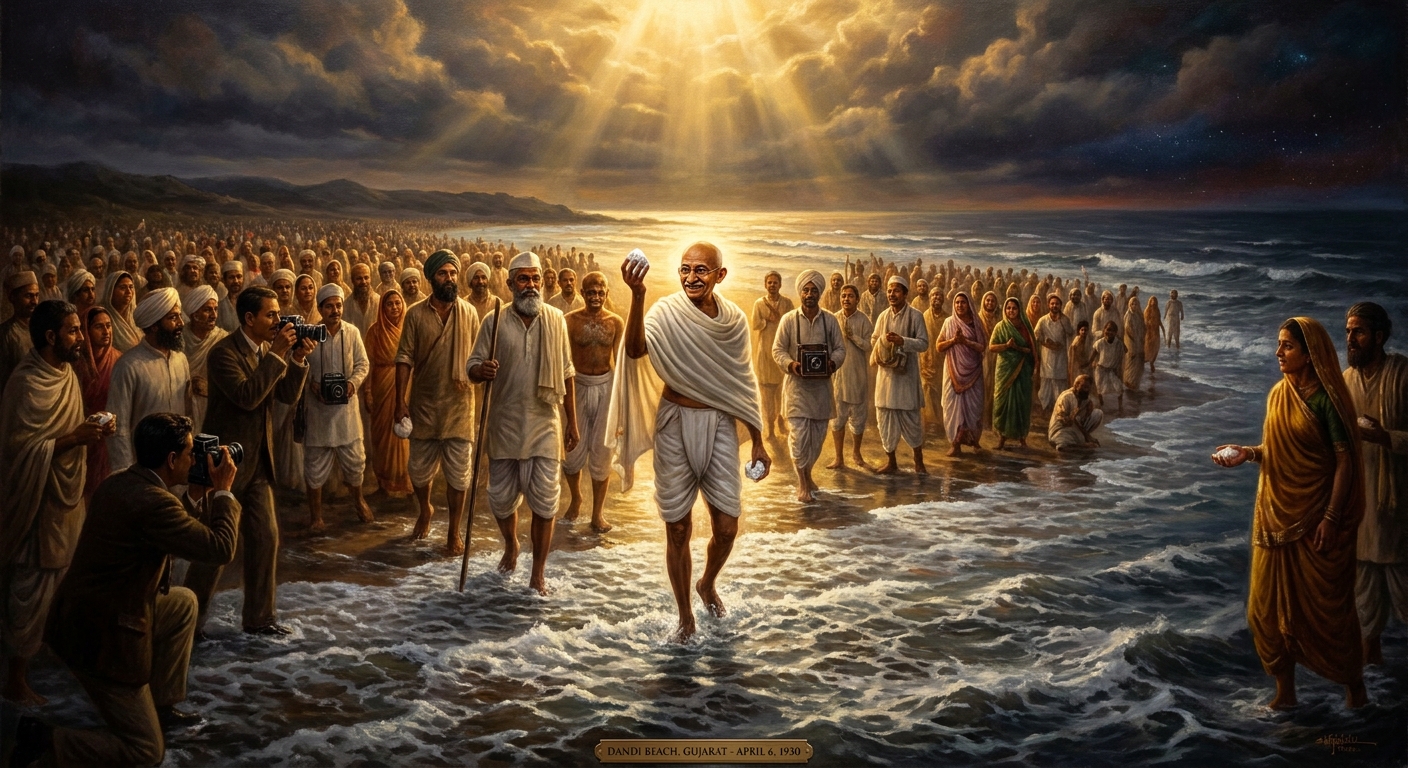
He arrives at Dandi on April fifth, prays through the night with his followers on the beach, and waits for the dawn tide to retreat. At six-thirty on the morning of April sixth, in the presence of Sarojini Naidu and a wall of cameras, he walks down to the wet sand, bends — slowly, the joints of a sixty-year-old who has just walked two hundred and forty miles — and lifts a single handful of salt-encrusted mud.
With this, Naidu cries, Hail, deliverer! — the founder of an empire shakes the foundations of an empire.
It is a fistful of dirty salt.
The Raj reacts with the violence the script requires.
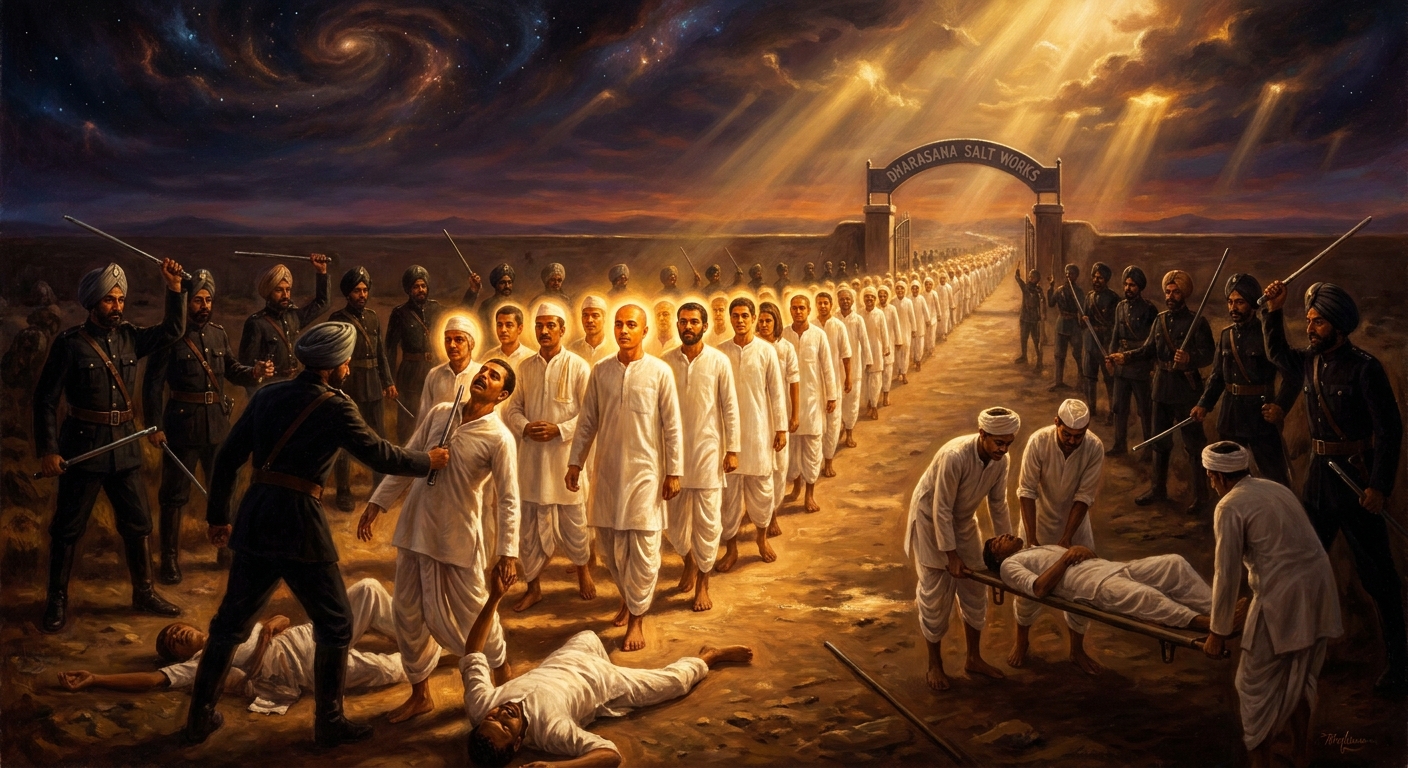
Across India, in the next two months, sixty thousand people are arrested for picking up salt or boiling seawater or distributing illegal grains of NaCl. At Dharasana Salt Works, Sarojini Naidu leads two thousand five hundred satyagrahis toward the depot’s barbed wire. They walk forward in rows. Police club them down with steel-tipped lathis. They do not raise a hand. New rows step over the bodies and walk forward and are clubbed down. Webb Miller’s dispatch — not one of the marchers even raised an arm to fend off the blows — runs in over a thousand newspapers worldwide.
Something cracks in the moral architecture of the Empire that morning. It will take seventeen more years to fall, but the cement is finished.
The Salt Act is amended at the Round Table Conference. The principle that imperial monopolies on basic life-substances are legitimate has been broken in front of a global press. Gandhi is arrested in May. He is released in January. Independence comes August 15, 1947, after the second world war finishes the empire that the salt began. Gandhi is shot dead in a New Delhi garden on January 30, 1948 by a Hindu nationalist who believes the Mahatma has been too kind to Muslims.
Three bullets at point-blank range. He whispers Hé Rām — O Rama — and falls.
Ahimsa was old. The Jain monks had been sweeping the path in front of their feet to avoid crushing insects for two and a half millennia. The Bhagavad Gita had warned against attachment to the fruits of action. Gandhi’s innovation was to take the renunciate’s discipline and bring it down off the mountain into the colonial street.
A handful of salt is not a weapon. It is a symbol that an empire’s law has overreached the moral law. The march taught the world that you do not have to outshoot the empire. You have to outlast its conscience.
Every nonviolent movement of the twentieth century — Selma, Prague, Manila, Cape Town, Tahrir, Yangon — is a footnote on twenty-four days in March of 1930.
Scenes
Day one — Gandhi steps out of Sabarmati Ashram with seventy-eight satyagrahis behind him, age sixty, a six-foot bamboo staff in his right hand
Generating art… April 6, 1930 — Dandi beach at low tide, the moment of the bend, the fistful of salt raised in defiance of the Salt Acts
 Generating art…
 Dharasana, May 1930 — Webb Miller's dispatches describing rows of unarmed satyagrahis walking into police lathis without raising a hand
 Generating art…
 Echoes Across Traditions
Entities
- Mohandas K. Gandhi
- Sarojini Naidu
- the British Raj
- Lord Irwin
- the satyagrahis
Sources
- M. K. Gandhi, *An Autobiography: The Story of My Experiments with Truth* (1927-1929)
- Louis Fischer, *The Life of Mahatma Gandhi* (1950)
- Joseph Lelyveld, *Great Soul: Mahatma Gandhi and His Struggle With India* (2011)
- Judith M. Brown, *Gandhi: Prisoner of Hope* (1989)
- Webb Miller (United Press dispatches from Dharasana, May 1930)