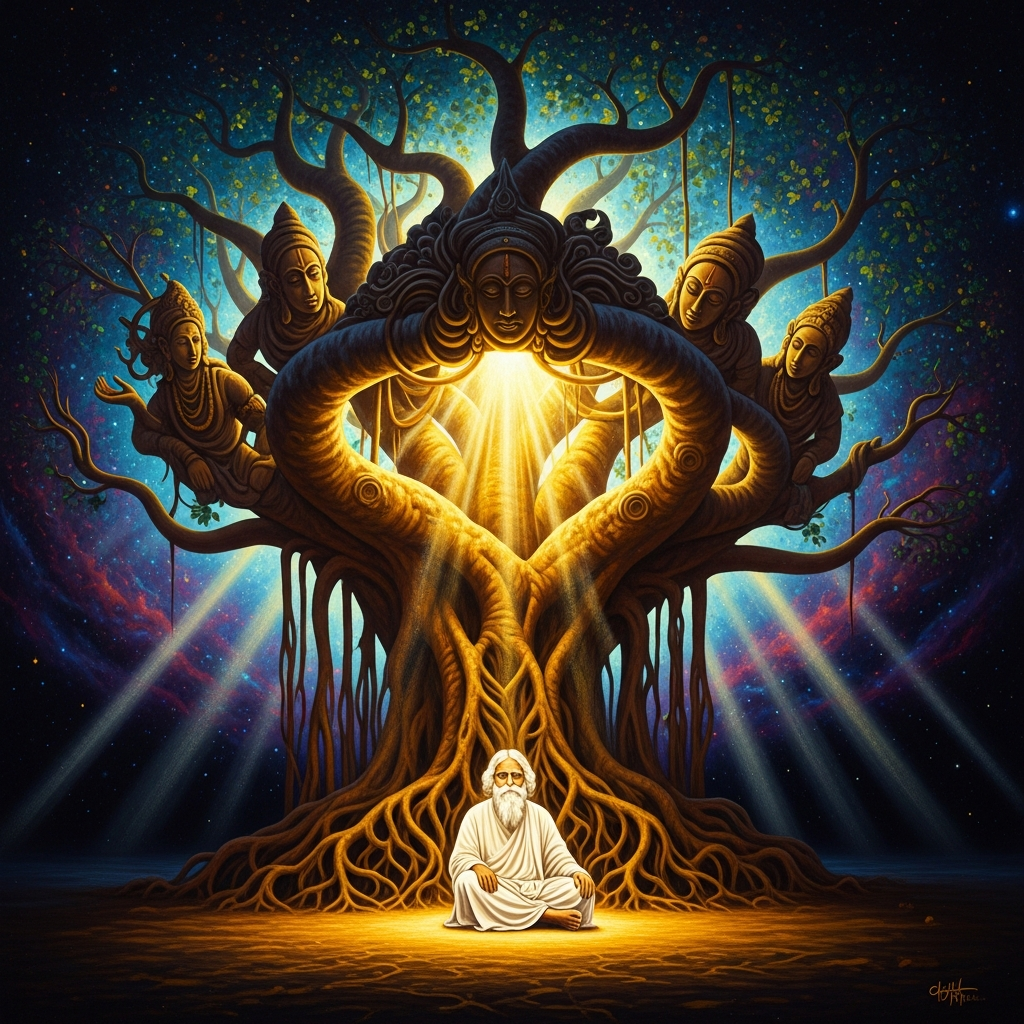
Tagore and the Religion of Man
1861-1941 CE (his life); 1912-13 (Gitanjali); 1901 (Shantiniketan ashram founded); 1930 (Hibbert Lectures) · Shantiniketan, West Bengal; the steamship between Calcutta and London; Oxford
Contents
In 1901 Rabindranath Tagore opens an ashram school at Shantiniketan, in the West Bengal countryside, on land his father had set aside for meditation. He will spend the rest of his life there. In 1912, on a steamship to England, he translates 103 of his Bengali devotional poems into English. W.B. Yeats reads the manuscript in London and weeps. The collection — *Gitanjali*, the Song Offerings — wins the Nobel Prize in Literature in 1913. Tagore is the first non-European Nobel laureate. The poems are not exactly religious and not exactly secular. They are addressed to a God who is found in other people, in the earth, in music, and in the failure of the political projects Tagore both supports and critiques. He delivers the Hibbert Lectures at Oxford in 1930 under the title *The Religion of Man* and gives the most systematic account of Brahmo theology that anyone has produced — a religion without dogma, without institution, centered on the human person as the site of the divine encounter.
- When
- 1861-1941 CE (his life); 1912-13 (Gitanjali); 1901 (Shantiniketan ashram founded); 1930 (Hibbert Lectures)
- Where
- Shantiniketan, West Bengal; the steamship between Calcutta and London; Oxford
The boy is reading Emerson on the roof of the house in Calcutta.
The house is at Jorasanko, in the old quarter of north Calcutta — an enormous joint-family compound owned by the Tagore family, who are zamindars, landowners, merchants, the most successful Bengali Hindu family of their generation, and the founding family of the Brahmo Samaj. The boy on the roof is twelve years old. He has been allowed to skip school, again, because school does not suit him and because his father — Debendranath Tagore, the Maharshi, the great sage of the reform movement — has decided that the boy will be educated by his older brothers and the family library.
The library is one of the finest in Asia.
The boy reads Emerson, Carlyle, Wordsworth, Coleridge, Shelley, Browning, the King James Bible, the Buddhist Dhammapada, the Upanishads in Sanskrit, the Persian Sufi poets in translation, and — when he is older — the Bengali poetry of the Vaishnava tradition: Vidyapati, Chandidas, the lyric padavali in which Krishna and Radha enact the cosmic love that the Bhakti tradition takes as the central theological fact.
The Tagore family has been Brahmo Samaj for two generations.
The Brahmo Samaj is the religious reform movement founded by Ram Mohan Roy in 1828 — a Bengali Hindu intellectual movement that rejects idol worship, caste hierarchy, polytheism, and most of the ritual apparatus of orthodox Hinduism, while attempting to recover what Roy considers the original monotheism of the Upanishads. The Brahmos read English. The Brahmos read Sanskrit. The Brahmos read Persian. They are trying to construct, out of the Bengali Renaissance, a Hinduism that can speak to the modernity that has arrived with the British without surrendering to Christian missionary theology — a religion of conscience and attention, not of priesthood and ritual.
Debendranath Tagore inherits the movement from Roy and reshapes it. He is, among other things, the man who has set aside the land at Shantiniketan — the abode of peace — as a meditation retreat for the family.
The boy on the roof will inherit the land.
His name is Rabindranath, born May 7, 1861.
He is the fourteenth child of his parents. He is treated, in the joint-family household of two hundred people, with a mixture of indulgence and benign neglect that produces, the biographers think, the precise psychological conditions for the kind of self-directed creative life he will lead. Nobody is watching him closely. Nobody requires him to be anything in particular. The brothers and sisters are running a kind of permanent in-house literary salon. He grows up listening to Bengali poetry being composed in the next room and Western philosophy being argued at the dinner table.
He writes his first poem at eight.
He publishes his first book of poems at sixteen.
He travels to England at seventeen with the intention of studying law, abandons it, returns. He marries at twenty-three — an arranged marriage to a girl of ten named Bhabatarini, who he renames Mrinalini. The marriage is arranged in the standard Bengali Brahmo manner. He treats her, the biographers think, with affection and distance. She bears him five children. She dies at the age of twenty-nine, in 1902, the year after he founds the school at Shantiniketan.
The deaths of the women in his life are part of the biographical record. The eldest sister-in-law Kadambari, with whom he had been close to the point of scandal, kills herself in 1884 at the age of twenty-five. The death is the wound around which the early poetry organizes itself. The wife dies in 1902. A daughter dies in 1903. The youngest son dies in 1907. The youngest daughter dies in 1918. The poet outlives them all and continues to write.
The poetry, in the years after these losses, takes on a strange quality. It is addressed to someone — the Jivan Devata, the Lord of Life, the One whose form is everything — who is not exactly God in any institutional sense and not exactly the human beloved in any romantic sense. The address is to a presence that the poems both find and fail to find, that is intimate and missing simultaneously. The poems are translated as devotional poems by Western readers and they are devotional poems, but the devotion is to a presence that includes the dead and the river and the morning light and the failure of the political project Tagore is publicly engaged in.
He founds the school at Shantiniketan in 1901 with five students.
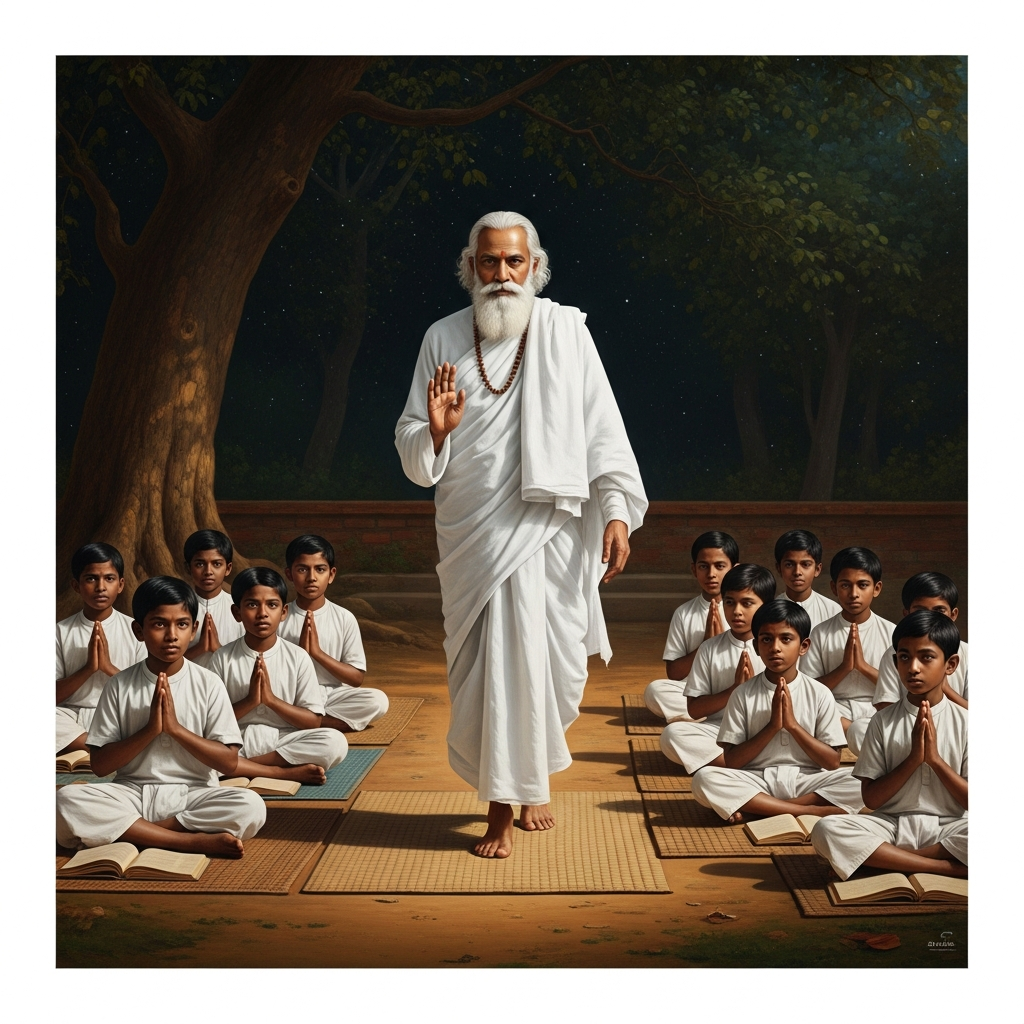
The land is the meditation grove his father had established. The buildings are simple — bamboo, thatch. The pedagogical principle is direct: classes are held outdoors, under the trees, year-round, in all weather short of monsoon. There are no walls between the teacher and the students. There are no walls between the school and the seasons. The children sing the morning hymn. They study Sanskrit and English and mathematics, but they also study music and painting and gardening and the craft work of the local villages. The point is not to produce administrators for the colonial bureaucracy. The point is to produce human beings.
The school grows. By 1921 it has become Visva-Bharati University — the world in India, India in the world — the first attempt in modern South Asia to build a university on principles that were not borrowed from the British colonial system or the European Catholic university or the Islamic madrasa.
The principle is what Tagore will later call the religion of man. The phrase is not metaphorical. He means that what the Brahmo movement had begun — the project of grounding religious life in the human person rather than in scripture or priesthood — has its institutional realization in a school where children learn that paying attention is the religious act.
He travels constantly. He is in Japan in 1916, in the United States in 1916, in China in 1924, in Latin America in 1924, in Europe repeatedly, in the Soviet Union in 1930, in Iran in 1932. He has long correspondences with Albert Einstein, Bertrand Russell, H.G. Wells, Romain Rolland, William Butler Yeats, Albert Schweitzer. He is, for two decades, the most globally recognized non-Western intellectual.
The travels fund the school. He gives lectures. He sells books. He returns to Shantiniketan with the funds and reinvests them in the project he refuses to call anything other than education.
The Nobel happens almost by accident.
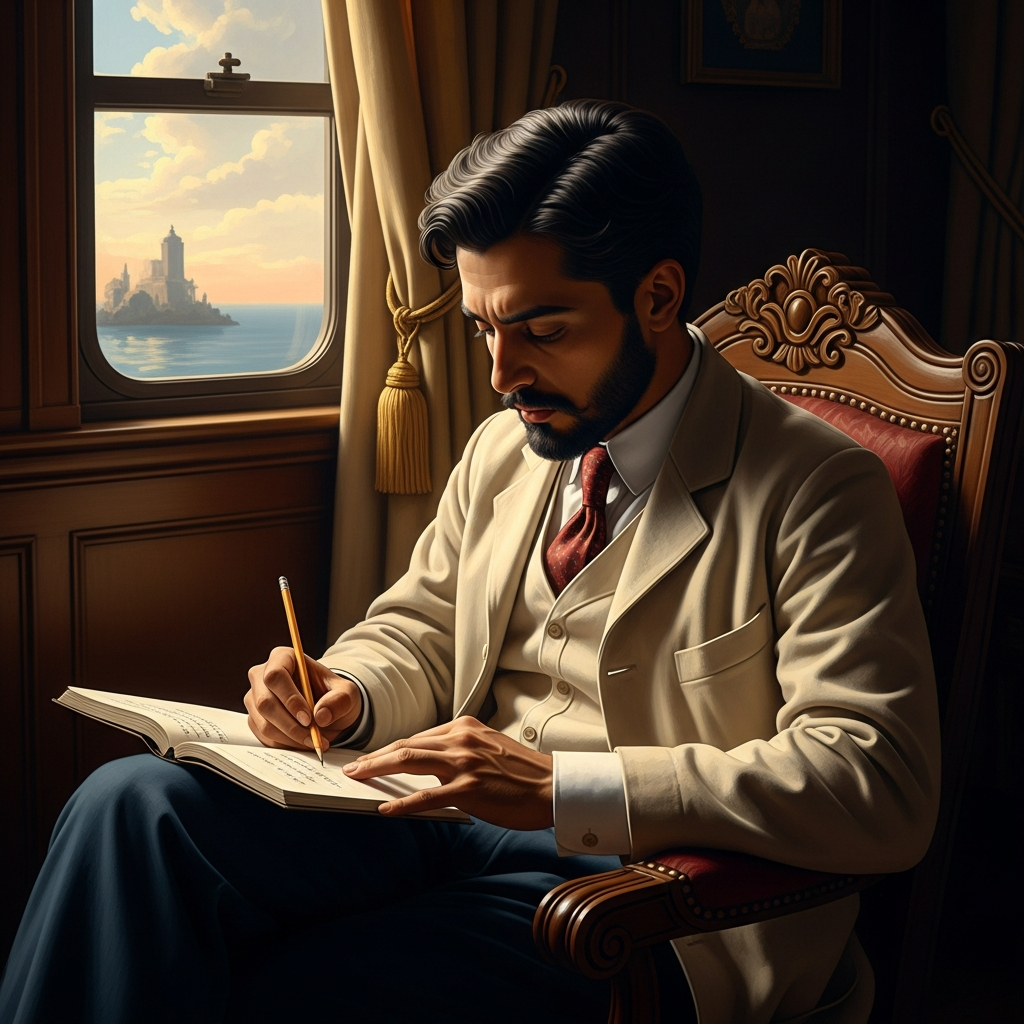
In the summer of 1912 he is on a steamship from Calcutta to London. He has been ill — depression, exhaustion, the after-effects of the family deaths. He has decided to take a long sea voyage. He brings a notebook. He has the idea, on the boat, of translating some of his Bengali poems into English — partly as an exercise in his own English prose, partly because he has friends in London he wants to share the work with.
He translates 103 poems on the boat and in the early weeks in London. The translations are loose. He is not preserving the meter or the rhyme of the originals. He is producing English prose-poems that capture, as best as he can, the devotional core of the Bengali lyrics. He shows the manuscript to the painter William Rothenstein, who shows it to W.B. Yeats.
Yeats reads the manuscript on a London park bench in late June 1912.
He is overcome. The biographies of Yeats record the moment with care. Yeats writes immediately to Rothenstein: I have carried the manuscript with me for days, reading it in railway trains, or on the tops of omnibuses and in restaurants, and I have often had to close it lest some stranger would see how much it moved me.
Yeats writes the introduction. Macmillan publishes the book — Gitanjali, Song Offerings — in November 1912. The Royal Society of Literature elects Tagore as a member. The book sells. Yeats and Rothenstein and the British poet Robert Bridges push the case to the Swedish Academy.
The Nobel Prize in Literature is awarded to Tagore on November 13, 1913. He is the first non-European Nobel laureate in any category. He is fifty-two years old.
The prize money goes to Shantiniketan.
The poems Yeats had wept over are addressed to someone the English reader cannot quite locate.
The someone is sometimes called Lord, sometimes called Master, sometimes called Friend, sometimes addressed without a name. The someone is found in unexpected places. Leave this chanting and singing and telling of beads, one poem says. Whom dost thou worship in this lonely dark corner of a temple with doors all shut? Open thine eyes and see thy God is not before thee. He is there where the tiller is tilling the hard ground and where the pathmaker is breaking stones.
The poem is a Bhakti poem rewritten as a Brahmo argument. The God is not in the temple. The God is in the field. The argument is the entire Tagore theology in eight lines.
Another poem says: I came out alone on my way to my tryst. But who is this that follows me in the silent dark? I move aside to avoid his presence but I escape him not. He makes the dust rise from the earth with his swagger. He adds his loud voice to every word that I utter. He is my own little self, my lord, he knows no shame. But I am ashamed to come to thy door in his company.
The doppelganger of the ego that follows the seeker to the door. The poem is a Sufi poem rewritten in Brahmo register. The Persian Sufis had been making the same argument for eight centuries. Tagore is taking the structure and writing it for a constituency — Western readers in 1912 — who have not encountered it before.
The poems are not all theological. Some are simple love poems addressed to a presence that is the spouse and the divine simultaneously. Some are children’s poems. Some are political — though Tagore is careful never to make the politics primary. Where the mind is without fear and the head is held high, one of the most quoted poems begins. Where knowledge is free… Where the world has not been broken up into fragments by narrow domestic walls… Into that heaven of freedom, my Father, let my country awake.
The poem is read at Indian independence ceremonies thirty-four years after it is written. Tagore is dead by then.
He gives the Hibbert Lectures at Oxford in May 1930.
He is sixty-nine. The Hibbert is the major British lecture series in religion and philosophy — William James gave it. He calls his lectures The Religion of Man. The published version, expanded, becomes the most systematic statement of his theology that he ever produces.
The argument is direct.
Religion, he says, is not a special category of experience walled off from ordinary life. Religion is the quality of attention that the human being brings to ordinary life when the human being is functioning at full capacity. The poet is religious not when he writes about God but when he sees clearly. The scientist is religious when he attends to the data. The mother is religious when she attends to the child. The sweeper is religious when he sweeps without resentment.
Religion is not what you believe. Religion is how you pay attention.
The institutions, he says, have it backward. They have made religion a department of life — a special compartment with rituals and priests and texts and authorities. The compartment is a deformation. The original religious gesture is the one the Upanishads recorded — aham brahmasmi, I am Brahman — and the gesture means simply that the human being is the site at which the cosmos becomes aware of itself. To live as that site is the religious life. To live as anything less is to be partial, to be reduced, to be a fragment of what one is.
The lectures are received politely at Oxford. The lectures are translated into many languages. They are not as widely read as Gitanjali and they are nowhere near as widely read as the songs.
The songs are the way Tagore enters Bengali memory. Rabindra Sangeet — the corpus of more than two thousand songs he composed across his life, words and music both — becomes the dominant religious music of Bengal in the twentieth century. The songs are sung at weddings, at funerals, at political rallies, at school assemblies, at private moments of ordinary grief. They are the soundtrack of educated Bengali life on both sides of the Bangladesh-India border. The two countries’ national anthems are both his.
He dies in August 1941, at Jorasanko, in the same compound where he had been born eighty years earlier.
The Second World War is on. India has not yet won independence — that will come six years after his death. He has spent the last decade of his life increasingly disillusioned with the political projects he had supported. He had quarreled publicly with Gandhi about nationalism, about the spinning wheel, about whether the Indian independence movement should organize around economic self-sufficiency or around education and culture. The quarrels are recorded in their correspondence. They part on respectful terms. Each thinks the other has missed something important. They are both, in different registers, correct.
He paints in the final years. He had not been a painter through most of his life and then in his sixties he began making paintings — strange, dark, primitivist works that look nothing like his poetry and that the art critics did not know what to do with at the time. The paintings have aged better than the critics expected.
He writes through the final illness. The last poems are short, plain, terminal. I have got my leave. Bid me farewell, my brothers. I bow to you all and take my departure. Here I give back the keys of my door — and I give up all claims to my house. I only ask for last kind words from you.
The poem is not addressed to God. The poem is not addressed to the Bengali nation. The poem is addressed to brothers — to the human company he is leaving. The religion of man, in the final hour, is the religion of saying goodbye to other men.
Shantiniketan continues. Visva-Bharati University continues. The complete works of Tagore in Bengali run to thirty-three volumes. The English versions, the songs, the dramas, the novels, the short stories, the lectures, the political essays — none of it has been fully integrated into the Western canon and probably will not be, because the work is too miscellaneous and too tied to Bengali language and Bengali music and Bengali landscape for full extraction.
The argument survives anyway.
The argument is the one the boy on the roof of Jorasanko had begun to construct from Emerson and the Upanishads and the Vaishnava lyrics — that the divine is not separate from the human, that the religious life is the life of attention rather than the life of belief, that institutions are downstream of the gesture and not the source of it, that a school under trees is a more religious place than a temple with walls, that a song sung at a stranger’s funeral is a more theological act than a sermon delivered to a paying congregation.
He had argued it in poems for sixty years.
He had argued it in songs that two hundred million Bengalis still know by heart.
He had argued it in the school he built on his father’s meditation grove and that is still functioning at this moment, ninety years after his death, with classes still held outside under the trees, the children still singing the morning hymn he composed for them at the founding.
The hymn is the form. The trees are the place. The song the children are singing this morning, somewhere in West Bengal, is the religion of man as he understood it — not a doctrine, not a creed, not an institution.
Just attention. Just the song. Just the morning. Just the trees.
That is what the Nobel Prize was for, although Yeats and the Swedish Academy did not quite say so in 1913. They were noticing the result. They were not yet able to name what was producing it.
The producer was a religion without walls. The poet was its first systematic theologian. The school he founded outlived him and is still teaching the doctrine by the only method the doctrine permits — by paying attention, in public, under the trees, in the open air.
Scenes
On the steamship from Calcutta to London in 1912, in pencil on small notebooks, he translates his Bengali poems into English for the first time
 Generating art…
 London, the summer of 1912
 Generating art…
 Shantiniketan
 Generating art…
 Echoes Across Traditions
Entities
- Rabindranath Tagore
- Debendranath Tagore
- W.B. Yeats
- Mahatma Gandhi
- Visva-Bharati University
Sources
- Rabindranath Tagore, *Gitanjali — Song Offerings* (1912; preface by W.B. Yeats)
- Rabindranath Tagore, *The Religion of Man — The Hibbert Lectures, 1930* (Macmillan, 1931)
- Rabindranath Tagore, *Sadhana — The Realisation of Life* (1913)
- Krishna Dutta and Andrew Robinson, *Rabindranath Tagore: The Myriad-Minded Man* (1995)
- William Radice (trans.), *Rabindranath Tagore: Selected Poems* (Penguin, 1987; rev. 2005)
- Amartya Sen, *The Argumentative Indian — Writings on Indian History, Culture, and Identity* (2005), chapters on Tagore
- Sisir Kumar Das (ed.), *The English Writings of Rabindranath Tagore* (3 vols., 1994-1996)