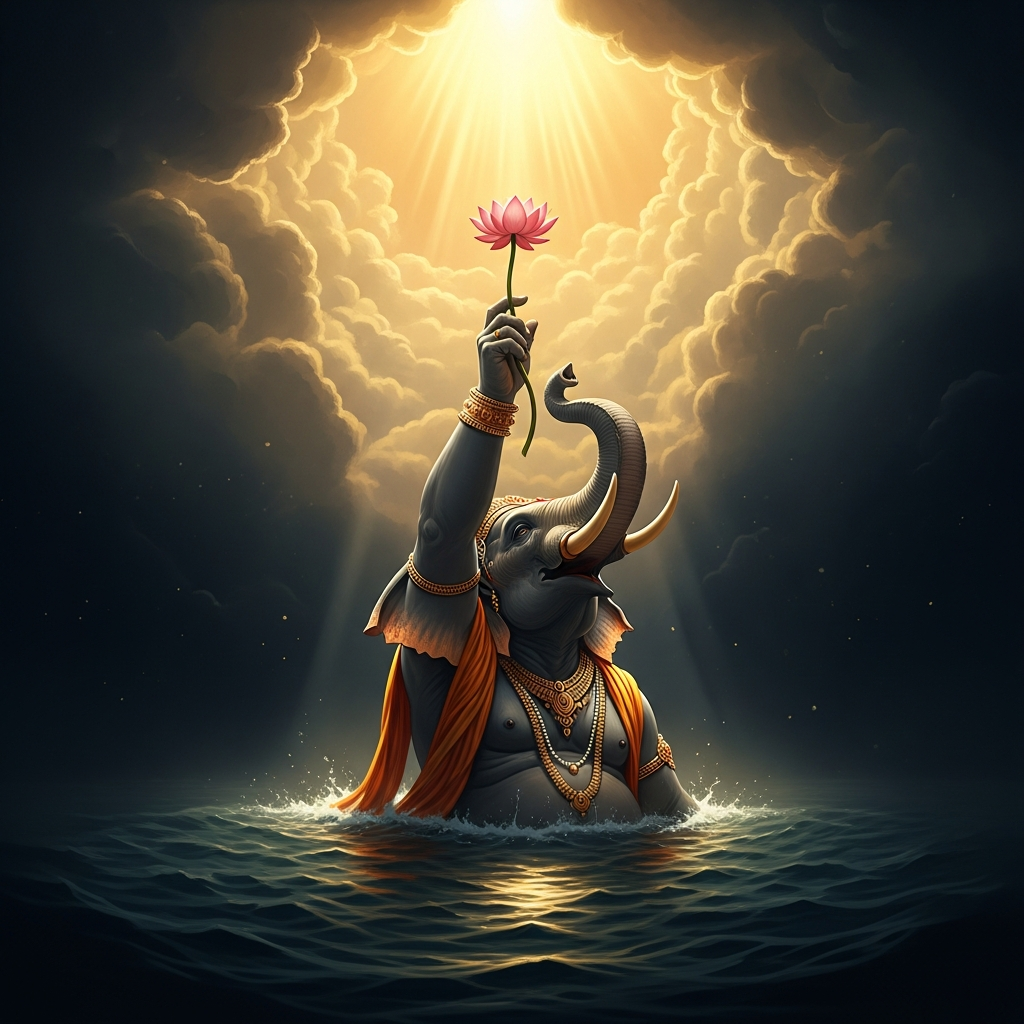
Gajendra Moksha: The Elephant's Liberation
Mythic Time — Sveta Dvipa age · Bhagavata Purana Book 8, ~9th century CE composition · The Trikuta Mountain and its lotus lake — a place of divine beauty at the edge of the human world
Contents
The elephant king Gajendra rules his mountain lake for ten thousand years in lordly pleasure. A crocodile seizes his foot. For a thousand years he fights. When his strength finally breaks and no earthly power answers his cry, he raises a lotus toward heaven — not begging for rescue, but offering praise. Vishnu descends on Garuda and kills the crocodile in an instant. The elephant king dies and goes directly to liberation.
- When
- Mythic Time — Sveta Dvipa age · Bhagavata Purana Book 8, ~9th century CE composition
- Where
- The Trikuta Mountain and its lotus lake — a place of divine beauty at the edge of the human world
He rules for ten thousand years and does not once consider that any of it will end.
The elephant king Gajendra moves through his mountain lake with the assurance of a being for whom the world has been correctly arranged. The Trikuta Mountain rises above him in three peaks, the forests are thick with fruit and shadow, and the lotus lake at the mountain’s foot is his court — cool in the hot season, warm with reflected sun in the cool season, filled with lotus flowers in every color that the world’s palette can produce. He swims in it with his wives and calves, spraying water into the afternoon light, trumpeting at the pleasure of existing in a body built to experience exactly this kind of pleasure.
This is not evil. The Bhagavata Purana does not condemn him for it. It simply notes that ten thousand years of undisturbed enjoyment is an effective way to forget that you are not the lord of this place.
He wades into the lotus lake one afternoon, deeper than usual.
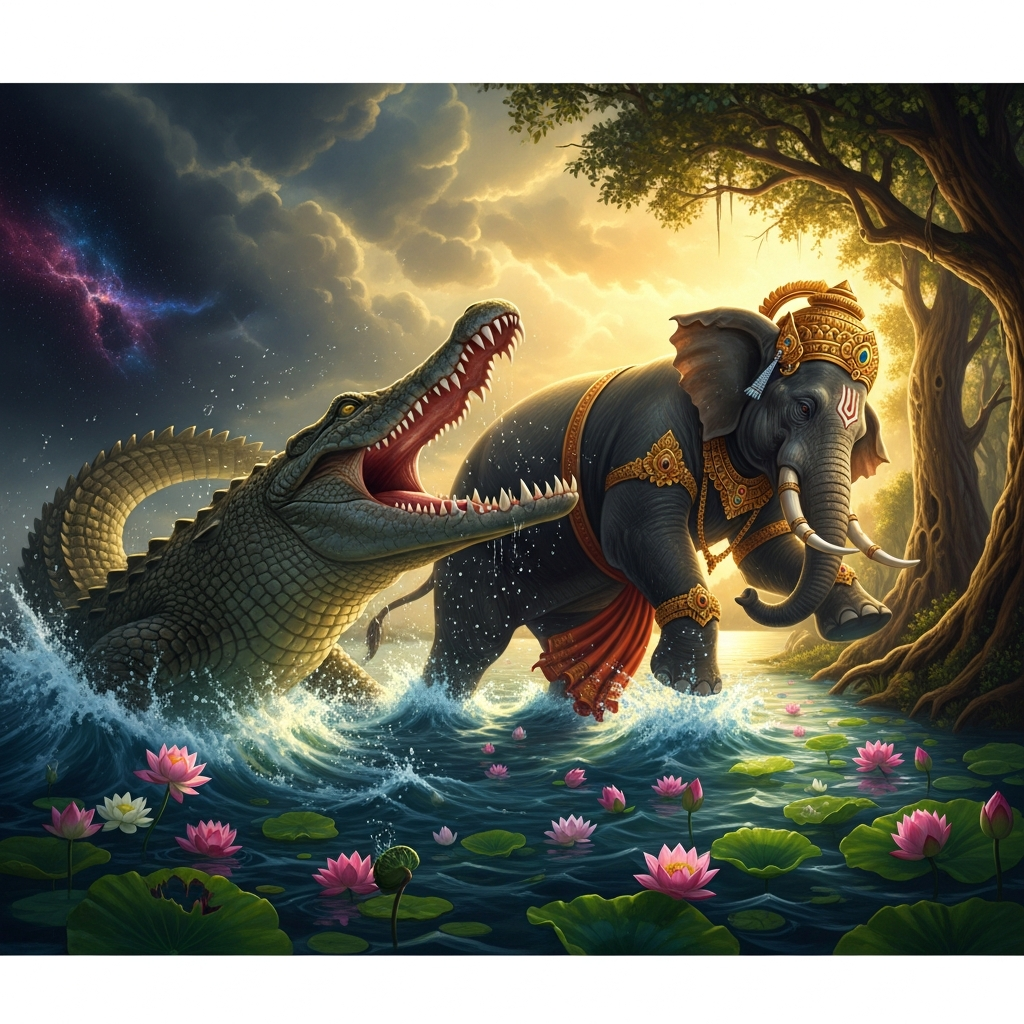
The crocodile comes from the deep with no announcement.
It seizes his right foot with jaws that do not open again. The grip is absolute — the architecture of a predator whose entire body is built around the non-negotiability of the bite. Gajendra lurches, trumpets, plants his other legs and pulls with every gram of force ten thousand years of mountainside living have built into him.
The crocodile does not move. It does not fight him. It simply holds.
The genius of the crocodile’s method is the same genius that the deep water uses against everything that enters it: inertia, patience, the advantage of the element. The crocodile is home. Gajendra is a visitor who has waded too far from the shore he controls. Every pull Gajendra makes toward the bank is matched by the subtle drag of the crocodile’s weight and the water’s resistance. He is stronger than the crocodile. He is not stronger than the situation.
The struggle continues. Days. Months. Years. A thousand years, the text says, though this is the text’s way of saying: long enough that the strength which seemed inexhaustible is exhausted completely. The lake fills with thrashing and trumpeting. The forest gods and river spirits watch from the banks. They are sympathetic. They are not able to help. Every earthly power that Gajendra invokes — other elephants, the mountain itself, the gods of the local forest — answers with the same helpless silence. The crocodile simply holds.
He stops fighting.
This is the moment the story has been building to for a thousand years, and it arrives not as a dramatic decision but as a physical fact: Gajendra can no longer pull. His legs have no more pull in them. His trunk hangs. The lake is quiet around him, which is the sound of his certainty running out.
He reaches into the water with his trunk.
He finds a lotus.
He lifts it above the water.
The gesture is the turning point of the Bhagavata’s eighth book, and it is worth holding before rushing to what follows: an elephant, mortally tired, half-submerged, a crocodile locked to his foot in water up to his shoulders — this being lifts a lotus toward the sky and begins to speak. Not pleading. Not bargaining. Not the prayer of a creature who needs something. The prayer he speaks is the Gajendra Stuti, the stotra that the tradition recites still at dawn and at death-beds, and it is a hymn of pure praise. He names the attributes of the divine. He describes what the formless absolute is like. He asks for nothing.
He is not asking to be saved. He is offering the last thing he has — attention — to the only thing that was always worth attending to.
The moment he stops asking for himself, Vishnu moves.
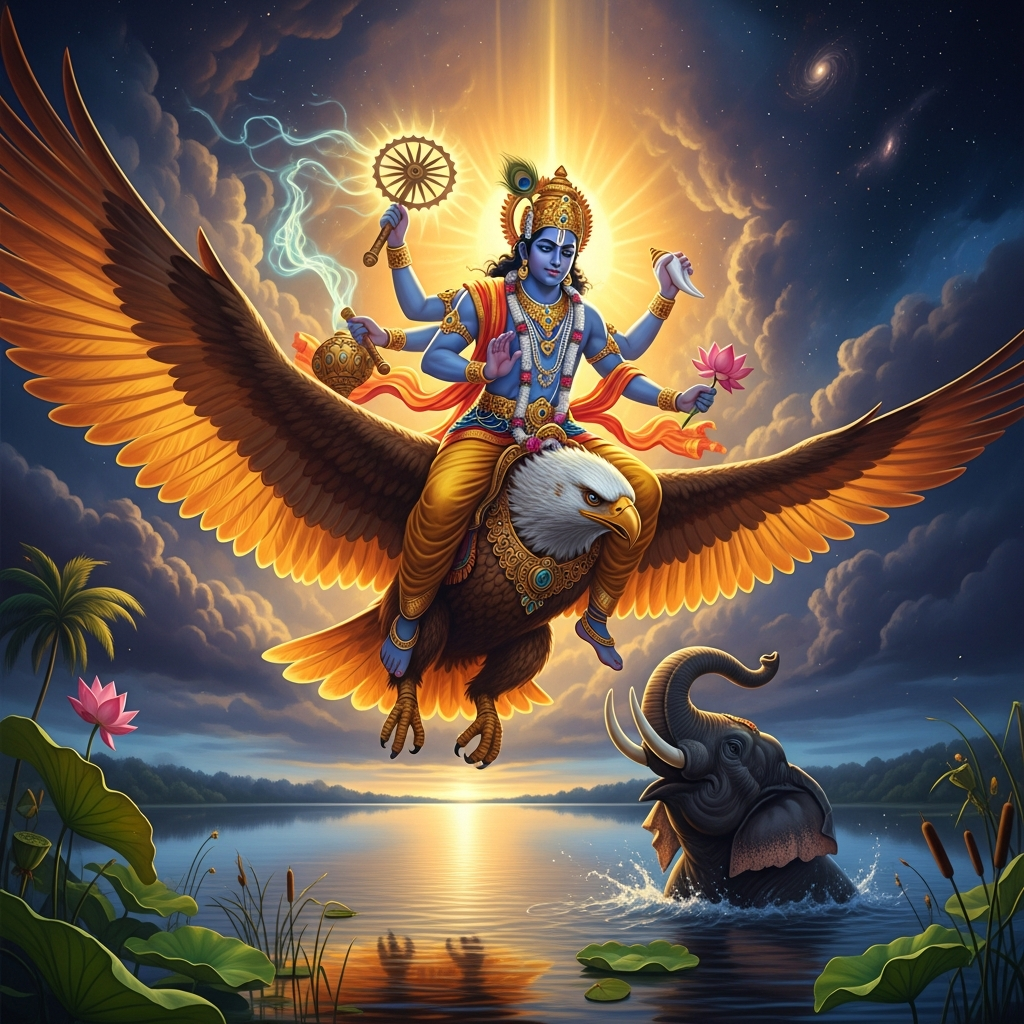
The texts say it like this: Vishnu rose from his seat. He did not finish his thought. He did not wait for proper ceremony. He stepped onto Garuda, the eagle who is the vehicle of divine will, and Garuda lifted into the sky, and they came down toward the Trikuta Mountain at the speed that Vishnu moves when there is no time between the intention and the arrival.
The Sudarshana Chakra — the spinning discus, the wheel of divine will — leaves Vishnu’s hand and crosses the water and takes the crocodile.
It happens before Gajendra’s prayer has finished echoing off the mountain stone. The crocodile releases its thousand-year grip and sinks, and from the crocodile’s body, the tradition says, rises the form of a Gandharva — a celestial musician who was cursed in a previous life to the shape of his greed, now released in the moment of divine contact, rising through the lotus-scattered water toward his liberation. Even the crocodile is freed. No one in this story receives only what they asked for.
Vishnu lifts the elephant from the water.
He touches him. The texts say: in the moment of Vishnu’s touch, Gajendra is released from his elephant body and the long memory of his previous lives floods back — he was once a great king, a devotee, whose accumulated karma carried him into the elephant’s birth to complete the teaching that no previous life had finished. The crocodile was also a previous soul, working out its own ancient account. The lake, the lotus, the thousand years — all of it was arranged by the logic of karma working toward this exact moment.
Gajendra does not go back to the forest.
He goes to Vishnu’s abode, Vaikuntha — liberated, not merely rescued. The elephant king who spent ten thousand years in undisturbed pleasure and a thousand years in inescapable struggle goes directly to the freedom that is beyond both. He did not earn it through good deeds or austerity or knowledge, though he may have done those things in earlier lives. He earned it in the final moment of complete surrender, when he stopped fighting and started praising, and there was nothing left between him and the divine but a lotus held in a tired trunk.
The teaching is so simple it is easy to miss.
The Bhagavatam records that Vishnu said to his consort Lakshmi, as he rose from his seat: I must go — my devotee is calling. Not: my devotee is in danger. Not: my devotee needs rescue. He said calling, as though the call were a summons and he were an invited guest.
This is the logic of prapatti, the yoga of surrender: not that Vishnu does not hear the cries of the struggling, but that the struggling itself is a kind of noise that can fill the space where the devotee might simply call. Gajendra’s thousand years of powerful, intelligent, determined self-rescue are the thousand years during which he was too occupied with his own strength to discover that a different kind of call is possible. It is not that the struggle was wrong. It is that it had to be completed — exhausted to its final gram — before he could find what was on the other side of it.
What is on the other side is a lotus held upward with no agenda except praise.
What comes to meet that lotus is faster than time.
Gajendra’s story is the answer to the question every tradition eventually asks: when you have tried everything and strength has run out, what is left? And the answer is: a lotus, and the name that goes with it, offered without condition.
Scenes
Gajendra, exhausted and half-submerged after a thousand years of struggle, lifts a lotus in his trunk toward the sky — not as a cry for help but as a gesture of pure offering — and the heavens open above him
Generating art… The crocodile's jaws lock around the elephant king's foot in the lotus lake, and the thousand-year war of attrition begins — the elephant dragging toward shore, the crocodile dragging toward the deep
 Generating art…
 Vishnu rides Garuda down through the sky at the speed of will itself, Sudarshana Chakra spinning in his hand, arriving at the lake before the echo of Gajendra's prayer has crossed the water
 Generating art…
 Echoes Across Traditions
Entities
- Vishnu
- Gajendra
- Garuda

Sources
- *Bhagavata Purana* 8.2-4
- A.C. Bhaktivedanta Swami Prabhupada, commentary on Book 8
- Raimon Panikkar, *The Vedic Experience* (surrender passages)
- Georg Feuerstein, *The Yoga Tradition* (prapatti chapter)