Huayna Cápac and the Prophecy of the Sea
1527 CE — death of Huayna Cápac · 1527-1532 CE — Inca Civil War · November 16, 1532 CE — Battle of Cajamarca · Quito — Cajamarca — Cuzco — the full length of the Tawantinsuyu
Contents
The last great Inca emperor dies in 1527 of a plague that runs ahead of the men who brought it. Before dying, he hears the oracles: strangers are coming from the sea, armed with weapons the empire cannot match. He divides the Tawantinsuyu between his two sons — the worst decision in the history of the Americas. The civil war that follows delivers the empire to Francisco Pizarro's 168 soldiers.
- When
- 1527 CE — death of Huayna Cápac · 1527-1532 CE — Inca Civil War · November 16, 1532 CE — Battle of Cajamarca
- Where
- Quito — Cajamarca — Cuzco — the full length of the Tawantinsuyu
The plague arrives before the men who sent it.
This is the fact that rewrites everything. The standard account of the Spanish conquest of the Inca Empire implies a confrontation: European soldiers meeting Andean warriors, technological superiority defeating numerical superiority, the gun and the horse defeating the sling and the spear. The standard account is not wrong about the technology. It is wrong about the sequence. What actually happened is that Old World diseases — smallpox, measles, typhus, traveling as they always travel, along trade networks, ahead of the armies, through populations that had never encountered them and had no immunity — arrived in the Andes perhaps a decade before any Spanish soldier did.
Huayna Cápac, the eleventh Sapa Inca, the last to rule the empire whole, is in Quito in 1527 when the plague finds him. He has been campaigning in the north for years, extending the empire’s northern boundary into what is now Ecuador and Colombia, the furthest the Tawantinsuyu ever reached. He is at the height of his power — an empire of perhaps twelve million people, the longest road system in the pre-Columbian world, storehouses full enough to feed the entire population for years, an administrative system so sophisticated that no Spanish colonial administrator will improve on it for a century.
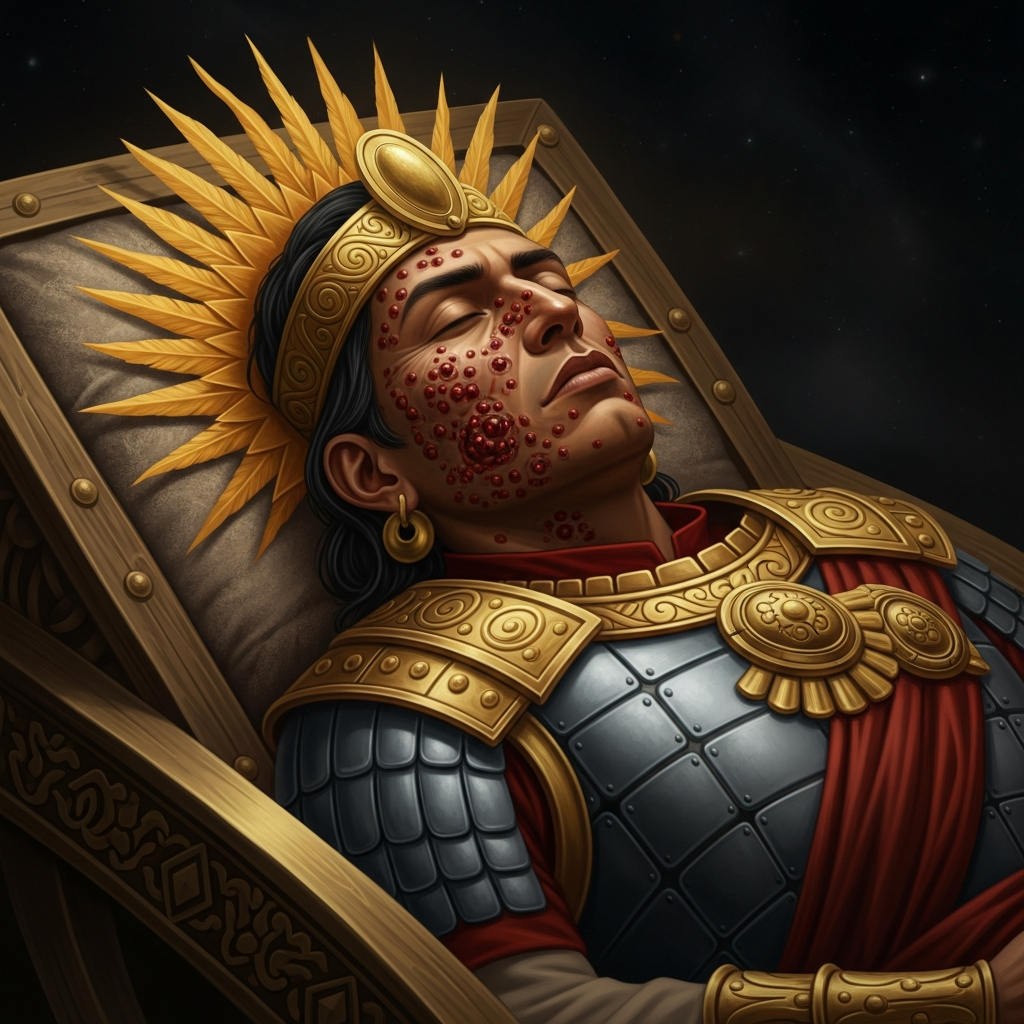
And then his face begins to show the marks.
He hears the prophecy from the oracles, and the oracles know what they know.
The Andean oracle tradition is not marginal superstition. The huacas — the sacred sites, the mummies of the royal ancestors, the dedicated priests — form an intelligence network that tracks patterns in the sky, in the earth, in the movements of peoples along the coastal trade routes. The Andean world has been aware of the ocean to the west for as long as the Andean world has existed; the Chimú and Moche coastal cultures fished it for centuries. Word travels along the coast. Unusual objects have been seen. Unusual people on unusual vessels.
The oracle speaks what the trade network knows: strangers are coming from the sea. They are unlike any people the world has encountered. They ride animals that are not known. They carry weapons that make thunder. The empire cannot resist them by force. This last part — the oracle’s assessment of military balance — is the most theologically interesting element, because the Inca oracle tradition is not generally defeatist. The huacas are regularly consulted for military campaigns and regularly predict Inca victory. That this oracle says otherwise is not a failure of nerve. It is the oracle doing what oracles do: reading the facts without comfort.
Huayna Cápac listens. He is dying. His face is marked and his body is failing and the plague is moving through his army in Quito, killing in swaths. He understands that he will not meet these strangers. He understands that his successor will.
He makes the decision that destroys the empire.
He divides the Tawantinsuyu between his two sons.
The decision violates everything the Inca had built. The empire is called Tawantinsuyu — the Four Quarters — because it is unified by the Sapa Inca at the center, the solar sovereignty that binds all four directions. The entire administrative architecture assumes a single authority: one Sapa Inca, one set of roads, one storehouse system, one mit’a labor obligation, one calendar. The ceque lines of Cuzco radiate from a single center. The concept of a divided empire is, within Inca theology, an oxymoron — a four-quartered thing with two centers is not a four-quartered thing. It is two things. Things that are two will fight each other.
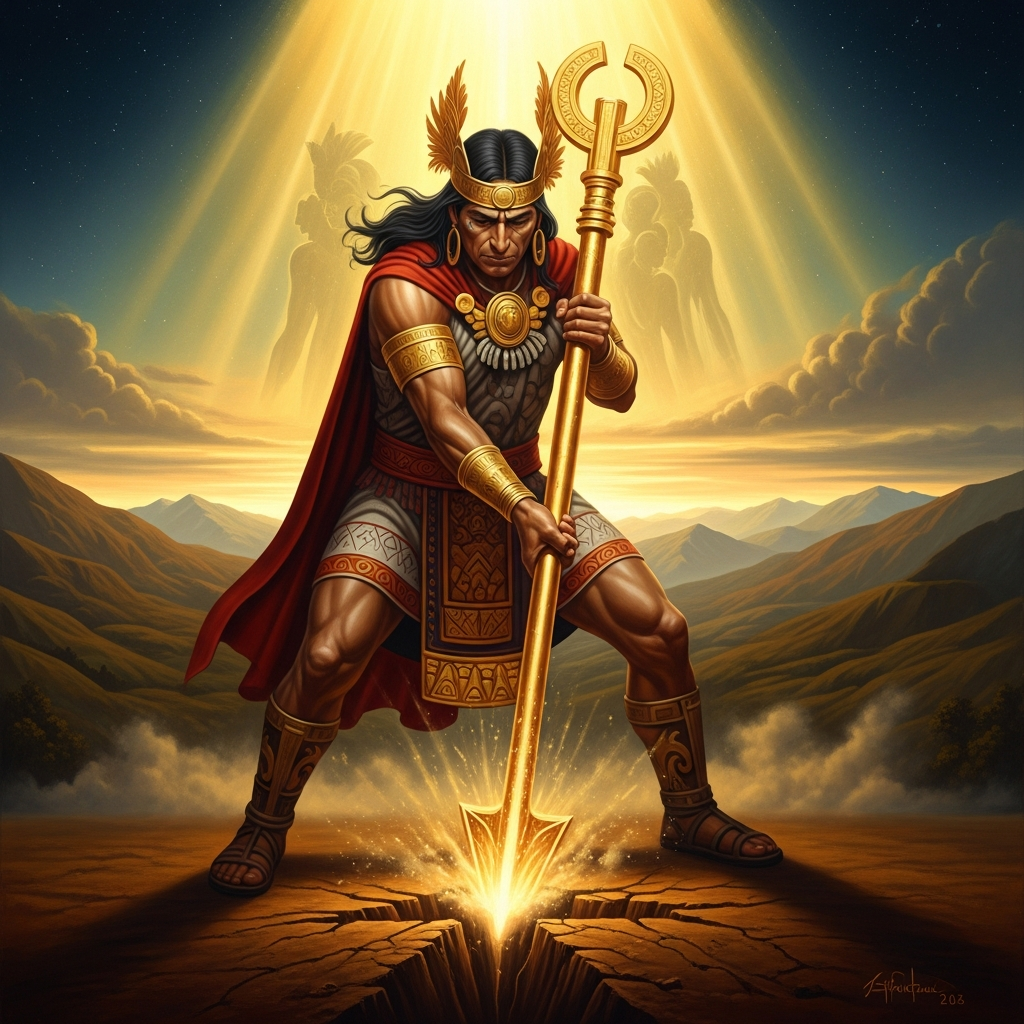
Huáscar receives Cuzco and the south — the ancestral homeland, the original empire, the holy city where Manco Cápac drove the golden staff into the earth. Atahualpa receives Quito and the north — the new conquests, the frontier, the armies that Huayna Cápac had built and trained and that are now loyal to the man they served with.
The will of the dying emperor is known. It is known that it violates the solar order. It is known that two Sapa Incas cannot exist. The decision is made anyway, perhaps because Huayna Cápac is beyond caring about the long-term consequences, perhaps because he cannot choose between his sons, perhaps because the oracle has told him the empire is ending regardless and this way both sons have something. Whatever the reasoning, the result is mechanical: two sons, two armies, one throne.
The civil war begins.
The war lasts five years and it is merciless.
Huáscar controls Cuzco and the south and has legitimacy — the traditional succession, the ancestral city, the priesthood. Atahualpa controls the north and has the army — hardened veterans of the northern campaigns, loyal to him personally, commanded by the finest generals the Tawantinsuyu had ever produced: Quizquiz and Chalcuchima and Rumiñawi, generals who would later be the most effective resistance fighters against the Spanish because they understood exactly what had happened and refused to accept it.
The battles run along the length of the royal road. The royal road — the most sophisticated transportation infrastructure in the pre-Columbian world, 40,000 kilometers of paved highway across some of the most extreme terrain on earth — is now a war corridor. The storehouses that were designed to feed the empire’s workers now feed the armies that are destroying the empire. The mit’a labor system that the Inca designed as an instrument of prosperity becomes the conscription system that fills both armies with men who would rather be planting.
Atahualpa’s generals win. By 1532, Huáscar is captured. His armies are broken. Atahualpa holds the whole empire from the north — which means he is in Cajamarca, in the highlands of northern Peru, with his army, when Francisco Pizarro’s 168 soldiers march up from the coast.
The prophecy made them hesitate, and the hesitation was fatal.
Pizarro knew about Atahualpa. His spies and allies — there were Andean peoples who had grievances with the Inca and were willing to cooperate with anyone who might challenge them — had given him detailed intelligence. He knew that Atahualpa had just won a civil war. He knew the exact size of the Inca force at Cajamarca. He knew that 168 men against eighty thousand was not a military contest in any conventional sense.
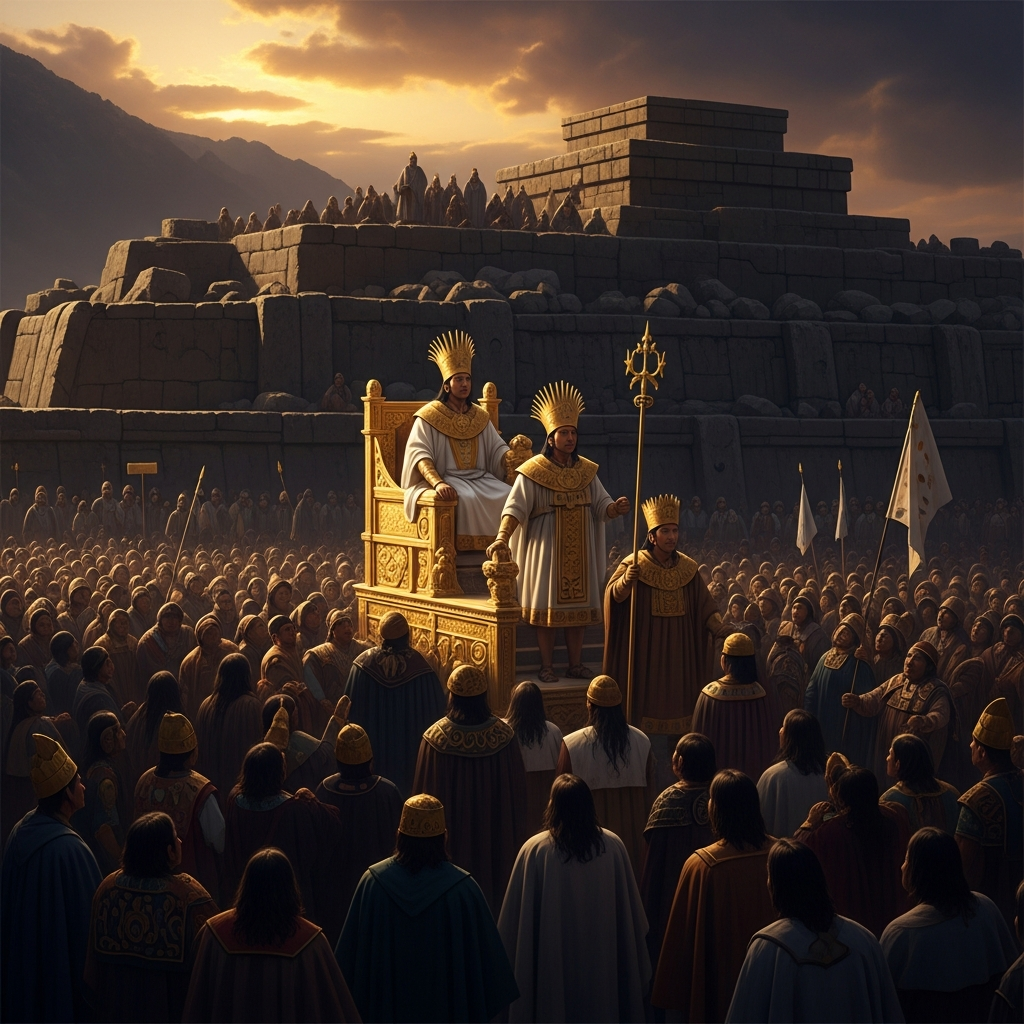
What Pizarro understood, because he had been told about the oracle’s prediction and the Quetzalcoatl-style prophecy of strangers from the sea, was that the Inca were expecting something they could not categorize. Not an army that could be defeated. A force that had been foretold. And forces that have been foretold are not attacked immediately — they are assessed, engaged diplomatically, managed. Atahualpa receives Pizarro’s embassy. He rides into Cajamarca to meet these strangers from the sea. He brings his court and his litter-bearers and his nobles. He leaves his eighty thousand soldiers outside the city because you do not bring an army to a diplomatic meeting.
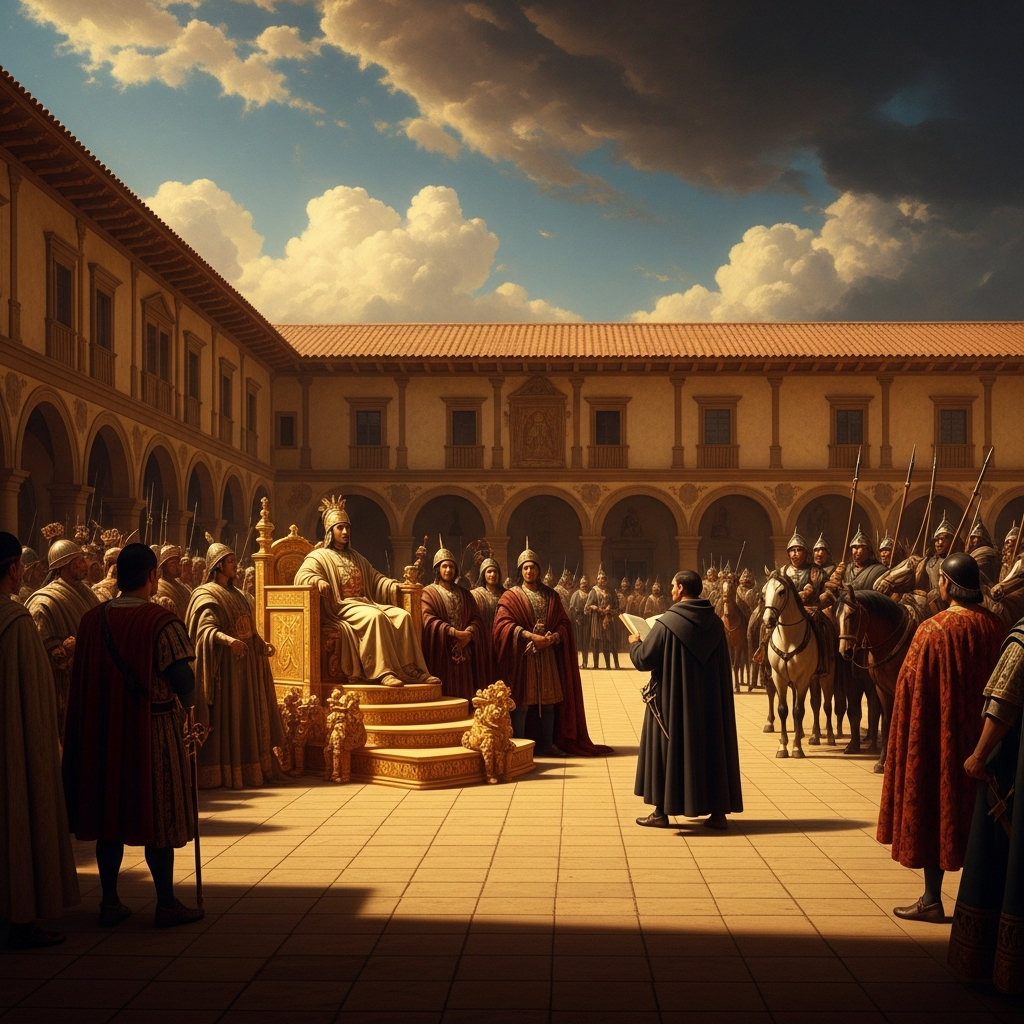
The Dominican friar Vicente de Valverde walks up to Atahualpa’s litter and presents him with a Bible — or perhaps a breviary, the accounts vary — and tells him through an interpreter that he must accept the Christian God and the sovereignty of the King of Spain. Atahualpa takes the book. He puts it to his ear, listening for the voice of God that Valverde claims is within it. He hears nothing. He drops the book.
Pizarro gives the signal. The arquebuses fire from the buildings. The cavalry charges from the alleys. The ambush breaks in all directions at once. Two thousand Inca nobles die in the plaza in approximately thirty minutes. Atahualpa is captured alive.
The solar calendar had a prophecy of its own unmaking built into it.
The Inca ceque calendar — the system of 41 lines radiating from the Coricancha, each one passing through a sequence of huacas, organizing both the landscape and the ritual year — was designed with crisis points. Moments when the solar year reached a structural uncertainty, when the astronomical alignment was ambiguous, when the priests had to perform their most demanding ceremonies to ensure the continuation of the cosmic order. The June solstice was one such moment: the sun’s reversal, requiring the Sapa Inca’s call to bring it back.
The crisis point of 1532 was different in kind but identical in structure: a moment when the cosmic order could continue or could fail, depending on whether the right action was taken at the right time. The Sapa Inca was supposed to perform the ceremony. But the Sapa Inca was in a cage in the plaza of Cajamarca, being ransomed for a room full of gold that arrived and was melted and did not save him.
Atahualpa was strangled on July 26, 1533 — a Christian execution date, a Saturday. He had converted to Christianity at the last moment, which changed his execution from burning (the pagan death) to garroting (the Christian mercy), and the Spanish buried him in a Christian grave, which the Inca understood as a final desecration: their ruler’s body not returned to the earth from which it came, not preserved as a royal mummy to be consulted by his successors, not placed in the ancestor network that made the empire’s governance possible.
The oracle had been right. The empire fell. The strangers from the sea had arrived with technologies that could not be resisted — not the horses and the guns, but the plague that ran ahead of them and the civil war it triggered. Pizarro’s 168 men did not conquer the Tawantinsuyu. They found it already broken, and they pushed the largest piece over.
The solar calendar still turns. Inti Raymi is still performed at Sacsayhuamán each June, the actor-Inca still calling the sun back from its southern extreme. But the dynasty that was supposed to perform the ceremony is gone — gone in a thirty-minute ambush in a plaza in Cajamarca, gone because a dying emperor divided what could not be divided, gone because a plague arrived before its carriers and cleared the way. The prophecy the oracle gave Huayna Cápac was not a warning. It was a description of what had already been set in motion, running ahead through the Andes like the smallpox itself, invisible and inevitable, arriving before the men who sent it.
Scenes
Huayna Cápac lies in his royal litter in Quito, his face marked by smallpox pustules — the disease that has already killed thousands of his soldiers and is now killing the Son of the Sun himself, the first Inca emperor to die of a foreign pathogen
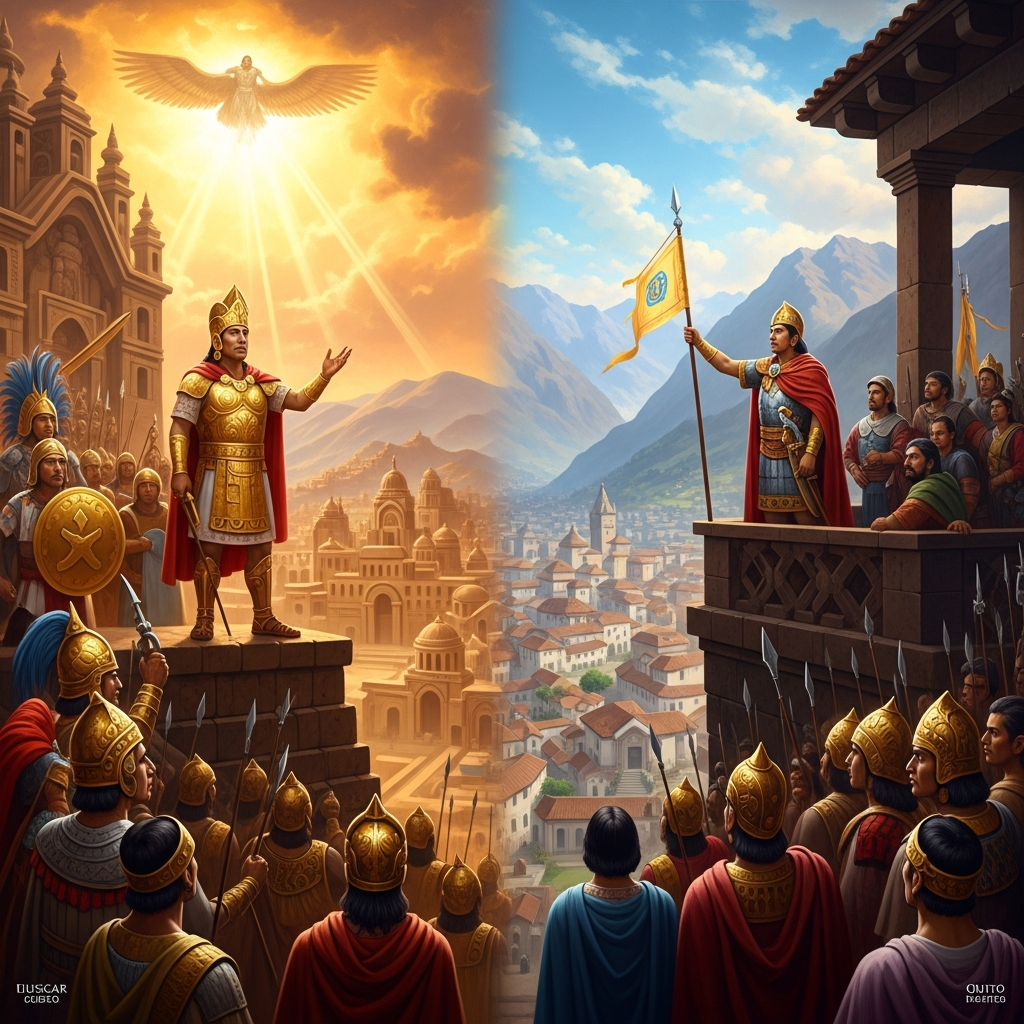
Generating art… Huáscar in Cuzco and Atahualpa in Quito: two sons of the same divine father, each commanding half an empire's army, meeting in battle along the length of the royal road while Pizarro's ships are still off the coast deciding whether to land
 Generating art…
 The plaza of Cajamarca on November 16, 1532: Atahualpa in his golden litter, surrounded by his court, watching a Spanish friar approach with a book — and then the ambush breaking from the buildings, the horses and arquebuses, the world ending in an afternoon
 Generating art…
 Echoes Across Traditions
Entities
- Huayna Cápac
- Huáscar
- Atahualpa
- Francisco Pizarro
- Villac Uma (High Priest)
- Viracocha

Sources
- Pedro Sarmiento de Gamboa, *Historia de los Incas* (1572)
- Juan de Betanzos, *Narrative of the Incas* (1557)
- Francisco de Jerez, *True Account of the Conquest of Peru* (1534)
- Titu Cusi Yupanqui, *Relación de la conquista del Perú* (1570)
- John Hemming, *The Conquest of the Incas* (1970)
- Charles Mann, *1491: New Revelations of the Americas Before Columbus* (2005)
- Nathan Wachtel, *The Vision of the Vanquished* (1977)