William Tyndale and the English Bible
1525–1536 · Cologne, Worms, Antwerp, and Vilvorde (modern Belgium)
Contents
William Tyndale translates the New Testament into English in secret, fleeing from city to city across northern Europe. Bishop Tunstall buys up copies to burn them and inadvertently funds the next print run. Fifteen years of exile end at Vilvorde in 1536 with a strangling and a fire. Eighty-three percent of his words survive in the King James Bible.
- When
- 1525–1536
- Where
- Cologne, Worms, Antwerp, and Vilvorde (modern Belgium)
The press is running when the city officers arrive.
It is 1525, and William Tyndale is in Cologne, renting a room above a printshop on the Rheingasse, watching the first English New Testament in history come off a press sheet by sheet. He has been working on this translation for three years — since the Bishop of London told him, in 1522, that there was no place in the bishop’s household for a man who wanted to put the scriptures into English, since England was doing perfectly well with Latin. Tyndale has taken this as information rather than instruction. He left England, crossed to the continent, and found a printer.
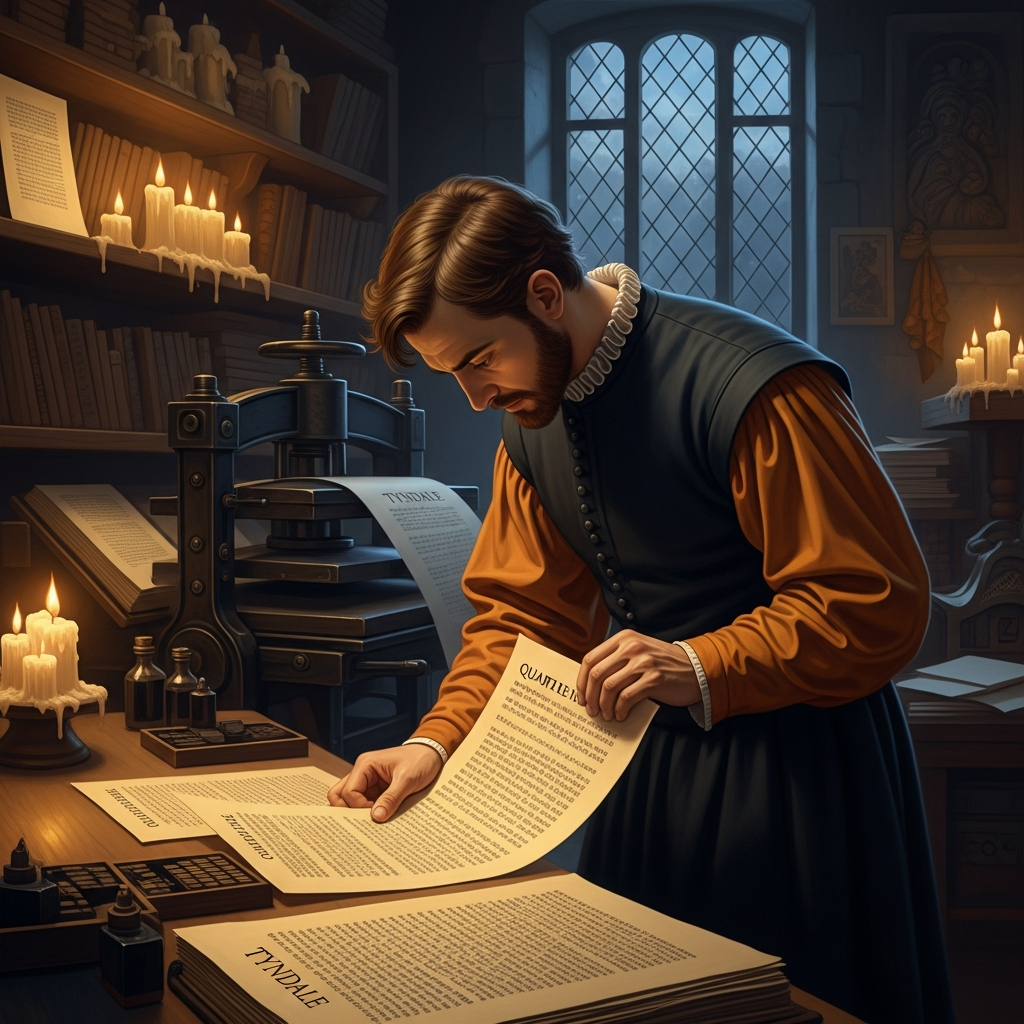
The Cologne printshop has reached Matthew chapter 22 when Johann Cochlaeus — a theologian who has been drinking with the printers and loosened their tongues — runs to the city council with the news that an English heretic is producing vernacular scripture in their city. The officers arrive. Tyndale grabs the completed quires and runs for the Rhine. He is on a boat to Worms before morning, carrying the first ten chapters of Matthew in printed English.
In Worms, he finds another printer and starts again. By February 1526 the New Testament is finished — six thousand copies in the first run, octavo format, small enough to fit in a coat pocket, cheap enough for a cloth merchant to buy. The copies begin moving toward England in bales of cloth, in sacks of flour, in the cargo of wool ships. They arrive in London.
Bishop Cuthbert Tunstall has a problem.
The books are already in England by the time he hears about them. His agents are finding them in the hands of merchants, students, tradespeople — exactly the people Luther’s German New Testament has reached across the Rhine, exactly the people that Tyndale said he was writing for when he told a priest that if God spares his life, a plowboy shall know more of the scripture than you do. Tunstall arranges public burnings at St. Paul’s Cross, which is the standard response, but the books keep coming.
A merchant named Augustine Packington approaches the bishop with an offer. He can, Packington says, get Tyndale’s New Testaments directly from the source — all of them, bought in bulk at the price Tyndale needs to stay solvent. Tunstall pays. Packington goes to Antwerp, where Tyndale is now living under the protection of English merchants in the house called the English House, and explains the situation. Tyndale takes the money, which pays off his debts and funds a corrected second edition, and Packington delivers the purchased books to Tunstall, who burns them publicly at St. Paul’s.
The second edition, corrected and improved, begins moving toward England within months. Thomas More, who is conducting the English church’s literary war against Tyndale and who is not stupid, immediately grasps what has happened. Tunstall has done Tyndale’s fundraising for him. More does not find this amusing.
The translation itself is the argument.
Tyndale is not simply rendering the Greek text into English. He is rendering it into a particular English — direct, rhythmic, concrete, Anglo-Saxon in its vocabulary where the Latin-derived alternatives carry ecclesiastical freight. He writes love where the Vulgate has caritas. He writes congregation where the church has ecclesia. He writes elder where the hierarchy has priest. He writes repent where the penitential system has do penance.
Each choice is a theological position. If the Greek word for the gathered community of believers is ekklesia, and you translate it as church, you are implying an institution with buildings and hierarchy and sacramental authority. If you translate it as congregation, you are implying a voluntary gathering of people who have chosen to meet. Tyndale’s opponents understand this perfectly. Thomas More writes hundreds of pages attacking specific word choices, correctly identifying that the translation embeds Lutheran theology into the English language at the level of vocabulary, so that anyone who reads Tyndale’s New Testament absorbs the theology whether they intend to or not.
Tyndale writes back at equal length. He is at this point in Antwerp, living carefully, moving between safe houses, producing an increasingly comprehensive English Bible — the Pentateuch in 1530, the historical books, revisions of the New Testament. He has been in exile for nine years. He has not seen England since 1524. He is forty years old, or perhaps forty-two; the exact date of his birth is uncertain. He is a careful scholar who reads Hebrew and Greek and has access to Erasmus’s critical edition of the Greek New Testament and Luther’s German translation and the Vulgate Latin, and he is producing, in conditions of persistent danger, the most important English prose of the sixteenth century.
He is also, because he is a man of his time, occasionally polemical, occasionally sharp-tongued, occasionally wrong about specific readings. He does not mind being corrected. He publishes revised editions. He intends to finish the whole Bible before he dies.
Henry Philips arrives in Antwerp in the spring of 1535.
He is young, well-dressed, apparently well-educated, apparently a man of similar Reformed sympathies to Tyndale’s own circle. He ingratiates himself with the English House. He eats with Tyndale. He borrows money from him. He is, in fact, an agent of someone — it is not entirely clear who, possibly the English authorities, possibly a continental Catholic faction — and in May 1535 he walks Tyndale out of the English House on a pretext and delivers him to the officers of the Holy Roman Emperor who are waiting in the street.
Tyndale is taken to Vilvorde Castle, eighteen miles north of Brussels. He is imprisoned for sixteen months while theological authorities examine his case and prepare the charges. He is convicted of heresy and villainy. He appeals, on specific doctrinal points, with precision and clarity. The appeal fails.
On October 6, 1536, he is brought to the castle yard at dawn. He is tied to a stake. A garrote is looped around his neck and pulled tight. He is dead before the fire is lit, which is the mercy the procedure allows. John Foxe, writing twenty-seven years later, records his last words: Lord, open the King of England’s eyes.
Within a year, Henry VIII authorizes an English Bible for every parish church in England.
The authorized Bible — the Matthew Bible of 1537, then the Great Bible of 1539 — is substantially Tyndale’s translation. The men who compile it use his New Testament directly and his Pentateuch directly and work in his style for the books he never reached. When the King James translators convene in 1604 and produce the version that will become canonical English scripture, they work from the previous English translations, which are Tyndale’s work revised and supplemented. The scholars who have counted the surviving Tyndale phrases in the King James Version arrive at figures between eighty and eighty-three percent.
The plowboy has the New Testament in his coat pocket. The language is Tyndale’s.
Cuthbert Tunstall becomes, in this accounting, one of the great inadvertent patrons of English literature. His bonfires at St. Paul’s Cross are the kindling that lit the corrected editions. Thomas More, who died on the scaffold in 1535 — one year before Tyndale, for a different reason — wrote his brilliant polemics against a translation that was already too deeply embedded in English to be burned out. Henry Philips, who delivered Tyndale to the officers at Antwerp, disappears from the historical record after 1543. What happened to him, nobody knows.
What happened to the words is legible in every English Bible ever printed.
Tyndale’s last request from Vilvorde, sent in a letter to the Marquis of Bergen-op-Zoom, was for a warmer cap, a candle to read by in the evenings, and his Hebrew Bible, grammar, and dictionary, so that he could continue studying while he waited for the trial to conclude.
The letter survives. It is the most dignified document in the history of English biblical scholarship: a man in prison in winter, asking for light and the tools to keep working.
Scenes
A printshop in Cologne, 1525 — candlelight, the smell of ink, Tyndale bending over a proof sheet while the press runs
 Generating art…
 St
 Generating art…
 The castle yard at Vilvorde, October 6, 1536 — dawn, cold light, a stake and a pile of faggots
 Generating art…
 Echoes Across Traditions
Entities
- William Tyndale
- Cuthbert Tunstall
- Thomas More
- Henry Philips
Sources
- David Daniell, *William Tyndale: A Biography* (Yale University Press, 1994)
- Diarmaid MacCulloch, *The Reformation: A History* (Viking, 2003)
- Brian Moynahan, *God's Bestseller: William Tyndale, Thomas More, and the Writing of the English Bible* (St. Martin's Press, 2002)
- Alister McGrath, *In the Beginning: The Story of the King James Bible* (Hodder and Stoughton, 2001)
- John Foxe, *Acts and Monuments* (1563), Book 8