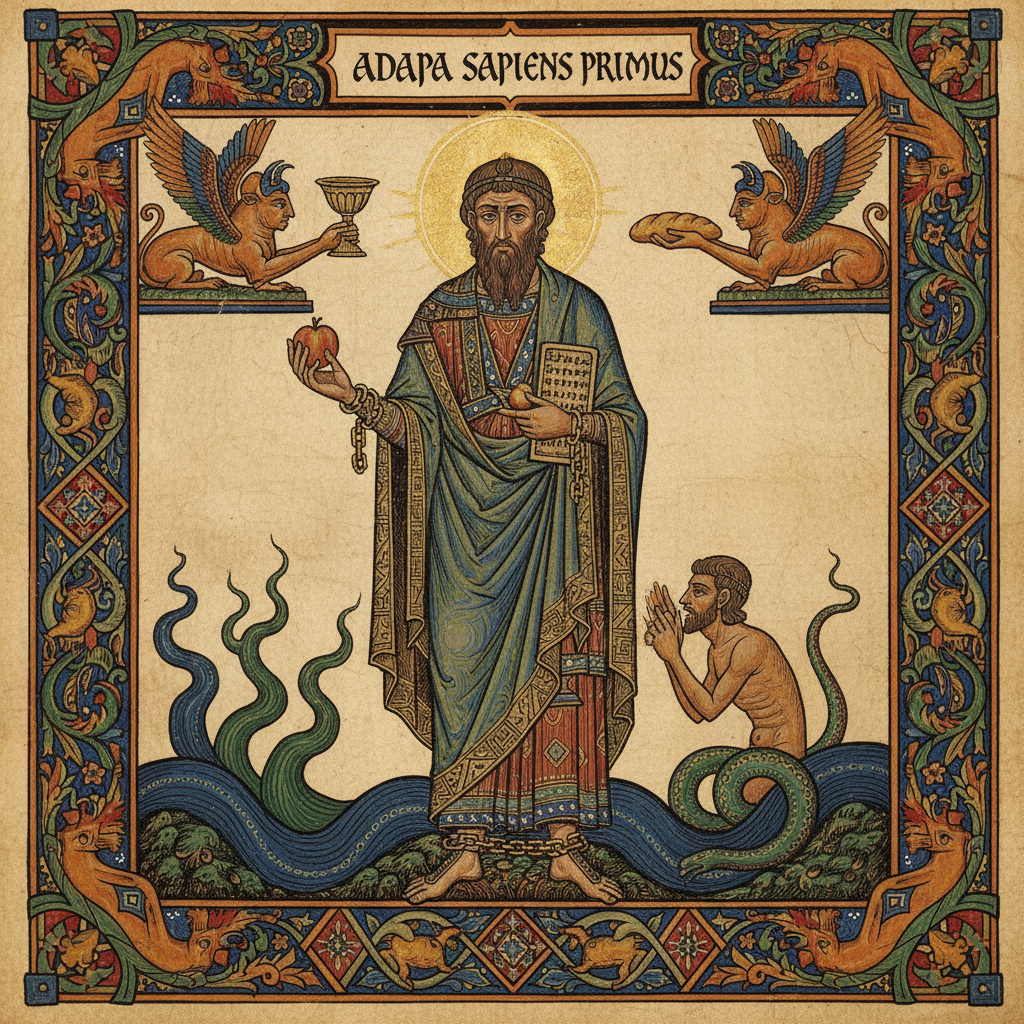
The Bread of Life: Adapa Before Anu
c. 1400 BCE · Eridu (southern Mesopotamia) and the heavens above
Contents
Adapa, the first wise man and priest of Eridu, breaks the south wind's wing and is summoned to stand trial before Anu in heaven. His own divine father warns him not to eat or drink what is offered — but the food was immortality, and Ea lied.
- When
- c. 1400 BCE
- Where
- Eridu (southern Mesopotamia) and the heavens above
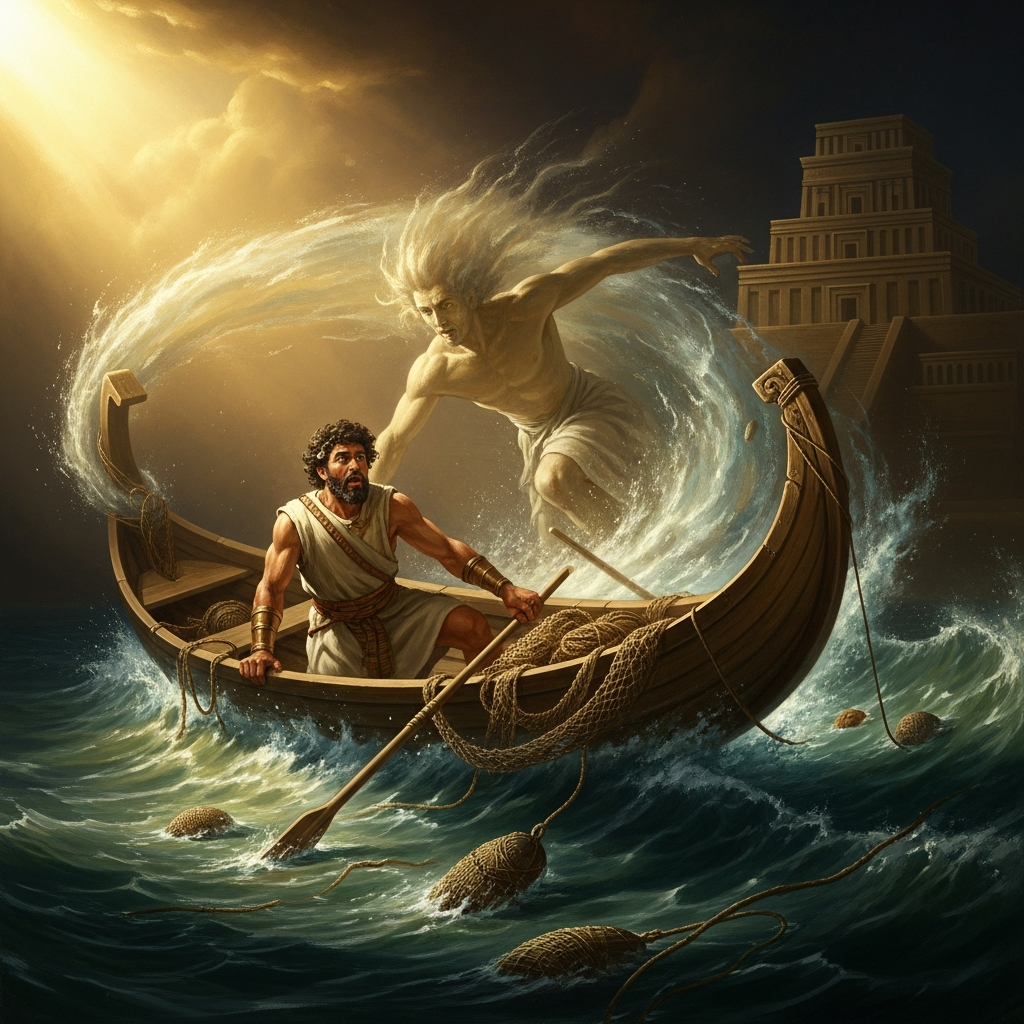
The south wind has been blowing for seven days when Adapa’s boat goes over.
He is fishing in the Persian Gulf, as he does every day, as the priest of Eridu has always done — gathering the catch that will feed Ea’s temple, the oldest temple in the world, the first house the gods built when they settled the black-headed land. He is not a great fisherman. He is the wisest man alive. These are different skills, but he has both, because Ea made him from the beginning with wisdom that approaches divine, with understanding that touches the ceiling of what flesh can hold.
The south wind finds his boat and tips it over. Adapa goes into the dark water. He comes up sputtering. He is furious in the way that only the deeply pious are furious when the world disobeys the order it is supposed to maintain. He has done nothing wrong. He was fishing for the god’s table. He was performing his function.
He speaks a word at the wind. He has been given some authority over the natural world — this much of divinity Ea allowed him, this much and no more. The south wind’s wing breaks. The sound is like a beam cracking in a large house. The wind goes still.
It stays still for seven days.
The reports reach Anu, king of heaven, in stages.
First: the south wind has stopped. Second: the crops in the lowland are drying out, the boats are becalmed, the normal movement of weather has been severed from its source. Third: a mortal did it. Not a warrior, not a king — a fisherman-priest from the oldest city in the world, working in the service of Ea.
The name Adapa reaches Anu’s throne room like a stone dropped into still water. Who is this? Anu asks. Who made him? He already knows the answer. Ea’s fingerprints are on everything in Eridu. The city was built to Ea’s design. The temple runs on Ea’s protocols. And this mortal who can break a wind’s wing — Ea put that power in him, even if the law of heaven says mortals are not given such things.
Summon him, Anu commands.
The messenger descends. Adapa, who has been preparing for exactly this since the wind’s wing snapped, learns he is to stand trial in heaven. For assaulting a divine being. For disturbing the order of the sky. For being, precisely, what Ea made him.
Ea comes to him before the journey.
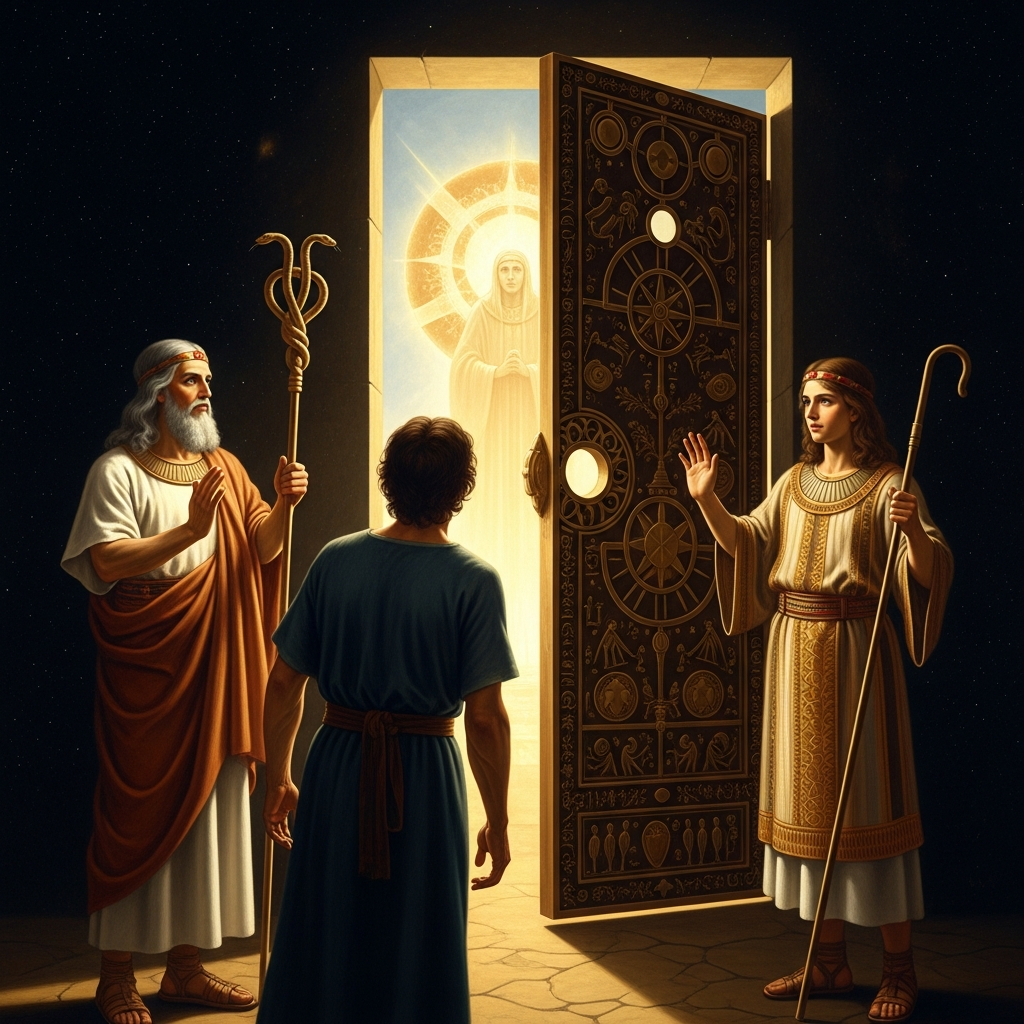
What passes between them is described in the tablets with peculiar precision. Ea is protective. He tells Adapa what to wear — mourning dress, because two gods sit at Anu’s gate who will see the mourning clothes and ask who he grieves for. Tell them you mourn for Dumuzi and Gizzida, Ea instructs, who have departed from the earth. Dumuzi the shepherd-god, gone to the underworld. Gizzida, the serpent-god of healing, also absent from the world of the living. These are the two gods who stand guard at heaven’s door, and they will be moved by a mortal who mourns for them.
They will intercede on his behalf, Ea says. They will speak well of him to Anu. Without their testimony, the trial goes badly.
Then Ea says the other thing. They will offer you food and water. Do not eat. Do not drink. What they will offer you is the food and water of death.
Adapa asks no questions. He does not challenge this. He trusts Ea the way a son trusts a father, the way a priest trusts the god whose fish he catches. He goes.
The gate of heaven is everything the tablets say it is and nothing Adapa was prepared for. The light is different here — not the clear light of the sky he knows, but something older and denser, the light from before the sun was placed in its track. Dumuzi and Gizzida stand at the gate in mourning clothes that mirror his own. They see what he is wearing and their faces change.
Who do you mourn?
I mourn for Dumuzi and Gizzida, who have gone from the land.
The two gods look at each other. Here is a mortal who knows their names, who wears grief for them like a garment, who has traveled to the place they left just to honor their absence. Something moves in them — divinity is not immune to being recognized, to being grieved for. They take him inside. They speak to Anu before he even reaches the throne.
Anu’s fury is still there when Adapa stands before him. Why did you break the south wind’s wing? The question is simple. The answer is simpler: I was fishing for my lord Ea’s table. The wind capsized me. I was angry. Anu looks at this man — this mortal with almost-divine wisdom standing upright before the king of heaven in mourning clothes — and finds, to his own surprise, that he is not angry anymore.
Why did Ea give wisdom like this to a mortal? Anu asks the air. What was he thinking? He is not asking for an answer. He is thinking out loud in the way of kings. The answer, which he does not speak because it would be an accusation he cannot prove, is: because Ea is always thinking three moves past the rest of us.
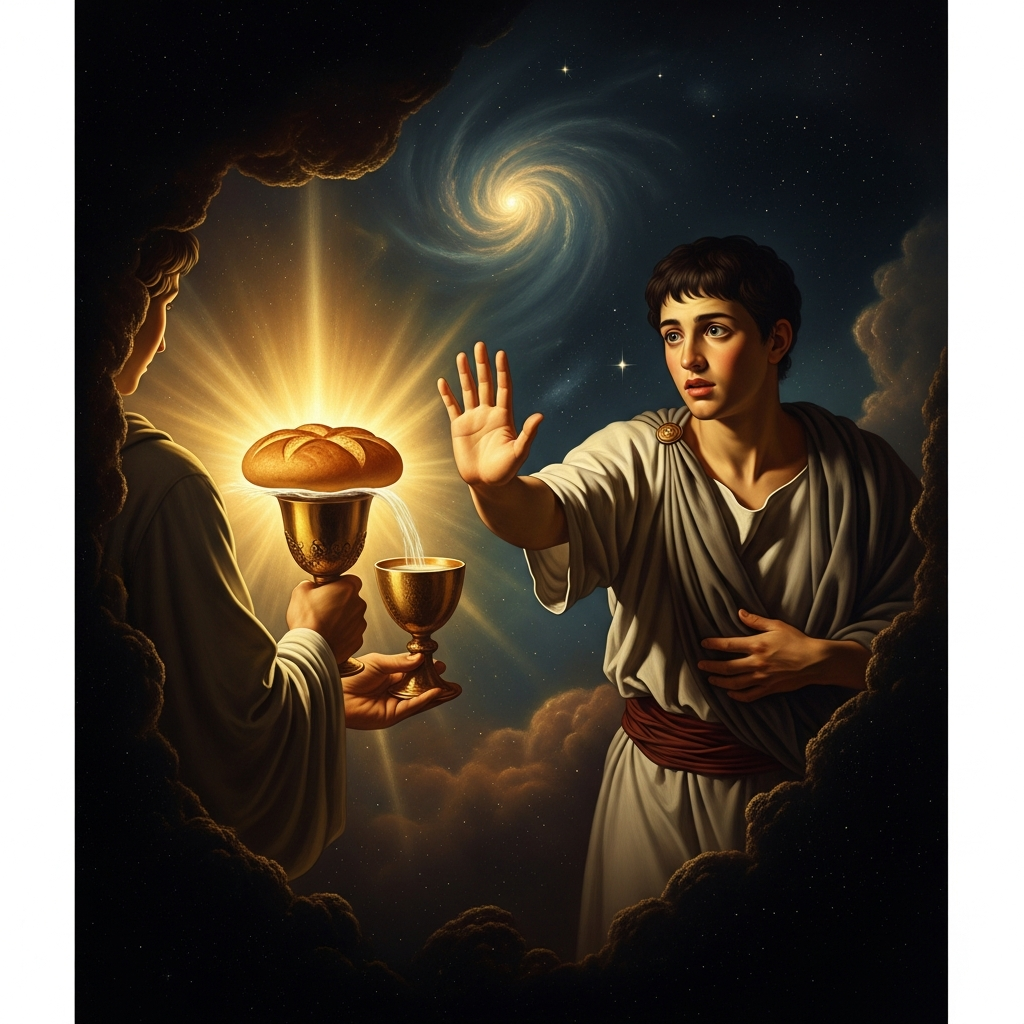
Let him eat, Anu says. Give him the bread and water of life. Let him take our nature. He earned it.
The bread is placed before Adapa.
The water of life in a cup beside it.
He looks at both for a moment that the tablets do not measure — it could be a heartbeat, it could be an hour. He remembers Ea’s voice through the wall of the situation Ea constructed. The food and water of death. Do not eat. Do not drink.
He refuses.
Anu, watching, goes very still. Why will you not eat? Why will you not drink? The question is genuinely confused. He has just offered this man the greatest gift in the cosmos, the one thing the gods have that mortals do not, the thing every hero in every future story will spend his life searching for — and this man is pushing it away.
My lord Ea told me not to, Adapa says. He says it without resentment. He says it with the simplicity of a man who has organized his entire life around instructions from a divine source and does not know how to stop.
Anu’s expression shifts. Understanding moves across his face slowly, the way dawn moves across a flat plain. Oh, he says. And then: Oh, Ea.
There is nothing to be done. The moment has passed. You cannot force immortality on a man who has already refused it. The gods have rules about this too. Anu sends Adapa back to Eridu, back to the fishing boat, back to the temple where he will serve out his mortal days with the wisdom of a god and the lifespan of a man, and the south wind will blow again from tomorrow, and the fish will be there to catch, and one day Adapa will die the way everything that breathes eventually dies.
Adapa descends through the same sky he crossed on the way up, and the wind picks up behind him, and he does not look back at the gate.
The question the texts leave open — the question the Babylonian scribes left open deliberately, because they understood its weight — is whether Ea lied. Whether the wise and cunning god of water, who designed Adapa with near-divine intelligence, who gave him the ability to break the south wind’s wing, who told him precisely how to win Anu’s mercy, then told him precisely the wrong thing at the moment of decision.
Ea’s reasoning, if he had any, is never given. Perhaps mortality is the necessary design. Perhaps a fully immortal human with Adapa’s wisdom would have been ungovernable — another Kingu, another general who becomes a rival. Perhaps Ea, the cleverest of the gods, looked at the gift Anu was about to give and calculated the consequences five hundred years forward and decided that the bread of life was a problem in disguise.
Or perhaps Ea simply lied because gods lie, because what they made was made to serve them, and serving requires ending.
The tablet breaks here. The clay is damaged. Whatever the scribes wrote next in the fourth column, it has returned to the dust it came from.
Adapa is wiser than almost anyone alive — wiser than kings, wiser than other priests, close enough to divine that even Anu shows him mercy. And he loses immortality not by sinning, not by pride, not by reaching above his station, but by trusting the wrong voice at the right moment.
The tragedy is structural. Ea built him to be obedient. Obedience was his finest quality. And obedience was the mechanism of his undoing.
Every tradition that tells a forbidden-food story is circling this original. The fruit in Eden, the pomegranate seeds in Persephone’s underworld, the ambrosia withheld from mortals on Olympus — all of them inherit this question: who decides when immortality is offered, and whose interest does mortality serve?
Adapa went home and fished and died. The south wind still blows today. The bread he refused is still baking somewhere in a kitchen no mortal can enter.
Scenes
Adapa fishes the sacred waters of Eridu for Ea's temple — until the south wind capsizes his boat
 Generating art…
 Adapa stands at Anu's gate flanked by Dumuzi and Gizzida, the two gods stationed to plead for his life
 Generating art…
 The bread and water of life are offered
 Generating art…
 Echoes Across Traditions
Entities


Sources
- Stephanie Dalley (trans.), *Myths from Mesopotamia* (Oxford University Press, 1989)
- E.A. Speiser (trans.), 'Adapa' in *Ancient Near Eastern Texts* (Princeton, 1950)
- Thorkild Jacobsen, *The Treasures of Darkness* (Yale University Press, 1976)
- Benjamin Foster, *Before the Muses: An Anthology of Akkadian Literature* (CDL Press, 2005)