Contents
Exiled from heaven, the storm god Susanoo descends to Izumo and finds a family undone by a serpent with eight heads. He brews eight vats of sake, gets the dragon drunk, cleaves it apart, and pulls from its tail a sword that will define Japan forever.
- When
- Mythic Time · Kojiki ~712 CE
- Where
- Izumo, Japan
He comes down from heaven with nothing.
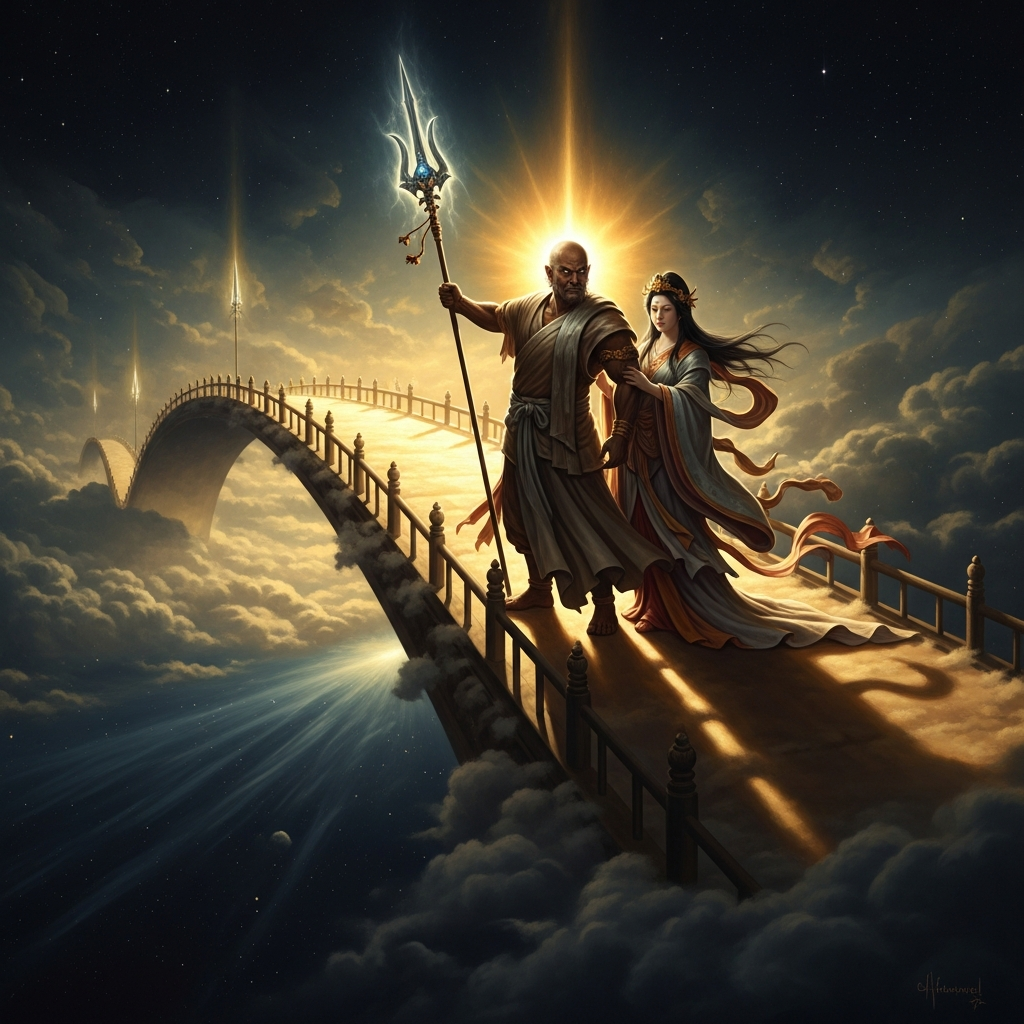
That is not the way the stories usually begin, but this one is honest about its starting condition. Susanoo, storm god, brother of Amaterasu, born from his father Izanagi’s nose during the first purification — he has been weeping at the border of heaven for so long that the rivers flooded and the mountains shook with his grief. His sister grew tired of it. The High Plain of Heaven grew tired of it. He was banished before he could do more damage, sent downward with no sword, no hall, no divine commission. Just the storm in his chest and the long fall to Izumo.
He lands in the province of Izumo, by the headwaters of the Hi River, and the first thing he hears is weeping.
An old man and an old woman kneel at the riverbank with their youngest daughter between them. The girl’s name is Kushinada — Wondrous-Inada-Princess — and she is the last one. The couple had eight daughters. Seven have been taken. The old man’s name is Ashinazuchi; the old woman is Tenazuchi; their grief is the kind that has moved past crying into a flat, resigned silence that looks almost like peace. The weeping Susanoo hears is new. Today is the day.
He asks them what has devoured the other seven.
Ashinazuchi raises his head. “Yamata-no-Orochi.” His voice is careful, the way people speak of things they cannot afford to believe. “Eight heads. Eight tails. Its body spans eight valleys and eight hills. Its eyes are red as winter cherries. Pine trees and moss grow on its back. Every year it comes. Every year it takes one.”
Susanoo looks at Kushinada. She does not look away.
“Give her to me as my wife,” he says, “and I will kill it.”
The old man does not ask him who he is. What he sees in Susanoo’s face is enough. He bows. Susanoo transforms Kushinada into a comb — a fine-toothed comb of sacred wood — and tucks her into his hair, safe against his skull. Then he turns to the old couple, and he gives them instructions.
The instructions are specific.
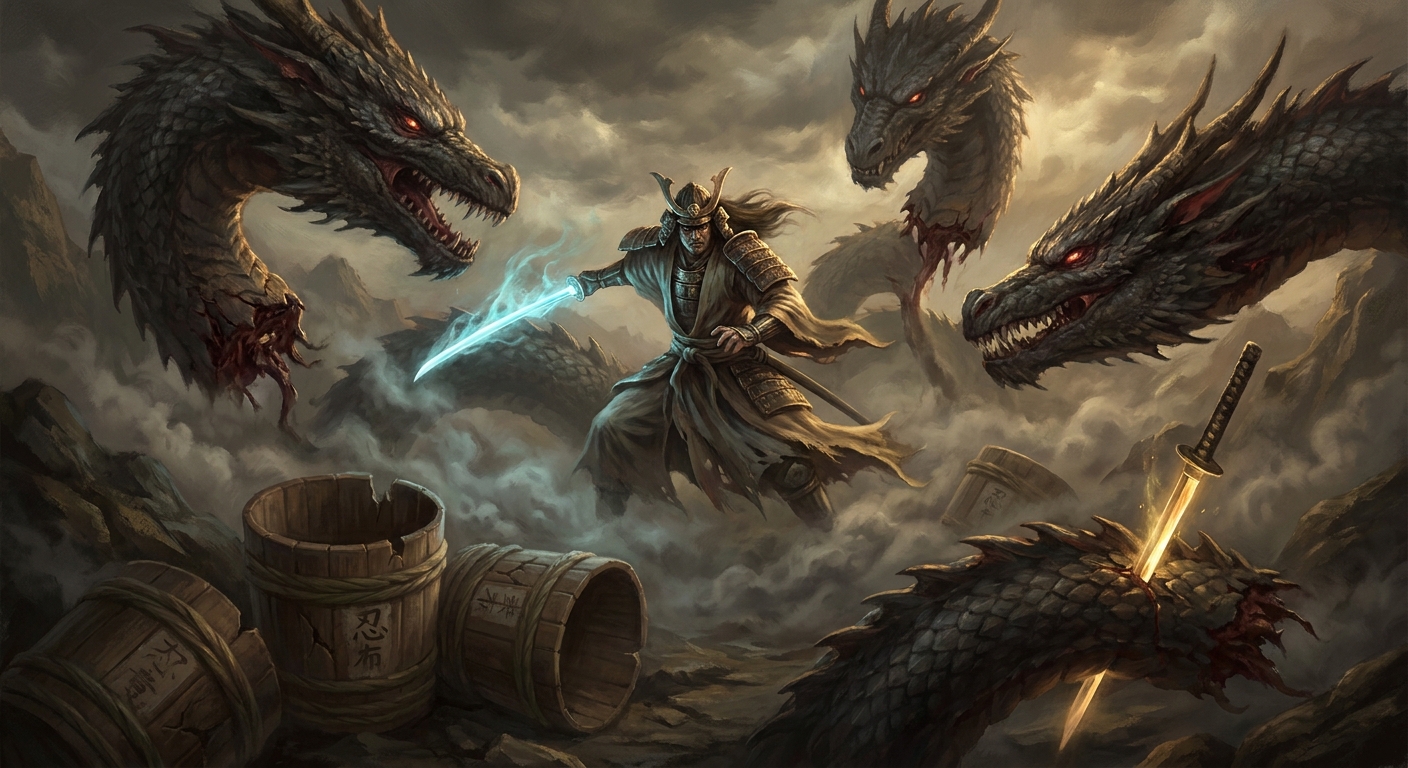
Brew sake eight times over. Make it as strong as sake can be made. Build a fence around the estate with eight gates, one for each head. At each gate, place a platform. On each platform, place a vat of sake, filled to the brim. Then wait.
Ashinazuchi and Tenazuchi do not question this. They build the fence. They brew the sake. The smell of it rises through the river valley like a second mist.
Susanoo waits.
There is a moment, before Yamata-no-Orochi arrives, when the valley goes entirely quiet. The birds stop. The river seems to pause. This is how it announces itself — not with sound but with the absence of sound, the way a storm cell reads on the skin before the lightning.
Then the eight heads come through the eight gates.
Each head finds its vat. Each head finds the sake. And Yamata-no-Orochi, which has terrorized Izumo for seven years, which has eaten seven daughters and bent an entire province to its hunger, bends its eight necks and drinks.
This is the thing about power without intelligence: it cannot resist what it wants. The serpent does not ask why the sake is here. It does not notice the fence designed to funnel it in. It drinks because the sake is good and the sake is plentiful and a creature with eight appetites is rarely in the habit of stopping.
It drinks all eight vats.
It sways.
Eight heads lower, one by one, to the wet grass.
Susanoo draws his sword.
What follows is not elegant. It is not ceremony. It is the work of a storm god with a blade and an enemy that cannot lift its heads, and Susanoo does what storms do — he is everywhere at once, precise and total. He takes the heads. He takes the tails. He works from the outer bodies inward until the valley runs red and the Hi River, they say, ran crimson all the way to the sea.
He is nearly done when his sword catches.
Not on bone. On something harder.
He cuts more carefully. Inside the fourth tail — or the eighth, the sources disagree, and it does not matter — there is a sword. He draws it out and holds it up. The blade is long and straight and faintly luminous, the way a thing is luminous when it has been sleeping inside power for longer than any living thing can remember. He does not know its name yet. Later it will be called Kusanagi-no-Tsurugi: the Grass-Cutting Sword.
He stands in the middle of what used to be a dragon, holding the most sacred blade in Japan, and he makes a decision that surprises everyone, including himself.
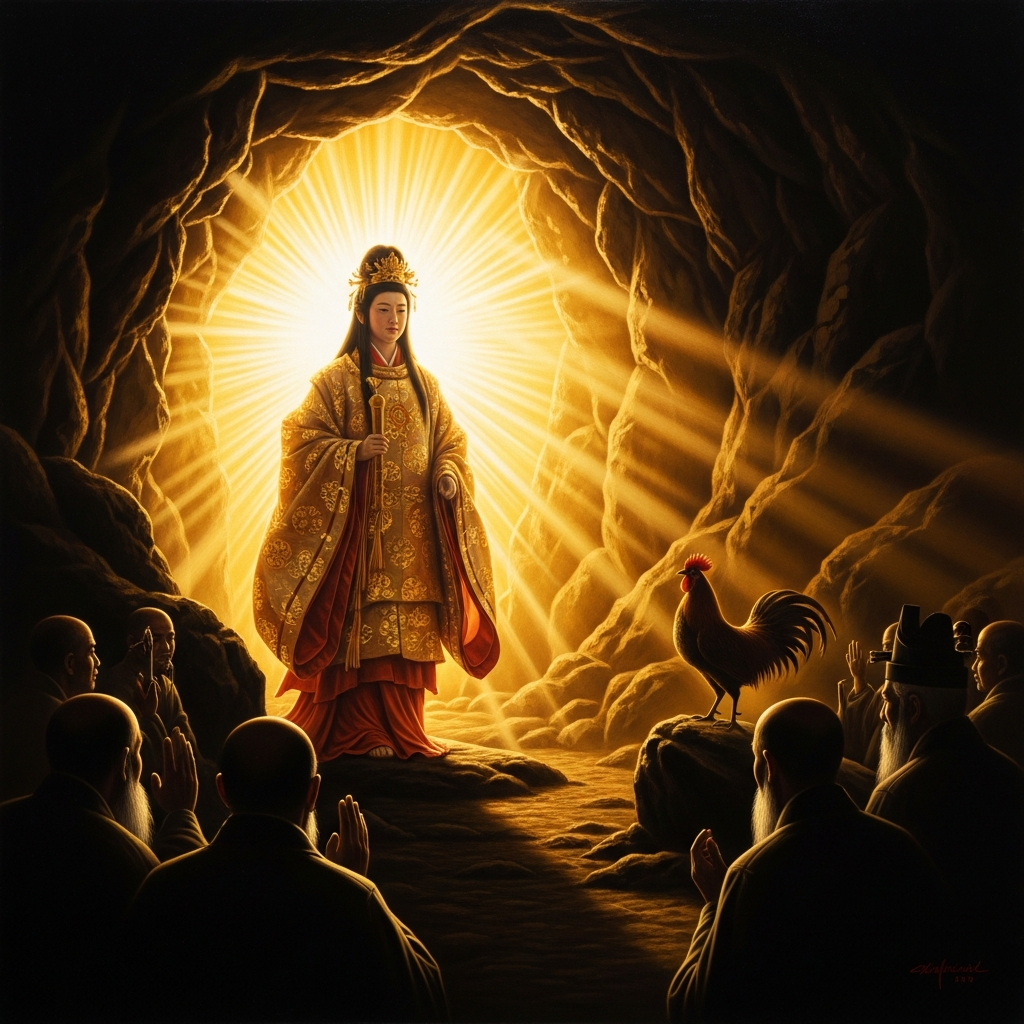
He sends it to Amaterasu.
This is the part that requires sitting with.
He was exiled. She banished him. He crossed heaven with his grief and his rage and broke things without meaning to and she drew a line and said: you cannot be here. And now, from the body of the serpent that terrorized Izumo, he pulls a sword of surpassing power — and his first thought is to give it to her.
The Kojiki does not editorialize this. It simply records it. Susanoo found the sword and offered it to Amaterasu. She kept it. Centuries later, Yamato Takeru, the warrior prince of the Yamato line, received it from her shrine. He used it to cut away burning grass during an ambush, and the sword took its permanent name: Kusanagi, the Grass-Cutter.
It sits today in the Atsuta Shrine in Nagoya. No one has seen it in centuries. It is not displayed. It is not ceremonially unsheathed. It simply exists, in the dark of the inner sanctum, one-third of the divine authority on which the Imperial house rests.
Meanwhile, Susanoo takes Kushinada from his hair.
She returns to herself on the grass of Izumo, the valley still red around them, the river carrying the dragon downstream piece by piece. He builds them a house. He composes a poem — the first waka in Japanese literature, it is said, though the scholars argue about this too:
“Many clouds rise — the clouds form a fence, a many-layered fence of clouds, in which the newlyweds may hide. Oh, that many-layered fence.”
It is a love poem about enclosure. About building a wall around something precious. He has just spent the night dismantling a monster, and the first thing he makes afterward is a house.
The pattern here is one of the oldest patterns there is. Storm god descends. Dragon holds a valley in terror. Hero arrives with nothing and leaves the monster in pieces. From the monster’s body comes the thing that arms the world.
Perseus does it to Medusa. Marduk does it to Tiamat. Indra does it to Vritra. The Hydra falls to Heracles. The worm falls to Beowulf. The dragon falls to George. Every tradition that has weather gods has a version of this night, this vat of sake, this sword in the tail.
The difference, in this telling, is what Susanoo does with what he finds.
He does not keep it. He does not build a kingdom on it. He sends the sword home to the sister who exiled him. He builds a house for a girl he has promised to protect. He writes a poem about clouds. The storm god, it turns out, is not interested in conquest. He is interested in Izumo, and in the house he is building, and in the clouds piling up at the edges of a life he is making for himself, finally, on the ground.
The sword goes to heaven. The storm god stays.
That is the Shinto version. Not every hero needs the weapon he forges.
Echoes Across Traditions
Entities


Sources
- *Kojiki* (712 CE), translated by Donald L. Philippi (1969)
- *Nihon Shoki* (720 CE)
- Joseph Campbell, *Oriental Mythology: The Masks of God* (1962)