Combat Profile
Ildanach
Lugh channels mastery over all crafts and arts into a devastating strike that adapts to exploit any weakness, scaling with the number of domains he commands.
Samhildanach
Lugh's excellence in all pursuits grants him supernatural competence; he gains bonuses to any action attempted and can never be unskilled at any task.
His dual heritage (half-Tuatha, half-Fomorian) creates tension; he must kill his own grandfather Balor
“What art do you practice? For no one without an art enters Tara.” “Question me,” said Lugh, “for I am a wright.” They said, “We do not need you. We have a wright already.” “I am a smith.” “We have a smith.” “I am a champion.” “We have one.” “I am a harper.” “We have one.” “I am a poet and historian.” “We have one.” “I am a sorcerer.” “We have sorcerers.” “I am a physician.” “We have one.” “I am a cupbearer.” “We have cupbearers.” “I am a brazier.” “We have one.” Then Lugh said, “Ask the king whether he has one man who possesses all these arts, and if he has, I will not enter Tara.” — Cath Maige Tuired
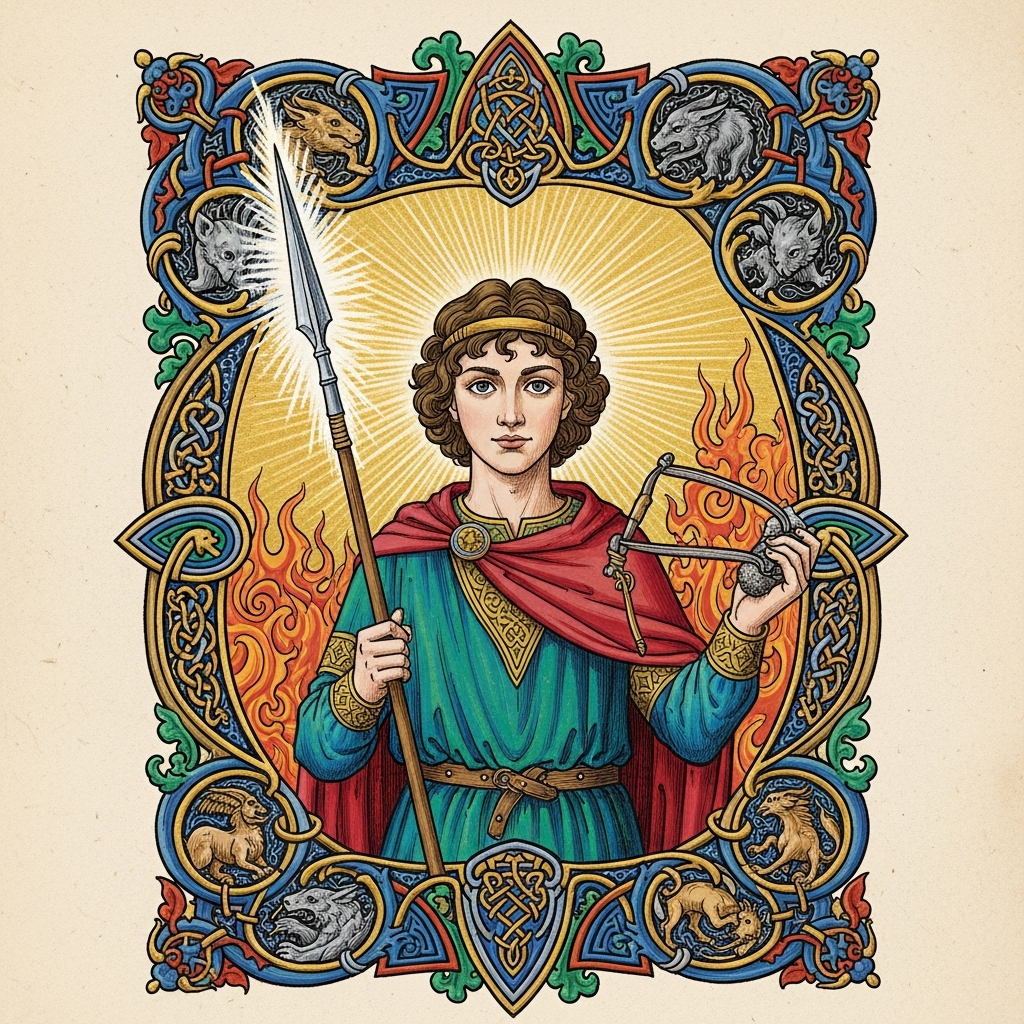
Lore: Lugh Lamhfada (“Lugh of the Long Arm”) is the brightest figure in Celtic mythology — literally and figuratively. He is half-Tuatha, half-Fomorian (his grandfather is Balor of the Evil Eye), and he embodies the synthesis of light and dark, order and chaos. When he arrived at Tara, the seat of the High King, the doorkeeper refused him entry unless he could name a skill the court lacked. Lugh named every skill — and the court already had a master of each. But when Lugh asked whether any one person possessed all of them, the gates opened. He is the ultimate polymath. His spear, the Spear of Lugh (one of the Four Treasures of the Tuatha De Danann), never misses its mark and is so bloodthirsty it must be kept submerged in a cauldron of poppy-infused water to prevent it from blazing with fire. At the Second Battle of Mag Tuired, Lugh faced his grandfather Balor and killed him with a sling-stone that struck his evil eye and drove it through the back of his skull, turning its destructive gaze on the Fomorian army. The harvest festival Lughnasadh (August 1), one of the four great Celtic festivals, is named for him.
Parallel: Lugh as light-bringer parallels Christ as the Light of the World (John 8:12). The young champion killing the seemingly invincible giant with a projectile weapon (sling-stone through the eye) closely parallels David and Goliath (1 Samuel 17). Lughnasadh, the harvest festival, was absorbed into the Christian calendar as Lammas (“Loaf-Mass”), when the first bread of the harvest was blessed. The name changed; the gratitude for the harvest remained.
2 min read
None. He is *Samildanach* -- "equally skilled in all arts." There is nothing he cannot do
*Cath Maige Tuired*; *Lebor Gabala Erenn*; Festival of Lughnasadh (August 1)