King Milinda and the Chariot That Has No Self
c. 150-130 BCE · Sagala (modern Sialkot, Pakistan) — the court of King Menander I of Bactria
Contents
The Greek-Bactrian king Menander, who has defeated every philosopher in his kingdom in debate, summons the monk Nagasena. If there is no self, who is it that practices? If no one carries karma across lives, how does rebirth make sense? Nagasena answers with a chariot. The king, who has never lost an argument, concedes.
- When
- c. 150-130 BCE
- Where
- Sagala (modern Sialkot, Pakistan) — the court of King Menander I of Bactria
The king has never lost a debate.
This is not merely a royal boast. Menander — Milinda in Pali, the language of the early texts — was a Greek-Bactrian king in what is now northern Pakistan, the inheritor of Alexander’s eastward push, a man educated in the full tradition of Greek philosophy and dialectic. He knew the Socratic method. He knew how to follow a claim to its logical consequences and then press on the consequences until the claim collapsed. He had done this to every philosopher in his kingdom, and the philosophers of his kingdom included Indians trained in Nyaya logic, which is as rigorous as anything the Greeks produced.
He has heard there is a monk named Nagasena, camped outside the city with a following. He sends a messenger. Nagasena comes.
The king begins with the question he considers unanswerable.
He says: you Buddhists teach that there is no self — that what we call a person is merely a collection of changing physical and mental processes, with no stable entity running the show. You also teach rebirth — that when the body dies, something continues to the next life and carries the moral weight of past actions. But if there is no self, who is reborn? If there is no persistent entity, what carries the karma?
This is a genuine philosophical problem. Milinda has found the seam in the doctrine and is pressing on it. If the tradition concedes no-self completely, rebirth becomes incoherent. If it concedes rebirth requires a self, it contradicts its central teaching. The king is sitting with his hands folded, waiting for the monk to fall onto one horn of the dilemma or the other.
Nagasena says: your majesty, how did you come here?
The king says: I came in a chariot.
Nagasena says: is the axle the chariot?
The king says: no.
Nagasena says: is the wheel the chariot?
No.
The frame? The yoke? The pole? The leather of the seat?
No. No. No. No.
Are all these things assembled together the chariot?
The king pauses. This is where the trap is — he can see it from a philosopher’s training. If he says yes, Nagasena will say: then point to the chariot-essence that is distinct from these assembled parts. If he says no, Nagasena will say: then there is no chariot at all, only parts, and you came here in a fiction.
He says: no, not that either.
Then, says Nagasena, is there a chariot at all? Or is the word chariot merely a conventional designation applied to an arrangement of parts that does not refer to any additional thing?
The king is quiet for a moment. Then he says: it is a conventional designation.
Nagasena says: just so with Nagasena.
There is a body, a form. There are sensations — pleasant, unpleasant, neutral — arising constantly and passing. There is perception, the recognition of shapes and sounds. There are mental formations, the impulses and intentions that constitute character. There is consciousness, the bare knowing. These five aggregates — the skandhas — are what Nagasena is. None of them, individually, is Nagasena. All of them together are not Nagasena in the sense of some additional entity. But the name Nagasena serves its function: it refers successfully, it tracks what is needed for practical and moral purposes, it is not nothing.
What passes between lives is not a soul. It is more like a flame touching another candle — the second flame is not the same flame as the first, is not a different flame in the sense of having no causal connection to the first. It is the continuation of a causal process. The karma is the pattern. The pattern persists without a patterned-thing that persists.
Milinda presses further: if there is no self that persists, who is it that practices? Who accumulates merit? Who achieves nibbana?
Nagasena says: who it is that practices is the same kind of question as who it is that runs — useful in ordinary language, pointing to a real causal process, but not requiring a runner-entity distinct from the running.
The king asks about the lamp.
If a lamp burns through the night, is the flame at midnight the same flame as the flame at midnight plus one hour?
No, says Nagasena. And yes, in the sense that a causal thread connects them. The flame at midnight produced the conditions for the flame at midnight-plus-one.
Is the person who went to sleep last night the same person who woke this morning?
Milinda says: I see what you are doing.
Nagasena says: yes.
The king is quiet for a longer moment. This is not the quiet of a man who has been defeated — he has lost arguments before, in his training, and knows what that feels like. This is the quiet of a man who has understood something and is turning it over. The claim Nagasena is making is not that nothing exists, not that persons are mere fictions, not that the conventional world is an illusion. The claim is subtler: the word exists points to a process, and process is enough. The chariot is real. It goes places. It carries people. The question of whether it has a chariot-essence, some additional ingredient that makes it chariot over and above its parts and their arrangement, is a question that generates only confusion.
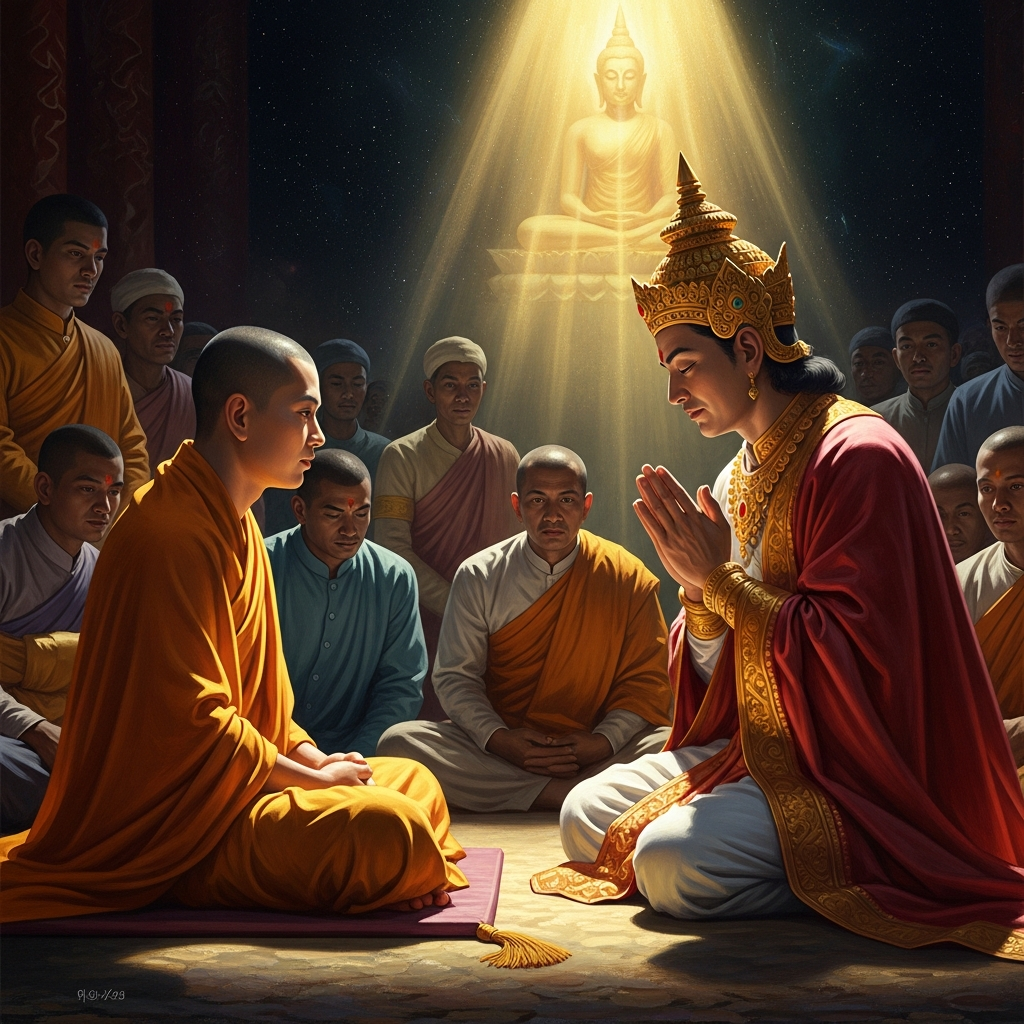
He presses his hands together.
He becomes a patron of the sangha. He asks more questions — the Milindapanha records hundreds of them, over what the text implies are many sessions — and Nagasena answers them with the same precision and the same refusal to oversimplify. The king is not converted in the sense of abandoning his throne. He is changed in the sense that a man is changed when a thing he thought was solid turns out to be a process, and the process turns out to be more interesting than the solid thing he thought it was.
The chariot is in the dust somewhere. The parts are wherever parts go. The debate continues in every university that teaches philosophy of mind, under different names, with different examples, with the same stubborn question underneath: what is it that makes you, you, across time?
Nagasena was named Nagasena before he was ordained, and the name meant something involving a particular association with serpent warriors that has been lost to the centuries. By the time he met the king he had been Nagasena for long enough that the name fit comfortably. He did not believe there was a self wearing the name, but he used the name, answered to it, built a teaching out of the precision with which it did and did not refer. The king went back to his palace. The monk went back to his camp outside the city. The chariot stood where it always stood in the courtyard. No one looked at it quite the same way.
Scenes
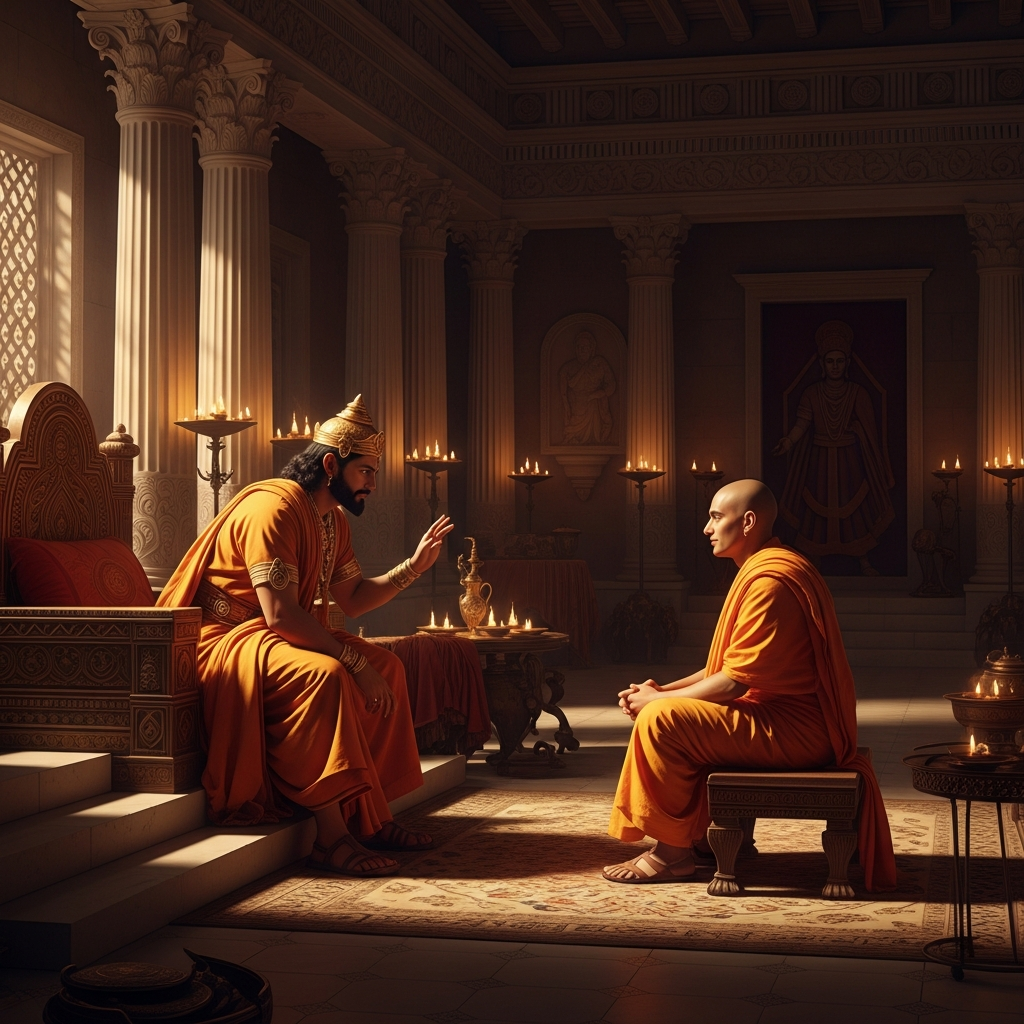
The court of Sagala — a wide room with Greek columns and Indian carvings, oil lamps along the walls
 Generating art…
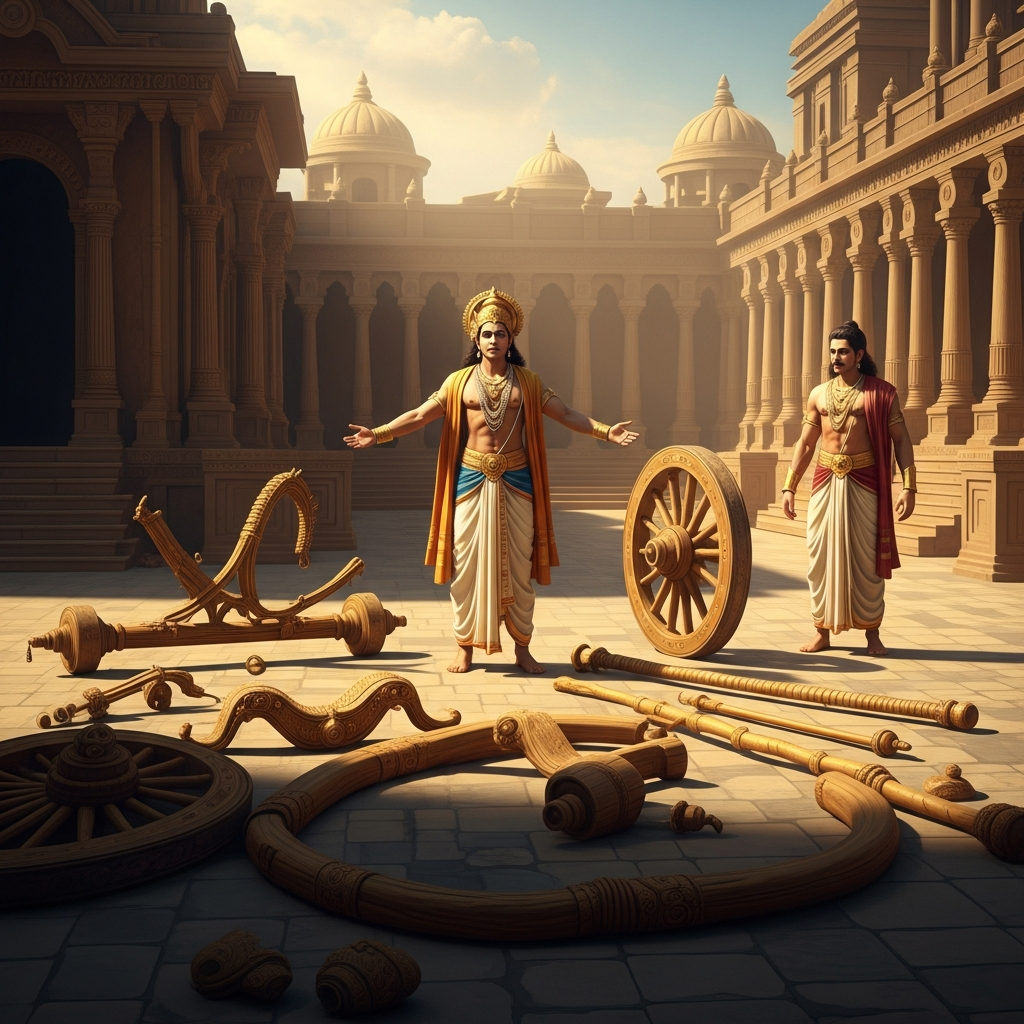
 Nagasena has taken apart a chariot in the courtyard and laid the pieces on the ground: wheel, axle, yoke, frame, pole
 Generating art…
 King Milinda with his hands pressed together in the anjali gesture — the bow of acknowledgment — before the seated monk
 Generating art…
 Echoes Across Traditions
Entities
- King Milinda
- Nagasena
- King Menander I
Sources
- Bhikkhu Pesala (trans.), *The Debate of King Milinda* (available through the Pali Text Society, various editions)
- I.B. Horner (trans.), *Milindapanha* (Pali Text Society, 1963)
- Walpola Rahula, *What the Buddha Taught* (Grove Press, 1959)
- Peter Harvey, *An Introduction to Buddhist Ethics* (Cambridge University Press, 2000)
- Bhikkhu Analayo, *A Meditator's Life of the Buddha* (Windhorse Publications, 2017)