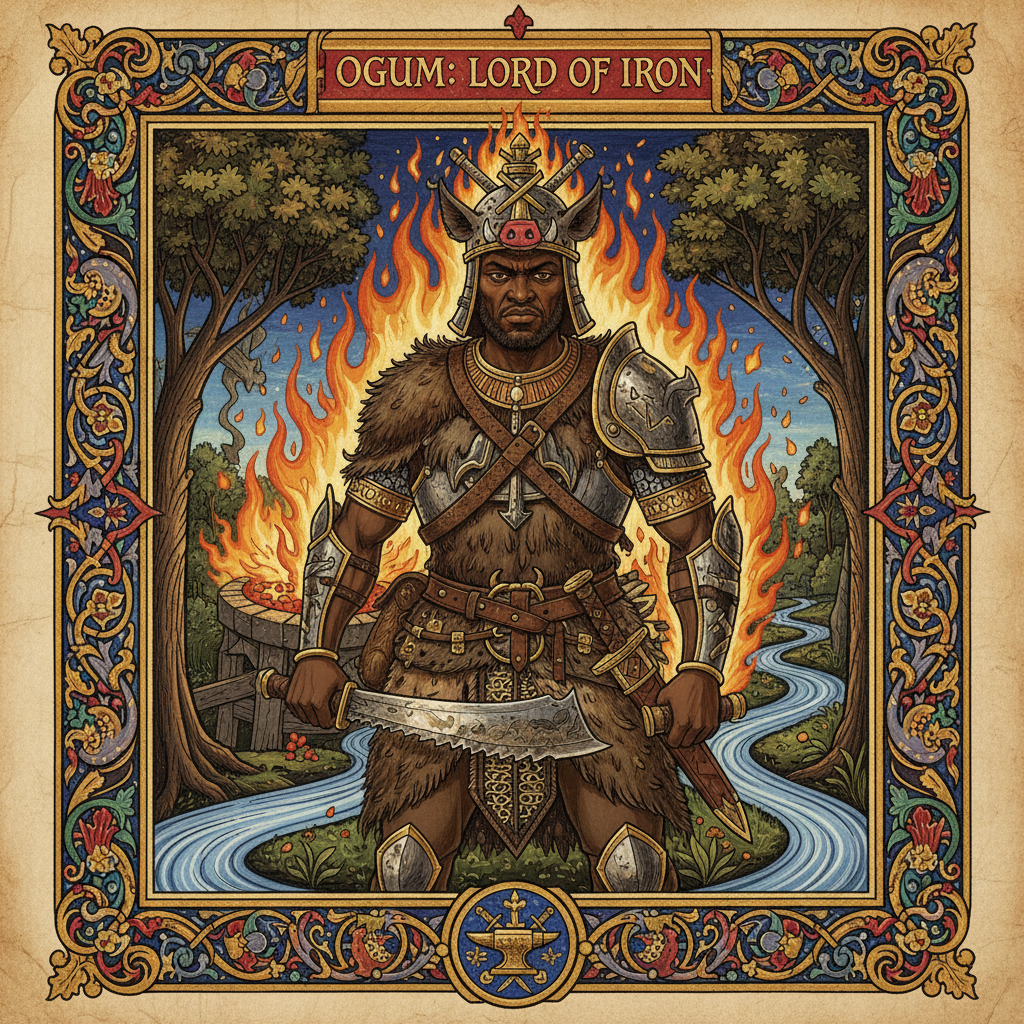
Combat Profile
Iron Path
Ogum cleaves through all obstacles both physical and spiritual, clearing roads and revealing hidden truths with unstoppable force.
Master of Steel
All tools, weapons, and technology function with divine precision in Ogum's presence, and oaths sworn before him cannot be broken without catastrophic consequence.
His fury, his solitude, his inability to rest from the work of clearing the path. In the key myth (preserved across Yoruba, Cuban, and Brazilian traditions), Ogun withdrew into the forest after his rage caused him to kill his own people. Only Oshun's beauty and honey lured him out. The warrior cannot sustain community without the diplomat
“Ogum cleared the forest so the other Orixás could descend to Earth. He did not wait to be thanked. He never does.” — Candomblé tradition
Lore: Ogum (Ogun in Yoruba, Ogún in Cuba, Ogou Feray in Haiti — see Yoruba.md and Haitian-Vodou.md) is the Orixá of iron and war, and in Brazil he achieved something that distinguishes his diaspora journey: the Catholic syncretization with St. George is arguably the most brilliant structural identification in the entire Afro-Brazilian tradition.
St. George — the Roman soldier of Cappadocian origin who, according to Catholic tradition, slew a dragon to free a city — is a warrior who defeats a monstrous adversary with an iron weapon (a spear or lance) while on horseback. The dragon is the enemy of the people, and George’s weapon — iron, sharp, the same metal that Ogun governs — is what destroys it. The practitioners who placed Ogum’s energy inside St. George’s image were making a precise theological claim: the Orixá who governs iron and war and the clearing of paths is present in the Catholic warrior-saint who uses iron to defeat the monster. The saint’s legend and the Orixá’s domain are not just compatible — they illuminate each other.
The St. George identification spread beyond Candomblé into Brazilian popular Catholicism in a remarkable way. São Jorge is enormously popular across all social classes in Brazil — there are São Jorge churches, São Jorge fan clubs in soccer stadiums, São Jorge tattoos, São Jorge bumper stickers. Most of those who venerate St. George in Brazil are not aware of, or do not engage with, the Ogum identification. Yet the Orixá’s energy moves through the popular devotion in ways that Candomblé practitioners understand and that academic theologians of the diaspora have analyzed. This is the deepest level of syncretism: not mere surface identification but a genuine merging in the popular consciousness.
Parallel: Ogum is Ogun across all diaspora traditions — the divine ironmaster and path-clearer who appears in every country where Yoruba religion took root. See Yoruba.md for the comprehensive parallel discussion. Brazil adds the St. George identification, which creates a new parallel: the dragon-slayer. In this frame, Ogum parallels Michael the Archangel (who defeats the dragon in Revelation 12:7 — which is also the image used for São Miguel, St. Michael, in Brazil), Perseus (who slays the sea-monster to free Andromeda), Indra (who slays the dragon-serpent Vritra with the thunderbolt), and Marduk (who defeats the chaos-dragon Tiamat with weapons of iron and fire). The dragon-slaying hero is universal. In Brazil, it wears Ogum’s iron and St. George’s armor simultaneously.
2 min read
Oxalá's coolness, Oshun's diplomacy. His own remorse -- the rage that burns too hot can turn inward
Roger Bastide, *The African Religions of Brazil* (1978); Sandra T. Barnes, ed., *Africa's Ogun: Old World and New* (1989); Stefania Capone, *Searching for Africa in Brazil* (2010)