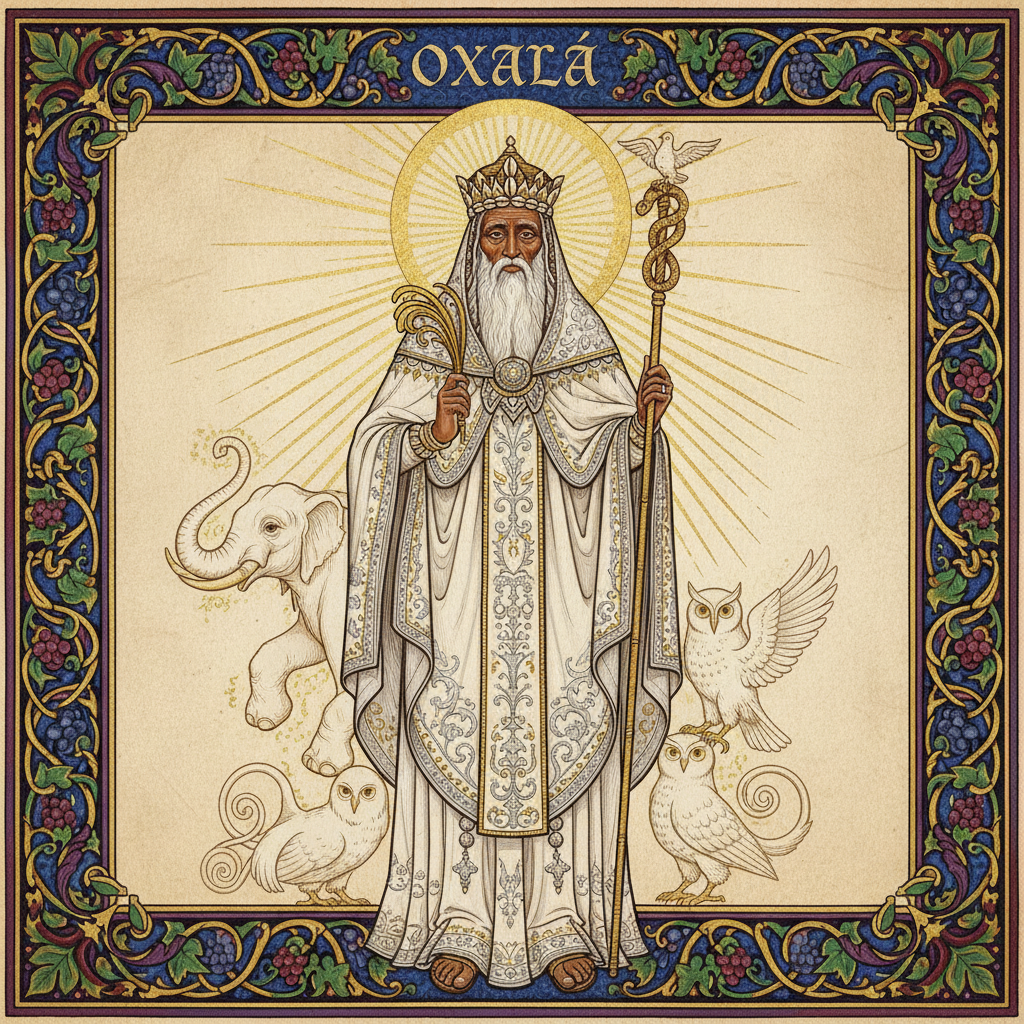
Combat Profile
Molding of Flesh
Oxalá grants divine restoration, healing wounds and disabilities while bestowing moral clarity upon the healed.
Celestial Purity
All allies in Oxalá's presence gain resistance to corruption and moral confusion, reflecting his domain over creation's wholeness.
Palm wine -- the same weakness as his Yoruba counterpart Obatala. In the creation mythology, Oxalá's intoxication during the shaping of human bodies produced physical variation, including disability. The theology is identical: disabled people are Oxalá's special children, shaped by the divine creator's own hands in a sacred moment of imperfection
“Oxalá does not hurry. He has been creating since before the world knew what it was.” — Candomblé tradition
Lore: Oxalá (Obatala in Yoruba, Obatalá in Cuba) is the supreme Orixá of Candomblé — not in the sense that Olodumare is supreme (Olodumare remains the unknowable source), but as the first and most honored intermediary between the divine and the human. He is the father figure of the Orixá family, the oldest, the purest, the one who wears only white and who requires that his followers do the same on Fridays, his sacred day. His axé (divine energy, the Brazilian term for the Yoruba ashe) is the axé of creation itself — the force that shapes the human form from the clay of the earth.
The Lavagem do Bonfim is one of the great spectacles of Brazilian religious life, and understanding it requires understanding what is actually happening: the Candomblé priestesses — who in most official contexts have been historically excluded from the Catholic church they are approaching — lead the procession to the steps of the most beloved church in Bahia and wash those steps in an act of purification. It is Oxalá’s ceremony performed on Bonfim’s steps. It is African religion claiming Catholic space. It is one of the most elegant acts of spiritual resistance in the Americas.
Oxalá’s personality differs from the Cuban/Haitian presentations. In Brazil, his mythology emphasizes imprisonment and patient endurance. In the central Oxalá narrative, he is wrongly imprisoned in the kingdom of Xangô (Shango) for a crime he did not commit. He endures imprisonment without complaint — for years, in some versions. His patience is not defeat but the embodiment of his essential nature: the divine does not rage against injustice, it endures until justice restores itself. When Xangô discovers the truth and releases him, he offers Oxalá any gift. Oxalá asks only for the children who were born in the kingdom during his imprisonment — he claims them as his own. The suffering becomes the source of a greater family. This is Oxalá’s theology: from wrongful imprisonment comes an expanded embrace.
Parallel: Oxalá maps precisely onto Obatala (see Yoruba.md) and onto the Jesus narrative with specific precision — not the warrior Christ but the suffering servant who endures wrongful punishment with patience and emerges with his authority intact (Isaiah 53; Philippians 2:5-11). He parallels Joseph, wrongly imprisoned in Egypt who endures without bitterness and rises to a position of power that allows him to save his people (Genesis 37-50). The imprisonment myth is the precise structural parallel to the Passion: wrongful accusation, patient suffering, vindication, and the expansion of the family through the experience of pain. That Oxalá is syncretized with the Lord of Bonfim — Christ in his suffering — is not accidental. The practitioners who made this identification recognized something structurally deep.
2 min read
His own slowness. Oxalá represents the ancient, the patient, the still. His coolness (oró funfun -- the white cool) can be mistaken for passivity. The world requires Orixás like Ogum and Iansã to act with urgency; Oxalá provides the moral center but not the momentum
Roger Bastide, *The African Religions of Brazil* (1978); J. Lorand Matory, *Black Atlantic Religion* (2005); Stefania Capone, *Searching for Africa in Brazil* (2010)