Combat Profile
Tempest Fury
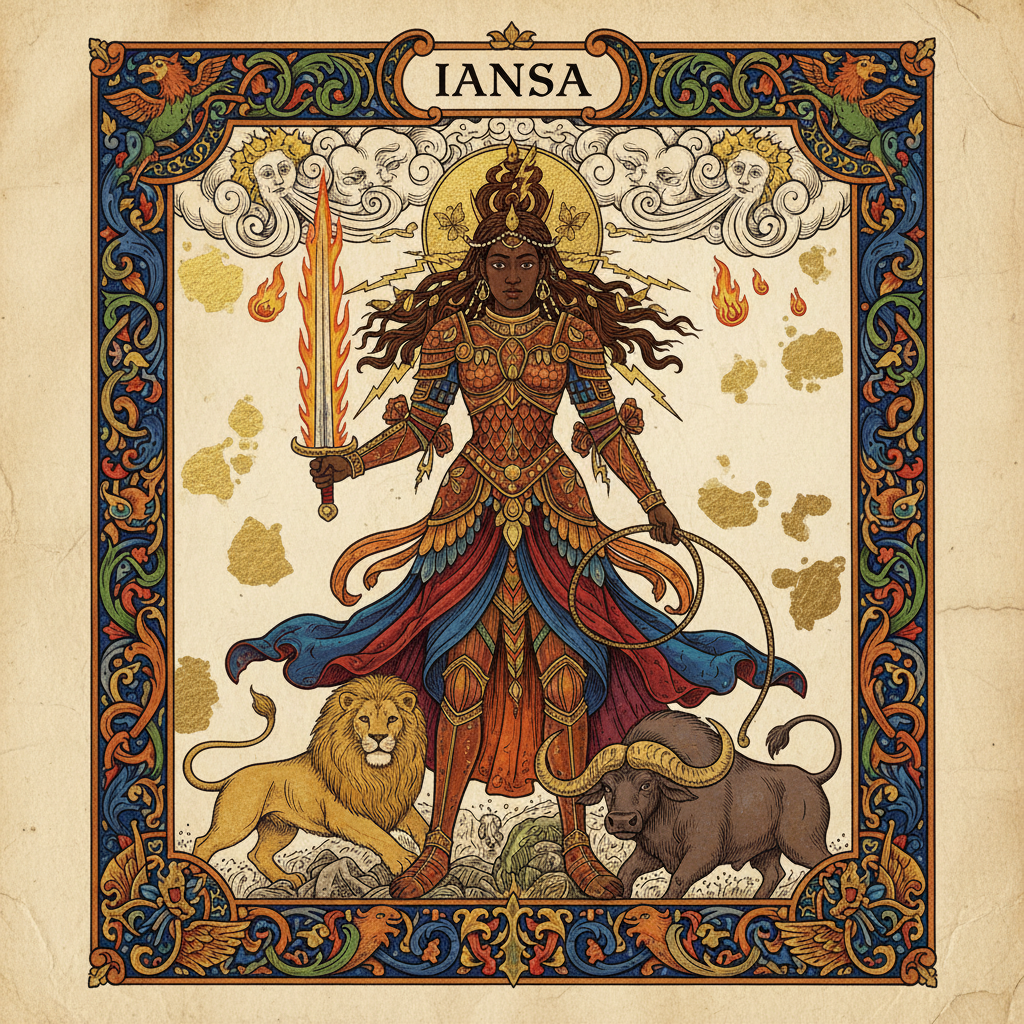
Iansã unleashes a devastating storm of lightning and wind that strikes all enemies while granting her temporary invulnerability, embodying her warrior dominion over the tempest.
Liminal Guardian
Iansã's presence grants immunity to crowd control and allows passage between worlds; she moves freely through cemeteries and storms as a conduit between the living and the dead.
Her ferocity. Iansã's storms do not distinguish between what deserves to be destroyed and what does not. She transforms through destruction, which is necessary -- but the destruction is real. Only Xangô (Shango) can match her storm for storm, which is why they are eternally bound: they are the thunder and the wind, inseparable in the storm
“The storm does not apologize for uprooting the dead tree. That is the tree’s problem for dying.” — Candomblé saying attributed to Iansã
Lore: Iansã (Oya in Yoruba and Cuba, Oya in most diaspora traditions) is the Orixá of the storm — the wind, the lightning, the transformative destruction that clears space for what is new. In Yoruba tradition she is Oya; in Cuba she is Oya; in Brazil she is Iansã, a name that some scholars derive from “Yansa” or “Ians,” the Yoruba word for the Niger River’s tributaries, or from “Ìyá Mèsàn,” “Mother of Nine.” However the name was formed, the spirit is recognizable across all three contexts: the fiercest female force in the Orixá family, the one who does not flinch, the warrior goddess who rides into battle alongside Xangô and sometimes ahead of him.
What distinguishes Iansã’s Brazilian iteration is the Catholic syncretism with Santa Bárbara. In Cuba, Shango (the thunder king) is syncretized with St. Barbara. In Brazil, Iansã (the storm goddess) is also syncretized with St. Barbara. The same Catholic saint — a woman martyred by her own father, associated with towers, storms, lightning, and artillery — absorbed both the male thunder king and the female storm goddess in different countries. This tells us something essential about the fluidity of diaspora theology: the practitioners were matching energy, not gender. Both Xangô and Iansã carry the force of lightning, and both found their Catholic mask in the woman who called down divine fire.
When Iansã mounts a devotee in Candomblé ceremony, the possession is unmistakable: the person moves with wind-like swiftness, arms spread wide, body spinning, often ululating in a high, piercing cry. She may sweep through the ceremonial space like a gust of air, disrupting everything in her path. Offerings include wine, dark plums, and objects associated with transformation. She does not stand still. She cannot. She is the wind.
Parallel: Iansã is Oya — see full discussion in Yoruba.md. In Brazil specifically, the Santa Bárbara parallel is theologically rich. St. Barbara was imprisoned in a tower by her father, a pagan, for converting to Christianity. When her father tried to execute her himself, he was immediately struck by lightning and killed. The woman who was associated with her father’s death-by-lightning became the patroness of storms and those who work with artillery and fire. This is a female figure who brings destruction to those who oppress her. This is Iansã. The practitioners who placed Iansã’s energy within St. Barbara’s image were reading the Catholic saint’s mythology with the same precision that the Cuban practitioners brought to Shango’s identification.
2 min read
Oxalá's coolness can temper her fire. Xangô is the only Orixá who rides alongside her as an equal. Nothing else slows her down
Roger Bastide, *The African Religions of Brazil* (1978); Stefania Capone, *Searching for Africa in Brazil* (2010)